
Tune details
Music: Isham Jones
Words: Gus Kahn
Published / composed / adapted — see history: 1924
Original key: Not established
Study level: Intermediate; advanced where the inherited roadmap needs reconstruction
 Djangopedia
A conversational standard that spends a long time away from its tonic before coming home. Strong phrase direction matters more than fast harmonic embellishment.
Let the long dominant passage finish its thought.
Owner content reviewed — 2026-10-05T18:28:11Z by admin. Coverage measures presence, not accuracy. Content review does not certify rights or musical perfection.
Django recordings for this tune. Uploader dates and take labels remain source claims; only an evidenced exact association enables a row’s Listen control.
Django Reinhardt
source-described; accuracy not independently verified
Uploader identifies this as Django Reinhardt’s performance; recording date and take require comparison with the discography.
| Entry | Year | Recording / session / release evidence | Listen |
|---|---|---|---|
| 01 | 1937 | It Had To Be You,OLA 2311-1 ,"Fremeaux 307, Affinity AFS 1003, Classics 777, Jazz Time 789604-2, EMI 780671-2"," - Philippe Brun (tpt), Alix Combelle (cl,ts), Michel Warlop (v), Stephane Grappelly(p), Django Reinhardt (g), Louis Vola (b), Maurice Chaillou (d)" | — |
| 02 | 1938 | It Had To Be You, 1/2/38, DTB 3533-1,"Fremeaux 307, JSP 342, Classics 708, Music Memoria 87948"," - London - Django Reinhardt (g), Stephane Grappelly (v&p)" | — |
| 03 | 1940 | It Had To Be You, (add Philippe Brun (tpt)),Acetate ,"Fremeaux FA 309, Vogue 228E 6004","12/1/40 - Paris - Gus Viseur (acc), Django Reinhardt (g), Emmanuel Soudieux (b)?" | — |
| 04 | 1947 | It Had To Be You, 8-13/11/47, "Fremeaux FA 315, Vogue 228E 6007, Vogue 668003-3"," - Paris - Souvenirs de Django Reinhardt - Django Reinhardt (elg), Gerard Leveque (cl), Eugene Vees (g), Emmanuel Soudieux (b), Andre Jourdan (d)" | — |
| 05 | 1940 | It Had To Be You (add Philippe Brun (tpt)),Acetate ,"Fremeaux FA 309, Vogue 228E 6004","12/1/40 - Paris - Gus Viseur (acc), Django Reinhardt (g), Emmanuel Soudieux (b)?" | — |
A dash means no video has been associated with this exact historical recording. Tune-level listening resources remain available above.
It Had To Be You is credited here to Isham Jones. The source date is 1924; publication, composition and later lyric adaptations may have separate dates. The inherited archive lists 4 recording entries, with dated entries spanning 1938–1947. These are archive rows, not a claim that every entry is a distinct released take. The linked recording rows preserve the original discographical wording. Compare their dates, matrices and personnel when choosing a performance to study.
Music: Isham Jones
Words: Gus Kahn
Published / composed / adapted — see history: 1924
Original key: Not established
Study level: Intermediate; advanced where the inherited roadmap needs reconstruction
Listening task: Practise singing a whole eight-bar phrase without interrupting it at the dominant changes. Mark the key, pickup, phrase lengths and ending before comparing another version.
It Had To Be You,OLA 2311-1 ,"Fremeaux 307, Affinity AFS 1003, Classics 777, Jazz Time 789604-2, EMI 780671-2"," - Philippe Brun (tpt), Alix Combelle (cl,ts), Michel Warlop (v), Stephane Grappelly(p), Django Reinhardt (g), Louis Vola (b), Maurice Chaillou (d)"
Compare the first and last listed entries for tempo, instrumentation and arrangement. Do not infer identical takes from a shared title. Let the long dominant passage finish its thought.
It Had To Be You, 8-13/11/47, "Fremeaux FA 315, Vogue 228E 6007, Vogue 668003-3"," - Paris - Souvenirs de Django Reinhardt - Django Reinhardt (elg), Gerard Leveque (cl), Eugene Vees (g), Emmanuel Soudieux (b), Andre Jourdan (d)"
The inherited chart is in F major. Confirm the backing track’s sounding key, pickup and complete form before playing; an instrument label may describe a transposed score.
F leads through D7 to G7, followed by C7 and a D-minor detour. The final half visits B♭ and B♭m before the closing cadence.
Chord symbols and source cell divisions are preserved from Djangopedia. Slashes mark rhythm; 0 is inherited diminished notation whose exact voicing should be checked against the melody. This is a chord reference, not a melody transcription.
[[Image:Ithadtobeyou.gif]]


| F/// | F/// | D7/// | D7/// | G7/// | G7/// | G7/// | G7/// |

| C7/// | C7/ C#0/ | Dm/// | Dm/// | G7/// | G7/// | C7/// | C7/// |

| F/// | F/// | D7/// | D7/// | G7/// | G7/// | G7/// | G7/ F7/ |

| Bb/// | Bbm/// | F/ A7(9-)/ | Dm/ Ab0 | C7/ F#0 | Gm/ C7/ | F/ Bbm | F/// |
Original source ↗
Gonzalo Bergara
The inherited chart is in F major. Confirm the backing track’s sounding key, pickup and complete form before playing; an instrument label may describe a transposed score. · 3:04
If playback is unavailable, use the source link.
Performed studies, transcriptions, TAB, notation and lessons for studying Django’s solo. Inclusion does not certify note-for-note accuracy.
tim robinson
creator-described recreation; web search verified
The performer describes an attempt at Django’s 1947 solo. Note-for-note accuracy remains to be reviewed.
If playback is unavailable, use the source link.
Follow a shared key, a harmonic idea or a familiar form. Keys refer to this site’s chart editions; other recordings may use a different key.
No sufficiently supported harmonic comparison has been added yet.
Showing 8 of 31 matches. Explore the full catalogue →
Showing 8 of 26 matches. Explore the full catalogue →
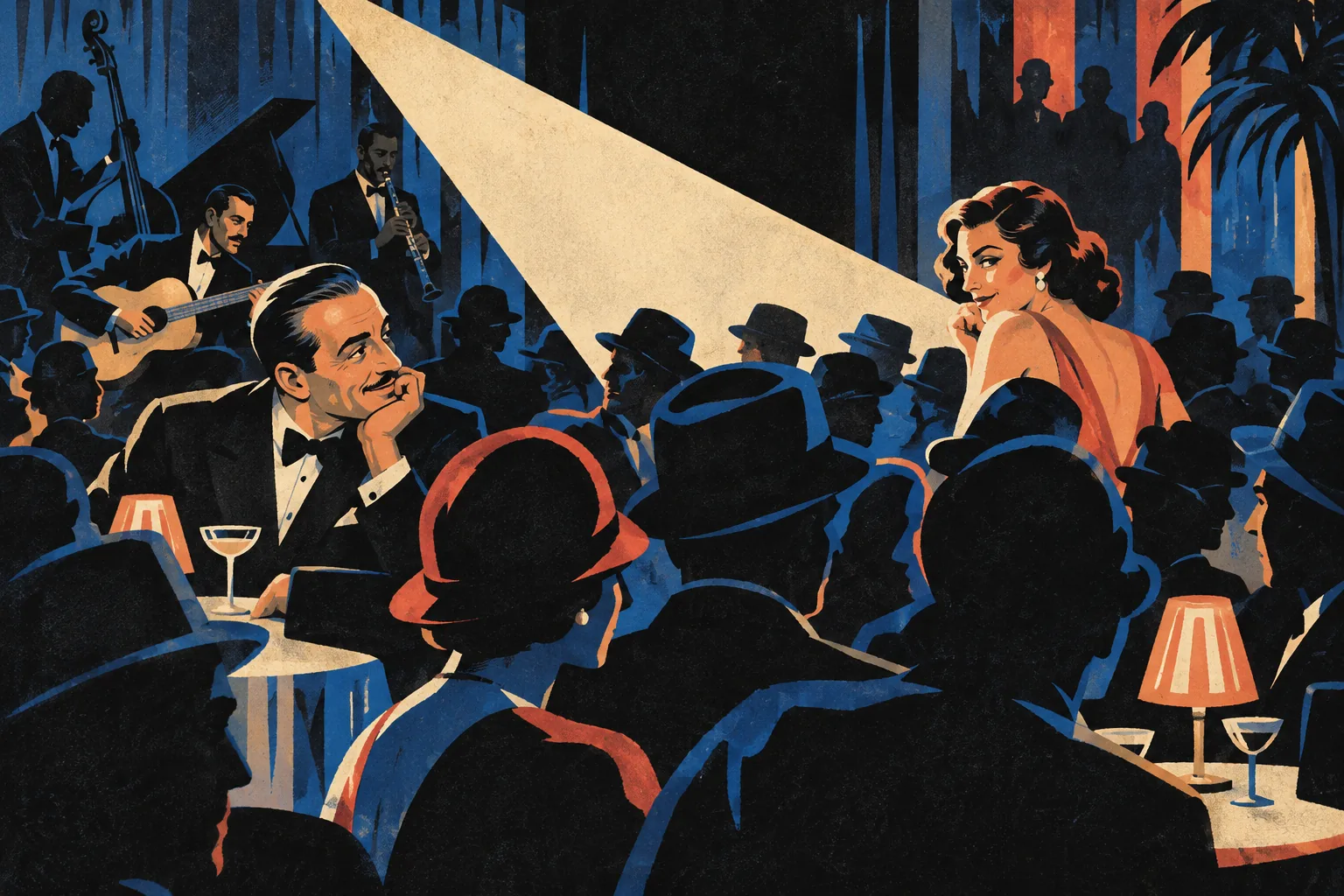
Owner-selected illustration. Two distinct adults separated by a crowd of simple hat silhouettes recognise each other instantly; a single cream spotlight connects their amused faces. A compact musical-theatre encounter, confident and unsentimental.
Original AI-assisted editorial artwork inspired by the tune; not a documented historical scene.
Original AI-assisted illustration created for Djangopedia
Illustration credits & provenance →Selected performances by notable Gypsy Jazz players and ensembles. Inclusion is editorial and does not imply an objective popularity ranking.
Tchavolo Schmitt and Romane · Alex Gokas
Jazz Manouche guitar performance · Watch title, source description and available positive-duration player checked 2026-10-05; independent performance; owner accuracy not independently verified.
Credited guitar interpretation; performance date and venue unstated.
If playback is unavailable, use the source link.
 Tchavolo Schmitt & Romane -IT HAD TO BE YOUTchavolo Schmitt and Romane · Alex GokasJazz Manouche guitar performance · Watch title, source description and available positive-duration player checked 2026-10-05; independent performance; owner accuracy not independently verified.Credited guitar interpretation; performance date and venue unstated.✓ Featured
 It Had to Be You - The Gonzalo Bergara QuartetGonzalo Bergara Quartet · cminor7b52009 · Django in June 2009 · Watch title, source description and available positive-duration player checked 2026-10-05; independent performance; owner accuracy not independently verified.With Jeffrey Radaich, Rob Hardt and Brian Netzley.Select video
 'It Had To Be You' - live at The Ark - gypsy jazzDjangophoniqueThe Ark, Ann Arbor, MI · Watch title, source description and available positive-duration player checked 2026-10-05; independent performance; owner accuracy not independently verified.Katie Lynne, Tyler Rindo, David Bendena, Andrew Brown and David Stearns are credited.Select video
 It Had to Be You - Kale, Brad & ChristiaanKale Stiles, Brad Brose and Christiaan van Hemert · Christiaan van HemertCollaborative Gypsy jazz performance · Watch title, source description and available positive-duration player checked 2026-10-05; independent performance; owner accuracy not independently verified.Vocals/clarinet and two guitars; independent arrangement, not a Django solo transcription.Select video
 It had to be you - H2R / Rodrigue - Quartet jazz manouche avec chanteur crooner de jazzH2R with Rodrigue Vera Ortiz · Clément Reboul2017 · Studio LDC, November 2017 · Watch title, source description and available positive-duration player checked 2026-10-05; independent performance; owner accuracy not independently verified.With Clément Reboul, Aurélien Robert and Ghali Hadefi; vocal quartet.Select video
Play the first sixteen bars with one chord tone per bar. In the second half, reserve your only chromatic line for B♭–B♭m–F.
Sustain the forward motion of the long G7 area without increasing volume. Leave space for the melody to complete its sentence.
Start around 100–140 bpm; increase only after the form stays secure
Play the first sixteen bars with one chord tone per bar. In the second half, reserve your only chromatic line for B♭–B♭m–F.
Begin with four quarter-note clicks. Halve the click rate and hear beats 2 and 4 while maintaining the same phrase lengths.
It Had To Be You — F major; 32 bars; two related halves with different endings. Agree the pickup, tempo and ending before counting in.
32 bars; two related halves with different endings. Keep the head and solo chorus lengths explicit at the count-in.
Start with melody and bass only. Add the following colour without interrupting the melody: Use F♯ on D7, then F natural over G7’s seventh.
Sustain the forward motion of the long G7 area without increasing volume. Leave space for the melody to complete its sentence. Agree the full roadmap and signal the last head before it starts.
Choose a comfortable vocal key and transpose the whole arrangement, including its introduction and ending.
This player guide combines inherited recording evidence and editorial study notes. Musical study notes are editorial suggestions; compare them with the recording.
Djangopedia — inherited chart and recording rows ↗
Composition credits and background ↗
Gonzalo Bergara — practice backing ↗
Feature photograph — source collection ↗
Original AI-assisted illustration created for Djangopedia
Original AI-assisted editorial artwork inspired by the tune; not a documented historical scene.
Generated with the native image-generation tool on 2026-10-26; original editorial artwork, not a historical photograph.
Prompt: Use case: stylized-concept. Create one finished original landscape 1536x1024 (3:2) raster illustration for Djangopedia, tune It Had To Be You. Tune context for interpretation only: It Had To Be You is credited here to Isham Jones. The source date is 1924; publication, composition and later lyric adaptations may have separate dates. The inherited archive lists 4 recording entries, with dated entries spanning 1938–1947. These are archive rows, not a claim that every entry is a distinct released take. The linked recording rows preserve the original discographical wording. Compare their dates, matrices and personnel when choosing a performance to study. Scene: Two distinct adults separated by a crowd of simple hat silhouettes recognise each other instantly; a single cream spotlight connects their amused faces. A compact musical-theatre encounter, confident and unsentimental. Art direction: Dramatic 1930s–1940s theatrical serigraph: angular light and shadow, mature expressive caricature with dignity, strong diagonal movement and clean colour separations. Palette: ink black, cobalt blue, muted coral and ivory. Subtle dry ink and paper texture, controlled print misregistration. Make it an artwork with a memorable singular idea, readable as a thumbnail and rewarding at full size; vary viewpoint and composition. Constraints: entirely original composition, not a copy of an artist's print. No title, words, notation, logos or watermark. No photorealism, glossy 3D, gradients, airbrushed romantic haze, generic sunset or decorative hearts. If Django appears, swept-back dark hair, pencil moustache and a distinct mature individual face; period clothes, no ethnic stereotypes. Respect plausible instruments and hands, keep key subjects within frame. Use strong flat ink shapes rather than photorealistic rendering.
Photograph provenance and rights are stated separately. Attribution does not establish permission.

