
Tune details
Music: Shelton Brooks
Words: Shelton Brooks
Published / composed / adapted — see history: 1917
Original key: Not established
Study level: Intermediate; advanced where the inherited roadmap needs reconstruction
 Djangopedia
A compact early jazz song whose unusual phrase length is part of its identity. It is a useful reminder that not every standard fits a 32-bar template.
Internalise the short chorus length.
Owner content reviewed — 2026-10-06T18:35:53Z by admin. Coverage measures presence, not accuracy. Content review does not certify rights or musical perfection.
Django recordings for this tune. Uploader dates and take labels remain source claims; only an evidenced exact association enables a row’s Listen control.
Django Reinhardt
source-described; accuracy not independently verified
Uploader identifies this as Django Reinhardt’s performance; recording date and take require comparison with the discography.
| Entry | Year | Recording / session / release evidence | Listen |
|---|---|---|---|
| 01 | 1939 | Darktown Strutters Ball, 24/5/1939,OSW 75 ,"Fremeaux FA 309, Classics 813, Jazz Time 251280-2",Same date - Personnel as for OSW 72 | — |
| 02 | 1950 | Darktown Strutters' Ball,1950, CW10,"Fremeaux FA 318, RCA ND 70929-2"," - Rome - Django Reinhardt (elg), Andre Ekyan (as,cl), Ralph Schecroun (p) Alf Masselier (b), Roger Paraboschi (d)" | — |
A dash means no video has been associated with this exact historical recording. Tune-level listening resources remain available above.
Darktown Strutters Ball is credited here to Shelton Brooks. The source date is 1917; publication, composition and later lyric adaptations may have separate dates. The inherited archive lists 2 recording entries, with dated entries spanning 1939–1950. These are archive rows, not a claim that every entry is a distinct released take. The linked recording rows preserve the original discographical wording. Compare their dates, matrices and personnel when choosing a performance to study.
Music: Shelton Brooks
Words: Shelton Brooks
Published / composed / adapted — see history: 1917
Original key: Not established
Study level: Intermediate; advanced where the inherited roadmap needs reconstruction
Listening task: Keep the pickup and the final answer tied to the twenty-cell roadmap. Mark the key, pickup, phrase lengths and ending before comparing another version.
Darktown Strutters Ball, 24/5/1939,OSW 75 ,"Fremeaux FA 309, Classics 813, Jazz Time 251280-2",Same date - Personnel as for OSW 72
Compare the first and last listed entries for tempo, instrumentation and arrangement. Do not infer identical takes from a shared title. Internalise the short chorus length.
Darktown Strutters' Ball,1950, CW10,"Fremeaux FA 318, RCA ND 70929-2"," - Rome - Django Reinhardt (elg), Andre Ekyan (as,cl), Ralph Schecroun (p) Alf Masselier (b), Roger Paraboschi (d)"
Count the form and check this arrangement’s key before joining in. The current preferred track is shown in Play along.
F moves through G7 and C7, then B♭ and a diminished approach lead into the closing D7–G7–C7 route.
One source line is missing a closing separator. Its four chord cells remain legible, but exact duration should still be checked against the chosen arrangement.
| F/// | F/// | G7/// | G7/// |

| C7/// | C7/// | F/ F#0/ | Gm7/ C7/|

| F/// | F/// | G7/// | G7///

| Bb/// | B0/// | F/// | D7/// |

| G7/// | C7/// | F/  F#o/ | Gm7/ C7/ :||
Original source ↗
Hot Club de France
190 BPM · This is the Jumping Jewels backing arrangement. Its feel and roadmap are not claimed to reproduce Django’s version. · 4:42 · Owner-approved study selection. YouTube identity and player availability checked 6 October 2026; musical accuracy and exact take not independently certified.
Owner selected 6 October 2026. Preferred practice resource; confirm its sounding key and full form before playing.
If playback is unavailable, use the source link.
Performed studies, transcriptions, TAB, notation and lessons for studying Django’s solo. Inclusion does not certify note-for-note accuracy.
No Django solo study aid yet. Know a useful resource — or want to record a study of this solo?
Follow a shared key, a harmonic idea or a familiar form. Keys refer to this site’s chart editions; other recordings may use a different key.
No sufficiently supported harmonic comparison has been added yet.
Showing 8 of 22 matches. Explore the full catalogue →
No match is established in the current chart metadata.
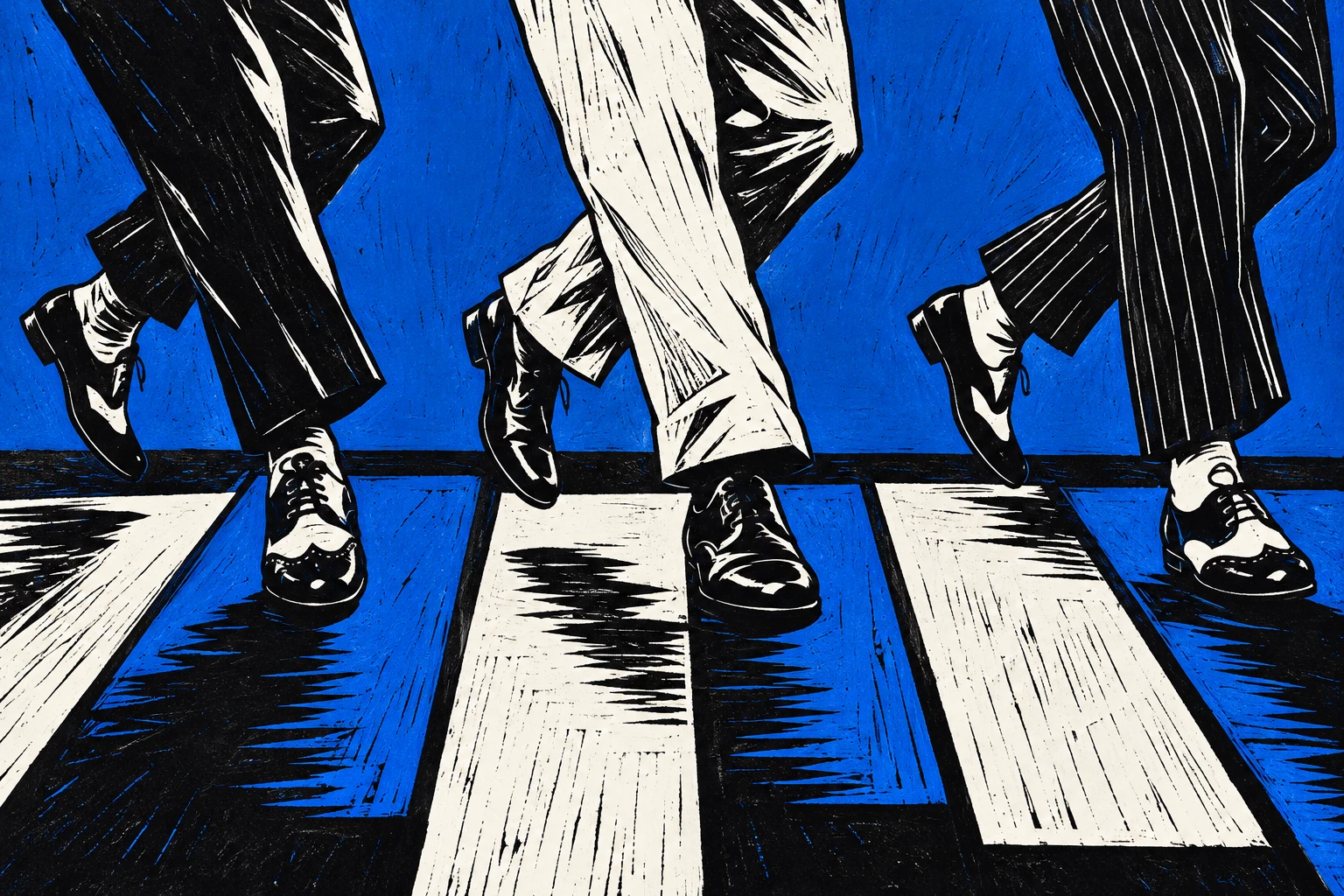
Only feet and trouser hems of three jazz dancers stride across a clean floor, five unequal rhythmic floor panels grouping a compact short chorus. Focus on swing gait and unusual phrase length, no literal reconstruction or racial caricature.
An original editorial interpretation of the tune. This is an illustration, not an archival photograph or a documented reconstruction of a recording session.
Original Djangopedia illustration · AI-assisted, 2026
Illustration credits & provenance →Selected performances by notable Gypsy Jazz players and ensembles. Inclusion is editorial and does not imply an objective popularity ranking.
Jake Sanders Quintet · swingyoucats
2011 · White Heat, Dance Manhattan, 18 May 2011 · YouTube title, uploader metadata and player availability checked 6 October 2026. Independent interpretation; proposed order awaits owner decision. No full-video musical audition claimed.
Stage 4N private performance. Traditional hot-jazz/swing ensemble with two guitars, reeds, cornet and bass; adjacent tradition, not strict Jazz Manouche.
If playback is unavailable, use the source link.
 "DARKTOWN STRUTTERS' BALL": JAKE SANDERS QUINTET (May 18, 2011)Jake Sanders Quintet · swingyoucats2011 · White Heat, Dance Manhattan, 18 May 2011 · YouTube title, uploader metadata and player availability checked 6 October 2026. Independent interpretation; proposed order awaits owner decision. No full-video musical audition claimed.Stage 4N private performance. Traditional hot-jazz/swing ensemble with two guitars, reeds, cornet and bass; adjacent tradition, not strict Jazz Manouche.✓ Featured
 "DARKTOWN STRUTTERS' BALL": TAMAR KORN'S WILDWOOD RAMBLERS (June 17, 2018)Tamar Korn’s Wildwood Ramblers · swingyoucats2018 · Wildwood Ramblers, 17 June 2018 · YouTube title, uploader metadata and player availability checked 6 October 2026. Independent interpretation; proposed order awaits owner decision. No full-video musical audition claimed.Stage 4N private performance. Traditional hot-jazz vocal ensemble with Dennis Lichtman; adjacent tradition, not strict Jazz Manouche.Select video
Count five four-bar phrases out loud over the selected arrangement. Play only the first chord of each phrase, then add the melody without changing the count.
Keep a light two-beat or four-beat swing pulse as agreed by the group. Make the shorter form feel natural rather than adding bars to fit a habitual count.
Start around 100–140 bpm; increase only after the form stays secure
Count five four-bar phrases out loud over the selected arrangement. Play only the first chord of each phrase, then add the melody without changing the count.
Begin with four quarter-note clicks. Halve the click rate and hear beats 2 and 4 while maintaining the same phrase lengths.
Darktown Strutters Ball — F major; 20-cell chorus in the inherited chart. Agree the pickup, tempo and ending before counting in.
20-cell chorus in the inherited chart. One source line is missing a closing separator. Its four chord cells remain legible, but exact duration should still be checked against the chosen arrangement.
Start with melody and bass only. Add the following colour without interrupting the melody: Use B natural to define G7 before B♭ appears in C7.
Keep a light two-beat or four-beat swing pulse as agreed by the group. Make the shorter form feel natural rather than adding bars to fit a habitual count. Agree the full roadmap and signal the last head before it starts.
Choose a comfortable vocal key and transpose the whole arrangement, including its introduction and ending.
Search online videos of "Darktown Strutters Ball" in youtube.com ↗
This player guide combines inherited recording evidence and editorial study notes. Musical study notes are editorial suggestions; compare them with the recording.
Djangopedia — inherited chart and recording rows ↗
Composition credits and background ↗
Feature photograph — source collection ↗
Original Djangopedia illustration · AI-assisted, 2026
An original editorial interpretation of the tune. This is an illustration, not an archival photograph or a documented reconstruction of a recording session.
Generated with the native image-generation tool on 2026-10-08; original editorial artwork, not a historical photograph.
Prompt: Use case: illustration-story. One original editorial feature illustration for Djangopedia's guide “Darktown Strutters Ball”. Landscape 1536 × 1024, opaque background. Scene: Only feet and trouser hems of three jazz dancers stride across a clean floor, five unequal rhythmic floor panels grouping a compact short chorus. Focus on swing gait and unusual phrase length, no literal reconstruction or racial caricature. Musical basis from the guide: A compact early jazz song whose unusual phrase length is part of its identity. It is a useful reminder that not every standard fits a 32-bar template. The supplied chart is F major; form: 20-cell chorus in the inherited chart; feel: Swing. These describe musical inspiration, not visible writing. Historical context: Darktown Strutters Ball is credited here to Shelton Brooks. The source date is 1917; publication, composition and later lyric adaptations may have separate dates. Do not illustrate disputed historical claims or suggest this imagined scene is an archival session. Medium: linocut. Dominant palette: black white and electric blue. Composition: low cropped dance rhythm. Human presence: lower legs only. Strong intentional design, clearly drawn/painted, distinctive material marks; keep essential subject safely within the central 70 percent width and middle 80 percent height for card crops. Maintain enough visual substance at thumbnail size. Broad inspiration observed in old photo, ONLY scale/rhythm and never a reference image: distant outdoor figures; sparse ground; vertical trees. Independently invent every pose, perspective, clothing, setting and lighting. Avoid: No trees, faces, historic ball reenactment, generated lettering. No photorealism, archival simulation, generated text, letters, numbers, labels, fake musical notation, logo, signature, watermark, fake dates, yellowed-paper patina, recognizable artwork or copied photograph. No imitation of any named artist. Render the art edge to edge without borders, mockup or typography.
Photograph provenance and rights are stated separately. Attribution does not establish permission.
