
Tune details
Music: Django Reinhardt, Stéphane Grappelli
Documented in archive: 1937
Original key: Not established
Study level: Intermediate; advanced where the inherited roadmap needs reconstruction
 Djangopedia
A compact tune with a winding chromatic approach to home. It teaches how bass inversion and diminished colour can make a familiar major key sound unexpectedly mobile.
Follow the opening C♯–C–B movement.
Owner content reviewed — 2026-10-04T17:06:38Z by admin. Coverage measures presence, not accuracy. Content review does not certify rights or musical perfection.
Django recordings for this tune. Uploader dates and take labels remain source claims; only an evidenced exact association enables a row’s Listen control.
Uploader identifies this as Django Reinhardt’s performance; recording date and take require comparison with the discography.
| Entry | Year | Recording / session / release evidence | Listen |
|---|---|---|---|
| 01 | 1937 | Bricktop, 13/6/37, Fremeaux 306," - CBS Broadcast - Stephane Grappelli (v), Django&Joseph Reinhardt (g), Gusti Mahla (g), Louis Vola (b)." | — |
| 02 | 1937 | Bricktop, 25/11/37, OLA 1987 ,"Fremeaux 306, Mosaic MD6-190(6 CD Set)."," - Paris - QHCF - Stephane Grappelly (v), Django Reinhardt, Joseph Reinhardt, Eugene Vees (g), Louis Vola (b)" | — |
| 03 | 1948 | Bricktop, 10/3/48, OSW 504-1,"Fremeaux FA 316, Jazz Time 789103-2, Mosaic MD6-190(6 CD Set)."," - Paris - QHCF - Stephane Grappelly (v,p), Django & Joseph Reinhardt, Challin Ferret (g), Emmanuel Soudieux (b)" | — |
| 04 | 1949 | Bricktop, Jan-Feb 1949, CW 56,"Fremeaux FA 317, RCA ND 70929-2, RCA ND 90448"," - Rome - Django Reinhardt (g), Stephane Grappelly (v),Gianni Safred (p), Carlo Pecori (b), Aurelio de Carolis (d)." | — |
A dash means no video has been associated with this exact historical recording. Tune-level listening resources remain available above.
Bricktop is credited here to Django Reinhardt, Stéphane Grappelli. The inherited archive lists 4 recording entries, with dated entries spanning 1937–1949. These are archive rows, not a claim that every entry is a distinct released take. The linked recording rows preserve the original discographical wording. Compare their dates, matrices and personnel when choosing a performance to study.
Music: Django Reinhardt, Stéphane Grappelli
Documented in archive: 1937
Original key: Not established
Study level: Intermediate; advanced where the inherited roadmap needs reconstruction
Listening task: Keep the melody distinct from the busy lower voice. Mark the key, pickup, phrase lengths and ending before comparing another version.
Bricktop, 13/6/37, Fremeaux 306," - CBS Broadcast - Stephane Grappelli (v), Django&Joseph Reinhardt (g), Gusti Mahla (g), Louis Vola (b)."
Compare the first and last listed entries for tempo, instrumentation and arrangement. Do not infer identical takes from a shared title. Follow the opening C♯–C–B movement.
Bricktop, Jan-Feb 1949, CW 56,"Fremeaux FA 317, RCA ND 70929-2, RCA ND 90448"," - Rome - Django Reinhardt (g), Stephane Grappelly (v),Gianni Safred (p), Carlo Pecori (b), Aurelio de Carolis (d)."
The inherited chart is in G major in the inherited chart. Confirm the backing track’s sounding key, pickup and complete form before playing; an instrument label may describe a transposed score.
The source alternates an A-over-C♯ reading with C diminished and G/B. Treat the moving bass as the main clue; later cadences bring the harmony back toward G.
The source writes A(#C) and G(/B). The inversion interpretation is an editorial reading, not a corrected source transcription.
| A(#C)/ C0/ | G(/B)/// | A(#C)/ C0/ | G(/B)/// | A(#C)/ C0/ | G(/B)/ Bb0/ | A0/ Ab7 | G69/// |

| A(#C)/ C0/ | G(/B)/// | A(#C)/ C0/ | G(/B)/// | A(#C)/ C0/ | G(/B)/ Bb0/ | Ab7/ D7 | G69/// |

| Bb0/ A0/ | G69/// | A7/ A0/ | G69/// | Bb0/ A0/ | G(/B)/ Bb0/ | A0/ D7 | G69/// |

| A(#C)/ C0/ | G(/B)/// | A(#C)/ C0/ | G(/B)/// | A(#C)/ C0/ | G(/B)/ Bb0/ | A0/ D7 | G69/// :||
Original source ↗
Guitare Improvisation · The inherited chart is in G major in the inherited chart. Confirm the backing track’s sounding key, pickup and complete form before playing; an instrument label may describe a transposed score. · 5:22
Checked 2026-10-01
Most-viewed suitable match selected from the captured search results after title/composition review; not a complete YouTube ranking. Source counts were captured on 1 October 2026. Coaching, unrelated songs and non-backing performances are excluded.
Performed studies, transcriptions, TAB, notation and lessons for studying Django’s solo. Resources are described by their creator; inclusion does not certify note-for-note accuracy.
augusto creni · source-described; accuracy not independently verified
Creator presents a study of Django’s recorded solo. Use it alongside the original recording; exact transcription accuracy has not been independently reviewed.
Checked 2026-10-02
Follow a shared key, a harmonic idea or a familiar form. Keys refer to this site’s chart editions; other recordings may use a different key.
No sufficiently supported harmonic comparison has been added yet.
Showing 8 of 23 matches. Explore the full catalogue →
Showing 8 of 12 matches. Explore the full catalogue →
Django/Grappelli’s G-major 32-bar swing has archive rows from 1937–1949. The old photo shows a seated guitarist at a dressing table with musicians in a mirror. No specific club or namesake story is asserted by the guide.
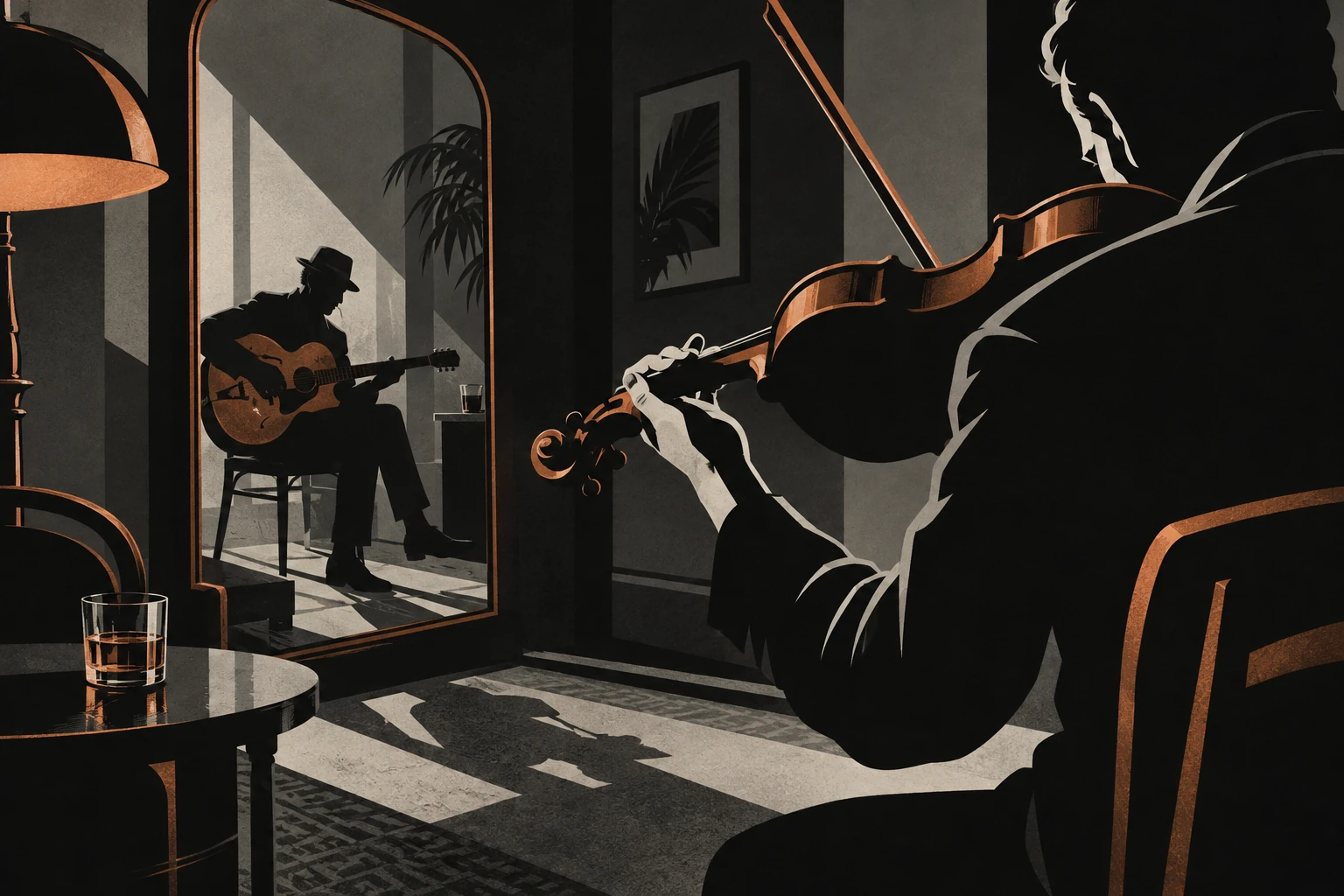
An original editorial interpretation of the tune. This is an illustration, not an archival photograph or a documented reconstruction of a recording session.
Original Djangopedia illustration · AI-assisted, 2026
Illustration credits & provenance →Selected performances by notable Gypsy Jazz players and ensembles. Inclusion is editorial and does not imply an objective popularity ranking.
Notable Gypsy Jazz performances are being curated.
Play the opening with just its descending bass and a common upper note. Add the melody afterward, then remove the bass and see whether your single-note line still suggests the progression.
Keep the inversions connected and the rhythm steady. Play the lowest moving voice clearly, without turning each inversion into a full-register chord jump.
Start around 100–140 bpm; increase only after the form stays secure
Play the opening with just its descending bass and a common upper note. Add the melody afterward, then remove the bass and see whether your single-note line still suggests the progression.
Begin with four quarter-note clicks. Halve the click rate and hear beats 2 and 4 while maintaining the same phrase lengths.
Bricktop — G major in the inherited chart; 32 bars in the printed arrangement. Agree the pickup, tempo and ending before counting in.
32 bars in the printed arrangement. The source writes A(#C) and G(/B). The inversion interpretation is an editorial reading, not a corrected source transcription.
Start with melody and bass only. Add the following colour without interrupting the melody: Trace C♯–C–B in the opening bass or an inner voice.
Keep the inversions connected and the rhythm steady. Play the lowest moving voice clearly, without turning each inversion into a full-register chord jump. Agree the full roadmap and signal the last head before it starts.
This guide focuses on the instrumental arrangement; any lyric adaptation needs separate credit and a chosen key.
This player guide combines inherited recording evidence and editorial study notes. Musical study notes are editorial suggestions; compare them with the recording.
Djangopedia — inherited chart and recording rows ↗
Composition credits and background ↗
Guitare Improvisation — practice backing ↗
Feature photograph — source collection ↗
Original Djangopedia illustration · AI-assisted, 2026
An original editorial interpretation of the tune. This is an illustration, not an archival photograph or a documented reconstruction of a recording session.
Generated with the native image-generation tool on 2026-10-08; original editorial artwork, not a historical photograph.
Prompt: Original editorial feature illustration for Bricktop. A noir graphic illustration exploring musical call-and-response through an oblique mirror: a small guitarist silhouette is visible indirectly in a mirror plane, with a violin bow and guitar curve echoing across the room like short swing phrases. Charcoal black, pale grey, a single copper accent, graphic solid shadows, no photographic shading. The mirrored-room idea is conceptual inspiration only; make an entirely new angled composition, not a reconstruction of the photograph or a claim about a named nightclub. Avoid a centered face. Original Djangopedia editorial illustration, clearly non-photographic. Do not copy a photograph, known artwork or specific artist. Landscape 1536 by 1024 feature image, important subjects within the middle 75% for responsive hero cropping. No lettering, numbers, musical notation glyphs, logos, signature, watermark, fake archival markings, caption or border. One finished candidate only.
Photograph provenance and rights are stated separately. Attribution does not establish permission.