
Tune details
Music: Django Reinhardt
Documented in archive: 1939
Original key: Not established
Study level: Advanced at performance tempo
 Djangopedia
A vigorous swing tune built from bright tonic passages, chromatic neighbours and a strongly directed dominant chain. Clarity at speed depends on knowing where a phrase is going before it starts.
Hear the destination of the dominant chain before playing the first note.
Owner content reviewed — 2026-10-04T21:21:55Z by admin. Coverage measures presence, not accuracy. Content review does not certify rights or musical perfection.
Django recordings for this tune. Uploader dates and take labels remain source claims; only an evidenced exact association enables a row’s Listen control.
Uploader identifies this as Django Reinhardt’s performance; recording date and take require comparison with the discography.
| Entry | Year | Recording / session / release evidence | Listen |
|---|---|---|---|
| 01 | 1939 | Hungaria, 21/3/39, 4967-HPP ,"Fremeaux FA 308, JSP 343, Classics 793, Conifer HD 206, Rhapsody RHCD6, Suisa JZCD 376, Music Memoria 87949, Gitanes 159 853-2"," - Paris - QHCF - Stephane Grappelly (g), Django Reinhardt, Joseph Reinhardt,Pierre Ferret (g), Emmanuel Soudieux (b)" | — |
| 02 | 1939 | Hungaria,21/3/39, 4967-1/2HPP ,"Fremeaux FA 308, JSP 343, Gitanes 159 853-2"," - Paris - QHCF - Stephane Grappelly (g), Django Reinhardt, Joseph Reinhardt,Pierre Ferret (g), Emmanuel Soudieux (b)" | — |
| 03 | 1939 | Hungaria, 17/5/39, 5084-HPP ,"Fremeaux FA 309, Classics 813, JSP 343, Music Memoria 87949"," - QHCF - Stephane Grappelly (v), Django Reinhardt, Joseph Reinhardt,Pierre Ferret (g),Emmanuel Soudieux (b)" | — |
| 04 | 1941 | Hungaria,11/9/41, OSW 225-1,"Fremeaux FA 311, Classics 877, OR0062"," - Paris - Andre Ekyan (as), Django Reinhardt, Eugene Vees (g), Emmanuel Soudieux (b), Pierre Fouad (d)" | — |
A dash means no video has been associated with this exact historical recording. Tune-level listening resources remain available above.
Djangopedia documents Paris takes dated 21 March 1939, including matrix 4967-HPP. The imported personnel text contains apparent instrument typos, so its verbatim record is retained rather than treated as a fully verified personnel table.
Music: Django Reinhardt
Documented in archive: 1939
Original key: Not established
Study level: Advanced at performance tempo
Listening task: Learn fast figures as short rhythmic groups, preserving the last note of each phrase. Count the head before comparing solo choruses.
Hungaria, 21/3/39, 4967-HPP ,"Fremeaux FA 308, JSP 343, Classics 793, Conifer HD 206, Rhapsody RHCD6, Suisa JZCD 376, Music Memoria 87949, Gitanes 159 853-2"," - Paris - QHCF - Stephane Grappelly (g), Django Reinhardt, Joseph Reinhardt,Pierre Ferret (g), Emmanuel Soudieux (b)"
Compare the tempo, key, introduction and final cadence with the first entry. Hear the destination of the dominant chain before playing the first note.
Hungaria,11/9/41, OSW 225-1,"Fremeaux FA 311, Classics 877, OR0062"," - Paris - Andre Ekyan (as), Django Reinhardt, Eugene Vees (g), Emmanuel Soudieux (b), Pierre Fouad (d)"
Count its form and check its key before joining in. The G-major opening is interrupted by a chromatic neighbour, then E7 starts the move toward A7 and D7. The second half closes through Am and C-minor colour before G. The inherited G♯ symbols and absent bar separators require comparison with a reliable chart or the selected track.
The G-major opening is interrupted by a chromatic neighbour, then E7 starts the move toward A7 and D7. The second half closes through Am and C-minor colour before G. The inherited G♯ symbols and absent bar separators require comparison with a reliable chart or the selected track.
Two rows each have seven cells and a missing separator around G♯ / G. Root and chord-quality spellings also need review. The printed cells are not a reliable bar count.
[[Image:Hungaria.gif]]


| G/// | G/// | G#/// | G#/// G/// | G/// | E7/// | E7/// |

| A7/// | A7/// | D7/// | D7/// | G(/B)/// | Bb0/// | Am/// | D7/// |

| G/// | G/// | G#/// | G#/// G/// | G/// | E7/// | E7/// |

| Am/// | Cm6/// | G/// | E7/// | Am/// | D7/// | G/// | G/// :||
Original source ↗
Gonzalo Bergara · 2:26
Checked 2026-09-20
Highest displayed view count among matching backing-track videos returned by relevance and view-count YouTube searches. Not a complete platform-wide ranking.
Guitare Improvisation · 5:33
Guitare Improvisation · 4:32
Clément Reboul · 4:32
Performed studies, transcriptions, TAB, notation and lessons for studying Django’s solo. Resources are described by their creator; inclusion does not certify note-for-note accuracy.
From Music · Owner approved 2026-10-05. Watch title and availability checked; transcription accuracy remains a source claim.
Owner-selected transcription study; use alongside the Django recording.
Checked 2026-10-02
Follow a shared key, a harmonic idea or a familiar form. Keys refer to this site’s chart editions; other recordings may use a different key.
No sufficiently supported harmonic comparison has been added yet.
Showing 8 of 23 matches. Explore the full catalogue →
Showing 8 of 12 matches. Explore the full catalogue →
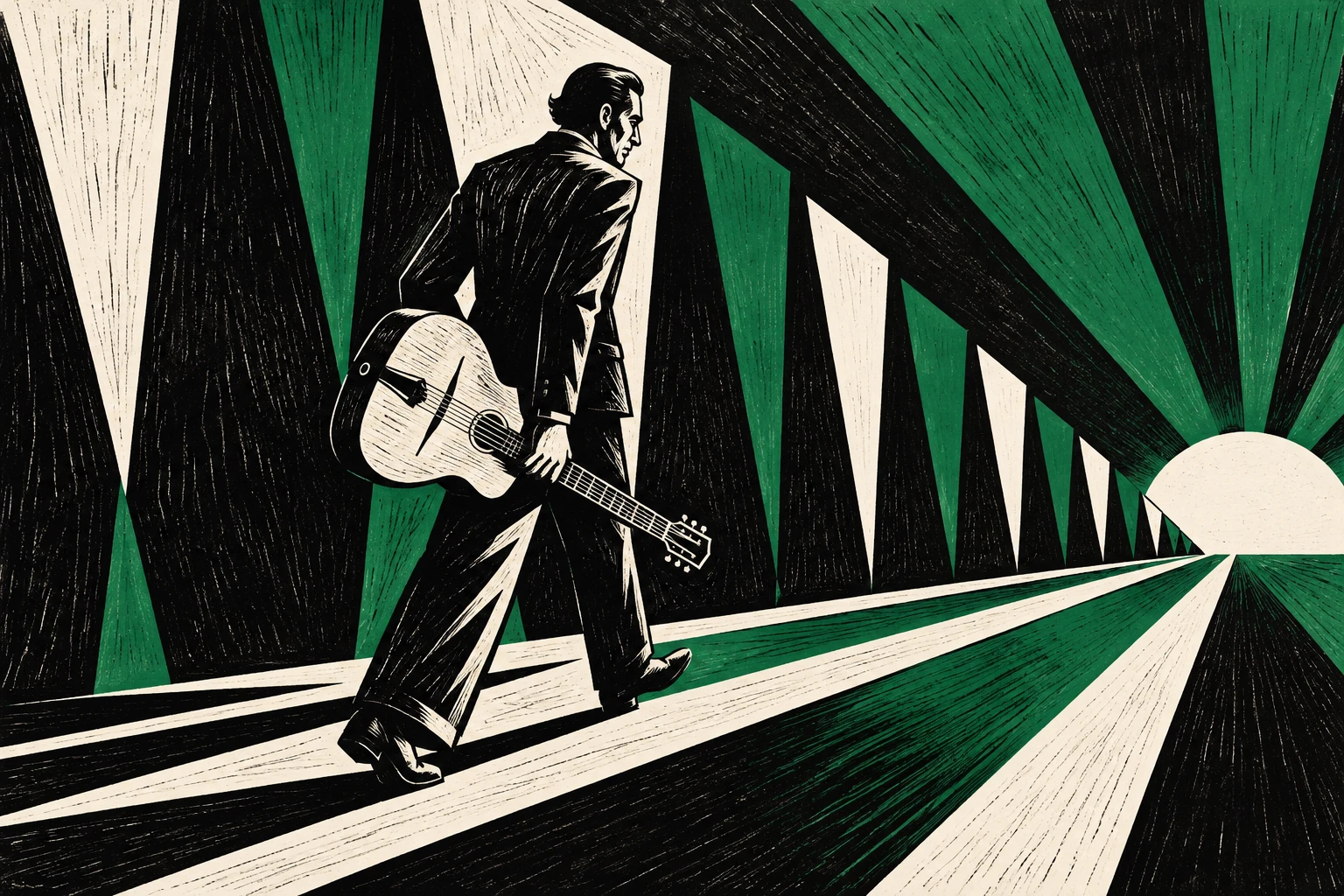
A small standing Django in angular silhouette walks between sharp rhythmic wedges with a guitar carried at his side. The wedges converge toward a stable bright landing, echoing Hungaria's vigorous tonic and directed dominant chain; no geographic costume.
An original editorial interpretation of the tune. This is an illustration, not an archival photograph or a documented reconstruction of a recording session.
Original Djangopedia illustration · AI-assisted, 2026
Illustration credits & provenance →Selected performances by notable Gypsy Jazz players and ensembles. Inclusion is editorial and does not imply an objective popularity ranking.
Biréli Lagrène & Joscho Stephan · Joscho Stephan
Official Joscho Stephan artist upload
Notable guitar collaboration; proposed first for an independent concert interpretation.
If playback is unavailable, use the source link.
 Hungaria // Bireli Lagrene & Joscho StephanBiréli Lagrène & Joscho Stephan · Joscho StephanOfficial Joscho Stephan artist uploadNotable guitar collaboration; proposed first for an independent concert interpretation.✓ Featured
 Angelo Debarre & Denis Chang - Hungaria (Gypsy Jazz)Angelo Debarre & Denis Chang · Will Dickerson2016 · Upstairs Jazz Bar & Grill, Montreal; 15 April 2016Live Gypsy Jazz concert interpretation.Select performance
 HUNGARIA-biréli lagrène - live in paris (2004).avi-.aviBiréli Lagrène · JuanRasGuitar2004 · Live in Paris, year attributed by titleHistorical concert alternative; uploader year is retained as a source claim.Select performance
 Rosenberg Trio: HungariaThe Rosenberg Trio · Djangodr0m2010 · Samois festival, uploader attributionRepresentative trio festival performance.Select performance
 Irene's GJ Adventurs 1110: Hungaria - Jimmy Rosenberg TrioJimmy Rosenberg Trio · Irene's Gypsy Jazz AdventuresDjango Amsterdam Festival, BimhuisUploader identifies Jimmy Rosenberg, Faifie Reinhardt and Fremdo Rosenberg.Select performance
 John Jorgenson Quintet - Hungaria (Gypsy Jazz guitar and violin) 2015John Jorgenson Quintet · magicfiddle2015 · Fire in the Kitchen, North Madison; 7 March 2015Guitar/violin concert ensemble offers a contrasting reading.Select performance
 Bireli & Rosenberg Trio : HungariaBiréli Lagrène & The Rosenberg Trio · MarioMaccaferriRules2011 · La Petite Pierre, France; 15 August 2011Live collaborative performance, distinct from the other selected concerts.Select performance
Practise the dominant chain at half speed using quarter notes. Increase tempo only when the last note of each phrase still lands exactly where intended.
Choose small grips and economical right-hand motion. Keep the volume below the lead so the melody remains readable at speed.
Start at 130–150; build toward 200–240 bpm
Practise the dominant chain at half speed using quarter notes. Increase tempo only when the last note of each phrase still lands exactly where intended.
Start below the suggested tempo. First hear four quarter-note clicks, then halve the click rate and place clicks on beats 2 and 4. Keep the same phrase length.
Hungaria — G major; 32-bar chorus; source has missing separators. Agree the tempo, pickup, solo order and ending before the count.
At this tempo, agree on a minimal ending and solo order before the count.
Reduce the accompaniment to bass landmarks and occasional chords; preserve the head’s rhythmic identity first.
At this tempo, agree on a minimal ending and solo order before the count.
This guide studies an instrumental arrangement. Any later lyric adaptation requires its own credit and chosen key.
This player guide combines inherited recording evidence and editorial study notes. Musical study notes are editorial suggestions; compare them with the recording.
Gonzalo Bergara — backing track ↗
Feature photograph — Gypsy Jazz UK historical archive ↗
Original Djangopedia illustration · AI-assisted, 2026
An original editorial interpretation of the tune. This is an illustration, not an archival photograph or a documented reconstruction of a recording session.
Generated with the native image-generation tool on 2026-10-08; original editorial artwork, not a historical photograph.
Prompt: Use case: illustration-story. One original editorial feature illustration for Djangopedia's guide “Hungaria”. Landscape 1536 × 1024, opaque background. Scene: A small standing Django in angular silhouette walks between sharp rhythmic wedges with a guitar carried at his side. The wedges converge toward a stable bright landing, echoing Hungaria's vigorous tonic and directed dominant chain; no geographic costume. Musical basis from the guide: A vigorous swing tune built from bright tonic passages, chromatic neighbours and a strongly directed dominant chain. Clarity at speed depends on knowing where a phrase is going before it starts. The supplied chart is G major; form: 32-bar chorus; source has missing separators; feel: Swing. These describe musical inspiration, not visible writing. Historical context: Djangopedia documents Paris takes dated 21 March 1939, including matrix 4967-HPP. The imported personnel text contains apparent instrument typos, so its verbatim record is retained rather than treated as a fully verified personnel table. Do not illustrate disputed historical claims or suggest this imagined scene is an archival session. Medium: woodcut. Dominant palette: black white and restrained emerald. Composition: forward lean offset rhythm. Human presence: one Django figure. Strong intentional design, clearly drawn/painted, distinctive material marks; keep essential subject safely within the central 70 percent width and middle 80 percent height for card crops. Maintain enough visual substance at thumbnail size. Broad inspiration observed in old photo, ONLY scale/rhythm and never a reference image: close instrument-led figure; diagonal guitar; strong contrast. Independently invent every pose, perspective, clothing, setting and lighting. Avoid: No source formal seated pose, violin, Hungarian costume. No photorealism, archival simulation, generated text, letters, numbers, labels, fake musical notation, logo, signature, watermark, fake dates, yellowed-paper patina, recognizable artwork or copied photograph. No imitation of any named artist. Render the art edge to edge without borders, mockup or typography.
Photograph rights are documented separately in its credit. They do not establish the rights status of the composition or recording.