
Tune details
Music: Henry Busse, Henry Lange
Words: Lou Davis
Documented in archive: 1937
Original key: Not established
Study level: Intermediate; melody, pulse and arrangement awareness
 Djangopedia
A bright riff tune for secondary dominants and precise, relaxed ensemble attacks.
Sing the riff on one pitch, then move it onto a B-flat chord tone.
Owner content reviewed — 2026-10-19T04:10:08Z by admin. Coverage measures presence, not accuracy. Content review does not certify rights or musical perfection.
Django recordings for this tune. Uploader dates and take labels remain source claims; only an evidenced exact association enables a row’s Listen control.
Django Reinhardt
source-described; accuracy not independently verified
Uploader identifies this as Django Reinhardt’s performance; recording date and take require comparison with the discography.
| Entry | Year | Recording / session / release evidence | Listen |
|---|---|---|---|
| 01 | 1937 | Hot Lips, 22/4/37, OLA 1707-1 ,"Fremeaux FA 305, Affinity AFS 1003, Classics 748, Mosaic MD6-190(6 CD Set).", - Paris - QHCF - | — |
A dash means no video has been associated with this exact historical recording. Tune-level listening resources remain available above.
The publisher identifies the 1937 quintet recording in its swing-era session sequence. The inherited solo study is retained; new lessons are labelled by the actual soloist they teach.
Music: Henry Busse, Henry Lange
Words: Lou Davis
Documented in archive: 1937
Original key: Not established
Study level: Intermediate; melody, pulse and arrangement awareness
A bright riff tune for secondary dominants and precise, relaxed ensemble attacks.
Hot Lips, 22/4/37, OLA 1707-1 ,"Fremeaux FA 305, Affinity AFS 1003, Classics 748, Mosaic MD6-190(6 CD Set).", - Paris - QHCF -
The B-flat head alternates tonic and F7. A contrasting passage moves through F and C7; later D7–Gm–C7–F7 returns home. Hear the third of D7 as the clear change into the minor destination. Check the video key before playing with the chart.
The B-flat head alternates tonic and F7. A contrasting passage moves through F and C7; later D7–Gm–C7–F7 returns home. Hear the third of D7 as the clear change into the minor destination.
Inherited chart retained exactly. Harmonic comments refer to this edition; ambiguous symbols are flagged rather than silently corrected.
[[Image:Hot_lips.gif]]


| Bb/// | Bb/// | F7/// | F7/// | F7/// | F7/// | Bb/// | F7/// |

| Bb/// | Bb/// | F/// | F/// | C7/// | C7/// | F/// | F7/// |

| Bb/// | Bb/// | F7/// | F7/// | F7/// | F7/// | Bb7/// | Bb7/// |

| D7/// | D7/// | Gm/// | Gm/// | C7/// | F7/// | Bb/// | F7/// :||
Original source ↗
Stephane Wrembel
Swing · 104 BPM · 2m33s · Video available when checked; creator-described attribution.
Creator-provided play-along; instrumentation and feel vary by selection. Check the key and full arrangement before joining in; the guide chart may use another key. Tempo is the creator’s stated value.
If playback is unavailable, use the source link.
Performed studies, transcriptions, TAB, notation and lessons for studying Django’s solo. Inclusion does not certify note-for-note accuracy.
School of Manouche
source-described; accuracy not independently verified
Creator presents a study of Django’s recorded solo. Use it alongside the original recording; exact transcription accuracy has not been independently reviewed.
If playback is unavailable, use the source link.
 Hot Lips Django solo slow with sheet & tabsSchool of Manouchesource-described; accuracy not independently verifiedCreator presents a study of Django’s recorded solo. Use it alongside the original recording; exact transcription accuracy has not been independently reviewed.✓ Featured
 Hot Lips Django's Solo 1937Bryan KilloughVideo available when checked; creator-described attribution.Creator-presented transcription of Django’s solo. This is a study aid, not an independent certification of note-for-note accuracy.Select video
Follow a shared key, a harmonic idea or a familiar form. Keys refer to this site’s chart editions; other recordings may use a different key.
No sufficiently supported harmonic comparison has been added yet.
No match is established in the current chart metadata.
Showing 8 of 26 matches. Explore the full catalogue →
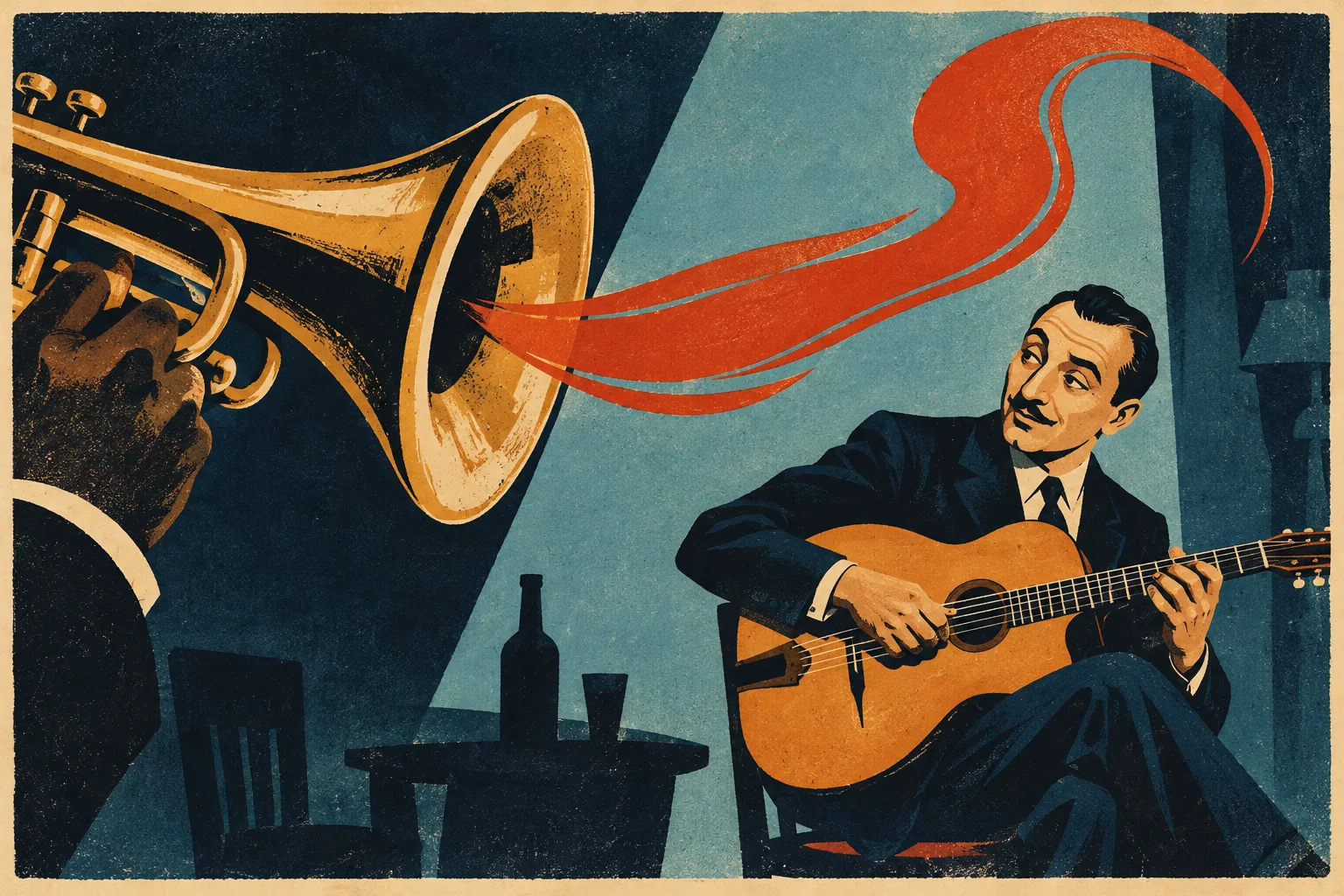
Owner-selected illustration. An oversized trumpet mouthpiece and a warm red curved sound ribbon face a tiny cool-blue guitarist who answers with a raised eyebrow. Lively instrumental banter, no sexualized mouth or giant disembodied lips.
Original AI-assisted editorial artwork inspired by the tune; not a documented historical scene.
Original AI-assisted illustration created for Djangopedia
Illustration credits & provenance →Selected performances by notable Gypsy Jazz players and ensembles. Inclusion is editorial and does not imply an objective popularity ranking.
Duved Dunayevsky
Video available when checked; creator-described attribution.
Performer attribution follows the video title and channel description. Proposed listening selection; no popularity ranking implied.
If playback is unavailable, use the source link.
 Hot Lips - Duved And His Transatlantic FiveDuved DunayevskyVideo available when checked; creator-described attribution.Performer attribution follows the video title and channel description. Proposed listening selection; no popularity ranking implied.✓ Featured
 Duved Dunayevsky and His Transatlantic Five “Hot lips” Festival Django Reinhardt 2023Daniel Gueli Gypsy Jazz ChannelVideo available when checked; creator-described attribution.Performer attribution follows the video title and channel description. Proposed listening selection; no popularity ranking implied.Select video
Sing the riff on one pitch, then move it onto a B-flat chord tone. At the D7–Gm point, reduce the solo to F-sharp resolving to G.
Excerpt of Stochelo Rosenberg teaching his theme and solo. Not a complete Django solo lesson.
Use buoyant short chords and a clean release. Keep the two-feel or four-feel consistent while the head supplies its own syncopations.
80–120 bpm, then increase gradually
Sing the riff on one pitch, then move it onto a B-flat chord tone. At the D7–Gm point, reduce the solo to F-sharp resolving to G.
Count quarter notes first. Then place the click on beats 2 and 4 at half the click rate, keeping the phrase length unchanged.
Bb; 32 bars in four eight-bar phrases in the inherited chart. Agree the arrangement, pickup and ending before counting in.
A Stochelo solo lesson studies Stochelo unless the creator explicitly identifies a Django recreation.
Keep the melody uppermost and begin with a single bass note under each harmony. Use buoyant short chords and a clean release. Keep the two-feel or four-feel consistent while the head supplies its own syncopations.
Use buoyant short chords and a clean release. Keep the two-feel or four-feel consistent while the head supplies its own syncopations.
Choose a comfortable singing key and transpose the accompaniment as a whole; lyrics are not reproduced here.
This player guide combines inherited recording evidence and editorial study notes. Musical study notes are editorial suggestions; compare them with the recording.
Reissue publisher discography and credits ↗
Inherited chart and recording evidence ↗
Original AI-assisted illustration created for Djangopedia
Original AI-assisted editorial artwork inspired by the tune; not a documented historical scene.
Generated with the native image-generation tool on 2026-10-26; original editorial artwork, not a historical photograph.
Prompt: Use case: stylized-concept. Create one finished original landscape 1536x1024 (3:2) raster illustration for Djangopedia, tune Hot Lips. Tune context for interpretation only: The publisher identifies the 1937 quintet recording in its swing-era session sequence. The inherited solo study is retained; new lessons are labelled by the actual soloist they teach. Scene: An oversized trumpet mouthpiece and a warm red curved sound ribbon face a tiny cool-blue guitarist who answers with a raised eyebrow. Lively instrumental banter, no sexualized mouth or giant disembodied lips. Art direction: Minimal mid-century musical still-life print: crisp hand-cut shapes, ingenious symbolic composition, uneven hand-pulled ink edges, very few carefully chosen details. Palette: deep indigo, dusty turquoise, burnt orange and warm paper. Subtle dry ink and paper texture, controlled print misregistration. Make it an artwork with a memorable singular idea, readable as a thumbnail and rewarding at full size; vary viewpoint and composition. Constraints: entirely original composition, not a copy of an artist's print. No title, words, notation, logos or watermark. No photorealism, glossy 3D, gradients, airbrushed romantic haze, generic sunset or decorative hearts. If Django appears, swept-back dark hair, pencil moustache and a distinct mature individual face; period clothes, no ethnic stereotypes. Respect plausible instruments and hands, keep key subjects within frame. Use strong flat ink shapes rather than photorealistic rendering.
