
Tune details
Music: Duke Ellington
Words: Irving Mills
Published / composed: 1931
Original key: Not established
Study level: Intermediate rhythm and mode changes
 Djangopedia
A compact Ellington theme balances minor-key drive with bright major arrivals. Its rhythmic identity matters as much as the changes: the head should still be recognisable when played with only a few notes.
Keep the tune’s rhythmic identity while moving between minor and major.
Owner content reviewed — 2026-10-05T18:28:08Z by admin. Coverage measures presence, not accuracy. Content review does not certify rights or musical perfection.
Django recordings for this tune. Uploader dates and take labels remain source claims; only an evidenced exact association enables a row’s Listen control.
Uploader identifies this as Django Reinhardt’s performance; recording date and take require comparison with the discography.
| Entry | Year | Recording / session / release evidence | Listen |
|---|---|---|---|
| 01 | 1935 | It Don't Mean A Thing.., 21/10/35, 2083-HPP ,"Fremeaux FA 304, Classics 708, JSP 344, Gitanes 159 853-2"," - Stephane Grappely's Hot Four - Grappelly (v), Django & Joseph Reinhardt, Pierre Ferret (g), Tony Rovira (b)" | — |
A dash means no video has been associated with this exact historical recording. Tune-level listening resources remain available above.
Ellington composed the music in 1931; the first recording followed in 1932, with lyrics credited to Irving Mills. The inherited Django entry is dated 21 October 1935. This guide studies the song as a swing vehicle rather than treating its title as permission to rush.
Music: Duke Ellington
Words: Irving Mills
Published / composed: 1931
Original key: Not established
Study level: Intermediate rhythm and mode changes
Listening task: Preserve the head’s characteristic rhythm when simplifying pitches. Count the head before comparing solo choruses.
It Don't Mean A Thing.., 21/10/35, 2083-HPP ,"Fremeaux FA 304, Classics 708, JSP 344, Gitanes 159 853-2"," - Stephane Grappely's Hot Four - Grappelly (v), Django & Joseph Reinhardt, Pierre Ferret (g), Tony Rovira (b)"
Count its form and check its key before joining in. G minor and E♭7–D7 establish the opening. C9 and F lead toward B♭, the relative major. The bridge reaches E♭ through Fm7–B♭7, then prepares the return to G minor with Am7♭5–D7♭9.
G minor and E♭7–D7 establish the opening. C9 and F lead toward B♭, the relative major. The bridge reaches E♭ through Fm7–B♭7, then prepares the return to G minor with Am7♭5–D7♭9.
Chord symbols follow the inherited Djangopedia chart. Slashes are rhythmic marks; chord quality and turnaround choices may differ from the backing track. This is a chord reference, not a melody transcription.
| Gm/// | Gm/// | Eb7/ D7/ | Gm/// | C9/// | F/// | Bb6/// | Am7b5/ D7b9/ |

| Gm/// | Gm/// | Eb7/ D7/ | Gm/// | C9/// | F/// | Bb6/// | Bb6/// |

| Fm7// | Bb7/// | Eb69/// | Eb69/// | C9/// | C9/// | Am7b5/// | D7b9/// |

| Gm/// | Gm/// | Eb7/ D7/ | Gm/// | C9/// | F/// | Bb6/// | Am7b5/ D7b9/ :||
Original source ↗
Study Gypsy Jazz · 3:13
Checked 2026-09-20
Highest displayed view count among matching backing-track videos returned by relevance and view-count YouTube searches. Not a complete platform-wide ranking.
Backingtracks JAZZ · 3:16
PRACTICE JAZZ · 4:12
Clément Reboul · 5:02
Performed studies, transcriptions, TAB, notation and lessons for studying Django’s solo. Resources are described by their creator; inclusion does not certify note-for-note accuracy.
From Music · Owner requested 2026-10-05; watch-page identity, title and positive-duration availability checked.
Owner-selected Django solo transcription study; creator labels this a complete transcription. Exact accuracy remains a source claim.
Checked 2026-10-02
Follow a shared key, a harmonic idea or a familiar form. Keys refer to this site’s chart editions; other recordings may use a different key.
No sufficiently supported harmonic comparison has been added yet.
Showing 8 of 12 matches. Explore the full catalogue →
Showing 8 of 42 matches. Explore the full catalogue →
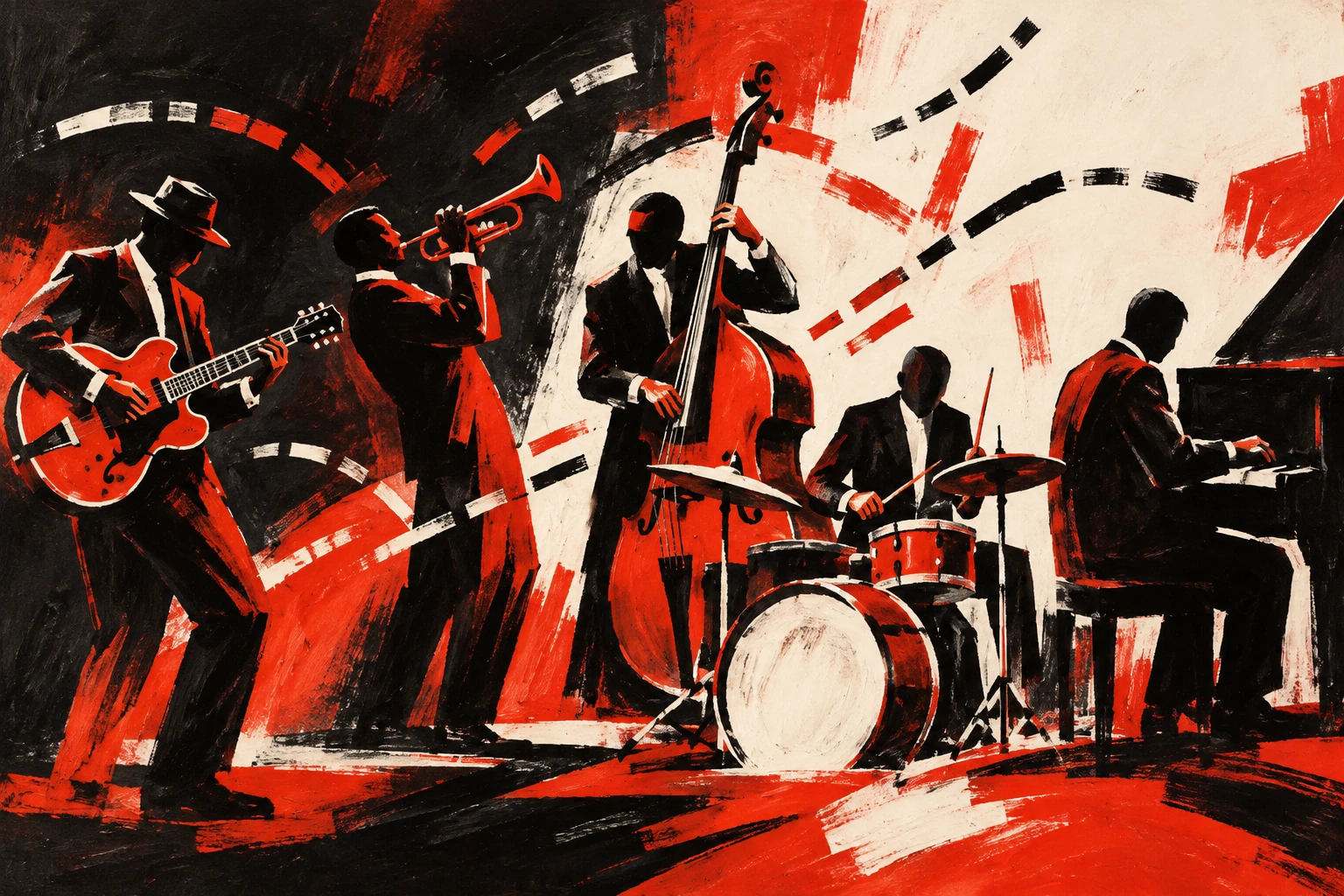
A fictional small swing ensemble, guitar, trumpet, bass, piano and drums, drawn as concise shapes with interrupted brush dashes passing between instruments. The rhythmic motif survives a change from dark to bright harmonic planes; musicians have no detailed faces.
An original editorial interpretation of the tune. This is an illustration, not an archival photograph or a documented reconstruction of a recording session.
Original Djangopedia illustration · AI-assisted, 2026
Illustration credits & provenance →Selected performances by notable Gypsy Jazz players and ensembles. Inclusion is editorial and does not imply an objective popularity ranking.
Jimmy Rosenberg and Frank Vignola · Daniel van Eek
2004 · Frank Vignola’s Gypsy Jazz Jam, New York, 2004
Independent guitar performance.
If playback is unavailable, use the source link.
 Jimmy Rosenberg & Frank Vignola - It Don't Mean a Thing(If It Ain't Got That Swing)Jimmy Rosenberg and Frank Vignola · Daniel van Eek2004 · Frank Vignola’s Gypsy Jazz Jam, New York, 2004Independent guitar performance.✓ Featured
 It don`t mean a thing - Duke Ellington in Gypsy Jazz Style (Joscho Stephan Quintett live)Joscho Stephan Quintet · Jazz Club Hannover by Gartenheim2018 · Jazz Club Hannover by Gartenheim, 19 December 2018Live Christmas concert in Gypsy jazz style.Select performance
 Angelo Debarre live à Guitare Village - It Don't Mean A ThingAngelo Debarre, Raangy Debarre and Olivier Hédin · Guitare VillageGuitare Village live performanceThree credited guitarists; spontaneous independent performance.Select performance
 Club Vilnius Hot - It Don't Mean a Thing [Gypsy Jazz]Club Vilnius Hot · HolmsPapparazi, Vilnius, LithuaniaLithuanian Gypsy jazz band; source warns of modest video quality.Select performance
Play the head’s rhythm on a single pitch, then assign chord tones to it. Carry the same rhythmic identity through one complete improvised chorus.
Use a firm but light swing pulse. Keep the approach to B♭ uncluttered so the change in mode sounds deliberate.
Start at 110–130; build toward 170–210 bpm
Play the head’s rhythm on a single pitch, then assign chord tones to it. Carry the same rhythmic identity through one complete improvised chorus.
Start below the suggested tempo. First hear four quarter-note clicks, then halve the click rate and place clicks on beats 2 and 4. Keep the same phrase length.
It Don't Mean A Thing.. — G minor / relative B♭ major; 32 bars, AABA. Agree the tempo, pickup, solo order and ending before the count.
Agree which major/minor ending is used and keep the tempo stable through energetic solos.
Use short chord punches as answers to the melody; keep a steady bass landmark underneath.
Agree which major/minor ending is used and keep the tempo stable through energetic solos.
Choose the singer’s comfortable key, then transpose the whole arrangement, including the introduction. Use the original lyric phrasing to shape breathing.
This player guide combines inherited recording evidence and editorial study notes. Musical study notes are editorial suggestions; compare them with the recording.
Composition background and credits ↗
Study Gypsy Jazz — backing track ↗
Feature photograph — Gypsy Jazz UK historical archive ↗
Original Djangopedia illustration · AI-assisted, 2026
An original editorial interpretation of the tune. This is an illustration, not an archival photograph or a documented reconstruction of a recording session.
Generated with the native image-generation tool on 2026-10-08; original editorial artwork, not a historical photograph.
Prompt: Use case: illustration-story. One original editorial feature illustration for Djangopedia's guide “It Don't Mean A Thing..”. Landscape 1536 × 1024, opaque background. Scene: A fictional small swing ensemble, guitar, trumpet, bass, piano and drums, drawn as concise shapes with interrupted brush dashes passing between instruments. The rhythmic motif survives a change from dark to bright harmonic planes; musicians have no detailed faces. Musical basis from the guide: A compact Ellington theme balances minor-key drive with bright major arrivals. Its rhythmic identity matters as much as the changes: the head should still be recognisable when played with only a few notes. The supplied chart is G minor / relative B♭ major; form: 32 bars, AABA; feel: Swing. These describe musical inspiration, not visible writing. Historical context: Ellington composed the music in 1931; the first recording followed in 1932, with lyrics credited to Irving Mills. The inherited Django entry is dated 21 October 1935. This guide studies the song as a swing vehicle rather than treating its title as permission to rush. Do not illustrate disputed historical claims or suggest this imagined scene is an archival session. Medium: expressionistic brushwork. Dominant palette: vermilion black and white. Composition: explosive syncopated cross-rhythm. Human presence: five small figures. Strong intentional design, clearly drawn/painted, distinctive material marks; keep essential subject safely within the central 70 percent width and middle 80 percent height for card crops. Maintain enough visual substance at thumbnail size. Broad inspiration observed in old photo, ONLY scale/rhythm and never a reference image: single profile; hand activity; open light wall. Independently invent every pose, perspective, clothing, setting and lighting. Avoid: No portrait painter, art easel, repeated acoustic quintet layout. No photorealism, archival simulation, generated text, letters, numbers, labels, fake musical notation, logo, signature, watermark, fake dates, yellowed-paper patina, recognizable artwork or copied photograph. No imitation of any named artist. Render the art edge to edge without borders, mockup or typography. Batch A diversity compensation: avoid blue sky, drifting clouds, cypress trees, moon discs, generic Paris landmarks and curving terrace backdrops unless explicitly essential to the stated scene. Keep this composition tied to its precise stated subject; do not add an unrequested landscape or city. For figure scenes keep the specified standing/walking pose; no seated centered guitar portrait. For abstracts keep purely graphic materials and forms.
Photograph rights are documented separately in its credit. They do not establish the rights status of the composition or recording.