
Tune details
Music: Phil Boutelje, Dick Winfree
Published / composed: 1922
Original key: Not established
Study level: Intermediate to advanced
 Djangopedia
A fast-moving swing vehicle with a generous tonic opening and a bridge in a contrasting major key. The main challenge is keeping the head’s lightness while changing the tonal vocabulary precisely.
Make the A♭ bridge sound like a new centre without losing the pulse.
Owner content reviewed — 2026-10-06T18:35:31Z by admin. Coverage measures presence, not accuracy. Content review does not certify rights or musical perfection.
Django recordings for this tune. Uploader dates and take labels remain source claims; only an evidenced exact association enables a row’s Listen control.
Uploader identifies this as Django Reinhardt’s performance; recording date and take require comparison with the discography.
| Entry | Year | Recording / session / release evidence | Listen |
|---|---|---|---|
| 01 | 1935 | China Boy,2081-HPP ,"Fremeaux FA 304, Classics 708, JSP 344, Rhapsody RHCD6, Conifer CDHD206, Gitanes 159 853-2","21/10/35 - Stephane Grappely's Hot Four - Grappelly (v), Django & Joseph Reinhardt, Pierre Ferret (g), Tony Rovira (b)" | — |
A dash means no video has been associated with this exact historical recording. Tune-level listening resources remain available above.
Phil Boutelje and Dick Winfree wrote China Boy in 1922. The legacy Django entry dates from 21 October 1935 under Stéphane Grappelli’s Hot Four designation. Its long life as a jazz instrumental follows an earlier popular-song setting.
Music: Phil Boutelje, Dick Winfree
Published / composed: 1922
Original key: Not established
Study level: Intermediate to advanced
Listening task: Learn the head’s rhythmic groups slowly before connecting them. Count the head before comparing solo choruses.
China Boy,2081-HPP ,"Fremeaux FA 304, Classics 708, JSP 344, Rhapsody RHCD6, Conifer CDHD206, Gitanes 159 853-2","21/10/35 - Stephane Grappely's Hot Four - Grappelly (v), Django & Joseph Reinhardt, Pierre Ferret (g), Tony Rovira (b)"
Count its form and check its key before joining in. The A material starts in F, then D7 and G7 move the ear away from home. B♭ minor and C7 reconnect to F. The bridge alternates A♭ and E♭7 before C7 returns to the final A.
The A material starts in F, then D7 and G7 move the ear away from home. B♭ minor and C7 reconnect to F. The bridge alternates A♭ and E♭7 before C7 returns to the final A.
Chord symbols follow the inherited Djangopedia chart. Slashes are rhythmic marks; chord quality and turnaround choices may differ from the backing track. This is a chord reference, not a melody transcription.
[[Image:Chinaboy.gif]]


| F/// | F/// | F/// | F/// | F/// | F/// | D7/// | D7/// |

| G7/// | G7/// | G7/// | G7/// | Bbm/// | G0/ C7/ | F/// | Eb7/// |

| Ab/// | Eb7/// | Ab/// | Eb7/// | Ab/// | Eb7/// | Ab/// | C7/// |

| F/// | F/// | F0/// | F0/// | F/// | C7/// | F/// | F/// :||
Original source ↗
Guitare Improvisation · 5:10
Checked 2026-09-20
Highest displayed view count among matching backing-track videos returned by relevance and view-count YouTube searches. Not a complete platform-wide ranking.
Gonzalo Bergara · 2:13
Clément Reboul · 3:43
DC Music School · 5:12
Performed studies, transcriptions, TAB, notation and lessons for studying Django’s solo. Resources are described by their creator; inclusion does not certify note-for-note accuracy.
Know a useful resource — or want to be the first to record Django’s solo for China Boy?
Follow a shared key, a harmonic idea or a familiar form. Keys refer to this site’s chart editions; other recordings may use a different key.
No sufficiently supported harmonic comparison has been added yet.
Showing 8 of 21 matches. Explore the full catalogue →
Showing 8 of 42 matches. Explore the full catalogue →
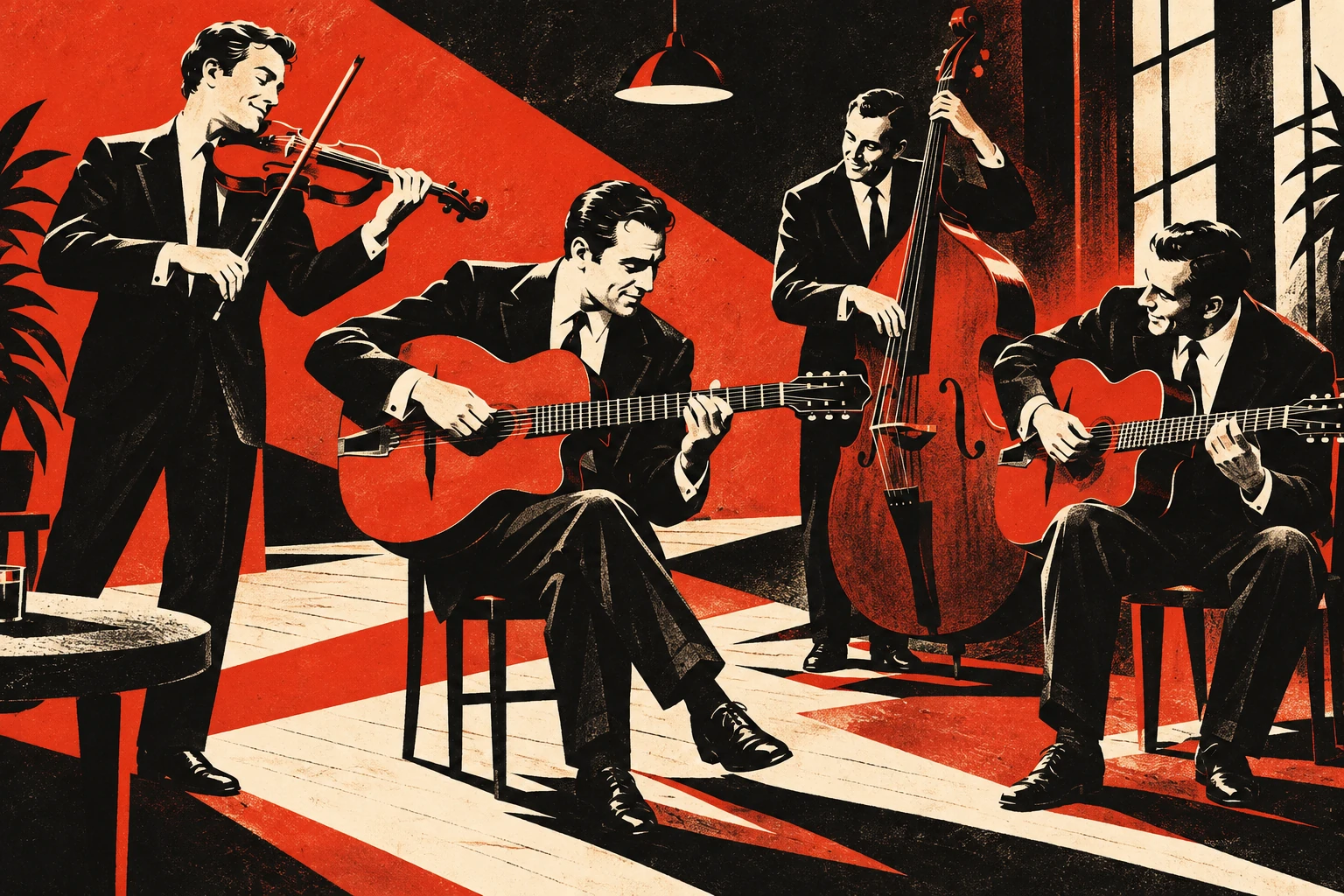
A fictional hot swing quartet, guitar, violin, bass and rhythm guitar, exchanging quick angular phrase shapes over a spacious stable floor; the bridge shifts the whole diagonal into a new zone. This refers to a Hot Four swing setting without reenacting the source photo.
An original editorial interpretation of the tune. This is an illustration, not an archival photograph or a documented reconstruction of a recording session.
Original Djangopedia illustration · AI-assisted, 2026
Illustration credits & provenance →Selected performances by notable Gypsy Jazz players and ensembles. Inclusion is editorial and does not imply an objective popularity ranking.
Romane and Angelo Debarre · Qwest TV
2011 · Europa Jazz Festival, Le Mans; broadcaster description identifies 2011
Stage 4N private performance. Live concert interpretation.
If playback is unavailable, use the source link.
 Romane & Angelo Debarre - China Boy | Live at Django Jazz FestivalRomane and Angelo Debarre · Qwest TV2011 · Europa Jazz Festival, Le Mans; broadcaster description identifies 2011Stage 4N private performance. Live concert interpretation.✓ Featured
 China Boy | feat. Paulus Schäfer | Full Transcription availableJoscho Stephan and Paulus Schäfer · Joscho StephanStudio session with Paulus Schäfer and Volker KampStage 4N private performance. Actual independent performance; optional transcription is of this new performance, not a Django solo.Select performance
 Chinaboy - Live in La Rochelle - Fapy Lafertin Trio + Adrian CoxFapy Lafertin Trio and Adrian Cox · Sebastien Girardot2026 · Forum Georges Pernoud, La Rochelle, 16 January 2026Stage 4N private performance. Artist-channel live quartet with Adrian Cox on clarinet.Select performance
 China Boy (Live)The Rosenberg Trio · The Rosenberg Trio - TopicTribute to Django Reinhardt — Live in SamoisStage 4N private performance. Label-distributed live album audio; 2003 release date not substituted for recording date.Select performance
 Joscho Stephan - China Boy - CAAS 2006Joscho Stephan · TampaFred2006 · CAAS 2006, as identified in uploader titleStage 4N private performance. Short live performance.Select performance
Improvise four bars in F and four in A♭ using the same rhythm. Then practise only the bridge’s final E♭7/A♭ area into C7 and F.
A small tonic grip and relaxed wrist help maintain clarity at speed. State the bridge root clearly, then reduce the urge to fill every gap.
Start at 120–140; build toward 200–260 bpm
Improvise four bars in F and four in A♭ using the same rhythm. Then practise only the bridge’s final E♭7/A♭ area into C7 and F.
Start below the suggested tempo. First hear four quarter-note clicks, then halve the click rate and place clicks on beats 2 and 4. Keep the same phrase length.
China Boy — F major; A♭ major bridge; 32 bars, AABA. Agree the tempo, pickup, solo order and ending before the count.
Agree on bridge key, final-A changes and a realistic starting tempo.
Use sparse bass notes and melody; avoid dense chord changes that interrupt fast articulation.
Agree on bridge key, final-A changes and a realistic starting tempo.
This guide studies an instrumental arrangement. Any later lyric adaptation requires its own credit and chosen key.
This player guide combines inherited recording evidence and editorial study notes. Musical study notes are editorial suggestions; compare them with the recording.
Composition background and credits ↗
Guitare Improvisation — backing track ↗
Feature photograph — Gypsy Jazz UK historical archive ↗
Original Djangopedia illustration · AI-assisted, 2026
An original editorial interpretation of the tune. This is an illustration, not an archival photograph or a documented reconstruction of a recording session.
Generated with the native image-generation tool on 2026-10-08; original editorial artwork, not a historical photograph.
Prompt: Use case: illustration-story. One original editorial feature illustration for Djangopedia's guide “China Boy”. Landscape 1536 × 1024, opaque background. Scene: A fictional hot swing quartet, guitar, violin, bass and rhythm guitar, exchanging quick angular phrase shapes over a spacious stable floor; the bridge shifts the whole diagonal into a new zone. This refers to a Hot Four swing setting without reenacting the source photo. Musical basis from the guide: A fast-moving swing vehicle with a generous tonic opening and a bridge in a contrasting major key. The main challenge is keeping the head’s lightness while changing the tonal vocabulary precisely. The supplied chart is F major; A♭ major bridge; form: 32 bars, AABA; feel: Swing. These describe musical inspiration, not visible writing. Historical context: Phil Boutelje and Dick Winfree wrote China Boy in 1922. The legacy Django entry dates from 21 October 1935 under Stéphane Grappelli’s Hot Four designation. Its long life as a jazz instrumental follows an earlier popular-song setting. Do not illustrate disputed historical claims or suggest this imagined scene is an archival session. Medium: screenprint. Dominant palette: black white and vermilion. Composition: opposing diagonals. Human presence: four medium figures. Strong intentional design, clearly drawn/painted, distinctive material marks; keep essential subject safely within the central 70 percent width and middle 80 percent height for card crops. Maintain enough visual substance at thumbnail size. Broad inspiration observed in old photo, ONLY scale/rhythm and never a reference image: group setting; central guitar; diagonal room depth. Independently invent every pose, perspective, clothing, setting and lighting. Avoid: No imitation of old room, no cultural costumes or caricatures. No photorealism, archival simulation, generated text, letters, numbers, labels, fake musical notation, logo, signature, watermark, fake dates, yellowed-paper patina, recognizable artwork or copied photograph. No imitation of any named artist. Render the art edge to edge without borders, mockup or typography.
Photograph rights are documented separately in its credit. They do not establish the rights status of the composition or recording.