
Tune details
Music: Ford Dabney
Words: Cecil Mack, Lew Brown
Documented in archive: 1936
Original key: Not established
Study level: Intermediate; dominant chains and confident articulation
 Djangopedia
A lively early standard that connects clear two-bar ideas with a succession of dominant resolutions.
Play two bars of melody, then two bars of silence while keeping the form.
Owner content reviewed — 2026-10-18T10:57:13Z by admin. Coverage measures presence, not accuracy. Content review does not certify rights or musical perfection.
Django recordings for this tune. Uploader dates and take labels remain source claims; only an evidenced exact association enables a row’s Listen control.
Django Reinhardt
source-described; accuracy not independently verified
Uploader identifies this as Django Reinhardt’s performance; recording date and take require comparison with the discography.
| Entry | Year | Recording / session / release evidence | Listen |
|---|---|---|---|
| 01 | 1936 | Shine, 15/10/36, OLA 1293-1 ,"Fremeaux FA 305, Classics 739, Affinity AFS 1003, Jazz Time 251270-2, Mosaic MD6-190(6 CD Set).", - Paris - Louis Vola (b) replaces Simoens | — |
A dash means no video has been associated with this exact historical recording. Tune-level listening resources remain available above.
The Library of Congress credits Ford Dabney, Cecil Mack and Lew Brown in its historical recording catalogue. This guide approaches Shine instrumentally and does not reproduce its dated lyrics. The inherited Django row is dated 15 October 1936. A creator-described Django transcription is proposed alongside modern string-band performances, preserving the distinction between a study and a new interpretation.
Music: Ford Dabney
Words: Cecil Mack, Lew Brown
Documented in archive: 1936
Original key: Not established
Study level: Intermediate; dominant chains and confident articulation
Compare the recurring rhythmic idea in Django’s recording with the phrasing of the proposed Joscho/Sandro Roy performance.
Shine, 15/10/36, OLA 1293-1 ,"Fremeaux FA 305, Classics 739, Affinity AFS 1003, Jazz Time 251270-2, Mosaic MD6-190(6 CD Set).", - Paris - Louis Vola (b) replaces Simoens
The opening alternates C and G7. The next phrase moves through E7–Am–D7–G7, giving each dominant time to speak. Near the end, F and F-sharp diminished connect back to C before A7–D7–G7. Hear the whole final cadence as a route home rather than four unrelated chord shapes. Check the video key before playing with the chart.
The opening alternates C and G7. The next phrase moves through E7–Am–D7–G7, giving each dominant time to speak. Near the end, F and F-sharp diminished connect back to C before A7–D7–G7. Hear the whole final cadence as a route home rather than four unrelated chord shapes.
Inherited chart is preserved verbatim as historical study material, not silently corrected or newly authenticated. Check the specific caveats below and match the arrangement and key to the selected video. External teaching material remains on its creator’s site.
[[Image:Shine.gif]]


| C/// | C/// | G7/// | G7/// | C/// | C/// | G7/// | G7/// |

| E7/// | E7/// | Am/// | Am/// | D7/// | D7/// | G7/// | G7/// |

| C/// | C/// | G7/// | G7/// | E7/// | E7/// | Am/// | C7/// |

| F/// | F#0/// | C/// | A7/// | D7/// | G7/// | C/// | C/// :||
Original source ↗
DC Music School
Swing · 160 BPM · 6m30s · Video available when checked; creator-described attribution.
Creator-provided play-along; instrumentation and feel vary by selection. Check the key and full arrangement before joining in; the guide chart may use another key. Tempo is the creator’s stated value.
If playback is unavailable, use the source link.
 Gypsy Jazz / Manouche - Shine 160bpm (Play along / Backing Track )DC Music SchoolSwing · 160 BPM · 6m30s · Video available when checked; creator-described attribution.Creator-provided play-along; instrumentation and feel vary by selection. Check the key and full arrangement before joining in; the guide chart may use another key. Tempo is the creator’s stated value.✓ Featured
 Gypsy Jazz / Manouche - Shine 200bpm (Play along / Backing Track )DC Music SchoolSwing · 200 BPM · 5m12s · Video available when checked; creator-described attribution.Creator-provided play-along; instrumentation and feel vary by selection. Check the key and full arrangement before joining in; the guide chart may use another key. Tempo is the creator’s stated value.Select video
Performed studies, transcriptions, TAB, notation and lessons for studying Django’s solo. Inclusion does not certify note-for-note accuracy.
Дмитрий Кушниров
Video available when checked; creator-described attribution.
Creator-presented transcription of Django’s solo. This is a study aid, not an independent certification of note-for-note accuracy.
If playback is unavailable, use the source link.
Follow a shared key, a harmonic idea or a familiar form. Keys refer to this site’s chart editions; other recordings may use a different key.
No sufficiently supported harmonic comparison has been added yet.
Showing 8 of 30 matches. Explore the full catalogue →
Showing 8 of 26 matches. Explore the full catalogue →
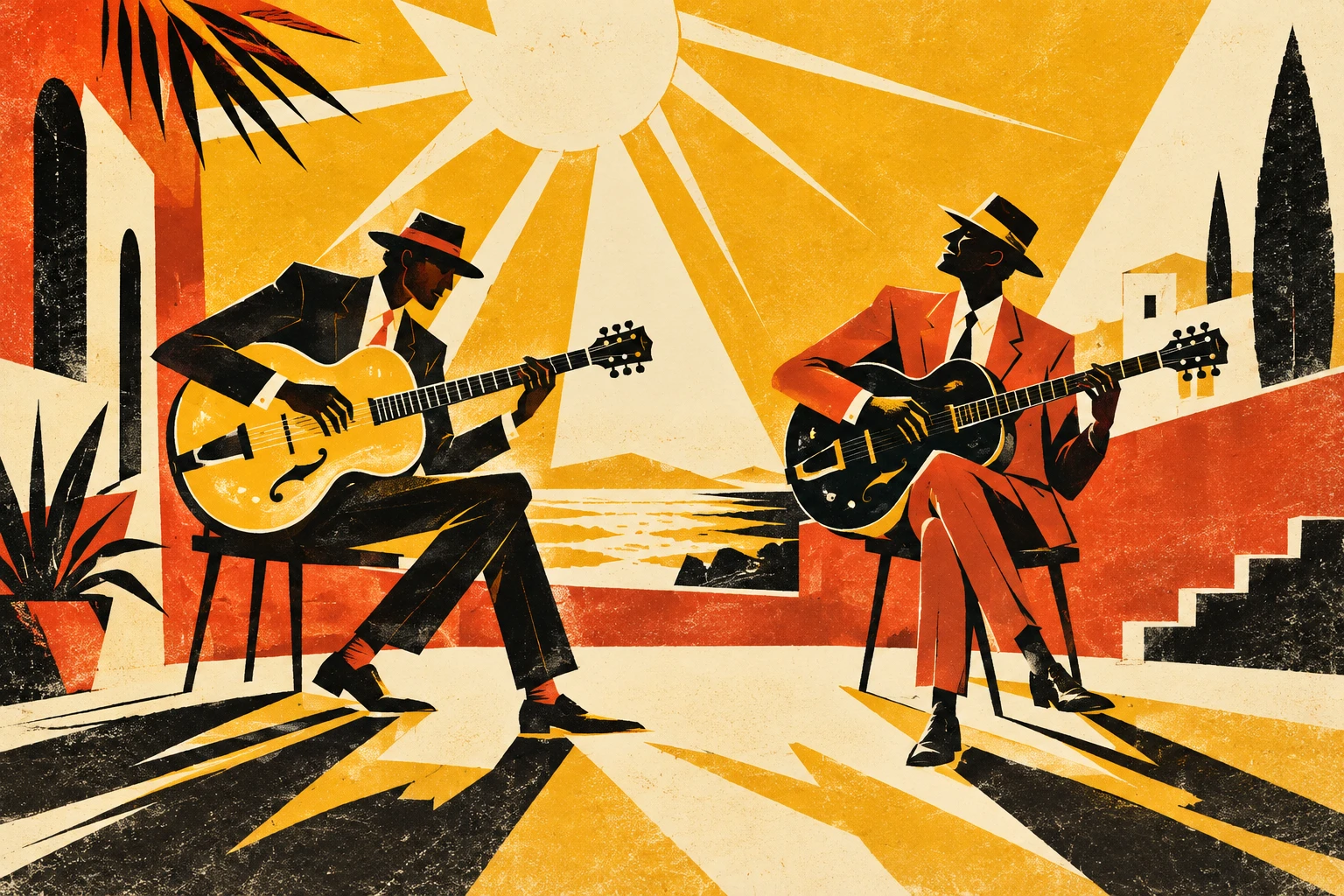
Original serigraph-style illustration for shine
Original AI-assisted editorial artwork inspired by the tune’s mood. It does not depict a documented historical event.
Original AI-assisted illustration created for Djangopedia
Illustration credits & provenance →Selected performances by notable Gypsy Jazz players and ensembles. Inclusion is editorial and does not imply an objective popularity ranking.
Joscho Stephan
Video available when checked; creator-described attribution.
Performer attribution follows the video title and channel description. Proposed listening selection; no popularity ranking implied.
If playback is unavailable, use the source link.
 Shine // Joscho Stephan Trio feat. Sandro RoyJoscho StephanVideo available when checked; creator-described attribution.Performer attribution follows the video title and channel description. Proposed listening selection; no popularity ranking implied.✓ Featured
 Eva Slongo, Sam Farthing, Jimmy Grant, Patrick Harry- Shine (Gypsy Jazz, Jazz Manouche)Jimmy GrantVideo available when checked; creator-described attribution.Performer attribution follows the video title and channel description. Proposed listening selection; no popularity ranking implied.Select video
Play two bars of melody, then two bars of silence while keeping the form. In the final eight bars, play one guide tone per chord and sing its resolution. Add rhythmic variation only after three clean choruses.
Keep strokes short enough to leave space between beats. The dominant chain should gain direction through voice leading rather than volume.
Begin at 100–120 bpm; proposed tracks 160 and 200 bpm
Play two bars of melody, then two bars of silence while keeping the form. In the final eight bars, play one guide tone per chord and sing its resolution. Add rhythmic variation only after three clean choruses.
Count quarter notes first. Then place the click on beats 2 and 4 at half the click rate, keeping the phrase length unchanged.
C major (inherited chart); 32-bar refrain in four eight-bar phrases. Agree the arrangement, pickup and ending before counting in.
The four eight-bar phrases do not all share the same ending. Learn the final cadence separately.
Keep the melody uppermost and begin with a single bass note under each harmony. Move compact third-and-seventh shells through A7, D7 and G7; avoid jumping to a new full barre chord for every change.
Keep strokes short enough to leave space between beats. The dominant chain should gain direction through voice leading rather than volume.
Choose a comfortable singing key and transpose the accompaniment as a whole; lyrics are not reproduced here.
This player guide combines inherited recording evidence and editorial study notes. Musical study notes are editorial suggestions; compare them with the recording.
Preserved Djangopedia archive ↗
Existing Django listening reference ↗
Original AI-assisted illustration created for Djangopedia
Original AI-assisted editorial artwork inspired by the tune’s mood. It does not depict a documented historical event.
Generated with the native image-generation tool on 2026-10-18; original editorial artwork, not a historical photograph.
Prompt: Create an original horizontal 3:2 editorial serigraph illustration for the jazz tune shine. Two stylized anonymous jazz guitarists exchange a joyful phrase under a radiant angular sun, playful elongated shadows. Mid-century jazz screen-print vocabulary: bold simplified angular silhouettes, asymmetrical negative space, flat limited ink palette of golden yellow, vermilion, black and warm ivory, rough ink edges and subtle paper grain. Crisp graphic shapes, playful restrained mid-century cartoon forms, handmade silk-screen print. No gradients, no photorealism, no lettering, no words, no border. Entirely original composition. Keep heads and instruments fully within the frame.
