
Tune details
Music: Django Reinhardt, Stéphane Grappelli
Documented in archive: 1938
Original key: Not established
Study level: Advanced; chromatic bass and extended form
 Djangopedia
An extended form and a descending bass route make this a rewarding test of harmonic hearing and concentration.
Play the opening bass route alone, then add one upper chord tone.

Owner content reviewed — 2026-10-18T10:57:16Z by admin. Coverage measures presence, not accuracy. Content review does not certify rights or musical perfection.
Django recordings for this tune. Uploader dates and take labels remain source claims; only an evidenced exact association enables a row’s Listen control.
Django Reinhardt
source-described; accuracy not independently verified
Uploader identifies this as Django Reinhardt’s performance; recording date and take require comparison with the discography.
| Entry | Year | Recording / session / release evidence | Listen |
|---|---|---|---|
| 01 | 1938 | Black and White, 31/1/38, DTB 3529-1 ,"Fremeaux 307, JSP 342, Classics 777, Music Memoria 87948"," - London - QHCF - Stephane Grappelly (v), Django Reinhardt, Roger Chaput, Eugene Vees (g), Louis Vola (b)" | — |
A dash means no video has been associated with this exact historical recording. Tune-level listening resources remain available above.
The archive retains a London recording dated 31 January 1938. The existing distributor names Stéphane Grappelli and Jean Reinhardt, Django’s given name, as composers. This guide keeps the original title identity and existing recording intact. The proposed forty-bar study roadmap comes from the inherited chart and should be checked against the specific performance before a jam.
Music: Django Reinhardt, Stéphane Grappelli
Documented in archive: 1938
Original key: Not established
Study level: Advanced; chromatic bass and extended form
Listen for the bass descent at the start and its return later in the form; use those as landmarks through the solo.
Black and White, 31/1/38, DTB 3529-1 ,"Fremeaux 307, JSP 342, Classics 777, Music Memoria 87948"," - London - QHCF - Stephane Grappelly (v), Django Reinhardt, Roger Chaput, Eugene Vees (g), Louis Vola (b)"
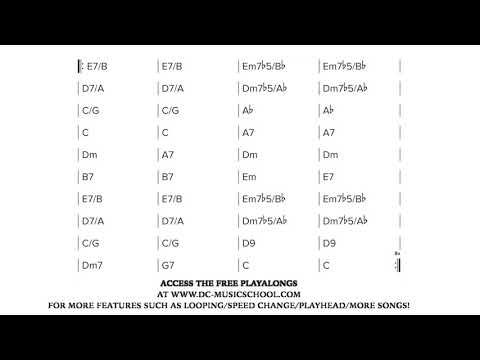
The opening bass descends B–B-flat–A–A-flat under E7, Gm6, D7 and Fm6 colours. The next block reaches C, then moves through A-flat and a chromatic dominant descent toward A7. A middle D-minor/E-minor area separates that passage from the returning opening and final C cadence. Follow the five blocks explicitly; a standard AABA reflex will lose eight bars. Check the video key before playing with the chart.
The opening bass descends B–B-flat–A–A-flat under E7, Gm6, D7 and Fm6 colours. The next block reaches C, then moves through A-flat and a chromatic dominant descent toward A7. A middle D-minor/E-minor area separates that passage from the returning opening and final C cadence. Follow the five blocks explicitly; a standard AABA reflex will lose eight bars.
Inherited chart is preserved verbatim as historical study material, not silently corrected or newly authenticated. Check the specific caveats below and match the arrangement and key to the selected video. External teaching material remains on its creator’s site.
[[Image:Black_white.gif]]


| E7(/B)/// | E7(/B)/// | Gm6(/Bb)/// | Gm6(/Bb)/// | D7(/A)/// | D7(/A)/// | Fm6(/Ab)/// | Fm6(/Ab)/// |

| C(/G)/// | C(/G)/// | Ab/// | Ab/// | C/// | C C7 B7 Bb7 | A7/// | A7/// |

| Dm/// | A7/// | Dm/// | Dm/// | B7/// | B7/// | Em/// | G7/// |

| E7(/B)/// | E7(/B)/// | Gm6(/Bb)/// | Gm6(/Bb)/// | D7(/A)/// | D7(/A)/// | Fm6(/Ab)/// | Fm6(/Ab)/// |

| C/// | C/// | D7/// | D7/// | Dm/// | G7/// | C/// | C/// :||
Original source ↗
DC Music School
Swing · 200 BPM · 6m29s · Video available when checked; creator-described attribution.
Creator-provided play-along; instrumentation and feel vary by selection. Check the key and full arrangement before joining in; the guide chart may use another key. Tempo is the creator’s stated value.
If playback is unavailable, use the source link.
 Gypsy Jazz / Manouche - Black And White 200bpm (Play along / Backing Track )DC Music SchoolSwing · 200 BPM · 6m29s · Video available when checked; creator-described attribution.Creator-provided play-along; instrumentation and feel vary by selection. Check the key and full arrangement before joining in; the guide chart may use another key. Tempo is the creator’s stated value.✓ Featured
 BLACK AND WHITE (200BPM) THE STEPHANE WREMBEL BAND - PLAY ALONG SERIESStephane WrembelSwing · 200 BPM · 3m20s · Video available when checked; creator-described attribution.Creator-provided play-along; instrumentation and feel vary by selection. Check the key and full arrangement before joining in; the guide chart may use another key. Tempo is the creator’s stated value.Select video
Performed studies, transcriptions, TAB, notation and lessons for studying Django’s solo. Inclusion does not certify note-for-note accuracy.
Miguel Mateu Jazz Guitar
Video available when checked; creator-described attribution.
Creator-presented transcription of Django’s solo. This is a study aid, not an independent certification of note-for-note accuracy.
If playback is unavailable, use the source link.
Follow a shared key, a harmonic idea or a familiar form. Keys refer to this site’s chart editions; other recordings may use a different key.
No sufficiently supported harmonic comparison has been added yet.
Showing 8 of 30 matches. Explore the full catalogue →
No match is established in the current chart metadata.
Original serigraph-style illustration for black and white
Original AI-assisted editorial artwork inspired by the tune’s mood. It does not depict a documented historical event.
Original AI-assisted illustration created for Djangopedia
Illustration credits & provenance →Selected performances by notable Gypsy Jazz players and ensembles. Inclusion is editorial and does not imply an objective popularity ranking.
CORDEONE OFFICIAL
Video available when checked; creator-described attribution.
Performer attribution follows the video title and channel description. Proposed listening selection; no popularity ranking implied.
If playback is unavailable, use the source link.
 Black and White (Django Reinhardt) - FADO MÃNOUCHE ORCHESTRACORDEONE OFFICIALVideo available when checked; creator-described attribution.Performer attribution follows the video title and channel description. Proposed listening selection; no popularity ranking implied.✓ Featured
 Gypsy Roots: Black and WhiteJohn ConleyVideo available when checked; creator-described attribution.Performer attribution follows the video title and channel description. Proposed listening selection; no popularity ranking implied.Select video
Play the opening bass route alone, then add one upper chord tone. Label all five eight-bar blocks on a practice sheet. Record a chorus using only two notes per bar and verify every block boundary before adding speed.
Use compact inversions and keep the descending bass deliberate. A rhythm guitarist should agree with the bassist which voice carries the line.
Begin at 90–110 bpm; proposed tracks 200 bpm
Play the opening bass route alone, then add one upper chord tone. Label all five eight-bar blocks on a practice sheet. Record a chorus using only two notes per bar and verify every block boundary before adding speed.
Count quarter notes first. Then place the click on beats 2 and 4 at half the click rate, keeping the phrase length unchanged.
C major (inherited chart); 40-bar study grid in five eight-bar blocks. Agree the arrangement, pickup and ending before counting in.
The inherited study form is forty bars. Do not shorten it to thirty-two simply because many standards use that length.
Keep the melody uppermost and begin with a single bass note under each harmony. Reduce each slash chord to its written bass and two essential upper tones; avoid replacing it with a root-position grip by habit.
Use compact inversions and keep the descending bass deliberate. A rhythm guitarist should agree with the bassist which voice carries the line.
No vocal arrangement is prescribed; use the instrumental melody as the phrasing reference.
This player guide combines inherited recording evidence and editorial study notes. Musical study notes are editorial suggestions; compare them with the recording.
Miguel Mateu — Django transcription ↗
Preserved Djangopedia archive ↗
Existing Django listening reference ↗
Original AI-assisted illustration created for Djangopedia
Original AI-assisted editorial artwork inspired by the tune’s mood. It does not depict a documented historical event.
Generated with the native image-generation tool on 2026-10-18; original editorial artwork, not a historical photograph.
Prompt: Create an original horizontal 3:2 editorial serigraph illustration for the jazz tune black and white. An abstract jazz guitar and piano keys interlock in a bold optical composition, elegant positive and negative silhouettes. Bold simplified mid-century jazz screen-print: asymmetrical negative space, large flat geometric shapes, limited ink palette of black and warm ivory only, slightly irregular ink edges and subtle paper grain. Sophisticated playful graphic artwork. No gradients, no photographic rendering, no text, no border, no copied existing artwork. Keep central subjects inside the frame.
