
Tune details
Music: Cole Porter
Words: Cole Porter
Published / composed / adapted — see history: 1935
Original key: Not established
Study level: Intermediate; advanced where the inherited roadmap needs reconstruction
 Djangopedia
A long-form song that asks players to think in paragraphs. Similar openings lead to different destinations, and the final extension is an essential part of the arrangement.
Know the sequence of sections without looking down.
Owner content reviewed — 2026-10-04T17:05:14Z by admin. Coverage measures presence, not accuracy. Content review does not certify rights or musical perfection.
Django recordings for this tune. Uploader dates and take labels remain source claims; only an evidenced exact association enables a row’s Listen control.
Uploader identifies this as Django Reinhardt’s performance; recording date and take require comparison with the discography.
| Entry | Year | Recording / session / release evidence | Listen |
|---|---|---|---|
| 01 | 1940 | Begin The Beguine, 1/10/40, OSW 129-1,"Fremeaux FA 310, Classics 831, Affinity AFS 1003, Jazz Time 252707-2, Music Memoria 31005, Mosaic MD6-190(6 CD Set)."," - QHCF - Paris - Hubert Rostaing (cl), Django & Joseph (b)Pierre Fouad (d), Josette Dayde (vo)*, Reinhardt(g),Francis Luca," | — |
| 02 | 1940 | Begin The Beguine, OSW 169-1 ,"Fremeaux FA 311, Classics 852", Paris - Pierre Allier Et Son Orchestre featuring Django Reinhardt | — |
| 03 | 1949 | Begin The Beguine, Jan-Feb 1949, BL 109 ,"Fremeaux FA 317, BGO CD 198"," - Rome - Django Reinhardt (g), Stephane Grappelly (v),Gianni Safred (p), Carlo Pecori (b), Aurelio de Carolis (d)." | — |
A dash means no video has been associated with this exact historical recording. Tune-level listening resources remain available above.
Begin The Beguine is credited here to Cole Porter. The source date is 1935; publication, composition and later lyric adaptations may have separate dates. The inherited archive lists 3 recording entries, with dated entries spanning 1940–1949. These are archive rows, not a claim that every entry is a distinct released take. The linked recording rows preserve the original discographical wording. Compare their dates, matrices and personnel when choosing a performance to study.
Music: Cole Porter
Words: Cole Porter
Published / composed / adapted — see history: 1935
Original key: Not established
Study level: Intermediate; advanced where the inherited roadmap needs reconstruction
Listening task: Learn the long melody as connected phrases; do not force it into a repeating AABA expectation. Mark the key, pickup, phrase lengths and ending before comparing another version.
Begin The Beguine, 1/10/40, OSW 129-1,"Fremeaux FA 310, Classics 831, Affinity AFS 1003, Jazz Time 252707-2, Music Memoria 31005, Mosaic MD6-190(6 CD Set)."," - QHCF - Paris - Hubert Rostaing (cl), Django & Joseph (b)Pierre Fouad (d), Josette Dayde (vo)*, Reinhardt(g),Francis Luca,"
Compare the first and last listed entries for tempo, instrumentation and arrangement. Do not infer identical takes from a shared title. Know the sequence of sections without looking down.
Begin The Beguine, Jan-Feb 1949, BL 109 ,"Fremeaux FA 317, BGO CD 198"," - Rome - Django Reinhardt (g), Stephane Grappelly (v),Gianni Safred (p), Carlo Pecori (b), Aurelio de Carolis (d)."
The inherited chart is in C major in the inherited chart. Confirm the backing track’s sounding key, pickup and complete form before playing; an instrument label may describe a transposed score.
C-major statements expand through Dm–G7. Later sections travel through B♭, A♭ and G areas, with minor-subdominant colour and an extended ending.
Section labels, repeats and coda are preserved from the source. The 92 printed cells do not by themselves describe every performed repeat.
[[Image:Begin_beguine.gif]]

Form AABCDD'

A:| C/// | C/// | C/// | C/// | C/// | C/ C#0/ | Dm/// | G7/// |

| Dm/// | Dm/// | Dm/// | Dm/// | Dm/// | G7/// | C/// | Dm/ G7/ |


B: | Cm/// | F7/// | Bb/// | Bb/// | Bbm/// | Eb7/// | Ab/// | Ab/// |

| A0/// | D7(9-)/// | G/// | Ab7/// | G/// | Fm/// | Dm/// | G7/// |


C: | C/// | G7(-9)/// | C/// | G7(9-)/// | C/// | E0/ A7(9-)/ | Dm/// | G7/// |

| Fm6/// | Fm6/// | Fm6/// | Fm6/// | C/// | Em/ Eb0/ | Dm/// | G7/// |


D: | C/// | C/// | C/// | C/// | C/// | Em/ Eb0/ | Dm/// | G7/// |

| F/// | F/// | Em/// | A7/// | Dm/// | G7/// | C/// | G7/// |


D: | C/// | C/// | C/// | C/// | C/// | Em/ Eb0/ | Dm/// | G7/// |

| F/// | F/// | Em/// | A7/// | Dm/// | G7/// | D0/// | G7/// |

| Dm/// | G7/// | C/// | C/// |

Coda:

| Dm/// | Dm/// | Dm/// | G7/// | C/// | Bb7/// | Ab/ Bb7/ | C/// |
Original source ↗
Enric Giralt · 160 BPM · 5:13 · Owner-selected media; guide content review is a separate decision. Video title and channel inspected 2026-10-04.
Owner-selected replacement backing track during Stage 4F. Confirm sounding key and complete form against the chart.
Music Minded, Music Hearted · The inherited chart is in C major in the inherited chart. Confirm the backing track’s sounding key, pickup and complete form before playing; an instrument label may describe a transposed score. · 4:12
Checked 2026-10-01
Most-viewed suitable match selected from the captured search results after title/composition review; not a complete YouTube ranking. Source counts were captured on 1 October 2026. Coaching, unrelated songs and non-backing performances are excluded.
Performed studies, transcriptions, TAB, notation and lessons for studying Django’s solo. Resources are described by their creator; inclusion does not certify note-for-note accuracy.
augusto creni · source-described; accuracy not independently verified
Creator presents a study of Django’s recorded solo. Use it alongside the original recording; exact transcription accuracy has not been independently reviewed.
Checked 2026-10-02
Follow a shared key, a harmonic idea or a familiar form. Keys refer to this site’s chart editions; other recordings may use a different key.
No sufficiently supported harmonic comparison has been added yet.
Showing 8 of 20 matches. Explore the full catalogue →
No match is established in the current chart metadata.
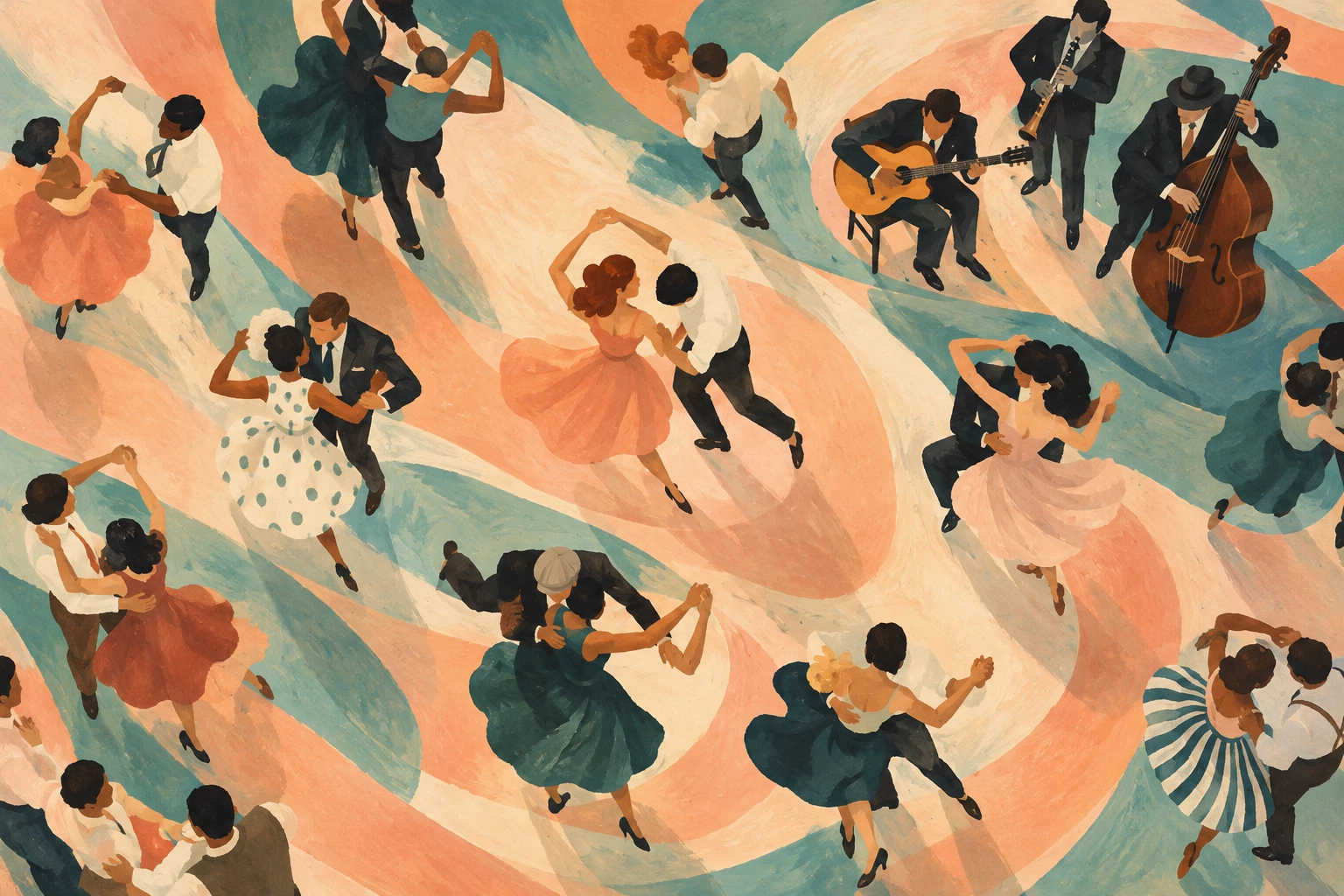
Cole Porter’s 1935 standard has an extended through-composed form; Django entries span 1940–1949. The photograph shows a wide musical group under a large mural, with guitar and bass.
An original editorial interpretation of the tune. This is an illustration, not an archival photograph or a documented reconstruction of a recording session.
Original Djangopedia illustration · AI-assisted, 2026
Illustration credits & provenance →Selected performances by notable Gypsy Jazz players and ensembles. Inclusion is editorial and does not imply an objective popularity ranking.
The Rosenberg Trio · The Rosenberg Trio - Θέμα
1995 · Gipsy Swing — artist release
Instrumental Rosenberg Trio recording issued on Gipsy Swing; year denotes the release.
If playback is unavailable, use the source link.
 Begin The Beguine (Instrumental)The Rosenberg Trio · The Rosenberg Trio - Θέμα1995 · Gipsy Swing — artist releaseInstrumental Rosenberg Trio recording issued on Gipsy Swing; year denotes the release.✓ Featured
 Begin the BeguinePearl Django · PearlDjangoVideosLive studio performanceGypsy jazz quintet performance with guitars, violin, accordion and bass, recorded by David Lange.Select performance
 Begin the beguine. Fapy Lafertin Quartet.Martin Limberger. Playing on dutch TV.1992. Paleis het Loo.Fapy Lafertin Quartet · Gipsy Music1992 · Dutch television — Paleis het LooTelevision performance with Martin Limberger, Simon Planting and Frans van Oosterhout; the source identifies 1992.Select performance
 Begin the BeguineGiacomo Smith and Mozes Rosenberg · Giacomo Smith - Θέμα2025 · Stunt Records — artist releaseClarinet and guitar collaboration released by Stunt Records; year denotes the release.Select performance
 Begin The BeguineYorgui Loeffler, Mike Reinhardt and Samson Schmitt · Yorgui Loeffler - Θέμα2008 · Les Enfants de Django — Live in ParisArtist release from the live Paris album; year denotes the album release.Select performance
Rehearse one labelled section at a time, then only the joins between sections. Write the final extension on a separate line and practise its cue before adding solos.
Reduce density while learning the long form. Give each labelled section a consistent accompaniment texture so the soloist can hear the roadmap.
Start around 100–140 bpm; increase only after the form stays secure
Rehearse one labelled section at a time, then only the joins between sections. Write the final extension on a separate line and practise its cue before adding solos.
Begin with four quarter-note clicks. Halve the click rate and hear beats 2 and 4 while maintaining the same phrase lengths.
Begin The Beguine — C major in the inherited chart; Long through-composed song; source labels AABCDD′ plus coda. Agree the pickup, tempo and ending before counting in.
Long through-composed song; source labels AABCDD′ plus coda. Section labels, repeats and coda are preserved from the source. The 92 printed cells do not by themselves describe every performed repeat.
Start with melody and bass only. Add the following colour without interrupting the melody: Mark each new major destination with its third before filling in passing chords.
Reduce density while learning the long form. Give each labelled section a consistent accompaniment texture so the soloist can hear the roadmap. Agree the full roadmap and signal the last head before it starts.
Choose a comfortable vocal key and transpose the whole arrangement, including its introduction and ending.
Search online videos of "Begin The Beguine" in youtube.com ↗
This player guide combines inherited recording evidence and editorial study notes. Musical study notes are editorial suggestions; compare them with the recording.
Djangopedia — inherited chart and recording rows ↗
Composition credits and background ↗
Music Minded, Music Hearted — practice backing ↗
Feature photograph — source collection ↗
Original Djangopedia illustration · AI-assisted, 2026
An original editorial interpretation of the tune. This is an illustration, not an archival photograph or a documented reconstruction of a recording session.
Generated with the native image-generation tool on 2026-10-08; original editorial artwork, not a historical photograph.
Prompt: Original editorial feature illustration for Begin The Beguine. Hand-painted gouache of an imagined dance-floor pattern seen from above, flowing pairs of simplified dancers circling a small guitar, clarinet and bass ensemble at one edge. The extended, unfolding composition suggests a long song that keeps finding new phrases. Peach, teal and warm cream, soft matte brushwork. Use the old image’s broad group scale only, invent an explicitly conceptual dance illustration rather than any documented venue. Elegant swing movement, generous landscape crop. Original Djangopedia editorial illustration, clearly non-photographic. Do not copy a photograph, known artwork or specific artist. Landscape 1536 by 1024 feature image, important subjects within the middle 75% for responsive hero cropping. No lettering, numbers, musical notation glyphs, logos, signature, watermark, fake archival markings, caption or border. One finished candidate only.
Photograph provenance and rights are stated separately. Attribution does not establish permission.