
Tune details
Music: Gerald Marks, Seymour Simons
Words: Gerald Marks, Seymour Simons
Published / composed: 1931
Original key: B♭ major
Study level: Beginner to intermediate
 Djangopedia
A familiar song whose secondary dominants and minor-subdominant close provide a complete small lesson in swing harmony. A convincing solo follows the tune’s long melodic arcs instead of resetting at every chord.
Hear A→A♭→G through the final major-to-minor turn.
Owner content reviewed — 2026-10-05T18:27:11Z by admin. Coverage measures presence, not accuracy. Content review does not certify rights or musical perfection.
Django recordings for this tune. Uploader dates and take labels remain source claims; only an evidenced exact association enables a row’s Listen control.
Uploader identifies this as Django Reinhardt’s performance; recording date and take require comparison with the discography.
| Entry | Year | Recording / session / release evidence | Listen |
|---|---|---|---|
| 01 | 1940 | All Of Me, 17/12/40, OSW 157-1 ,"Fremeaux FA 310, Classics 852, Affinity AFS 1003, Jazz Time 252707-2, Music Memoria 31005, OR 0062, Mosaic MD6-190(6 CD Set)."," - Paris - QHCF+ - Hubert Rostaing (cl), Alix Combelle (cl,ts) Django & Joseph Reinhardt (g), Tony Rovira (b), Pierre Fouad (d)" | — |
A dash means no video has been associated with this exact historical recording. Tune-level listening resources remain available above.
Gerald Marks and Seymour Simons wrote the song in 1931. The published key is B♭; the archive’s guitar chart is in C. Djangopedia lists Django’s December 1940 recording. This is the jazz standard, not the John Legend song with the same name.
Music: Gerald Marks, Seymour Simons
Words: Gerald Marks, Seymour Simons
Published / composed: 1931
Original key: B♭ major
Study level: Beginner to intermediate
Listening task: Keep the opening descending gesture recognisable. Count the head before comparing solo choruses.
All Of Me, 17/12/40, OSW 157-1 ,"Fremeaux FA 310, Classics 852, Affinity AFS 1003, Jazz Time 252707-2, Music Memoria 31005, OR 0062, Mosaic MD6-190(6 CD Set)."," - Paris - QHCF+ - Hubert Rostaing (cl), Alix Combelle (cl,ts) Django & Joseph Reinhardt (g), Tony Rovira (b), Pierre Fouad (d)"
Count its form and check its key before joining in. In C, E7 and A7 lead the ear toward minor destinations. D7 later becomes Dm–G7. Near the end, F major changes to F minor before Em–A7–Dm–G7 resolves home.
In C, E7 and A7 lead the ear toward minor destinations. D7 later becomes Dm–G7. Near the end, F major changes to F minor before Em–A7–Dm–G7 resolves home.
The source’s final C/Eb/ cell is ambiguous. It is preserved literally; do not assume that it specifies a verified slash chord or two-chord bar.
[[image:all_of_me.gif]]

| C/// | C/// | E7/// | E7/// | A7/// | A7/// | Dm/// | Dm/// |

| E7/// | E7/// | Am/// | Am/// | D7/// | D7/// | Dm/// | G7/// |

| C/// | C/// | E7/// | E7/// | A7/// | A7/// | Dm/// | Dm/// |

| F/// | Fm6/// | Em/// | A7/// | Dm/// | D7/ G7/ | C/Eb/ | Dm/G7/ :||
Original source ↗
Guitare Improvisation · 5:12
Checked 2026-09-20
Highest displayed view count among matching backing-track videos returned by relevance and view-count YouTube searches. Not a complete platform-wide ranking.
Learn Jazz Standards · 6:03
Gonzalo Bergara · 3:11
Guitare Improvisation · 5:19
Performed studies, transcriptions, TAB, notation and lessons for studying Django’s solo. Resources are described by their creator; inclusion does not certify note-for-note accuracy.
Mike Tele Tuck · source-described; accuracy not independently verified
Creator presents a study of Django’s recorded solo. Use it alongside the original recording; exact transcription accuracy has not been independently reviewed.
Checked 2026-10-02
Follow a shared key, a harmonic idea or a familiar form. Keys refer to this site’s chart editions; other recordings may use a different key.
No sufficiently supported harmonic comparison has been added yet.
Showing 8 of 20 matches. Explore the full catalogue →
No match is established in the current chart metadata.
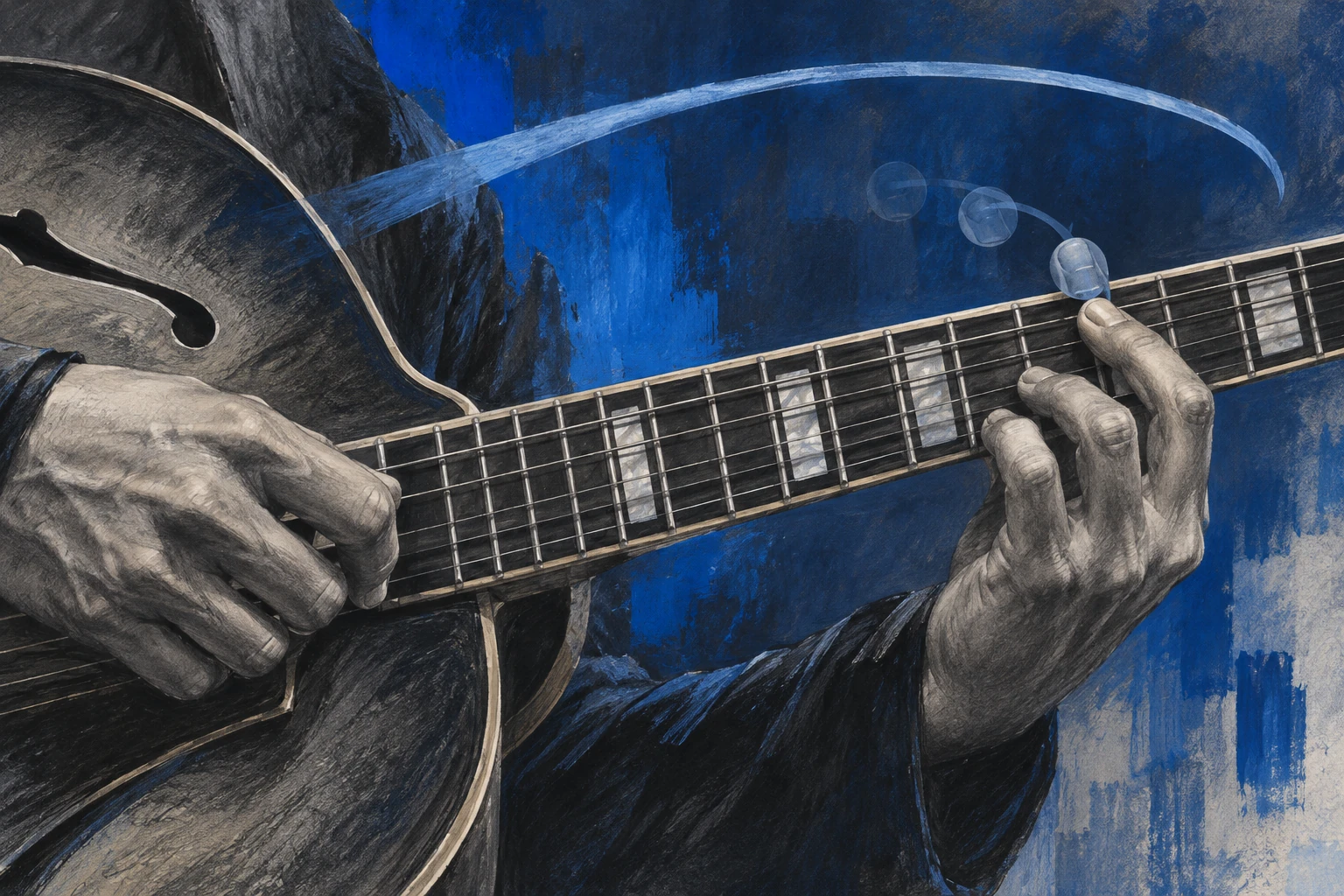
A jazz guitar's fretboard and two gently moving hands, three translucent fingertip traces descending toward one stable string, a single broad arc passing above the neck. The long arc and small semitone descent express the flowing chorus and major-to-minor close; do not draw notation.
An original editorial interpretation of the tune. This is an illustration, not an archival photograph or a documented reconstruction of a recording session.
Original Djangopedia illustration · AI-assisted, 2026
Illustration credits & provenance →Selected performances by notable Gypsy Jazz players and ensembles. Inclusion is editorial and does not imply an objective popularity ranking.
Josh Turner, Gonzalo Bergara and Clipper Anderson · Josh Turner Guitar
Crown Guitar Festival, Bigfork, MT
Guitar duo with credited bassist; live independent interpretation.
If playback is unavailable, use the source link.
 All Of Me (Feat. Gonzalo Bergara)Josh Turner, Gonzalo Bergara and Clipper Anderson · Josh Turner GuitarCrown Guitar Festival, Bigfork, MTGuitar duo with credited bassist; live independent interpretation.✓ Featured
 "All Of Me" (Gypsy jazz/Swing) - Rhythm Future QuartetRhythm Future Quartet · magicfiddleBerklee College of Music, Boston, MAJason Anick, Henry Acker, Bruno Peterson and Greg Loughman are credited.Select performance
 All Of Me (Django Reinhardt / Gypsy Jazz) by Hot Club InternationalHot Club International · Nuno Marinho2025 · Netherlands tour, 2025Source describes the quintet and tour; specific venue for this clip is not established.Select performance
 All Of Me - Jonny Hepbir Quartet - UK & International Jazz Band HireJonny Hepbir Quartet · Jonny Hepbir Trio2010 · Brighton recording session, 2010Independent quartet performance including vocals.Select performance
Play only the changing thirds over E7, A7, D7 and Dm. Then build a two-note line through F–Fm–Em and use it as the climax of one chorus.
Use plain shells first and reserve minor-sixth colour for Fm. Keep the turnaround clean enough for a beginning soloist to hear the top.
Start at 100–120; build toward 160–190 bpm
Play only the changing thirds over E7, A7, D7 and Dm. Then build a two-note line through F–Fm–Em and use it as the climax of one chorus.
Start below the suggested tempo. First hear four quarter-note clicks, then halve the click rate and place clicks on beats 2 and 4. Keep the same phrase length.
All Of Me — C major (this chart); published in B♭ major; 32-bar ABAC chorus; introductory verse usually omitted. Agree the tempo, pickup, solo order and ending before the count.
Confirm C versus B♭ with singers and horn players before starting; the printed original key and jam key differ.
Keep the melody on top and use a descending inner voice for the F–Fm–Em moment.
Confirm C versus B♭ with singers and horn players before starting; the printed original key and jam key differ.
Choose the singer’s comfortable key, then transpose the whole arrangement, including the introduction. Use the original lyric phrasing to shape breathing.
This player guide combines inherited recording evidence and editorial study notes. Musical study notes are editorial suggestions; compare them with the recording.
Composition background and credits ↗
Guitare Improvisation — backing track ↗
Feature photograph — Gypsy Jazz UK historical archive ↗
Original Djangopedia illustration · AI-assisted, 2026
An original editorial interpretation of the tune. This is an illustration, not an archival photograph or a documented reconstruction of a recording session.
Generated with the native image-generation tool on 2026-10-08; original editorial artwork, not a historical photograph.
Prompt: Use case: illustration-story. One original editorial feature illustration for Djangopedia's guide “All Of Me”. Landscape 1536 × 1024, opaque background. Scene: A jazz guitar's fretboard and two gently moving hands, three translucent fingertip traces descending toward one stable string, a single broad arc passing above the neck. The long arc and small semitone descent express the flowing chorus and major-to-minor close; do not draw notation. Musical basis from the guide: A familiar song whose secondary dominants and minor-subdominant close provide a complete small lesson in swing harmony. A convincing solo follows the tune’s long melodic arcs instead of resetting at every chord. The supplied chart is C major (this chart); published in B♭ major; form: 32-bar ABAC chorus; introductory verse usually omitted; feel: Swing. These describe musical inspiration, not visible writing. Historical context: Gerald Marks and Seymour Simons wrote the song in 1931. The published key is B♭; the archive’s guitar chart is in C. Djangopedia lists Django’s December 1940 recording. This is the jazz standard, not the John Legend song with the same name. Do not illustrate disputed historical claims or suggest this imagined scene is an archival session. Medium: graphite with selective gouache. Dominant palette: cool grey and cobalt. Composition: diagonal close detail. Human presence: partial hands. Strong intentional design, clearly drawn/painted, distinctive material marks; keep essential subject safely within the central 70 percent width and middle 80 percent height for card crops. Maintain enough visual substance at thumbnail size. Broad inspiration observed in old photo, ONLY scale/rhythm and never a reference image: small horizontal group; high contrast; conversational rhythm. Independently invent every pose, perspective, clothing, setting and lighting. Avoid: No faces, no trio seated together, no photographic backdrop. No photorealism, archival simulation, generated text, letters, numbers, labels, fake musical notation, logo, signature, watermark, fake dates, yellowed-paper patina, recognizable artwork or copied photograph. No imitation of any named artist. Render the art edge to edge without borders, mockup or typography.
Photograph rights are documented separately in its credit. They do not establish the rights status of the composition or recording.