
Tune details
Music: Django Reinhardt, Stéphane Grappelli
Documented in archive: 1939
Original key: Not established
Study level: Intermediate; crisp articulation at brisk tempo
 Djangopedia
A buoyant Hot Club string-ensemble tune: crisp melodic replies, bright dominant movement and an economical chromatic bridge.
Alternate a two-bar question with a two-bar answer, keeping each phrase under six notes.

Owner content reviewed — 2026-10-15T13:12:29Z by admin. Coverage measures presence, not accuracy. Content review does not certify rights or musical perfection.
Django recordings for this tune. Uploader dates and take labels remain source claims; only an evidenced exact association enables a row’s Listen control.
Django Reinhardt
source-described; accuracy not independently verified
Uploader identifies this as Django Reinhardt’s performance; recording date and take require comparison with the discography.
| Entry | Year | Recording / session / release evidence | Listen |
|---|---|---|---|
| 01 | 1939 | HCQ Strut, 25/8/39, DR 3862-1 ,"Fremeaux FA 309, Classics 813, JSP 342, Verve 516 931-2, Music Memoria 87949, Jazz Archives 157222"," - London - QHCF - Stephane Grappelly (v,p), Django Reinhardt, Joseph Reinhardt, Eugene Vees (g), Emmanuel Soudieux (b), Beryl Davis (vo)" | — |
A dash means no video has been associated with this exact historical recording. Tune-level listening resources remain available above.
H.C.Q. Strut evokes the small-string-ensemble sound of the Hot Club quintet. The archive and Django in June teaching page identify a London recording on 25 August 1939, shortly before the war disrupted the group's work. The inherited row includes session-level personnel text; it should not be read as proof that every listed musician or vocalist is audible on this instrumental. The tune's short gestures invite clean, conversational exchanges between lead instruments.
Music: Django Reinhardt, Stéphane Grappelli
Documented in archive: 1939
Original key: Not established
Study level: Intermediate; crisp articulation at brisk tempo
Notice how the lead phrases leave room for the ensemble's rhythmic response.
HCQ Strut, 25/8/39, DR 3862-1 ,"Fremeaux FA 309, Classics 813, JSP 342, Verve 516 931-2, Music Memoria 87949, Jazz Archives 157222"," - London - QHCF - Stephane Grappelly (v,p), Django Reinhardt, Joseph Reinhardt, Eugene Vees (g), Emmanuel Soudieux (b), Beryl Davis (vo)"
The G-major study chart moves through dominant A7 and D7 before returning to G. Its bridge visits C and a chromatic C♯ diminished connection. Hear the moving voice within those shapes rather than treating the diminished chord as a separate tonal center. Check the video key before playing with the chart.
The G-major study chart moves through dominant A7 and D7 before returning to G. Its bridge visits C and a chromatic C♯ diminished connection. Hear the moving voice within those shapes rather than treating the diminished chord as a separate tonal center.
Inherited chart retained. The new solo resource is explicitly presented by its creator as a transcription; accuracy remains open to owner musical review.
[[Image:Hcq_strut.gif]]

| A7/ D7/ | G/// | A7/ D7/ | G/// | A7/ D7/ | G/ E7/ |A7/ D7/ | G/// |

| A7/ D7/ | G/// | A7/ D7/ | G/// | A7/ D7/ | G/ E7/ |A7/ D7/ | G/// |

| C/// | C#0/// | G/// | G7/// | C/// | C#0/// |G/// | D7/// |

| A7/ D7/ | G/// | A7/ D7/ | G/// | A7/ D7/ | G/ E7/ |A7/ D7/ | G/// :||
Original source ↗
Guitare Improvisation
Swing · 160 BPM · 5m24s · Video available when checked; creator-described attribution.
Creator-described gypsy-jazz play-along. Check the key and full arrangement before joining in; the guide chart may use another key. Tempo is the creator’s stated value.
If playback is unavailable, use the source link.
 HCQ Strut (160 bpm) - Gypsy jazz Backing track / Jazz manoucheGuitare ImprovisationSwing · 160 BPM · 5m24s · Video available when checked; creator-described attribution.Creator-described gypsy-jazz play-along. Check the key and full arrangement before joining in; the guide chart may use another key. Tempo is the creator’s stated value.✓ Featured
 HCQ STRUT (103BPM) THE STEPHANE WREMBEL BAND - PLAY ALONG SERIESStephane WrembelSwing · 103 BPM · 3m24s · Video available when checked; creator-described attribution.Creator-described gypsy-jazz play-along. Check the key and full arrangement before joining in; the guide chart may use another key. Tempo is the creator’s stated value.Select video
Performed studies, transcriptions, TAB, notation and lessons for studying Django’s solo. Inclusion does not certify note-for-note accuracy.
Miguel Mateu Jazz Guitar
Video available when checked; creator-described attribution.
Creator-presented transcription of Django’s solo. This is a study aid, not an independent certification of note-for-note accuracy.
If playback is unavailable, use the source link.
Follow a shared key, a harmonic idea or a familiar form. Keys refer to this site’s chart editions; other recordings may use a different key.
No sufficiently supported harmonic comparison has been added yet.
Showing 8 of 25 matches. Explore the full catalogue →
Showing 8 of 49 matches. Explore the full catalogue →
Original illustration: A violinist, guitarist and double bassist on an Art Deco bandstand.
Original AI-assisted editorial artwork inspired by the tune’s mood. It does not depict a documented historical event.
Original Djangopedia illustration · AI-assisted, 2026
Illustration credits & provenance →Selected performances by notable Gypsy Jazz players and ensembles. Inclusion is editorial and does not imply an objective popularity ranking.
Isabel Smith
Video available when checked; creator-described attribution.
Performer attribution follows the video title and channel description. Proposed listening selection; no popularity ranking implied.
If playback is unavailable, use the source link.
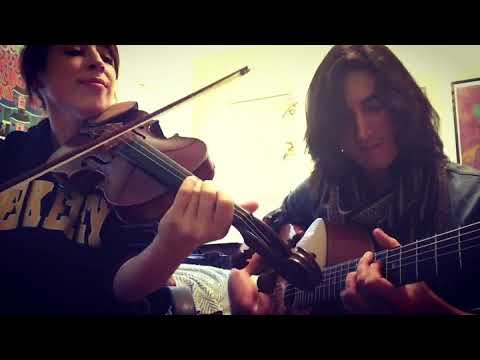 "HCQ Strut" - Isabel Smith and Luca PinoIsabel SmithVideo available when checked; creator-described attribution.Performer attribution follows the video title and channel description. Proposed listening selection; no popularity ranking implied.✓ Featured
 "H.C.Q. STRUT": LE JAZZ HOT at MONTEREY (3.8.20)swingyoucatsVideo available when checked; creator-described attribution.Performer attribution follows the video title and channel description. Proposed listening selection; no popularity ranking implied.Select video
Alternate a two-bar question with a two-bar answer, keeping each phrase under six notes. Then practice the bridge's chromatic inner voice in two positions.
Use short, buoyant quarter notes with enough release for the violin or guitar melody. Avoid adding a heavy accent on every beat at fast tempos.
Start at 100–120; explore 160–200 bpm
Alternate a two-bar question with a two-bar answer, keeping each phrase under six notes. Then practice the bridge's chromatic inner voice in two positions.
Count quarter notes first. Then place the click on beats 2 and 4 at half the click rate, keeping the phrase length unchanged.
G major (inherited chart); 32-bar AABA study form. Agree the arrangement, pickup and ending before counting in.
Mistaking session-level vocal credits for a vocal performance on this track.
Keep the melody uppermost and begin with a single bass note under each harmony. G6: G–B–D–E; C6: C–E–G–A.
Use short, buoyant quarter notes with enough release for the violin or guitar melody. Avoid adding a heavy accent on every beat at fast tempos.
No vocal arrangement is prescribed; use the instrumental melody as the phrasing reference.
This player guide combines inherited recording evidence and editorial study notes. Musical study notes are editorial suggestions; compare them with the recording.
Miguel Mateu — HCQ Strut transcription ↗
Django in June — HCQ Strut teaching edition ↗
Original Djangopedia illustration · AI-assisted, 2026
Original AI-assisted editorial artwork inspired by the tune’s mood. It does not depict a documented historical event.
Generated with the native image-generation tool on 2026-10-15; original editorial artwork, not a historical photograph.
Prompt: Use case: illustration-story. Create one original illustration for a Djangopedia jazz tune guide. High-resolution landscape 3:2, 1536x1024 or larger. Shared collection art direction: original mid-century modern graphic shapes, Art Deco geometry, expressive angular silhouettes, flat color blocks, confident outlines and subtle screenprint grain, imaginary 1930s–1950s atmosphere. Not an imitation of any artist. No text, logos, watermark or historical documentary claims. Keep faces and focal objects within generous crop-safe margins. A jaunty imaginary small string ensemble on an Art Deco bandstand: angular violinist upright, acoustic guitarist at a different angle, double bassist, lively short interlocking shapes like musical replies. Mustard, sage, charcoal, cream. Full instruments and expressive hands. Light playful swagger.
