
Tune details
Music: Django Reinhardt, Stéphane Grappelli
Documented in archive: 1938
Original key: Not established
Study level: Intermediate; advanced where the inherited roadmap needs reconstruction
 Djangopedia
A graceful major-key piece with chromatic bass movement and a long chain of dominants. Its subtlety lies in the way an apparently simple melody floats above those moving lower voices.
Keep the chromatic bass separate from the singing melody.
Owner content reviewed — 2026-10-04T17:06:03Z by admin. Coverage measures presence, not accuracy. Content review does not certify rights or musical perfection.
Django recordings for this tune. Uploader dates and take labels remain source claims; only an evidenced exact association enables a row’s Listen control.
Django Reinhardt
source-described; accuracy not independently verified
Uploader identifies this as Django Reinhardt’s performance; recording date and take require comparison with the discography.
| Entry | Year | Recording / session / release evidence | Listen |
|---|---|---|---|
| 01 | 1938 | Billet Doux, 14/6/38, 4209-1/2HPP ,"Fremeaux FA 308, JSP 343, Classics 777, Conifer HD 206, Rhapsody RHCD6, Music Memoria 87948 (Wrong Matrix-4209-HPP), Gitanes 159 853-2"," - Paris - QHCF - Stepane Grappelly (v), Django Reinhardt (g), Joseph Reinhardt, Eugene Vees (g), Roger Grasset (b)" | — |
| 02 | 1947 | Billet Doux, 22/9/47, "Fremeaux FA 314, Vogue 228E 6007, Vogue 668003-2"," Paris - Souvenirs de Django - Django Reinhardt (elg), Hubert Rostaing (cl), Eugene Vees (g), Emmanuel Soudieux (b), Andre Jourdan (d)" | — |
A dash means no video has been associated with this exact historical recording. Tune-level listening resources remain available above.
Billet Doux is credited here to Django Reinhardt, Stéphane Grappelli. The inherited archive lists 2 recording entries, with dated entries spanning 1938–1947. These are archive rows, not a claim that every entry is a distinct released take. The linked recording rows preserve the original discographical wording. Compare their dates, matrices and personnel when choosing a performance to study.
Music: Django Reinhardt, Stéphane Grappelli
Documented in archive: 1938
Original key: Not established
Study level: Intermediate; advanced where the inherited roadmap needs reconstruction
Listening task: Let the phrase span the chromatic bass motion without adding unintended accents. Mark the key, pickup, phrase lengths and ending before comparing another version.
Billet Doux, 14/6/38, 4209-1/2HPP ,"Fremeaux FA 308, JSP 343, Classics 777, Conifer HD 206, Rhapsody RHCD6, Music Memoria 87948 (Wrong Matrix-4209-HPP), Gitanes 159 853-2"," - Paris - QHCF - Stepane Grappelly (v), Django Reinhardt (g), Joseph Reinhardt, Eugene Vees (g), Roger Grasset (b)"
Compare the first and last listed entries for tempo, instrumentation and arrangement. Do not infer identical takes from a shared title. Keep the chromatic bass separate from the singing melody.
Billet Doux, 22/9/47, "Fremeaux FA 314, Vogue 228E 6007, Vogue 668003-2"," Paris - Souvenirs de Django - Django Reinhardt (elg), Hubert Rostaing (cl), Eugene Vees (g), Emmanuel Soudieux (b), Andre Jourdan (d)"
Count the form and check this arrangement’s key before joining in. The current preferred track is shown in Play along.
G/B descends through B♭ diminished toward Am. E7–A7–D7 creates a longer return route; the final phrase also uses Cm as borrowed minor colour.
The third printed row is short; 31 cells are present overall. Missing duration is left unresolved pending comparison with a chosen score or recording.
[[Image:Billetdoux.gif]]


| G/// | G(/B)/ Bb0/ | Am/ Ab0/ | Am/ D7/ | Am/// | D7/// | G/// | G/// |

| E7/// | E7/// | A7/// | A7/// | A7/// | A7/// | D7/ Db7/ | D7/// |

| G/// | G(/B)/ Bb0/ | Am/ Ab0/ | Am/// | D7/// | B7/// | E7/// |

| Am/// | Cm/// | G/// | E7/// | A7/// | D7/// | G/// | G/// :||
Original source ↗
Guitare Improvisation
140 BPM · 5:44 · Owner-selected media; guide content review is a separate decision. Video title and channel inspected 2026-10-04.
Owner-selected backing track during Stage 4F. Confirm sounding key and complete form against the chart.
If playback is unavailable, use the source link.
Performed studies, transcriptions, TAB, notation and lessons for studying Django’s solo. Inclusion does not certify note-for-note accuracy.
Tessa Spaaij
source-described; accuracy not independently verified
Creator presents a study of Django’s recorded solo. Use it alongside the original recording; exact transcription accuracy has not been independently reviewed.
If playback is unavailable, use the source link.
Follow a shared key, a harmonic idea or a familiar form. Keys refer to this site’s chart editions; other recordings may use a different key.
No sufficiently supported harmonic comparison has been added yet.
Showing 8 of 28 matches. Explore the full catalogue →
No match is established in the current chart metadata.
Django/Grappelli’s G-major swing appears in 1938 and 1947 archive rows; the practice focus separates chromatic bass from singing melody. The photograph shows a group stacked along outdoor steps.
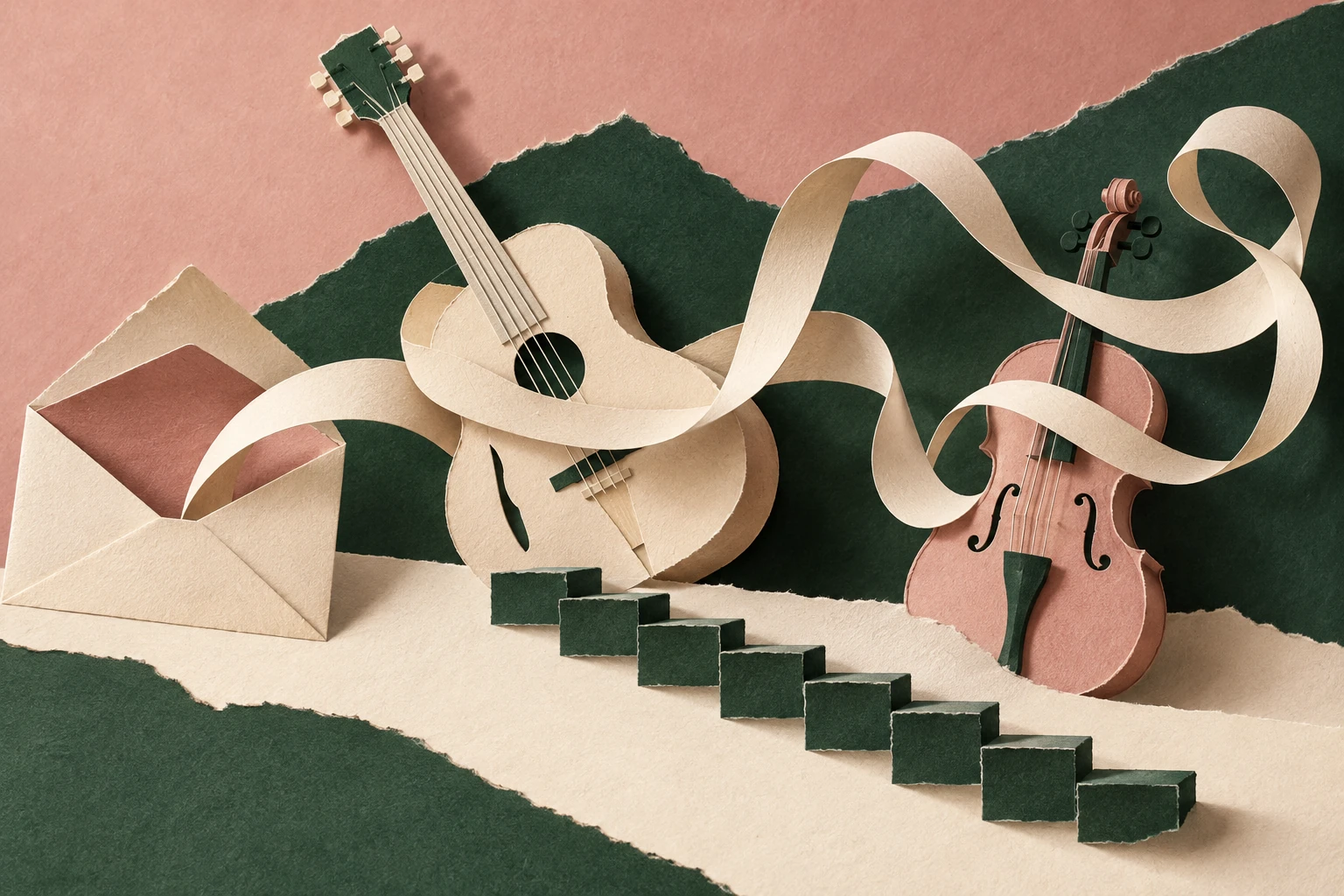
An original editorial interpretation of the tune. This is an illustration, not an archival photograph or a documented reconstruction of a recording session.
Original Djangopedia illustration · AI-assisted, 2026
Illustration credits & provenance →Selected performances by notable Gypsy Jazz players and ensembles. Inclusion is editorial and does not imply an objective popularity ranking.
Adrien Moignard and Selmer #607 · Moignard Adrien
2010 · The Selmer #607 Album · Watch-page identity, tune, performers and Gypsy jazz context checked 2026-10-07; date/session details remain source claims.
Artist release crediting Adrien Moignard, Rocky Gresset, Noé Reinhardt, Sébastien Giniaux and Richard Manetti; year denotes the release.
If playback is unavailable, use the source link.
 Billet DouxAdrien Moignard and Selmer #607 · Moignard Adrien2010 · The Selmer #607 Album · Watch-page identity, tune, performers and Gypsy jazz context checked 2026-10-07; date/session details remain source claims.Artist release crediting Adrien Moignard, Rocky Gresset, Noé Reinhardt, Sébastien Giniaux and Richard Manetti; year denotes the release.✓ Featured
 Billet doux - Tchavolo Schmitt en live à l'atelier JRT LutherieTchavolo Schmitt and Sylvain Prince · JRT LutherieJRT Lutherie workshop concert · Watch-page identity, tune, performers and Gypsy jazz context checked 2026-10-07; date/session details remain source claims.Live workshop performance by Tchavolo Schmitt with Sylvain Prince, published by JRT Lutherie.Select video
 Billet Doux - Jonny Hepbir Trio - Gypsy Swing - Jazz Band Hire UKJonny Hepbir Trio2012 · Brighton recording session · Watch-page identity, tune, performers and Gypsy jazz context checked 2026-10-07; date/session details remain source claims.Trio performance recorded in Brighton in April 2012, as identified by the ensemble.Select video
 Billet Doux Django ReinhardtAdrien Tarraga and Martin · Adrien TarragaGypsy jazz guitar duo · Watch-page identity, tune, performers and Gypsy jazz context checked 2026-10-07; date/session details remain source claims.Informal duo interpretation published by Adrien Tarraga; the description identifies his partner only as Martin.Select video
Rehearse the opening as bass and melody only. Next isolate the closing Am–Cm–G movement and sing a smooth upper line before choosing voicings.
Keep bass inversions connected and the upper voicings light. Do not double every melodic movement with a chord attack.
Start around 100–140 bpm; increase only after the form stays secure
Rehearse the opening as bass and melody only. Next isolate the closing Am–Cm–G movement and sing a smooth upper line before choosing voicings.
Begin with four quarter-note clicks. Halve the click rate and hear beats 2 and 4 while maintaining the same phrase lengths.
Billet Doux — G major; Song form; inherited chart has 31 cells and needs duration review. Agree the pickup, tempo and ending before counting in.
Song form; inherited chart has 31 cells and needs duration review. The third printed row is short; 31 cells are present overall. Missing duration is left unresolved pending comparison with a chosen score or recording.
Start with melody and bass only. Add the following colour without interrupting the melody: Follow B–B♭–A in the opening bass.
Keep bass inversions connected and the upper voicings light. Do not double every melodic movement with a chord attack. Agree the full roadmap and signal the last head before it starts.
This guide focuses on the instrumental arrangement; any lyric adaptation needs separate credit and a chosen key.
This player guide combines inherited recording evidence and editorial study notes. Musical study notes are editorial suggestions; compare them with the recording.
Djangopedia — inherited chart and recording rows ↗
Composition credits and background ↗
Feature photograph — source collection ↗
Original Djangopedia illustration · AI-assisted, 2026
An original editorial interpretation of the tune. This is an illustration, not an archival photograph or a documented reconstruction of a recording session.
Generated with the native image-generation tool on 2026-10-08; original editorial artwork, not a historical photograph.
Prompt: Original editorial feature illustration for Billet Doux. A tactile cut-paper collage: an open unmarked envelope and curling blank paper ribbons become lyrical guitar and violin shapes. A descending staircase of small bass-coloured paper blocks runs below a buoyant melodic ribbon. Pale rose, forest green and cream with visible torn edges and layered shadows. The love-note motif is an editorial interpretation of the title, not a biographical claim. Keep the old photo’s stepped vertical rhythm but build a completely different, mostly object-based horizontal composition. Original Djangopedia editorial illustration, clearly non-photographic. Do not copy a photograph, known artwork or specific artist. Landscape 1536 by 1024 feature image, important subjects within the middle 75% for responsive hero cropping. No lettering, numbers, musical notation glyphs, logos, signature, watermark, fake archival markings, caption or border. One finished candidate only.
Photograph provenance and rights are stated separately. Attribution does not establish permission.

