
Tune details
Music: Sholom Secunda
Words: Jacob Jacobs, Sammy Cahn, Saul Chaplin
Source-attributed publication / composition: 1932
Original key: Not established
Study level: Intermediate; melody, pulse and arrangement awareness
 Djangopedia
A minor-key song for hearing tonic-sixth colour and a bridge that briefly turns C into a dominant.
Sing the melody over C and G bass notes.

Owner content reviewed — 2026-10-19T04:10:05Z by admin. Coverage measures presence, not accuracy. Content review does not certify rights or musical perfection.
Django recordings for this tune. Uploader dates and take labels remain source claims; only an evidenced exact association enables a row’s Listen control.
Django Reinhardt - Topic
Video available when checked; creator-described attribution.
Distributor-supplied Django recording. No exact historical row association is asserted.
| Entry | Year | Recording / session / release evidence | Listen |
|---|---|---|---|
| 01 | 1938 | Bei Mir Bis Du Schon, 30/6/38, Acetate ,Fremeaux 308," - Swing Night in Paris - Valaida Snow (tp&voc), Django Reinhardt (g),Roger Grasset (g)" | — |
A dash means no video has been associated with this exact historical recording. Tune-level listening resources remain available above.
Originally a Yiddish theatre song, it later circulated with English lyrics. The inherited Django row names Valaida Snow; it is not simply another instrumental quintet session. The lyric credits cover different versions, not one jointly written text.
Music: Sholom Secunda
Words: Jacob Jacobs, Sammy Cahn, Saul Chaplin
Source-attributed publication / composition: 1932
Original key: Not established
Study level: Intermediate; melody, pulse and arrangement awareness
A minor-key song for hearing tonic-sixth colour and a bridge that briefly turns C into a dominant.
Bei Mir Bis Du Schon, 30/6/38, Acetate ,Fremeaux 308," - Swing Night in Paris - Valaida Snow (tp&voc), Django Reinhardt (g),Roger Grasset (g)"
Keep C–E-flat–G–A audible in Cm6. The bridge shifts to Fm6 and C7; distinguish that C7 from the home tonic minor. Hear Ab7–G7 as an approach to C minor, not a new tonic. Check the video key before playing with the chart.
Keep C–E-flat–G–A audible in Cm6. The bridge shifts to Fm6 and C7; distinguish that C7 from the home tonic minor. Hear Ab7–G7 as an approach to C minor, not a new tonic.
Inherited chart retained exactly. Harmonic comments refer to this edition; ambiguous symbols are flagged rather than silently corrected.
[[Image:Beimir.gif]]

| Cm6/// | Cm6/// | Cm6/// | Cm6/// | G7/// | G7/// | Cm6/// | Ab7/ G7/ |

| Cm6/// | Cm6/// | Cm6/// | Cm6/// | G7/// | G7/// | Cm6/// | Cm6/// |

| Fm6/// | Fm6/// | C7/// | C7/// | Fm6/// | Fm6/// | C7/// | C7/// |

| Cm6/// | Cm6/// | Cm6/// | Cm6/// | G7/// | G7/// | Cm6/// | Cm6/// |
Original source ↗
Clément Reboul
Swing · 228 BPM · 3m47s · Video available when checked; creator-described attribution.
Creator-provided play-along; instrumentation and feel vary by selection. Check the key and full arrangement before joining in; the guide chart may use another key. Tempo is the creator’s stated value. Creator counts half notes: 114 half notes per minute corresponds to 228 quarter notes per minute.
If playback is unavailable, use the source link.
 Bei Mir Bist Du Schön - Playback jazz manouche - Gypsy jazz backing track / play alongClément ReboulSwing · 228 BPM · 3m47s · Video available when checked; creator-described attribution.Creator-provided play-along; instrumentation and feel vary by selection. Check the key and full arrangement before joining in; the guide chart may use another key. Tempo is the creator’s stated value. Creator counts half notes: 114 half notes per minute corresponds to 228 quarter notes per minute.✓ Featured
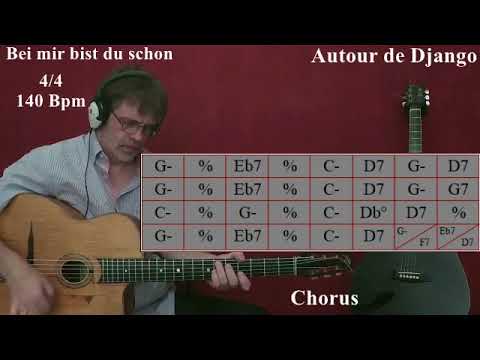 Bei mir bist du schon / Sholom Secunda / Playback Jazz ManoucheAutour de Django Reinhardt4m42s · Video available when checked; creator-described attribution.Creator-provided play-along; instrumentation and feel vary by selection. Check the key and full arrangement before joining in; the guide chart may use another key.Select video
Performed studies, transcriptions, TAB, notation and lessons for studying Django’s solo. Inclusion does not certify note-for-note accuracy.
No Django solo study aid yet. Know a useful resource — or want to record a study of this solo?
Follow a shared key, a harmonic idea or a familiar form. Keys refer to this site’s chart editions; other recordings may use a different key.
No sufficiently supported harmonic comparison has been added yet.
No match is established in the current chart metadata.
Showing 8 of 85 matches. Explore the full catalogue →
Two elegant dancers trade angular steps while a clarinet and archtop guitar form a small band behind them; the dance floor is made of broad alternating rectangles.
Original AI-assisted editorial artwork inspired by the tune’s mood. It does not depict a documented historical event.
Original AI-assisted illustration created for Djangopedia
Illustration credits & provenance →Selected performances by notable Gypsy Jazz players and ensembles. Inclusion is editorial and does not imply an objective popularity ranking.
Marion & Sobo Band
Video available when checked; creator-described attribution.
Performer attribution follows the video title and channel description. Proposed listening selection; no popularity ranking implied.
If playback is unavailable, use the source link.
 "Bei mir bistu shein" - MARION & SOBO BAND (feat. Joscho Stephan)Marion & Sobo BandVideo available when checked; creator-described attribution.Performer attribution follows the video title and channel description. Proposed listening selection; no popularity ranking implied.✓ Featured
 Bei Mir Bist Du Schön - Joscho Stephan & friends , just amazing & beautifulJazz Club Hannover by GartenheimVideo available when checked; creator-described attribution.Performer attribution follows the video title and channel description. Proposed listening selection; no popularity ranking implied.Select video
 Bei mir bist du schön - Aurore / Philippe / H2R - Quintette jazz manoucheClément ReboulVideo available when checked; creator-described attribution.Performer attribution follows the video title and channel description. Proposed listening selection; no popularity ranking implied.Select video
Sing the melody over C and G bass notes. Then loop the bridge using only the thirds A-flat and E over Fm6 and C7; return to the opening without changing tempo.
Use short minor-sixth grips and let the bridge change of colour speak through its inner voice. Avoid making the dominant louder than the melody.
Melody/fakebook TAB aid. Not identified as a Django solo transcription.
80–120 bpm, then increase gradually
Sing the melody over C and G bass notes. Then loop the bridge using only the thirds A-flat and E over Fm6 and C7; return to the opening without changing tempo.
Count quarter notes first. Then place the click on beats 2 and 4 at half the click rate, keeping the phrase length unchanged.
Cm; 32-bar AABA in the inherited chart. Agree the arrangement, pickup and ending before counting in.
Bei Mir Bistu Shein and Bei Mir Bist Du Schön are title variants; agree the lyric or instrumental arrangement before counting in.
Keep the melody uppermost and begin with a single bass note under each harmony. Use short minor-sixth grips and let the bridge change of colour speak through its inner voice. Avoid making the dominant louder than the melody.
Use short minor-sixth grips and let the bridge change of colour speak through its inner voice. Avoid making the dominant louder than the melody.
Choose a comfortable singing key and transpose the accompaniment as a whole; lyrics are not reproduced here.
This player guide combines inherited recording evidence and editorial study notes. Musical study notes are editorial suggestions; compare them with the recording.
Reissue publisher discography and credits ↗
Inherited chart and recording evidence ↗
Library of Congress recording-registry essay ↗
Original AI-assisted illustration created for Djangopedia
Original AI-assisted editorial artwork inspired by the tune’s mood. It does not depict a documented historical event.
Generated with the native image-generation tool on 2026-10-19; original editorial artwork, not a historical photograph.
Prompt: Use case: stylized-concept. Asset: horizontal 1536x1024, 3:2 Djangopedia tune illustration for Bei Mir Bist Du Schön. Original scene: Two elegant dancers trade angular steps while a clarinet and archtop guitar form a small band behind them; the dance floor is made of broad alternating rectangles. Medium: authentic-feeling 1950s silk-screen editorial print, flat separate ink layers, boldly simplified shapes, long expressive angular silhouettes, spare wiry line accents, off-register overlaps, small areas of crosshatching, slight dry ink and paper texture. Strong asymmetric composition with generous negative space; witty and musical, sophisticated rather than children's cartoon. Limited palette: petrol teal, coral red, warm cream and black. All heads and instrument bodies wholly inside frame unless otherwise specified. No letters, words, numbers, captions, borders, logos, watermark, realistic shading, gradients or photographed paper. Invent an entirely new composition, not a reproduction of any existing print. No claim of a documented historical scene.