
Tune details
Music: Django Reinhardt, Stéphane Grappelli
Documented in archive: 1936
Original key: Not established
Study level: Intermediate; vocal-length phrasing and arrangement awareness
 Djangopedia
A swinging question-and-answer study with three historical archive entries and contrasting ensemble settings.
Sing the melody once without playing.

Owner content reviewed — 2026-10-18T10:57:15Z by admin. Coverage measures presence, not accuracy. Content review does not certify rights or musical perfection.
Django recordings for this tune. Uploader dates and take labels remain source claims; only an evidenced exact association enables a row’s Listen control.
Django Reinhardt
source-described; accuracy not independently verified
Uploader identifies this as Django Reinhardt’s performance; recording date and take require comparison with the discography.
| Entry | Year | Recording / session / release evidence | Listen |
|---|---|---|---|
| 01 | 1936 | Are You In The Mood, 4/5/36, OLA 1061-1 ,"Fremeaux FA 305, Affinity AFS 1003, Classics 739, JSP 344, Mosaic MD6-190(6 CD Set).","Paris - QHCF - Stephane Grappelly (v), Django Reinhardt, Joseph Reinhardt, Pierre Ferret (g), Lucien Simoens (b), Freddy Taylor (vo)" | — |
| 02 | 1945 | Are You In The Mood, 6/11/45, OSW 411-1 ,"Fremeaux FA 312, Classics 945", - Paris - Django Reinhardt and his American Swing Band | — |
| 03 | 1945 | Are You In The Mood, 16/12/45, "Fremeaux FA 312, Jass JCD 628, Vogue 228E 6005", - Paris - Django Reinhardt and the A.T.C. Band - Concert - Salle Pleyel | — |
A dash means no video has been associated with this exact historical recording. Tune-level listening resources remain available above.
The archive retains entries dated 4 May 1936, 6 November 1945 and 16 December 1945. The first names Freddy Taylor as vocalist; the later entries identify larger ensembles. The existing listening upload gives different date readings, so this guide does not use its description to overwrite the archive or assign an exact take. Brad Brose’s modern performance credits Reinhardt and Grappelli as composers.
Music: Django Reinhardt, Stéphane Grappelli
Documented in archive: 1936
Original key: Not established
Study level: Intermediate; vocal-length phrasing and arrangement awareness
Compare vocal-length phrases in the earlier setting with the later ensemble approach; identify the start of the solo before transcribing it.
Are You In The Mood, 4/5/36, OLA 1061-1 ,"Fremeaux FA 305, Affinity AFS 1003, Classics 739, JSP 344, Mosaic MD6-190(6 CD Set).","Paris - QHCF - Stephane Grappelly (v), Django Reinhardt, Joseph Reinhardt, Pierre Ferret (g), Lucien Simoens (b), Freddy Taylor (vo)"
No owned readable grid is present. Use Sven Jungbeck’s explicitly labelled G-major play-along as one study setting, while checking its complete form against the melody. First identify tonic arrivals and contrasting phrases by ear; then mark the third and seventh of the actual chords. Do not infer a stock thirty-two-bar sequence solely from the style. Check the video key before playing with the chart.
No owned readable grid is present. Use Sven Jungbeck’s explicitly labelled G-major play-along as one study setting, while checking its complete form against the melody. First identify tonic arrivals and contrasting phrases by ear; then mark the third and seventh of the actual chords. Do not infer a stock thirty-two-bar sequence solely from the style.
Inherited chart is preserved verbatim as historical study material, not silently corrected or newly authenticated. Check the specific caveats below and match the arrangement and key to the selected video. External teaching material remains on its creator’s site.
No readable chord chart has been added for this title.
Sven Jungbeck
Swing · 80 BPM · 4m17s · Video available when checked; creator-described attribution.
Sven Jungbeck: G major, creator-labelled 80 bpm, five choruses, no introduction or outro. Confirm the counted pulse.
If playback is unavailable, use the source link.
Performed studies, transcriptions, TAB, notation and lessons for studying Django’s solo. Inclusion does not certify note-for-note accuracy.
DjangoKOR
source-described; accuracy not independently verified
Creator presents a study of Django’s recorded solo. Use it alongside the original recording; exact transcription accuracy has not been independently reviewed.
If playback is unavailable, use the source link.
Follow a shared key, a harmonic idea or a familiar form. Keys refer to this site’s chart editions; other recordings may use a different key.
No sufficiently supported harmonic comparison has been added yet.
Showing 8 of 28 matches. Explore the full catalogue →
No match is established in the current chart metadata.
Editorial reuse of a verified Gottlieb photograph already in the Djangopedia gallery. This image is not claimed to depict this tune or its recording session.
Part of William P. Gottlieb’s documented Aquarium photographs in New York, circa November 1946. The catalogue supplies the location and approximate date; this is not evidence of a particular tune being played.
Explore this photograph, its context & credits →Selected performances by notable Gypsy Jazz players and ensembles. Inclusion is editorial and does not imply an objective popularity ranking.
Jazz Club Hannover by Gartenheim
Video available when checked; creator-described attribution.
Performer attribution follows the video title and channel description. Proposed listening selection; no popularity ranking implied.
If playback is unavailable, use the source link.
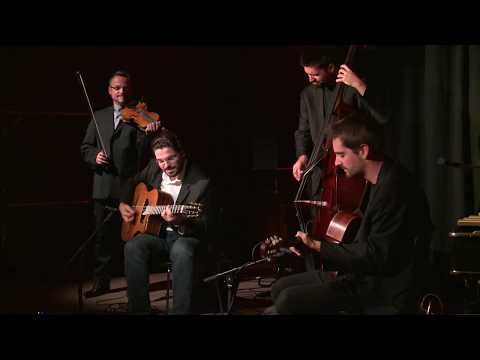 Gypsy-Jazz `Are you in the mood` played by Joscho Stephan & friendsJazz Club Hannover by GartenheimVideo available when checked; creator-described attribution.Performer attribution follows the video title and channel description. Proposed listening selection; no popularity ranking implied.✓ Featured
 Gypsy Jazz Sessions - "Are you in the mood?"Brad BVideo available when checked; creator-described attribution.Performer attribution follows the video title and channel description. Proposed listening selection; no popularity ranking implied.Select video
Sing the melody once without playing. Mark each phrase ending, then play only those landing notes over the backing track. Add a short answer to alternate phrases, keeping the silent phrases exactly in time.
The selected backing has no introduction or outro and five choruses. Agree a count-in and final cue before joining it.
Begin with the creator-labelled 80 bpm play-along; confirm its counted pulse
Sing the melody once without playing. Mark each phrase ending, then play only those landing notes over the backing track. Add a short answer to alternate phrases, keeping the silent phrases exactly in time.
Count quarter notes first. Then place the click on beats 2 and 4 at half the click rate, keeping the phrase length unchanged.
G major (Sven Jungbeck play-along); Confirm the selected recording’s full chorus and introduction. Agree the arrangement, pickup and ending before counting in.
The archive and upload description disagree on some dates. No exact take association is asserted.
Keep the melody uppermost and begin with a single bass note under each harmony. Begin with a G-major shell, then add only chord shapes established by the chosen teaching arrangement.
The selected backing has no introduction or outro and five choruses. Agree a count-in and final cue before joining it.
No vocal arrangement is prescribed; use the instrumental melody as the phrasing reference.
This player guide combines inherited recording evidence and editorial study notes. Musical study notes are editorial suggestions; compare them with the recording.
Preserved Djangopedia archive ↗
Existing Django listening reference ↗
William P. Gottlieb / Library of Congress · Aquarium, New York, N.Y. · circa November 1946
Gottlieb collection photographs entered the public domain on February 16, 2010, according to the source file page.
Photograph source ↗ · Rights details ↗Used to illustrate Django’s life; no connection to this tune’s recording session is claimed.

