
Tune details
Music: Django Reinhardt
Documented in archive: 1944
Original key: Not established
Study level: Intermediate; advanced where the inherited roadmap needs reconstruction
 Djangopedia
A heavy, deliberate riff tune whose bridge descends in dominant steps. Its character comes from leaving the repeated figure space and making the descent sound inevitable.
Make A♭7–G7–C sound like one gesture.
Owner content reviewed — 2026-10-04T10:11:33Z by admin. Coverage measures presence, not accuracy. Content review does not certify rights or musical perfection.
Django recordings for this tune. Uploader dates and take labels remain source claims; only an evidenced exact association enables a row’s Listen control.
Uploader identifies this as Django Reinhardt’s performance; recording date and take require comparison with the discography.
| Entry | Year | Recording / session / release evidence | Listen |
|---|---|---|---|
| 01 | 1944 | Artillerie Lourde, 3/11/44 , 2SW 401-1 ,"Fremeaux FA 312, Classics 945, Jazz Time 799991-2", Paris - Django's Music | — |
| 02 | 1945 | Artillerie Lourde, 25/2/45, Fremeaux FA 312," - Django Reinhardt et son Orchestre (Concert) Alex Renard, Alphonse Marlier, Charles Suire (tpt), Pierre Remy, Maurice Gladieu (tbn), Gerard Leveque (cl), Andre Lamory (sax), Django Reinhardt, Joseph Reinhardt (g), Lucien Simoens (b), Yvan Meyer (d)." | — |
| 03 | 1947 | Artillerie Lourde, 8-13/11/47, "Fremeaux FA 315, Vogue 228E 6007, Vogue 668003-3, Legacy 411"," - Paris - Souvenirs de Django Reinhardt - Django Reinhardt (elg), Gerard Leveque (cl), Eugene Vees (g), Emmanuel Soudieux (b), Andre Jourdan (d)" | — |
| 04 | 1949 | Artillerie Lourde, Jan-Feb 1949, CW 53,"Fremeaux FA 317, RCA ND 70929-2, RCA ND 90448"," - Rome - Django Reinhardt (g), Stephane Grappelly (v),Gianni Safred (p), Carlo Pecori (b), Aurelio de Carolis (d)" | — |
| 05 | 1950 | Artillerie Lourde, 1950, BL104,"BGO CD 198, Jazz Time 827447-2"," - Rome - Django Reinhardt (elg), Andre Ekyan (as,cl), Ralph Schecroun (p), Alf Masselier (b), Roger Paraboschi (d)" | — |
| 06 | 1948 | Artillerie Lourde, Dec 1948, "Vogue 228E 6009, RCA 74321 237692"," - Concert in Brussels - Hubert Rostaing (cl), Django Reinhardt (g), Henri ""Louson"" Baumgartner (g), Louis Vola (b), Arthur Motta (d)" | — |
A dash means no video has been associated with this exact historical recording. Tune-level listening resources remain available above.
Artillerie Lourde is credited here to Django Reinhardt. The inherited archive lists 6 recording entries, with dated entries spanning 1944–1950. These are archive rows, not a claim that every entry is a distinct released take. The inherited archive spans a 1944 entry, a 1945 large-ensemble performance, and later small-group settings through 1950.
Music: Django Reinhardt
Documented in archive: 1944
Original key: Not established
Study level: Intermediate; advanced where the inherited roadmap needs reconstruction
Listening task: Retain the weight of the repeated motif; do not fill every gap with a run. Mark the key, pickup, phrase lengths and ending before comparing another version.
Artillerie Lourde, 3/11/44 , 2SW 401-1 ,"Fremeaux FA 312, Classics 945, Jazz Time 799991-2", Paris - Django's Music
Compare the first and last listed entries for tempo, instrumentation and arrangement. Do not infer identical takes from a shared title. Make A♭7–G7–C sound like one gesture.
Artillerie Lourde, Dec 1948, "Vogue 228E 6009, RCA 74321 237692"," - Concert in Brussels - Hubert Rostaing (cl), Django Reinhardt (g), Henri ""Louson"" Baumgartner (g), Louis Vola (b), Arthur Motta (d)"
The inherited chart is in C major. Confirm the backing track’s sounding key, pickup and complete form before playing; an instrument label may describe a transposed score.
The A sections cycle C–Am7 against A♭7–G7. The bridge moves through C7, B♭7, A♭7 and G7, with additional passing dominants printed between them.
Chord symbols and source cell divisions are preserved from Djangopedia. Slashes mark rhythm; 0 is inherited diminished notation whose exact voicing should be checked against the melody. This is a chord reference, not a melody transcription.
[[Image:Artillerie_lourde.gif]]


| C/ Am7/ | Ab7/ G7/ | C/ Am7/ | Ab7/ G7/ | C/ Am7/ | Ab7/ G7/ | C// G7  | B C // |

| C/ Am7/ | Ab7/ G7/ | C/ Am7/ | Ab7/ G7/ | C/ Am7/ | Ab7/ G7/ | C// G7  | B C // |

| C7/// | C7// B7 | Bb7/// | Bb7// A7 | Ab7/// | Ab7/// | G7/// | G7/// |

| C/ Am7/ | Ab7/ G7/ | C/ Am7/ | Ab7/ G7/ | C/ Am7/ | Ab7/ G7/ | C// G7  | B C// |
Original source ↗
Study Gypsy Jazz · The inherited chart is in C major. Confirm the backing track’s sounding key, pickup and complete form before playing; an instrument label may describe a transposed score. · 3:42
Checked 2026-10-01
Most-viewed suitable match selected from the captured search results after title/composition review; not a complete YouTube ranking. Source counts were captured on 1 October 2026. Coaching, unrelated songs and non-backing performances are excluded.
Performed studies, transcriptions, TAB, notation and lessons for studying Django’s solo. Resources are described by their creator; inclusion does not certify note-for-note accuracy.
DjangoKOR · owner-selected; content approved by owner
Owner-selected for closer solo correspondence and on-screen tablature during guitar performance; exact recording take not independently established.
Checked 2026-10-04
Follow a shared key, a harmonic idea or a familiar form. Keys refer to this site’s chart editions; other recordings may use a different key.
No sufficiently supported harmonic comparison has been added yet.
Showing 8 of 20 matches. Explore the full catalogue →
Showing 8 of 42 matches. Explore the full catalogue →
Django’s C-major riff tune has 1944–1950 archive entries, including a 1945 large ensemble. Its bridge uses connected dominants. The old photo is a formal frontal head portrait, high contrast; use only that graphic clarity.
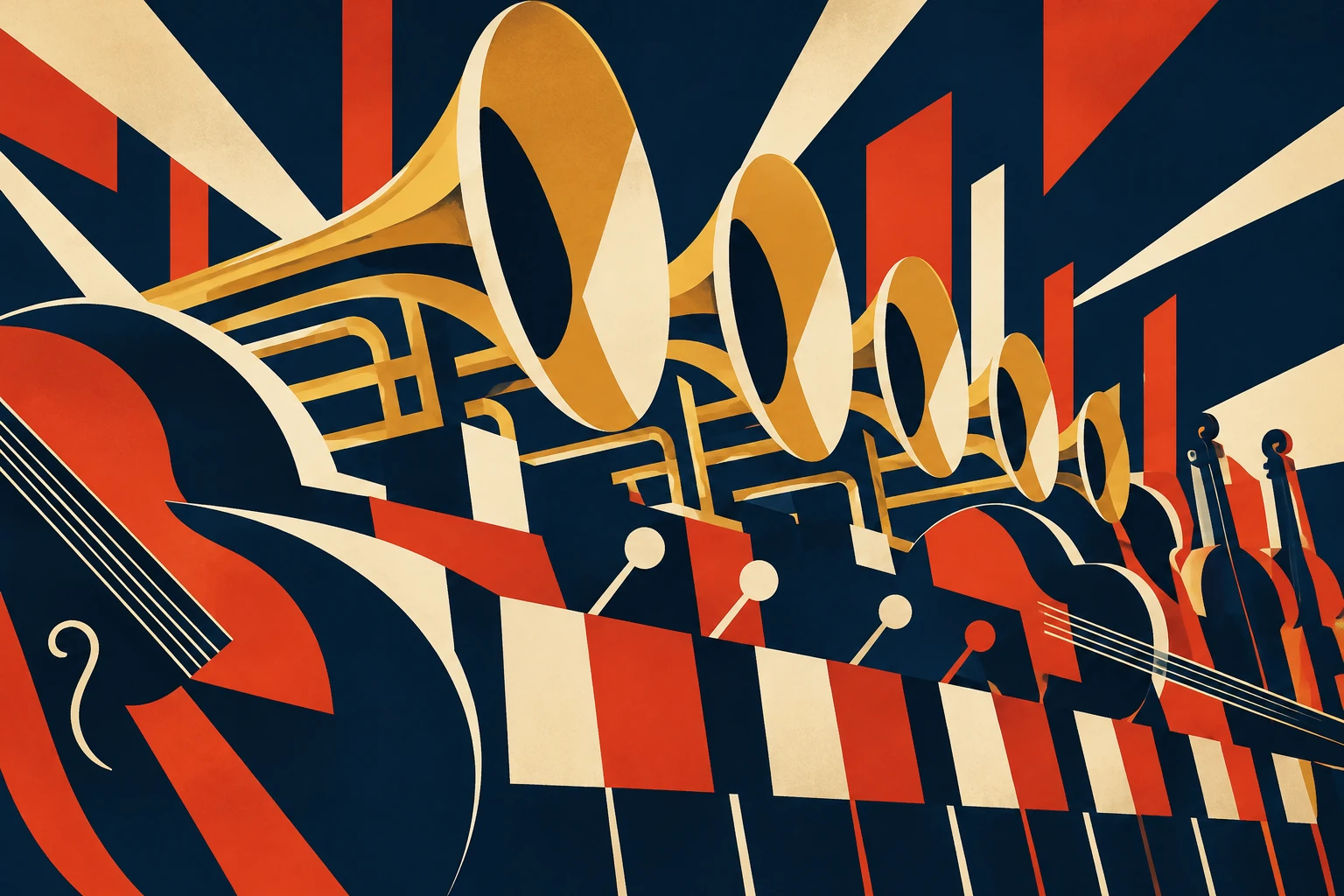
An original editorial interpretation of the tune. This is an illustration, not an archival photograph or a documented reconstruction of a recording session.
Original Djangopedia illustration · AI-assisted, 2026
Illustration credits & provenance →Selected performances by notable Gypsy Jazz players and ensembles. Inclusion is editorial and does not imply an objective popularity ranking.
Joscho Stephan, Sven Jungbeck and Volker Kamp · Joscho Stephan
2020 · Live at King Georg, Cologne
Trio performance recorded in October 2020; theme, guitar and bass solos are identified in the source chapters.
If playback is unavailable, use the source link.
 Artillerie Lourde // Joscho Stephan TrioJoscho Stephan, Sven Jungbeck and Volker Kamp · Joscho Stephan2020 · Live at King Georg, CologneTrio performance recorded in October 2020; theme, guitar and bass solos are identified in the source chapters.✓ Featured
 Artillerie LourdeBiréli Lagrène Gipsy Project · Biréli Lagrène2002 · Gipsy Project & Friends — artist releaseArtist release with Stochelo Rosenberg, Florin Niculescu and the Gipsy Project ensemble; year denotes the album release.Select performance
 Django Reinhardt Original "Artillerie Lourde" // Joscho Stephan TrioJoscho Stephan, Sven Jungbeck and Volker Kamp · Joscho StephanGypsy jazz trioA separate trio arrangement and performance, including bass solo and exchanges; linked teaching material is not this video.Select performance
Loop A♭7–G7–C and sing C–B–C over it. Then play the bridge on two strings, using one sustained guide tone per chord before adding the riff rhythm.
Keep the low pulse firm and the chord attacks short. Use the bridge’s descending roots as the arrangement’s main event.
Start around 100–140 bpm; increase only after the form stays secure
Loop A♭7–G7–C and sing C–B–C over it. Then play the bridge on two strings, using one sustained guide tone per chord before adding the riff rhythm.
Begin with four quarter-note clicks. Halve the click rate and hear beats 2 and 4 while maintaining the same phrase lengths.
Artillerie Lourde — C major; 32 bars, AABA in the inherited chart. Agree the pickup, tempo and ending before counting in.
32 bars, AABA in the inherited chart. Keep the head and solo chorus lengths explicit at the count-in.
Start with melody and bass only. Add the following colour without interrupting the melody: Let the C of A♭7 descend to B over G7.
Keep the low pulse firm and the chord attacks short. Use the bridge’s descending roots as the arrangement’s main event. Agree the full roadmap and signal the last head before it starts.
This guide focuses on the instrumental arrangement; any lyric adaptation needs separate credit and a chosen key.
This player guide combines inherited recording evidence and editorial study notes. Musical study notes are editorial suggestions; compare them with the recording.
Djangopedia — inherited chart and recording rows ↗
Composition credits and background ↗
Study Gypsy Jazz — practice backing ↗
Feature photograph — source collection ↗
Original Djangopedia illustration · AI-assisted, 2026
An original editorial interpretation of the tune. This is an illustration, not an archival photograph or a documented reconstruction of a recording session.
Generated with the native image-generation tool on 2026-10-08; original editorial artwork, not a historical photograph.
Prompt: Original editorial feature illustration for Artillerie Lourde. Original geometric modernist music illustration: a broad formation of abstract brass bells, guitar arcs and pulsing rectangular rhythm blocks, arranged like a powerful ensemble answering a compact riff. Deep navy, vermilion, cream, hard-edged diagonals. Evoke heavy rhythmic drive from the title and documented large-ensemble context. No weapons, battle scene, flags, or fabricated wartime event; no human portrait. Avoid resemblance to an existing poster. Original Djangopedia editorial illustration, clearly non-photographic. Do not copy a photograph, known artwork or specific artist. Landscape 1536 by 1024 feature image, important subjects within the middle 75% for responsive hero cropping. No lettering, numbers, musical notation glyphs, logos, signature, watermark, fake archival markings, caption or border. One finished candidate only.
Photograph provenance and rights are stated separately. Attribution does not establish permission.