
Tune details
Music: Jean Schwartz
Words: William Jerome
Published / composed / adapted — see history: 1910
Original key: Not established
Study level: Intermediate; advanced where the inherited roadmap needs reconstruction
 Djangopedia
A brisk standard that moves from long tonic stretches into dominant chains and a minor-subdominant ending. Its energy comes from rhythmic clarity, not from filling every stable bar.
Build interest while the harmony stays on C.

Owner content reviewed — 2026-10-06T18:35:42Z by admin. Coverage measures presence, not accuracy. Content review does not certify rights or musical perfection.
Django recordings for this tune. Uploader dates and take labels remain source claims; only an evidenced exact association enables a row’s Listen control.
Uploader identifies this as Django Reinhardt’s performance; recording date and take require comparison with the discography.
| Entry | Year | Recording / session / release evidence | Listen |
|---|---|---|---|
| 01 | 1935 | Chinatown, 30/9/35, 2010-HPP ,Unissued," - Stephane Grappely's Hot Four - Grappelly (v), Django & Joseph Reinhardt (g) Pierre Ferret (g), Louis Vola (b)" | — |
| 02 | 1935 | Chinatown, Oct.35, 2037-HPP ,Inissued | — |
A dash means no video has been associated with this exact historical recording. Tune-level listening resources remain available above.
Chinatown is credited here to Jean Schwartz. The source date is 1910; publication, composition and later lyric adaptations may have separate dates. The inherited archive lists 2 recording entries, with dated entries spanning 1935–1935. These are archive rows, not a claim that every entry is a distinct released take. The linked recording rows preserve the original discographical wording. Compare their dates, matrices and personnel when choosing a performance to study.
Music: Jean Schwartz
Words: William Jerome
Published / composed / adapted — see history: 1910
Original key: Not established
Study level: Intermediate; advanced where the inherited roadmap needs reconstruction
Listening task: Learn the quick articulation slowly enough that every pickup remains in time. Mark the key, pickup, phrase lengths and ending before comparing another version.
Chinatown, 30/9/35, 2010-HPP ,Unissued," - Stephane Grappely's Hot Four - Grappelly (v), Django & Joseph Reinhardt (g) Pierre Ferret (g), Louis Vola (b)"
Compare the first and last listed entries for tempo, instrumentation and arrangement. Do not infer identical takes from a shared title. Build interest while the harmony stays on C.
Chinatown, Oct.35, 2037-HPP ,Inissued
The inherited chart is in C major. Confirm the backing track’s sounding key, pickup and complete form before playing; an instrument label may describe a transposed score.
C and G7 establish the opening. E7–Am and D7–G7 add direction; the final phrase uses F–Fm–C before the last dominant route.
Chord symbols and source cell divisions are preserved from Djangopedia. Slashes mark rhythm; 0 is inherited diminished notation whose exact voicing should be checked against the melody. This is a chord reference, not a melody transcription.
| C/// | C/// | C/// | C/// | C/// | C/// | G7/// | G7/// |

| E7/// | E7/// | Am/// | Am/// | D7/// | D7/// | G7/// | G7/// |

| C/// | C/// | C/// | C/// | C/// | C/ A7/ | Dm/// | Dm/// |

| F/// | Fm/// | C/// | A7/// | D7/// | G7/// | C/ A7/ | G7/// :||
Original source ↗
Hot Club de France · 240 BPM · 3:20 · Owner-approved study selection. YouTube identity and player availability checked 6 October 2026; musical accuracy and exact take not independently certified.
Owner selected 6 October 2026. Preferred practice resource; confirm its sounding key and full form before playing.
Backing tracks · 240 BPM · C major · 1:39 · Owner-approved study selection. YouTube identity and player availability checked 6 October 2026; musical accuracy and exact take not independently certified.
Owner selected 6 October 2026. Preferred practice resource; confirm its sounding key and full form before playing.
The Binary Woodshed · The inherited chart is in C major. Confirm the backing track’s sounding key, pickup and complete form before playing; an instrument label may describe a transposed score. · 4:28
Checked 2026-10-01
Most-viewed suitable match selected from the captured search results after title/composition review; not a complete YouTube ranking. Source counts were captured on 1 October 2026. Coaching, unrelated songs and non-backing performances are excluded.
Performed studies, transcriptions, TAB, notation and lessons for studying Django’s solo. Resources are described by their creator; inclusion does not certify note-for-note accuracy.
DjangoKOR · Owner-approved study selection. YouTube identity and player availability checked 6 October 2026; musical accuracy and exact take not independently certified.
Owner selected 6 October 2026. Easy theme demonstration with TAB; not a verified recreation of Django’s improvised solo.
Follow a shared key, a harmonic idea or a familiar form. Keys refer to this site’s chart editions; other recordings may use a different key.
No sufficiently supported harmonic comparison has been added yet.
Showing 8 of 20 matches. Explore the full catalogue →
No match is established in the current chart metadata.
A respectful imagined urban side street of plain shop fronts and fire escapes, sparse abstract rhythmic window blocks leading toward an unexpected side lane then returning. Title location is a generic editorial setting; the long tonic and dominant-chain turn shape the street rhythm.
An original editorial interpretation of the tune. This is an illustration, not an archival photograph or a documented reconstruction of a recording session.
Original Djangopedia illustration · AI-assisted, 2026
Illustration credits & provenance →Selected performances by notable Gypsy Jazz players and ensembles. Inclusion is editorial and does not imply an objective popularity ranking.
Collectif Paris Swing and Giacomo Smith · Edouard Pennes
2017 · Paris studio session, March 2017
Stage 4N private performance. Clarinet, saxophone, piano, guitar and bass; contrasting hot-jazz ensemble.
If playback is unavailable, use the source link.
 Collectif Paris Swing feat. Giacomo Smith // Chinatown my Chinatown // studio sessionCollectif Paris Swing and Giacomo Smith · Edouard Pennes2017 · Paris studio session, March 2017Stage 4N private performance. Clarinet, saxophone, piano, guitar and bass; contrasting hot-jazz ensemble.✓ Featured
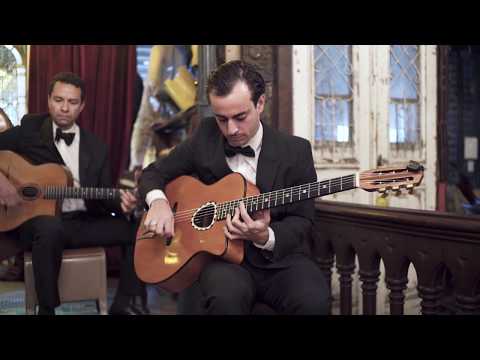 Charlie Roman Hot Club - Chinatown, My ChinatownCharlie Roman Hot Club · Charlie Roman Jazz BandThe Keep, BrooklynStage 4N private performance. Independent Hot Club performance, not a Django solo transcription.Select performance
Limit yourself to a two-note motif during the opening six tonic cells. Save a longer phrase for E7–Am, then leave space before the ending.
Hold a consistent pulse through the long C area. Make the final minor-subdominant colour a phrase event rather than a sudden dynamic accent.
Start around 100–140 bpm; increase only after the form stays secure
Limit yourself to a two-note motif during the opening six tonic cells. Save a longer phrase for E7–Am, then leave space before the ending.
Begin with four quarter-note clicks. Halve the click rate and hear beats 2 and 4 while maintaining the same phrase lengths.
Chinatown — C major; 32 printed bars with a different final phrase. Agree the pickup, tempo and ending before counting in.
32 printed bars with a different final phrase. Keep the head and solo chorus lengths explicit at the count-in.
Start with melody and bass only. Add the following colour without interrupting the melody: Resolve G♯ on E7 into A over Am.
Hold a consistent pulse through the long C area. Make the final minor-subdominant colour a phrase event rather than a sudden dynamic accent. Agree the full roadmap and signal the last head before it starts.
Choose a comfortable vocal key and transpose the whole arrangement, including its introduction and ending.
This player guide combines inherited recording evidence and editorial study notes. Musical study notes are editorial suggestions; compare them with the recording.
Djangopedia — inherited chart and recording rows ↗
Composition credits and background ↗
The Binary Woodshed — practice backing ↗
Feature photograph — source collection ↗
Original Djangopedia illustration · AI-assisted, 2026
An original editorial interpretation of the tune. This is an illustration, not an archival photograph or a documented reconstruction of a recording session.
Generated with the native image-generation tool on 2026-10-08; original editorial artwork, not a historical photograph.
Prompt: Use case: illustration-story. One original editorial feature illustration for Djangopedia's guide “Chinatown”. Landscape 1536 × 1024, opaque background. Scene: A respectful imagined urban side street of plain shop fronts and fire escapes, sparse abstract rhythmic window blocks leading toward an unexpected side lane then returning. Title location is a generic editorial setting; the long tonic and dominant-chain turn shape the street rhythm. Musical basis from the guide: A brisk standard that moves from long tonic stretches into dominant chains and a minor-subdominant ending. Its energy comes from rhythmic clarity, not from filling every stable bar. The supplied chart is C major; form: 32 printed bars with a different final phrase; feel: Swing. These describe musical inspiration, not visible writing. Historical context: Chinatown is credited here to Jean Schwartz. The source date is 1910; publication, composition and later lyric adaptations may have separate dates. Do not illustrate disputed historical claims or suggest this imagined scene is an archival session. Medium: editorial linework with flat colour. Dominant palette: jade and muted brick red. Composition: layered street perspective. Human presence: no close people. Strong intentional design, clearly drawn/painted, distinctive material marks; keep essential subject safely within the central 70 percent width and middle 80 percent height for card crops. Maintain enough visual substance at thumbnail size. Broad inspiration observed in old photo, ONLY scale/rhythm and never a reference image: outdoor vertical enclosure; small pair beside large object. Independently invent every pose, perspective, clothing, setting and lighting. Avoid: No readable signs, stereotype, lantern cliché, caravan copy. No photorealism, archival simulation, generated text, letters, numbers, labels, fake musical notation, logo, signature, watermark, fake dates, yellowed-paper patina, recognizable artwork or copied photograph. No imitation of any named artist. Render the art edge to edge without borders, mockup or typography.
Photograph provenance and rights are stated separately. Attribution does not establish permission.