
Tune details
Music: Django Reinhardt, Stéphane Grappelli
Documented in archive: 1936
Original key: Not established
Study level: Intermediate; advanced where the inherited roadmap needs reconstruction
 Djangopedia
A bright conversation built from short turnarounds. The bridge widens the rhythm section’s view: subdominant colour gives way to a dominant that must soften back into the home-key cadence.
Hear the bridge’s major-to-minor change.
Owner content reviewed — 2026-10-06T15:53:21Z by admin. Coverage measures presence, not accuracy. Content review does not certify rights or musical perfection.
Django recordings for this tune. Uploader dates and take labels remain source claims; only an evidenced exact association enables a row’s Listen control.
Uploader identifies this as Django Reinhardt’s performance; recording date and take require comparison with the discography.
| Entry | Year | Recording / session / release evidence | Listen |
|---|---|---|---|
| 01 | 1936 | Swing Guitars, 15/10/36, OLA 1291-1,"Fremeaux FA 305, Classics 739, Affinity AFS 1003, JSP 344, EMI 780671-2, Jazz Time 251270-2, Mosaic MD6-190(6 CD Set).", - Paris - Louis Vola (b) replaces Simoens | — |
| 02 | 1937 | Swing Guitars, 19/11/37, OLA 1982-1 ,"Fremeaux 306, Affinity AFS 1003, EMI 780671-2"," - Paris - Bill Coleman (tpt), Frank ""Big Boy"" Goudie (cl&ts), Christian Wagner (cl&as), Emil Stern (p), Django Reinhardt (g), Lucien Simoens (b), Jerry Mengo (d)" | — |
| 03 | 1938 | Swing Guitars, 30/6/38, Acetate ,Fremeaux 308, - Swing Night in Paris ? Same personnel | — |
| 04 | 1945 | Swing Guitars, 6/11/45, OSW 409-1 ,"Fremeaux FA 312, Classics 945", - Paris - Django Reinhardt and his American Swing Band | — |
| 05 | 1947 | Swing Guitars, 25/8/47, " Fremeaux FA 314, Vogue 228E 6006, Vogue 668003-2, Vogue 670205, Kardum GLO 139"," - Paris - Souvenirs de Django - Django Reinhardt (g), Maurice Meunier (cl), Eddie Bernard (p), Eugene Vees (g), Emmanuel Soudieux (b), Jacques Martinon (d)" | — |
| 06 | 1947 | Swing Guitars, 21/11/47, "Fremeaux FA 315, Vogue 228E 6008, Vogue 600121", RTF Broadcast | — |
| 07 | 1949 | Swing Guitars, Jan-Feb 1949, CW 60 ,"Fremeaux FA 317, RCA ND 70929-2, Suisa CD 32"," - Rome - Django Reinhardt (g), Stephane Grappelly (v),Gianni Safred (p), Carlo Pecori (b), Aurelio de Carolis (d)." | — |
A dash means no video has been associated with this exact historical recording. Tune-level listening resources remain available above.
Swing Guitars is credited here to Django Reinhardt, Stéphane Grappelli. The inherited archive lists 7 recording entries, with dated entries spanning 1936–1949. These are archive rows, not a claim that every entry is a distinct released take. The old page identifies 15 October 1936 as its first listed session; later rows reach the Rome period. The recording list is a better starting point than unsourced online claims of a 1939 debut.
Music: Django Reinhardt, Stéphane Grappelli
Documented in archive: 1936
Original key: Not established
Study level: Intermediate; advanced where the inherited roadmap needs reconstruction
Listening task: Keep the short answers connected; avoid turning each turnaround into a new beginning. Mark the key, pickup, phrase lengths and ending before comparing another version.
Swing Guitars, 15/10/36, OLA 1291-1,"Fremeaux FA 305, Classics 739, Affinity AFS 1003, JSP 344, EMI 780671-2, Jazz Time 251270-2, Mosaic MD6-190(6 CD Set).", - Paris - Louis Vola (b) replaces Simoens
Compare the first and last listed entries for tempo, instrumentation and arrangement. Do not infer identical takes from a shared title. Hear the bridge’s major-to-minor change.
Swing Guitars, Jan-Feb 1949, CW 60 ,"Fremeaux FA 317, RCA ND 70929-2, Suisa CD 32"," - Rome - Django Reinhardt (g), Stephane Grappelly (v),Gianni Safred (p), Carlo Pecori (b), Aurelio de Carolis (d)."
The inherited chart is in C major. Confirm the backing track’s sounding key, pickup and complete form before playing; an instrument label may describe a transposed score.
C–Am7–Dm7–G7 supplies the recurring home-key loop. C7 points toward F; F♯ diminished connects that area back toward C. The bridge’s D7 changes to Dm7 before G7, so make the major-to-minor third audible.
Chord symbols and source cell divisions are preserved from Djangopedia. Slashes mark rhythm; 0 is inherited diminished notation whose exact voicing should be checked against the melody. This is a chord reference, not a melody transcription.
[[Image:Swing_guitar.gif]]

| C69/ Am7/ | Dm7/ G7/ | C69/ Am7/ | Dm7/ G7/ | C69/ C7/ | F/ F#0/ | Dm7/ G7/ | C69/ G7 |

| C69/ Am7/ | Dm7/ G7/ | C69/ Am7/ | Dm7/ G7/ | C69/ C7/ | F/ F#0/ | Dm7/ G7/ | C69/ G7 |

| F/// | F#0/// | C69/// | C69/// | D7/// | D7/// | Dm7/// | G7/// |

| C69/ Am7/ | Dm7/ G7/ | C69/ Am7/ | Dm7/ G7/ | C69/ C7/ | F/ F#0/ | Dm7/ G7/ | C69/ G7 :||
Original source ↗
DC Music School · The inherited chart is in C major. Confirm the backing track’s sounding key, pickup and complete form before playing; an instrument label may describe a transposed score. · 5:12
Checked 2026-10-01
Most-viewed suitable match selected from the captured search results after title/composition review; not a complete YouTube ranking. Source counts were captured on 1 October 2026. Coaching, unrelated songs and non-backing performances are excluded.
Performed studies, transcriptions, TAB, notation and lessons for studying Django’s solo. Resources are described by their creator; inclusion does not certify note-for-note accuracy.
Nathan Royal · Nathan Royal · Uploader identifies Django Swing Guitars 1947; live guide lists two 1947 recordings, exact one unestablished · 1947 · Guitarist visibly playing; explicit solo-transcription title and playing-along description. Exact 1947 take/session not identified; musical accuracy not independently checked. Checked 2026-10-06; private research candidate, not owner approved. Note-for-note accuracy not independently verified.
Stage 4L — Class A. 74-second performed solo transcription along with record. No TAB visible. Source claim: Uploader identifies Django Swing Guitars 1947; live guide lists two 1947 recordings, exact one unestablished
Follow a shared key, a harmonic idea or a familiar form. Keys refer to this site’s chart editions; other recordings may use a different key.
Showing 8 of 20 matches. Explore the full catalogue →
Showing 8 of 42 matches. Explore the full catalogue →
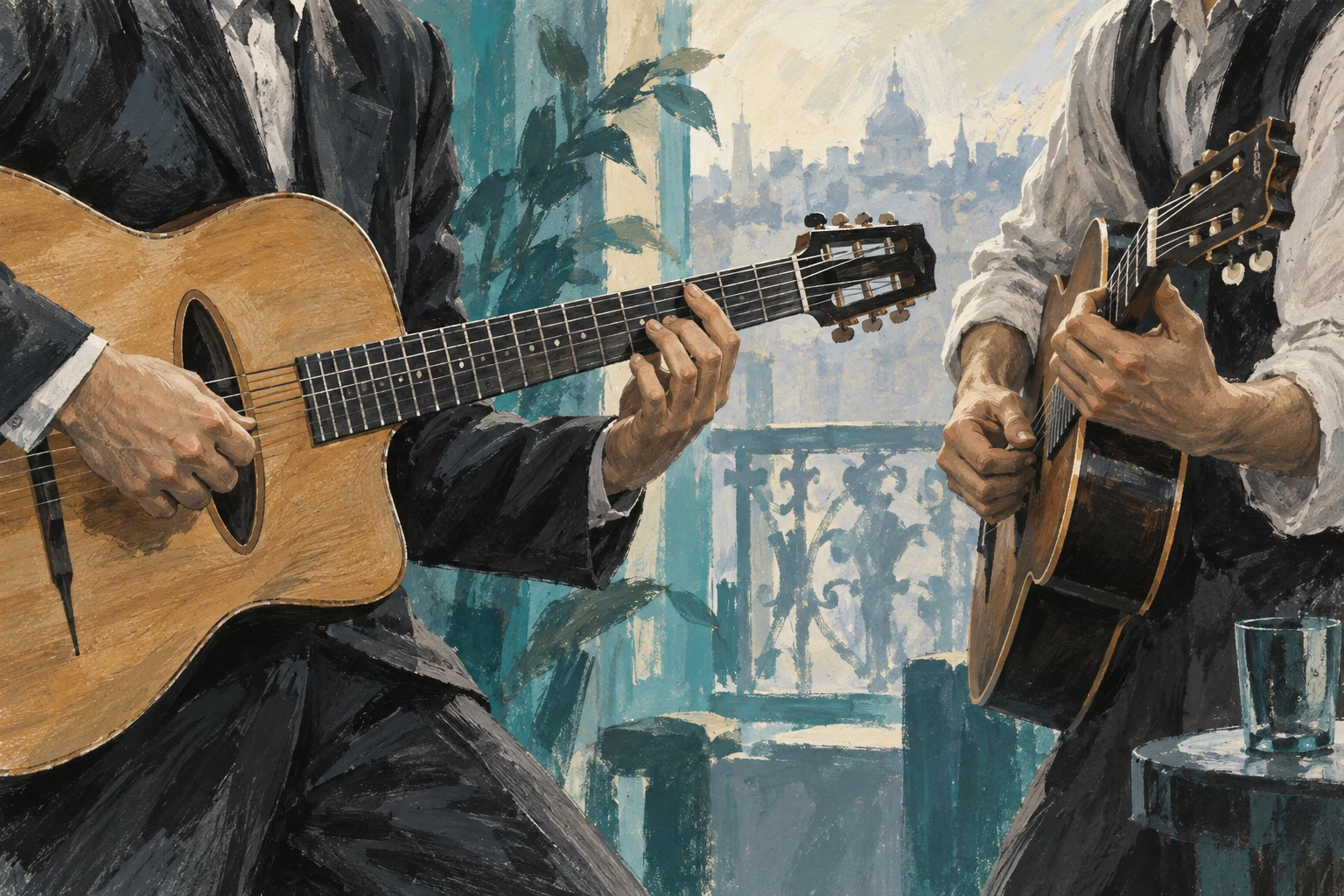
Two guitarists, Django and a fictional rhythm player, are drawn as cropped torsos at different depths; their coherent guitar necks point toward a common open cadence. Bright short turnarounds and conversational exchange supply movement. Keep heads outside the crop by deliberate design.
An original editorial interpretation of the tune. This is an illustration, not an archival photograph or a documented reconstruction of a recording session.
Original Djangopedia illustration · AI-assisted, 2026
Illustration credits & provenance →Selected performances by notable Gypsy Jazz players and ensembles. Inclusion is editorial and does not imply an objective popularity ranking.
The New Hot Club of America · Gonzalo Bergara
Artist-channel album audio
Stage 4M private performance. Artist-channel album audio. Static ensemble photograph; exact performance year unestablished.
If playback is unavailable, use the source link.
 The New Hot Club Of America - Swing GuitarsThe New Hot Club of America · Gonzalo BergaraArtist-channel album audioStage 4M private performance. Artist-channel album audio. Static ensemble photograph; exact performance year unestablished.✓ Featured
 New Hot Club of Zurich - Swing Guitars (2020)New Hot Club of Zurich2020 · Band-channel live performance; title identifies 2020Stage 4M private performance. Band-channel live performance; title identifies 2020. Visible clarinet, guitars and bass.Select performance
 Hot Club of Hungary: Swing guitarsHot Club of Hungary · wedeliLive ensembleStage 4M private performance. Live ensemble. Pál Gáspár, Noémi Flór, Tibor Antal, Gábor Flór and Zoltán Marosi; older low-resolution concert footage.Select performance
 VID 20260117 211903 Swing Guitars (Django Reinhardt)Para Hot Jazz Quartet · George Mineos2026 · HOM’S, Sofia, 17 January 2026Stage 4M private performance. HOM’S, Sofia, 17 January 2026. Vladi Mihailov, Dimitar Blagoev, Boris Iliev and Dimitar Karamfilov; some table obstruction.Select performance
Play one chorus using only thirds and sevenths. In the next, keep the same two-bar rhythm but change its last note for each cadence. Record the D7–Dm7 transition separately.
Use light C6/9 shapes and compact Dm7–G7 pairs. Give the bridge room to grow without increasing the number of strokes.
Start around 100–140 bpm; increase only after the form stays secure
Play one chorus using only thirds and sevenths. In the next, keep the same two-bar rhythm but change its last note for each cadence. Record the D7–Dm7 transition separately.
Begin with four quarter-note clicks. Halve the click rate and hear beats 2 and 4 while maintaining the same phrase lengths.
Swing Guitars — C major; 32 bars, AABA in the inherited chart. Agree the pickup, tempo and ending before counting in.
32 bars, AABA in the inherited chart. Keep the head and solo chorus lengths explicit at the count-in.
Start with melody and bass only. Add the following colour without interrupting the melody: Move F♯ down to F when D7 becomes Dm7.
Use light C6/9 shapes and compact Dm7–G7 pairs. Give the bridge room to grow without increasing the number of strokes. Agree the full roadmap and signal the last head before it starts.
This guide focuses on the instrumental arrangement; any lyric adaptation needs separate credit and a chosen key.
This player guide combines inherited recording evidence and editorial study notes. Musical study notes are editorial suggestions; compare them with the recording.
Djangopedia — inherited chart and recording rows ↗
Composition credits and background ↗
DC Music School — practice backing ↗
Feature photograph — source collection ↗
Original Djangopedia illustration · AI-assisted, 2026
An original editorial interpretation of the tune. This is an illustration, not an archival photograph or a documented reconstruction of a recording session.
Generated with the native image-generation tool on 2026-10-08; original editorial artwork, not a historical photograph.
Prompt: Use case: illustration-story. One original editorial feature illustration for Djangopedia's guide “Swing Guitars”. Landscape 1536 × 1024, opaque background. Scene: Two guitarists, Django and a fictional rhythm player, are drawn as cropped torsos at different depths; their coherent guitar necks point toward a common open cadence. Bright short turnarounds and conversational exchange supply movement. Keep heads outside the crop by deliberate design. Musical basis from the guide: A bright conversation built from short turnarounds. The bridge widens the rhythm section’s view: subdominant colour gives way to a dominant that must soften back into the home-key cadence. The supplied chart is C major; form: 32 bars, AABA in the inherited chart; feel: Swing. These describe musical inspiration, not visible writing. Historical context: Swing Guitars is credited here to Django Reinhardt, Stéphane Grappelli. Do not illustrate disputed historical claims or suggest this imagined scene is an archival session. Medium: graphite and gouache. Dominant palette: monochrome with teal accents. Composition: opposing instrument necks and cropped torsos. Human presence: two partial musicians. Strong intentional design, clearly drawn/painted, distinctive material marks; keep essential subject safely within the central 70 percent width and middle 80 percent height for card crops. Maintain enough visual substance at thumbnail size. Broad inspiration observed in old photo, ONLY scale/rhythm and never a reference image: small face portrait; compact high-contrast head. Independently invent every pose, perspective, clothing, setting and lighting. Avoid: No face focus, seated paired source pose, violin or cream paper. No photorealism, archival simulation, generated text, letters, numbers, labels, fake musical notation, logo, signature, watermark, fake dates, yellowed-paper patina, recognizable artwork or copied photograph. No imitation of any named artist. Render the art edge to edge without borders, mockup or typography. Batch B diversity compensation: make light and midtone areas substantial; avoid near-black dominant backdrops, violet monochrome, empty chair/stool/bench compositions, repeated sunset terraces and generic cloud panoramas. Preserve the stated tune-specific scene. Human figures remain standing or peripheral except an explicitly named ensemble; no centered seated Django portrait. For graphic images use clearly plain colour shapes, no ruled parallel staffs, circles with stems, note-like marks or typography.
Photograph provenance and rights are stated separately. Attribution does not establish permission.