
Tune details
Music: Art Hickman
Words: Harry Williams
Published / composed: 1917
Original key: Not established
Study level: Intermediate
 Djangopedia
A warm swing standard whose two related halves travel through tonic, subdominant and minor-subdominant regions. Its balanced phrases provide space for melodic development without losing harmonic direction.
Hear the journey from F to B♭ and back as one connected phrase.

Owner content reviewed — 2026-10-05T18:25:45Z by admin. Coverage measures presence, not accuracy. Content review does not certify rights or musical perfection.
Django recordings for this tune. Uploader dates and take labels remain source claims; only an evidenced exact association enables a row’s Listen control.
Uploader identifies this as Django Reinhardt’s performance; recording date and take require comparison with the discography.
| Entry | Year | Recording / session / release evidence | Listen |
|---|---|---|---|
| 01 | 1937 | Rose Room, 22/4/37, OLA 1709-1,"Fremeaux FA 305, Affinity AFS 1003, Classics 748, Jazz Archives ZET 752, Mosaic MD6-190(6 CD Set).", - Paris - QHCF | — |
A dash means no video has been associated with this exact historical recording. Tune-level listening resources remain available above.
Art Hickman and Harry Williams wrote Rose Room in 1917. Djangopedia lists Django’s recording on 22 April 1937. The progression also has a wider swing history, including its relationship to Duke Ellington’s In a Mellotone.
Music: Art Hickman
Words: Harry Williams
Published / composed: 1917
Original key: Not established
Study level: Intermediate
Listening task: Keep the two halves recognisably related while distinguishing their endings. Count the head before comparing solo choruses.
Rose Room, 22/4/37, OLA 1709-1,"Fremeaux FA 305, Affinity AFS 1003, Classics 748, Jazz Archives ZET 752, Mosaic MD6-190(6 CD Set).", - Paris - QHCF
Count its form and check its key before joining in. G7–C7 brings F into focus. Cm7–F7 reaches B♭, which then darkens through B♭m7–E♭7 before F returns. D7 and G7 continue the dominant route into the close.
G7–C7 brings F into focus. Cm7–F7 reaches B♭, which then darkens through B♭m7–E♭7 before F returns. D7 and G7 continue the dominant route into the close.
The source adds a parenthesised F after the 32-bar turnaround. It is shown separately as an ending option and is not counted as an extra bar in each solo chorus.
[[Image:Rose_room.gif]]


| G7/// | C7/// | F/// | F/// | Cm7/// | F7/// | Bb/// | Bb/// |

| Bbm7/// | Eb7/// | F(/A)/// | D7/// | G7/// | G7/// | Gm7/// | C7/// |

| G7/// | C7/// | F/// | F/// | Cm7/// | F7/// | Bb/// | Bb/// |

| Bbm7/// | Eb7/// | F(/A)/// | D7/// | G7/// | C7/// | F/// | Am7/ D7/ | (F):||
Original source ↗
Gonzalo Bergara · 3:08
Checked 2026-09-20
Highest displayed view count among matching backing-track videos returned by relevance and view-count YouTube searches. Not a complete platform-wide ranking.
Guitare Improvisation · 5:01
Guitare Improvisation · 4:56
Graham Tichy · 2:31
Performed studies, transcriptions, TAB, notation and lessons for studying Django’s solo. Resources are described by their creator; inclusion does not certify note-for-note accuracy.
David Jones · source-described; accuracy not independently verified
Creator presents a study of Django’s recorded solo. Use it alongside the original recording; exact transcription accuracy has not been independently reviewed.
Checked 2026-10-02
Follow a shared key, a harmonic idea or a familiar form. Keys refer to this site’s chart editions; other recordings may use a different key.
No sufficiently supported harmonic comparison has been added yet.
Showing 8 of 21 matches. Explore the full catalogue →
Showing 8 of 12 matches. Explore the full catalogue →
A single rose in a plain vase casts two related curved shadows across a small empty room; an unplayed guitar rests along a side wall. The warm two-half harmonic journey is represented by the paired shadows and return, an editorial title metaphor.
An original editorial interpretation of the tune. This is an illustration, not an archival photograph or a documented reconstruction of a recording session.
Original Djangopedia illustration · AI-assisted, 2026
Illustration credits & provenance →Selected performances by notable Gypsy Jazz players and ensembles. Inclusion is editorial and does not imply an objective popularity ranking.
Gary Potter, Ian Cruickshank, Andy Crowdy · kapitanswing
1991 · Django Reinhardt Festival, Rijswijk, Netherlands
Archive festival trio footage; year follows uploader.
If playback is unavailable, use the source link.
 Gary Potter Trio - Rose Room (Rijswiik, Holland '91)Gary Potter, Ian Cruickshank, Andy Crowdy · kapitanswing1991 · Django Reinhardt Festival, Rijswijk, NetherlandsArchive festival trio footage; year follows uploader.✓ Featured
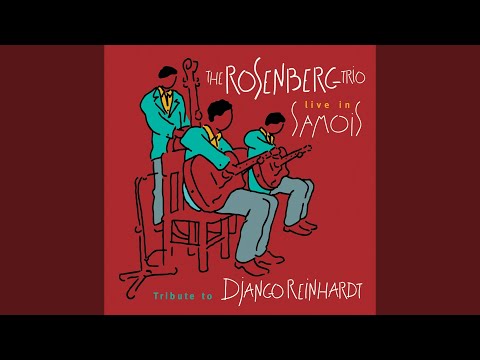 Rose Room (Live)The Rosenberg Trio · The Rosenberg Trio - TopicTribute to Django Reinhardt - Live in Samois; 2003 releaseAudio-only live album reading; release year is not asserted as performance date.Select performance
 rose room -Paris Jazz Sessions feat. Dave BlenkhornParis Jazz Sessions featuring Dave Blenkhorn · Edouard PennesParis Jazz SessionsGuitar-led ensemble; no performance date supplied.Select performance
 Jonathan Stout Trio - "Rose Room" - Django in June 2023Jonathan Stout, Denis Chang, Giacomo Smith · campusfive2023 · Django in June, Northampton; 17 June 2023Guitar, clarinet and double bass concert trio.Select performance
 Rose Room - Harry Diplock Trio feat Joe WebbHarry Diplock Trio featuring Joe Webb · Harry Diplock2023 · Recorded April 2023Acoustic guitar trio with guest piano; date stated by artist.Select performance
Use only thirds and sevenths through the first sixteen bars. Repeat with one rhythmic motif, then compose a different closing answer for the second half.
Light shells make the dominant chain legible. Avoid rushing through the minor-subdominant passage just because it contains more chromatic notes.
Start at 100–120; explore 150–190 bpm
Use only thirds and sevenths through the first sixteen bars. Repeat with one rhythmic motif, then compose a different closing answer for the second half.
Start below the suggested tempo. First hear four quarter-note clicks, then halve the click rate and place clicks on beats 2 and 4. Keep the same phrase length.
Rose Room — F major; 32-bar chorus; source adds a parenthesised final tonic. Agree the tempo, pickup, solo order and ending before the count.
Agree whether the turnaround restarts the tune or resolves to the optional ending tonic.
Let the melody sit above close inner-voice movement and a bass note at each new destination.
Agree whether the turnaround restarts the tune or resolves to the optional ending tonic.
Choose the singer’s comfortable key, then transpose the whole arrangement, including the introduction. Use the original lyric phrasing to shape breathing.
This player guide combines inherited recording evidence and editorial study notes. Musical study notes are editorial suggestions; compare them with the recording.
Composition background and credits ↗
Gonzalo Bergara — backing track ↗
Feature photograph — Gypsy Jazz UK historical archive ↗
Original Djangopedia illustration · AI-assisted, 2026
An original editorial interpretation of the tune. This is an illustration, not an archival photograph or a documented reconstruction of a recording session.
Generated with the native image-generation tool on 2026-10-08; original editorial artwork, not a historical photograph.
Prompt: Use case: illustration-story. One original editorial feature illustration for Djangopedia's guide “Rose Room”. Landscape 1536 × 1024, opaque background. Scene: A single rose in a plain vase casts two related curved shadows across a small empty room; an unplayed guitar rests along a side wall. The warm two-half harmonic journey is represented by the paired shadows and return, an editorial title metaphor. Musical basis from the guide: A warm swing standard whose two related halves travel through tonic, subdominant and minor-subdominant regions. Its balanced phrases provide space for melodic development without losing harmonic direction. The supplied chart is F major; form: 32-bar chorus; source adds a parenthesised final tonic; feel: Swing. These describe musical inspiration, not visible writing. Historical context: Art Hickman and Harry Williams wrote Rose Room in 1917. Djangopedia lists Django’s recording on 22 April 1937. The progression also has a wider swing history, including its relationship to Duke Ellington’s In a Mellotone. Do not illustrate disputed historical claims or suggest this imagined scene is an archival session. Medium: ink wash still life. Dominant palette: rose burgundy and cool white. Composition: interior corner with curved guitar body. Human presence: none. Strong intentional design, clearly drawn/painted, distinctive material marks; keep essential subject safely within the central 70 percent width and middle 80 percent height for card crops. Maintain enough visual substance at thumbnail size. Broad inspiration observed in old photo, ONLY scale/rhythm and never a reference image: single lit guitarist against deep dark ground; close instrument. Independently invent every pose, perspective, clothing, setting and lighting. Avoid: No seated guitarist portrait, dark photographic spotlight or words. No photorealism, archival simulation, generated text, letters, numbers, labels, fake musical notation, logo, signature, watermark, fake dates, yellowed-paper patina, recognizable artwork or copied photograph. No imitation of any named artist. Render the art edge to edge without borders, mockup or typography. Batch B diversity compensation: make light and midtone areas substantial; avoid near-black dominant backdrops, violet monochrome, empty chair/stool/bench compositions, repeated sunset terraces and generic cloud panoramas. Preserve the stated tune-specific scene. Human figures remain standing or peripheral except an explicitly named ensemble; no centered seated Django portrait. For graphic images use clearly plain colour shapes, no ruled parallel staffs, circles with stems, note-like marks or typography.
Photograph rights are documented separately in its credit. They do not establish the rights status of the composition or recording.