Tune details
Music: Jimmy McHugh
Words: Dorothy Fields
Published / composed: 1930
Original key: Not established
Study level: Approachable repertoire
 Djangopedia
An economical song built around a major-key dominant chain and a bridge that turns major subdominant into minor. It gives developing improvisers room to make a small idea sound complete.
Make F♯–F–E and A–A♭–G sound like sung phrases.
Owner content reviewed — 2026-10-04T21:21:41Z by admin. Coverage measures presence, not accuracy. Content review does not certify rights or musical perfection.
Django recordings for this tune. Uploader dates and take labels remain source claims; only an evidenced exact association enables a row’s Listen control.
Django Reinhardt
source-described; accuracy not independently verified
Uploader identifies this as Django Reinhardt’s performance; recording date and take require comparison with the discography.
| Entry | Year | Recording / session / release evidence | Listen |
|---|---|---|---|
| 01 | 1937 | Exactly Like You, 21/4/37, OLA 1702-1 ,"Fremeaux FA 305, Classics 748, Affinity 1003, EMI 780671-2, Mosaic MD6-190(6 CD Set)."," - Paris - QHCF - Stephane Grappelly (v), Django Reinhardt, Pierre Ferret, Marcel Bianchi (g), Louis Vola (b)" | — |
| 02 | 1937 | Exactly Like You, 29/5/37, Fremeaux FA 305," - BBC Jazz Show Programme - Stephane Grappelli (v), Django & Joseph Reinhardt (g), Pierre Ferret (g), Louis Vola (b)." | — |
| 03 | 1940 | Pour Vous,OSW 147-1 ,"Fremeaux FA 310, Classics 852, Affinity AFS 1003, Jazz Time 252707-2, Music Memoria 31005, Mosaic MD6-190(6 CD Set).","13/12/40 - Paris - QHCF+ - Hubert Rostaing (cl), Alix Combelle (cl,ts) Django & Joseph Reinhardt (g), Tony Rovira (b), Pierre Fouad (d)" | — |
A dash means no video has been associated with this exact historical recording. Tune-level listening resources remain available above.
Jimmy McHugh and Dorothy Fields introduced the song in the 1930 International Revue. Djangopedia lists Django recordings from April and May 1937. The song’s simple outline supports both vocal phrasing and instrumental swing.
Music: Jimmy McHugh
Words: Dorothy Fields
Published / composed: 1930
Original key: Not established
Study level: Approachable repertoire
Listening task: Use the lyric’s natural phrase lengths even in an instrumental performance. Count the head before comparing solo choruses.
Exactly Like You, 21/4/37, OLA 1702-1 ,"Fremeaux FA 305, Classics 748, Affinity 1003, EMI 780671-2, Mosaic MD6-190(6 CD Set)."," - Paris - QHCF - Stephane Grappelly (v), Django Reinhardt, Pierre Ferret, Marcel Bianchi (g), Louis Vola (b)"
Compare the tempo, key, introduction and final cadence with the first entry. Make F♯–F–E and A–A♭–G sound like sung phrases.
Exactly Like You, 29/5/37, Fremeaux FA 305," - BBC Jazz Show Programme - Stephane Grappelli (v), Django & Joseph Reinhardt (g), Pierre Ferret (g), Louis Vola (b)."
Count its form and check its key before joining in. The A sections move C→D7→G7→C. The bridge repeatedly contrasts F and Fm before returning to C; this minor-subdominant change supplies much of its colour.
The A sections move C→D7→G7→C. The bridge repeatedly contrasts F and Fm before returning to C; this minor-subdominant change supplies much of its colour.
The source’s last bridge cell reads Dm7 / C7. Other editions can differ at this cadence; compare it with the melody and selected track.
[[Image:Exactly_like_you.gif]]


| C/// | C/// | D7/// | D7/// | G7/// | G7/// | C/// | Dm7/ G7/ |

| C/// | C/// | D7/// | D7/// | G7/// | G7/// | C/// | C7/// |

| F/// | Fm/// | C/// | C7/// | F/// | Fm/// | C/// | Dm7/ C7/ |

| C/// | C/// | D7/// | D7/// | G7/// | G7/// | C/// | G7/// :||
Original source ↗
saxsolos
7:30
If playback is unavailable, use the source link.
 Exactly Like You Chords Backing Tracksaxsolos7:30✓ Featured
 Exactly Like You - with Intro + Lyrics in C (Female) - Jazz Sing-Along (Backing Track)Jazz Sing-Along3:12Select video
 Exactly Like You - Gypsy Jazz Backing Track 180 BPM - Django ReinhardtHot Club de France4:27Select video
 Exactly like you play alongSuperloco guitar2:44Select video
Performed studies, transcriptions, TAB, notation and lessons for studying Django’s solo. Inclusion does not certify note-for-note accuracy.
Christiaan van Hemert
source-described; accuracy not independently verified
Creator presents a study of Django’s recorded solo. Use it alongside the original recording; exact transcription accuracy has not been independently reviewed.
If playback is unavailable, use the source link.
Follow a shared key, a harmonic idea or a familiar form. Keys refer to this site’s chart editions; other recordings may use a different key.
No sufficiently supported harmonic comparison has been added yet.
Showing 8 of 30 matches. Explore the full catalogue →
Showing 8 of 85 matches. Explore the full catalogue →
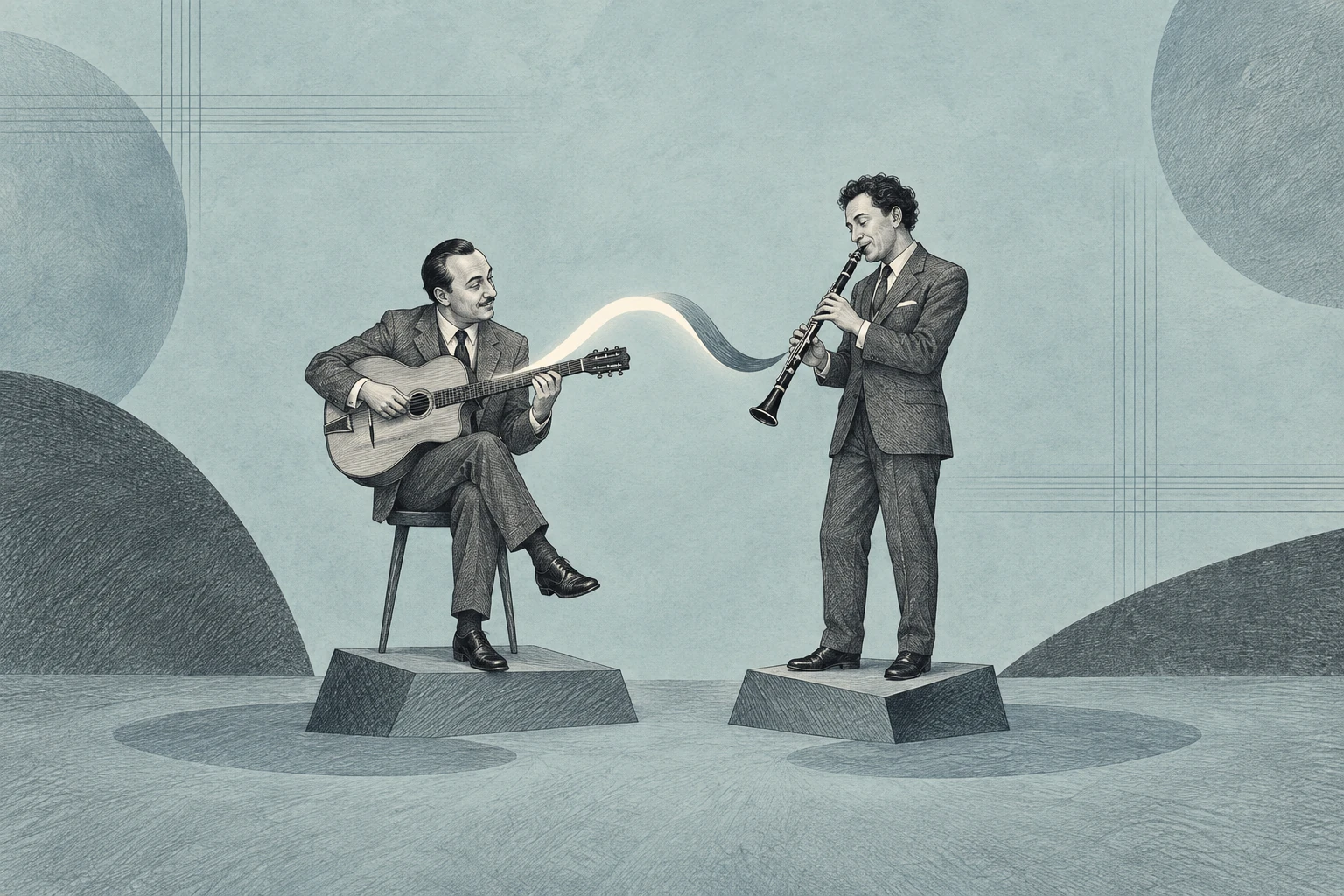
Django and a fictional clarinetist stand far apart on two narrow platforms; one melody ribbon runs between them, its middle changing from bright to dark before both return together. The near-parallel shapes with one small difference express the title and minor-subdominant voice leading.
An original editorial interpretation of the tune. This is an illustration, not an archival photograph or a documented reconstruction of a recording session.
Original Djangopedia illustration · AI-assisted, 2026
Illustration credits & provenance →Selected performances by notable Gypsy Jazz players and ensembles. Inclusion is editorial and does not imply an objective popularity ranking.
Joscho Stephan Trio · Joscho Stephan
Official artist trio performance · YouTube title/description checked 2026-10-04; owner listening and publication pending.
Proposed first for a clearly identified Gypsy Jazz ensemble reading.
If playback is unavailable, use the source link.
 Exactly like you // Joscho Stephan TrioJoscho Stephan Trio · Joscho StephanOfficial artist trio performance · YouTube title/description checked 2026-10-04; owner listening and publication pending.Proposed first for a clearly identified Gypsy Jazz ensemble reading.✓ Featured
 Exactly Like YouFapy Lafertin Quintet · Fapy Lafertin Quintet - TopicJazz Manouche (Gypsy Jazz); official distributed audio · YouTube title/description checked 2026-10-04; owner listening and publication pending.Quintet interpretation. Audio-only upload; release date does not establish recording year.Select video
 Exactly Like You (feat. The Gabe Terracciano Trio)Josh Turner feat. Gabe Terracciano Trio · Josh Turner GuitarArtist-channel collaboration · YouTube title/description checked 2026-10-04; owner listening and publication pending.Vocal/violin/acoustic swing interpretation provides a contrasting ensemble setting.Select video
 Exactly Like YouRino van Hooijdonk / Watti Rosenberg jam · acousticdregsAsten jam, uploader-credited personnel · YouTube title/description checked 2026-10-04; owner listening and publication pending.Informal Hot Club jam; ambiguous first-name credits are not expanded beyond the source.Select video
 Exactly Like You - Manouchka Gypsy JazzManouchka Gypsy Jazz · Marian YanchykPortuguese Gypsy Jazz ensemble · YouTube title/description checked 2026-10-04; owner listening and publication pending.Identified group performance. Source’s composer attribution is not imported into the guide.Select video
 Gypsy Swing Revue - Exactly Like YouGypsy Swing Revue · Vail JazzVail Jazz / Riverwalk performance · YouTube title/description checked 2026-10-04; owner listening and publication pending.Independent acoustic ensemble performance.Select video
 Exactly like you(GYPSY JAZZ) played by Sven JungbeckSven JungbeckIndependent solo over recorded accompaniment · YouTube title/description checked 2026-10-04; owner listening and publication pending.Performed improvisation rather than accompaniment-only material; studio setting.Select video
Improvise one chorus using only the two three-note descending lines above. Give each line a different rhythm on its next appearance.
Plain shells and a light four-to-the-bar feel make the dominant chain easy to follow. Voice the F-to-Fm shift quietly but clearly.
Start at 90–110; build toward 140–180 bpm
Improvise one chorus using only the two three-note descending lines above. Give each line a different rhythm on its next appearance.
Start below the suggested tempo. First hear four quarter-note clicks, then halve the click rate and place clicks on beats 2 and 4. Keep the same phrase length.
Exactly Like You — C major; 32 bars, AABA. Agree the tempo, pickup, solo order and ending before the count.
Confirm the bridge’s last cadence; the inherited chart has a C7 reading where other editions may differ.
A descending inner voice can support the head with only occasional bass notes.
Confirm the bridge’s last cadence; the inherited chart has a C7 reading where other editions may differ.
Choose the singer’s comfortable key, then transpose the whole arrangement, including the introduction. Use the original lyric phrasing to shape breathing.
This player guide combines inherited recording evidence and editorial study notes. Musical study notes are editorial suggestions; compare them with the recording.
Composition background and credits ↗
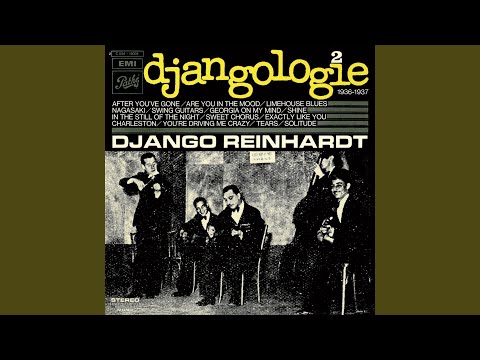
Feature photograph — Gypsy Jazz UK historical archive ↗
Original Djangopedia illustration · AI-assisted, 2026
An original editorial interpretation of the tune. This is an illustration, not an archival photograph or a documented reconstruction of a recording session.
Generated with the native image-generation tool on 2026-10-08; original editorial artwork, not a historical photograph.
Prompt: Create one original editorial illustration for Djangopedia’s “Exactly Like You” guide. Landscape 1536×1024, opaque. Etching-like editorial linework, cool grey and pale teal. Two SMALL musicians, Django with guitar and a fictional clarinetist, stand on separate low geometric platforms, BOTH COMPLETELY INSIDE THE CENTRAL 60% OF THE IMAGE WIDTH. Left musician at 38% of width, right musician at 62%; both entire bodies, heads, instruments, elbows and platforms fit between x=30% and x=70%, y=20% and y=78%. They face inward; a single luminous melody ribbon bridges the narrow gap, changing briefly from bright to dark to express major-to-minor subdominant voice leading. Deliberately broad empty drawn texture at both outer edges is expendable in mobile cropping. Keep no figures or instruments near the image edges. Minimal abstract background of pale teal air, subtle parallel lines and charcoal shapes; no city, river, cliff, landscape panorama or bridge. The tune is an economical 32-bar AABA C-major swing standard by Jimmy McHugh and Dorothy Fields, introduced in 1930; this is an imagined musical conversation, not a historical recording session. Clearly hand-drawn editorial art, no photorealism, no source photograph recreation, no copied artwork, no text, letters, numbers, music notation, logos, watermarks, signature, border or yellowed patina. Objective correction: the first illustration lost BOTH musicians’ heads and bodies in a narrow 343×310 cover crop. Ensure this central composition retains BOTH heads and instruments in such a crop.
Photograph rights are documented separately in its credit. They do not establish the rights status of the composition or recording.
