
Tune details
Music: Stéphane Grappelli
Documented in archive: 1947
Original key: Not established
Study level: Intermediate listening study; arrangement and source awareness
 Djangopedia
Eveline belongs to the November 1947 Quintette recordings with Grappelli. Follow the violin’s melodic contour and listen for how the guitar shifts from support to reply.
Sing one violin phrase, answer with a short guitar idea and then swap roles with a partner using the same timing.
Owner content reviewed — 2026-10-19T23:29:21Z by admin. Coverage measures presence, not accuracy. Content review does not certify rights or musical perfection.
Django recordings for this tune. Uploader dates and take labels remain source claims; only an evidenced exact association enables a row’s Listen control.
Django Reinhardt
source-described; accuracy not independently verified
Uploader identifies this as Django Reinhardt’s performance; recording date and take require comparison with the discography.
| Entry | Year | Recording / session / release evidence | Listen |
|---|---|---|---|
| 01 | 1947 | Eveline,OSW 485-1,"Fremeaux FA 315, Jazztime 789103-2, Mosaic MD6-190(6 CD Set).","14/11/47 - Paris - QHCF - Stephane Grappelly (v), Django & Joseph Reinhardt, Eugene Vees (g), Fred Ermelin (b)" | — |
A dash means no video has been associated with this exact historical recording. Tune-level listening resources remain available above.
Eveline belongs to the November 1947 Quintette recordings with Grappelli. The inherited OSW 485-1 listing and the publisher’s entry provide its historical anchor without assigning every online reissue to that take.
Music: Stéphane Grappelli
Documented in archive: 1947
Original key: Not established
Study level: Intermediate listening study; arrangement and source awareness
Follow the violin’s melodic contour and listen for how the guitar shifts from support to reply. Source-attributed credits: Stéphane Grappelli, credited by the publisher.
A complete harmonic route is not established here. First sing the melody and mark phrase endings; verify the underlying chords from a reliable edition before adding substitutions.
No verified complete chart is supplied. The listening and practice notes do not stand in for a chord chart.
No readable chord chart has been added for this title.
No backing track has been added.
Performed studies, transcriptions, TAB, notation and lessons for studying Django’s solo. Inclusion does not certify note-for-note accuracy.
No Django solo study aid yet. Know a useful resource — or want to record a study of this solo?
Follow a shared key, a harmonic idea or a familiar form. Keys refer to this site’s chart editions; other recordings may use a different key.
No sufficiently supported harmonic comparison has been added yet.
No match is established in the current chart metadata.
No match is established in the current chart metadata.
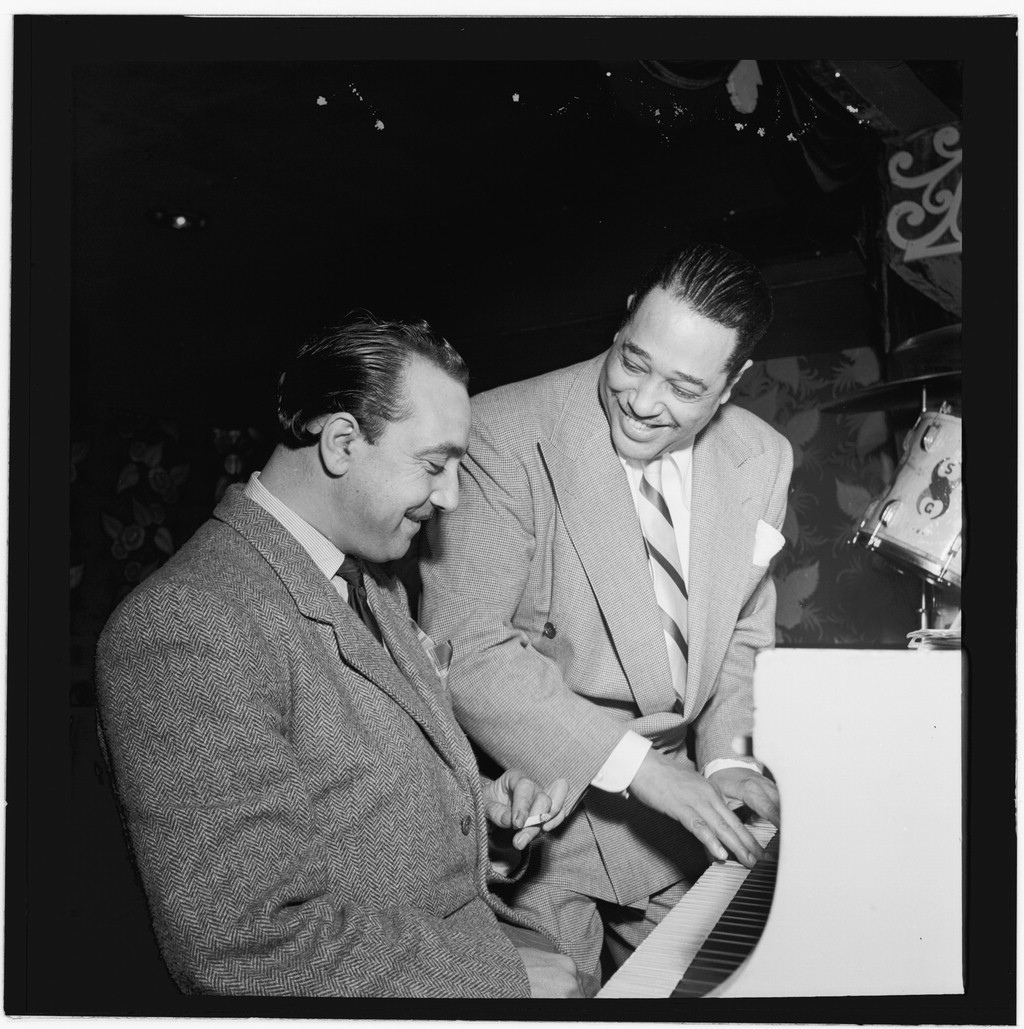
Editorial portrait from the documented Gottlieb public-domain collection. It does not depict this tune or its recording session.
Part of William P. Gottlieb’s documented Aquarium photographs in New York, circa November 1946. The catalogue supplies the location and approximate date; this is not evidence of a particular tune being played.
Explore this photograph, its context & credits →Selected performances by notable Gypsy Jazz players and ensembles. Inclusion is editorial and does not imply an objective popularity ranking.
Notable Gypsy Jazz performances are being curated.
Sing one violin phrase, answer with a short guitar idea and then swap roles with a partner using the same timing.
Keep the pulse gentle beneath the violin; use a clean reduction in volume when the melody returns.
60–90 quarter-note BPM for short study fragments; slow the source as needed
Sing one violin phrase, answer with a short guitar idea and then swap roles with a partner using the same timing.
Use a quiet quarter-note click for short loops. Keep the preceding rest and the next entry in the loop; remove the click briefly to test internal time.
Confirm the composition identity, concert key and complete arrangement before calling the tune. Agree pickup and ending together.
Do not infer a full chord chart or solo recreation from a reissue upload labelled only with the tune title.
Begin with the melody alone, then add only independently established bass arrivals. Keep the pulse gentle beneath the violin; use a clean reduction in volume when the melody returns.
Keep the pulse gentle beneath the violin; use a clean reduction in volume when the melody returns.
Follow the song’s breathing where a vocal version exists. Establish the singer’s key independently; lyrics are not reproduced here.
This player guide combines inherited recording evidence and editorial study notes. Musical study notes are editorial suggestions; compare them with the recording.
Djangopedia full discography ↗
Reissue publisher booklet and track listing ↗
William P. Gottlieb / Library of Congress · Aquarium, New York · circa November 1946
Public domain (PD-Gottlieb)
Photograph source ↗ · Rights details ↗Used to illustrate Django’s life; no connection to this tune’s recording session is claimed.