
Tune details
Music: Paul Misraki
Words: Paul Misraki
Published / composed / adapted — see history: 1946
Original key: Not established
Study level: Intermediate; advanced where the inherited roadmap needs reconstruction
 Djangopedia
A flowing French song whose apparently settled F-major opening quickly takes a minor detour. Careful inner-voice movement helps the more unusual chords sound like part of one phrase.
Hear the minor detours as part of the F-major phrase.
Owner content reviewed — 2026-10-05T18:28:06Z by admin. Coverage measures presence, not accuracy. Content review does not certify rights or musical perfection.
Django recordings for this tune. Uploader dates and take labels remain source claims; only an evidenced exact association enables a row’s Listen control.
Django Reinhardt
source-described; accuracy not independently verified
Uploader identifies this as Django Reinhardt’s performance; recording date and take require comparison with the discography.
| Entry | Year | Recording / session / release evidence | Listen |
|---|---|---|---|
| 01 | 1947 | Insensiblement, 4/10/47, 4765-1, , Django Reinhardt et le Quintette du Hot Club de France, Hubert Rostaing (cl); Django Reinhardt (g solo); Joseph Reinhardt (g); Emmanuel Soudieux (b); André Jourdan (dm) | — |
| 02 | 1953 | Insensiblement, 10/3/53, Verve 835418-2," - Paris - Django Reinhardt (elg), Maurice Vander (p), Pierre Michelot(b), Jean-Louis Viale (d)" | — |
| 03 | 1947 | Part 4765-1 Insensiblement,"Fremeaux FA 315, Classics 1046, Verve 835 418-2","4/10/47 - Paris - QHCF - Django Reinhardt (elg), Hubert Rostaing (cl), Joseph Reinhardt (g), Emmanuel Soudieux (b), Andre Jourdan (d)" | — |
A dash means no video has been associated with this exact historical recording. Tune-level listening resources remain available above.
Insensiblement is credited here to Paul Misraki. The source date is 1946; publication, composition and later lyric adaptations may have separate dates. The inherited archive lists 2 recording entries, with dated entries spanning 1947–1953. These are archive rows, not a claim that every entry is a distinct released take. The linked recording rows preserve the original discographical wording. Compare their dates, matrices and personnel when choosing a performance to study.
Music: Paul Misraki
Words: Paul Misraki
Published / composed / adapted — see history: 1946
Original key: Not established
Study level: Intermediate; advanced where the inherited roadmap needs reconstruction
Listening task: Keep a continuous lyrical line across the temporary minor destinations. Mark the key, pickup, phrase lengths and ending before comparing another version.
Insensiblement, 4/10/47, 4765-1, , Django Reinhardt et le Quintette du Hot Club de France, Hubert Rostaing (cl); Django Reinhardt (g solo); Joseph Reinhardt (g); Emmanuel Soudieux (b); André Jourdan (dm)
Compare the first and last listed entries for tempo, instrumentation and arrangement. Do not infer identical takes from a shared title. Hear the minor detours as part of the F-major phrase.
Insensiblement, 10/3/53, Verve 835418-2," - Paris - Django Reinhardt (elg), Maurice Vander (p), Pierre Michelot(b), Jean-Louis Viale (d)"
The inherited chart is in F major / D minor. Confirm the backing track’s sounding key, pickup and complete form before playing; an instrument label may describe a transposed score.
F6/9 moves through Em7♭5–A7 to Dm, then E7 points toward Am. C♯7 is a striking source colour before Gm7–C9 returns home.
Chord symbols and source cell divisions are preserved from Djangopedia. Slashes mark rhythm; 0 is inherited diminished notation whose exact voicing should be checked against the melody. This is a chord reference, not a melody transcription.
| F69/// | Em7b5/ A7/ | Dm/// | Dm/ E7/ | Am/ Am6/ | C#7/// | Gm7/// | C9/// |

| F69/// | Em7b5/ A7/ | Dm/// | Dm/ E7/ | Am/ Am6/ | C#7/// | Gm7/// | C9/// |

| F69/// | Gm7/ C7/ | F9/ Eb7/ | D9/// | Gm/// | G7/// | Gm/// | C9/// |

| F69/// | Em7b5/ A7/ | Dm/// | Dm/ E7/ | Am/ Am6/ | C#7/// | Gm7/// | C9/// :||
Original source ↗
Superloco guitar
The inherited chart is in F major / D minor. Confirm the backing track’s sounding key, pickup and complete form before playing; an instrument label may describe a transposed score. · 3:12
If playback is unavailable, use the source link.
Performed studies, transcriptions, TAB, notation and lessons for studying Django’s solo. Inclusion does not certify note-for-note accuracy.
olivier1759
creator-described performance
The creator identifies a recreation of Django’s recorded solo. Compare it with the original; note-for-note accuracy remains to be reviewed.
If playback is unavailable, use the source link.
Follow a shared key, a harmonic idea or a familiar form. Keys refer to this site’s chart editions; other recordings may use a different key.
No sufficiently supported harmonic comparison has been added yet.
Showing 8 of 39 matches. Explore the full catalogue →
Showing 8 of 85 matches. Explore the full catalogue →
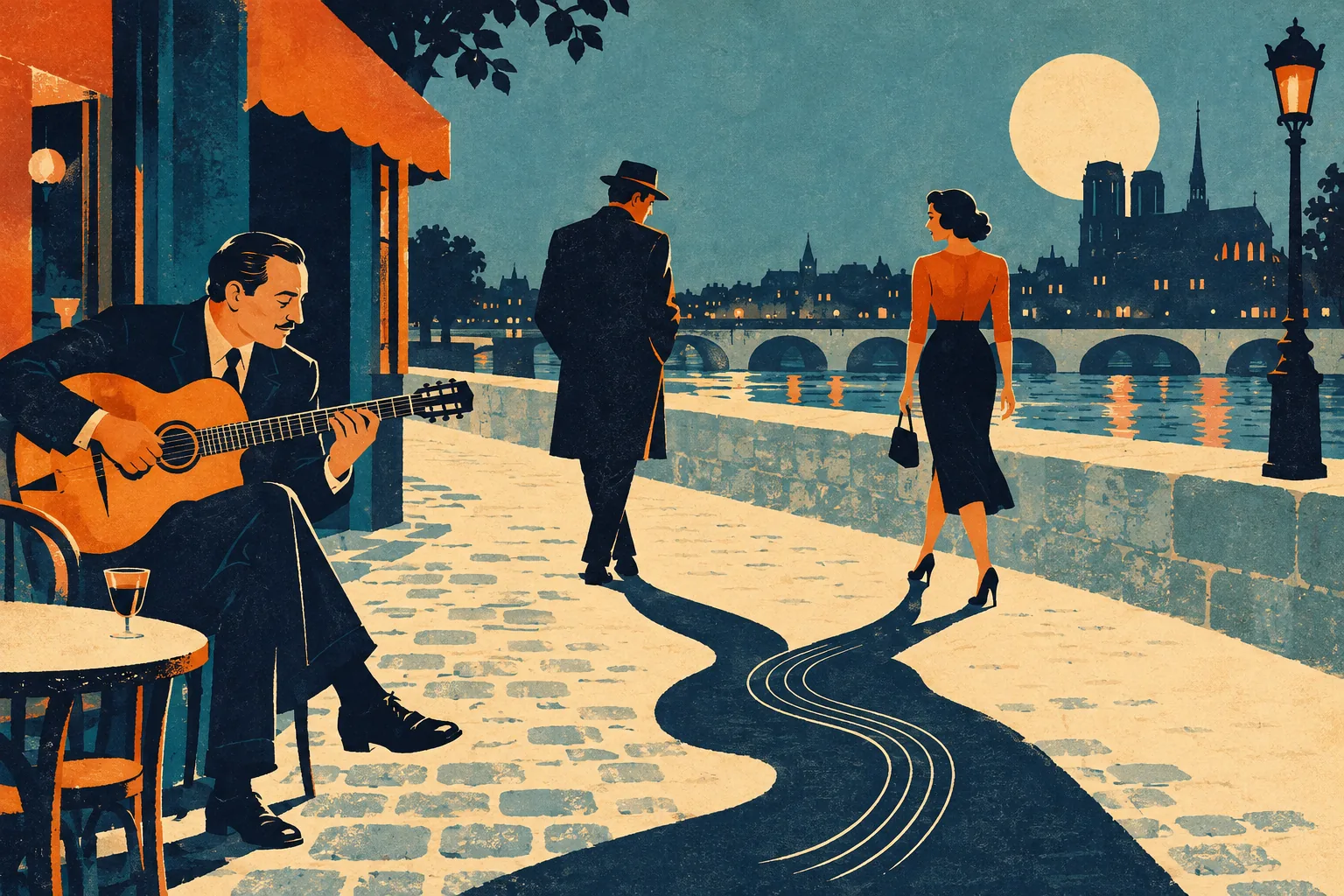
Owner-selected illustration. An adult couple drifts past one another so subtly that only their long shadows meet; a small guitar's curved sound line quietly joins the composition. Gradual, almost imperceptible affection, elegant visual understatement.
Original AI-assisted editorial artwork inspired by the tune; not a documented historical scene.
Original AI-assisted illustration created for Djangopedia
Illustration credits & provenance →Selected performances by notable Gypsy Jazz players and ensembles. Inclusion is editorial and does not imply an objective popularity ranking.
Tatiana Eva-Marie, Dion Berardo and Wallace Stelzer · Tatiana Eva-Marie
The Keep, Brooklyn, live recording · Watch title, source description and available positive-duration player checked 2026-10-05; independent performance; owner accuracy not independently verified.
Credited voice, guitar and bass interpretation; 1941 is composition year, not performance year.
If playback is unavailable, use the source link.
 Tatiana Eva-Marie x Dion Berardo - InsensiblementTatiana Eva-Marie, Dion Berardo and Wallace Stelzer · Tatiana Eva-MarieThe Keep, Brooklyn, live recording · Watch title, source description and available positive-duration player checked 2026-10-05; independent performance; owner accuracy not independently verified.Credited voice, guitar and bass interpretation; 1941 is composition year, not performance year.✓ Featured
 Quartet Jazz Manouche "Insensiblement" Festival Off Django Reinhardt au Fenjy Bar Samoreau, 20-06-22Angelo Debarre, Aurore Voilqué, Mathieu Châtelain and Tristan Loriaut · Nathalie Mari2022 · Festival Off Django Reinhardt, Fenjy Bar, Samoreau, 20 June 2022 · Watch title, source description and available positive-duration player checked 2026-10-05; independent performance; owner accuracy not independently verified.Credited live Jazz Manouche quartet.Select video
Loop F–Em7♭5–A7–Dm at a slow tempo, then connect the Am passage to the final Gm7–C7 cadence with the fewest moving voices.
Use sparse shells through the minor detour. Check C♯7 against the melody and chosen recording before adding further substitutions.
Start around 60–90 bpm and preserve the full phrase
Loop F–Em7♭5–A7–Dm at a slow tempo, then connect the Am passage to the final Gm7–C7 cadence with the fewest moving voices.
Begin with four quarter-note clicks. Halve the click rate and hear beats 2 and 4 while maintaining the same phrase lengths.
Insensiblement — F major / D minor; 32 bars, AABA in the inherited chart. Agree the pickup, tempo and ending before counting in.
32 bars, AABA in the inherited chart. Keep the head and solo chorus lengths explicit at the count-in.
Start with melody and bass only. Add the following colour without interrupting the melody: Resolve C♯ on A7 into D.
Use sparse shells through the minor detour. Check C♯7 against the melody and chosen recording before adding further substitutions. Agree the full roadmap and signal the last head before it starts.
Choose a comfortable vocal key and transpose the whole arrangement, including its introduction and ending.
This player guide combines inherited recording evidence and editorial study notes. Musical study notes are editorial suggestions; compare them with the recording.
Djangopedia — inherited chart and recording rows ↗
Composition credits and background ↗
Superloco guitar — practice backing ↗
Feature photograph — source collection ↗
Original AI-assisted illustration created for Djangopedia
Original AI-assisted editorial artwork inspired by the tune; not a documented historical scene.
Generated with the native image-generation tool on 2026-10-26; original editorial artwork, not a historical photograph.
Prompt: Use case: stylized-concept. Create one finished original landscape 1536x1024 (3:2) raster illustration for Djangopedia, tune Insensiblement. Tune context for interpretation only: Insensiblement is credited here to Paul Misraki. The source date is 1946; publication, composition and later lyric adaptations may have separate dates. The inherited archive lists 2 recording entries, with dated entries spanning 1947–1953. These are archive rows, not a claim that every entry is a distinct released take. The linked recording rows preserve the original discographical wording. Compare their dates, matrices and personnel when choosing a performance to study. Scene: An adult couple drifts past one another so subtly that only their long shadows meet; a small guitar's curved sound line quietly joins the composition. Gradual, almost imperceptible affection, elegant visual understatement. Art direction: Spare 1950s cut-paper serigraph: large flat interlocking ink shapes, a few assured irregular contours, witty geometric reduction and generous ivory negative space. Palette: deep indigo, dusty turquoise, burnt orange and warm paper. Subtle dry ink and paper texture, controlled print misregistration. Make it an artwork with a memorable singular idea, readable as a thumbnail and rewarding at full size; vary viewpoint and composition. Constraints: entirely original composition, not a copy of an artist's print. No title, words, notation, logos or watermark. No photorealism, glossy 3D, gradients, airbrushed romantic haze, generic sunset or decorative hearts. If Django appears, swept-back dark hair, pencil moustache and a distinct mature individual face; period clothes, no ethnic stereotypes. Respect plausible instruments and hands, keep key subjects within frame. Use strong flat ink shapes rather than photorealistic rendering.
Photograph provenance and rights are stated separately. Attribution does not establish permission.

