Tune details
Music: Edgar Battle, Eddie Durham
Source-attributed publication / composition: 1937
Original key: Not established
Study level: Intermediate; dominant bridge and riff development
 Djangopedia
A swing-era riff tune by Edgar Battle and Eddie Durham, ideal for developing short ideas through a minor-key chorus and dominant bridge.
Build three choruses from one two-bar riff: repeat it, shift its starting beat, then answer it with a bridge phrase following the dominant thirds.
Owner content reviewed — 2026-10-15T13:12:26Z by admin. Coverage measures presence, not accuracy. Content review does not certify rights or musical perfection.
Django recordings for this tune. Uploader dates and take labels remain source claims; only an evidenced exact association enables a row’s Listen control.
Django Reinhardt
source-described; accuracy not independently verified
Uploader identifies this as Django Reinhardt’s performance; recording date and take require comparison with the discography.
| Entry | Year | Recording / session / release evidence | Listen |
|---|---|---|---|
| 01 | 1947 | Topsy, 4/10/47, Part 4763-1, "Fremeaux FA 315, Classics 1046, Verve 835 418-2"," - Paris - QHCF - Django Reinhardt (elg), Hubert Rostaing (cl), Joseph Reinhardt (g), Emmanuel Soudieux (b), Andre Jourdan (d)" | — |
A dash means no video has been associated with this exact historical recording. Tune-level listening resources remain available above.
Edgar Battle and Eddie Durham's Topsy belongs to the riff-based swing repertoire. Django's inherited entry places his performance in Paris on 4 October 1947 and preserves the Part 4763-1 reference in its source text. Stéphane Wrembel's recorded repertoire also credits Battle and Durham, helping distinguish the composition from unrelated uses of the title. For improvisers, the compact minor-key idea is a useful starting point for variation: a small rhythmic change can carry more character than a continuous run of notes.
Music: Edgar Battle, Eddie Durham
Source-attributed publication / composition: 1937
Original key: Not established
Study level: Intermediate; dominant bridge and riff development
Follow the recurring riff and notice how accompaniment density changes under the soloist.
Topsy, 4/10/47, Part 4763-1, "Fremeaux FA 315, Classics 1046, Verve 835 418-2"," - Paris - QHCF - Django Reinhardt (elg), Hubert Rostaing (cl), Joseph Reinhardt (g), Emmanuel Soudieux (b), Andre Jourdan (d)"
The C-minor A sections contrast with a bridge driven by dominant chords. In the inherited chart, C7–F7–B♭7 leads toward A♭7 and G7 before C minor returns. Hear each local third instead of treating the bridge as one C-minor scale. Check the video key before playing with the chart.
The C-minor A sections contrast with a bridge driven by dominant chords. In the inherited chart, C7–F7–B♭7 leads toward A♭7 and G7 before C minor returns. Hear each local third instead of treating the bridge as one C-minor scale.
Inherited text retained, including the separate closing cells. Do not count the ending as extra bars in every chorus.
| Cm/ Cm(Bb)/ | Ab7/ G7/ |  Cm/ Cm(Bb)/ | Ab7/ G7/ |

| Cm/ Cm(Bb)/ | Ab7/ G7/ |  Cm/// | C7/// |


| Fm/ Fm(Eb)/ | Db7/ C7/ |  Fm/ Fm(Eb)/ | Db7/ C7/ |

| Cm/// | Cm/ Bb/ | Ab7/ G7/ | Cm/// |


| C7/// |  C7/// | F7/// | F7/// |

| Bb7/// | Bb7/// | Ab7/// | G7/// |


| Cm/ Cm(Bb)/ | Ab7/ G7/ |  Cm/ Cm(Bb)/ | Ab7/ G7/ |

| Cm/ Cm(Bb)/ | Ab7/ G7/ |  Cm/// | Dm7/ G7/ :|| Cm |
Original source ↗
Clément Reboul
Swing · 110 BPM · 4m24s · Video available when checked; creator-described attribution.
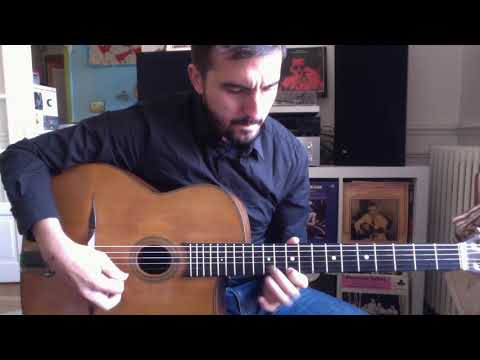
Creator-described gypsy-jazz play-along. Check the key and full arrangement before joining in; the guide chart may use another key. Tempo is the creator’s stated value.
If playback is unavailable, use the source link.
Performed studies, transcriptions, TAB, notation and lessons for studying Django’s solo. Inclusion does not certify note-for-note accuracy.
Adrien Tarraga
source-described; accuracy not independently verified
Creator presents a study of Django’s recorded solo. Use it alongside the original recording; exact transcription accuracy has not been independently reviewed.
If playback is unavailable, use the source link.
Follow a shared key, a harmonic idea or a familiar form. Keys refer to this site’s chart editions; other recordings may use a different key.
No sufficiently supported harmonic comparison has been added yet.
Showing 8 of 85 matches. Explore the full catalogue →
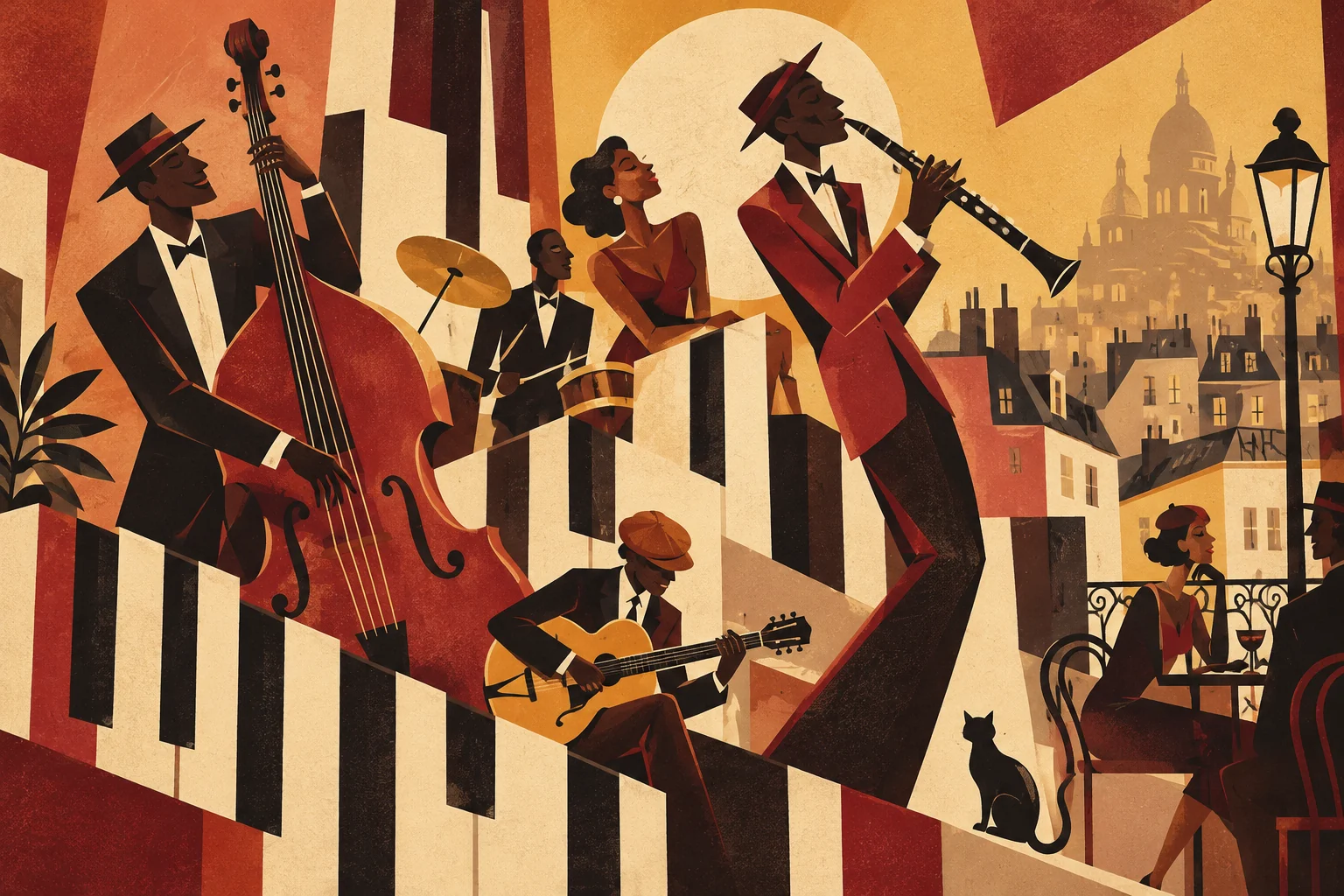
Original illustration: Geometric instruments and musicians arranged among tilted piano-key shapes.
Original AI-assisted editorial artwork inspired by the tune’s mood. It does not depict a documented historical event.
Original Djangopedia illustration · AI-assisted, 2026
Illustration credits & provenance →Selected performances by notable Gypsy Jazz players and ensembles. Inclusion is editorial and does not imply an objective popularity ranking.
Dave Kelbie
Video available when checked; creator-described attribution.
Performer attribution follows the video title and channel description. Proposed listening selection; no popularity ranking implied.
If playback is unavailable, use the source link.
 Topsy by The Tcha Limberger Trio with Mozes Rosenberg 2015Dave KelbieVideo available when checked; creator-described attribution.Performer attribution follows the video title and channel description. Proposed listening selection; no popularity ranking implied.✓ Featured
 Topsy - The Hot Club (Nottingham)Wayne JefferiesVideo available when checked; creator-described attribution.Performer attribution follows the video title and channel description. Proposed listening selection; no popularity ranking implied.Select video
Build three choruses from one two-bar riff: repeat it, shift its starting beat, then answer it with a bridge phrase following the dominant thirds.
Aim for a compact, riff-friendly pulse. Keep the bridge's changes clear without accenting every chord. Save a stronger gesture for the return of the head.
Start at 100–110; explore 160–200 bpm
Build three choruses from one two-bar riff: repeat it, shift its starting beat, then answer it with a bridge phrase following the dominant thirds.
Count quarter notes first. Then place the click on beats 2 and 4 at half the click rate, keeping the phrase length unchanged.
C minor (inherited chart); 32-bar AABA study form; separate ending in inherited chart. Agree the arrangement, pickup and ending before counting in.
Losing the dominant-chain bridge while repeating a minor pentatonic shape.
Keep the melody uppermost and begin with a single bass note under each harmony. Cm6: C–E♭–G–A; Fm6: F–A♭–C–D.
Aim for a compact, riff-friendly pulse. Keep the bridge's changes clear without accenting every chord. Save a stronger gesture for the return of the head.
No vocal arrangement is prescribed; use the instrumental melody as the phrasing reference.
This player guide combines inherited recording evidence and editorial study notes. Musical study notes are editorial suggestions; compare them with the recording.
Stéphane Wrembel — The Django Experiment IV ↗
Princeton Jazz programme — Topsy ↗
Original Djangopedia illustration · AI-assisted, 2026
Original AI-assisted editorial artwork inspired by the tune’s mood. It does not depict a documented historical event.
Generated with the native image-generation tool on 2026-10-15; original editorial artwork, not a historical photograph.
Prompt: Use case: illustration-story. One original Djangopedia jazz tune guide illustration. High resolution landscape 3:2, 1536x1024 or larger. Original playful mid-century modern graphic illustration mixed with 1930s–1950s Paris and Art Deco. Angular geometric construction, expressive silhouettes, bold confident outlines, flat limited colors, subtle vintage print grain. Balanced professional editorial artwork with personality. No text, no lettering, no logos, no watermark. Not a photograph or documented event. Do not imitate any particular artist. Focal objects within safe 10% margins. A playful abstract swing orchestra: tilted upright bass and clarinet silhouettes weave diagonally between staggered piano-key architectural blocks, small guitarist near the bottom, energetic call-and-response rather than chaos. Burgundy, terracotta, mustard and warm cream.