
Tune details
Music: Django Reinhardt, Stéphane Grappelli
Documented in archive: 1937
Original key: Not established
Study level: Intermediate to advanced
 Djangopedia
A reflective composition whose minor and major regions offer sharply different emotional colours. The important task is to hear the sectional contrast and agree a roadmap before improvising.
Make the move from E♭ to E tell the listener that a new section has begun.
Owner content reviewed — 2026-10-05T18:26:45Z by admin. Coverage measures presence, not accuracy. Content review does not certify rights or musical perfection.
Django recordings for this tune. Uploader dates and take labels remain source claims; only an evidenced exact association enables a row’s Listen control.
Django Reinhardt
source-described; accuracy not independently verified
Uploader identifies this as Django Reinhardt’s performance; recording date and take require comparison with the discography.
| Entry | Year | Recording / session / release evidence | Listen |
|---|---|---|---|
| 01 | 1937 | Tears , 21/4/37, OLA 1705-1 ,"Fremeaux FA 305, Classics 748, Affinity 1003, Jazz Time 790560-2, Jazz Archives ZET 752, Conifer HD 165, Mosaic MD6-190(6 CD Set)."," - Paris - QHCF - Stephane Grappelly (v), Django Reinhardt, Pierre Ferret, Marcel Bianchi (g), Louis Vola (b)" | — |
| 02 | 1940 | Tears, 22/3/40, OSW 118-1,"Fremeaux FA 310, Classics 831, Affinity AFS 1003, Jazz Time 252707-2, HEP 1041"," - Paris - Django Reinhardt (g), Philippe Brun, Pierre Allier, Alex Renard, Al Piguillem (tpt), Andre Ekyan (as), Guy Paquinet, Gaston Moat, Pierre Deck (tbn), Alix Combelle (bs), Charlie Lewis (p), Pierre Ferret (g), Emmanuel Soudieux (b)" | — |
| 03 | 1947 | Tears, Nov. 1947, "Fremeaux FA 315, Vogue 228E 6008, Vogue 600121", RTF Broadcast | — |
A dash means no video has been associated with this exact historical recording. Tune-level listening resources remain available above.
The legacy prose says March 1937, while its detailed first session row gives 21 April 1937, matrix OLA 1705-1. The detailed row is shown and the disagreement remains visible. Later entries include a 1940 recording.
Music: Django Reinhardt, Stéphane Grappelli
Documented in archive: 1937
Original key: Not established
Study level: Intermediate to advanced
Listening task: Separate the minor lament from the more open major statement through dynamics. Count the head before comparing solo choruses.
Tears , 21/4/37, OLA 1705-1 ,"Fremeaux FA 305, Classics 748, Affinity 1003, Jazz Time 790560-2, Jazz Archives ZET 752, Conifer HD 165, Mosaic MD6-190(6 CD Set)."," - Paris - QHCF - Stephane Grappelly (v), Django Reinhardt, Pierre Ferret, Marcel Bianchi (g), Louis Vola (b)"
Compare the tempo, key, introduction and final cadence with the first entry. Make the move from E♭ to E tell the listener that a new section has begun.
Tears, Nov. 1947, "Fremeaux FA 315, Vogue 228E 6008, Vogue 600121", RTF Broadcast
Count its form and check its key before joining in. The minor material uses Cm with Dm7♭5–G7, then visits F minor and E♭. A contrasting C-major passage changes both the tonic third and the quality of the cadences. The old text prints repeated blocks and an ending cell; it is not a clean universal chorus map.
The minor material uses Cm with Dm7♭5–G7, then visits F minor and E♭. A contrasting C-major passage changes both the tonic third and the quality of the cadences. The old text prints repeated blocks and an ending cell; it is not a clean universal chorus map.
The source prints two 12-cell minor blocks, two eight-cell major blocks and an extra ending. Agree the section repeats with your chosen recording or track.
[[Image:Tears.gif]]


| Cm/ Cm(Eb)/ | Dm7b5/ G7/ |  Cm/ Cm(Eb)/ | Dm7b5/ G7/ |

| Gm7b5/ C7/ | Fm/// | Fm7b5/ Bb7/ | Eb69/// |

| Am7b5/// | Ab6/// | Ab7/ G7/ | Cm/ G7/ |


| Cm/ Cm(Eb)/ | Dm7b5/ G7/ |  Cm/ Cm(Eb)/ | Dm7b5/ G7/ |

| Gm7b5/ C7/ | Fm/// | Fm7b5/ Bb7/ | Eb69/// |

| Am7b5/// | Ab6/// | Ab7/ G7/ | Cm/ G7/ |


| CM7/ Em7/ | Dm7/ G7/ | CM7/ Em7/ | Dm7/ G7/ |

| Gm7/ C7/ | FM7/// | D9/// | Db9/// |


| CM7/ Em7/ | Dm7/ G7/ | CM7/ Em7/ | Dm7/ G7/ |

| Gm7/ C7/ | FM7/// | Ab7/ G7/ | Cm/ G7/ :|| Cm |
Original source ↗
Guitare Improvisation
6:10
If playback is unavailable, use the source link.
 Tears (110 bpm) - Gypsy jazz Backing track / Jazz manoucheGuitare Improvisation6:10✓ Featured
 Tears - Playback jazz manouche - Gypsy jazz backing track / play alongClément Reboul6:13Select video
 Tears gypsy jazz backing track 100 bpmJazz guitar with Andy3:20Select video
 Tears - Gypsy jazz backing track + music sheetWerner Schmedding3:23Select video
Performed studies, transcriptions, TAB, notation and lessons for studying Django’s solo. Inclusion does not certify note-for-note accuracy.
Elias Prinz
creator-described performance
The creator identifies a recreation of Django’s recorded solo. Compare it with the original; note-for-note accuracy remains to be reviewed.
If playback is unavailable, use the source link.
Follow a shared key, a harmonic idea or a familiar form. Keys refer to this site’s chart editions; other recordings may use a different key.
No sufficiently supported harmonic comparison has been added yet.
Showing 8 of 33 matches. Explore the full catalogue →
No match is established in the current chart metadata.
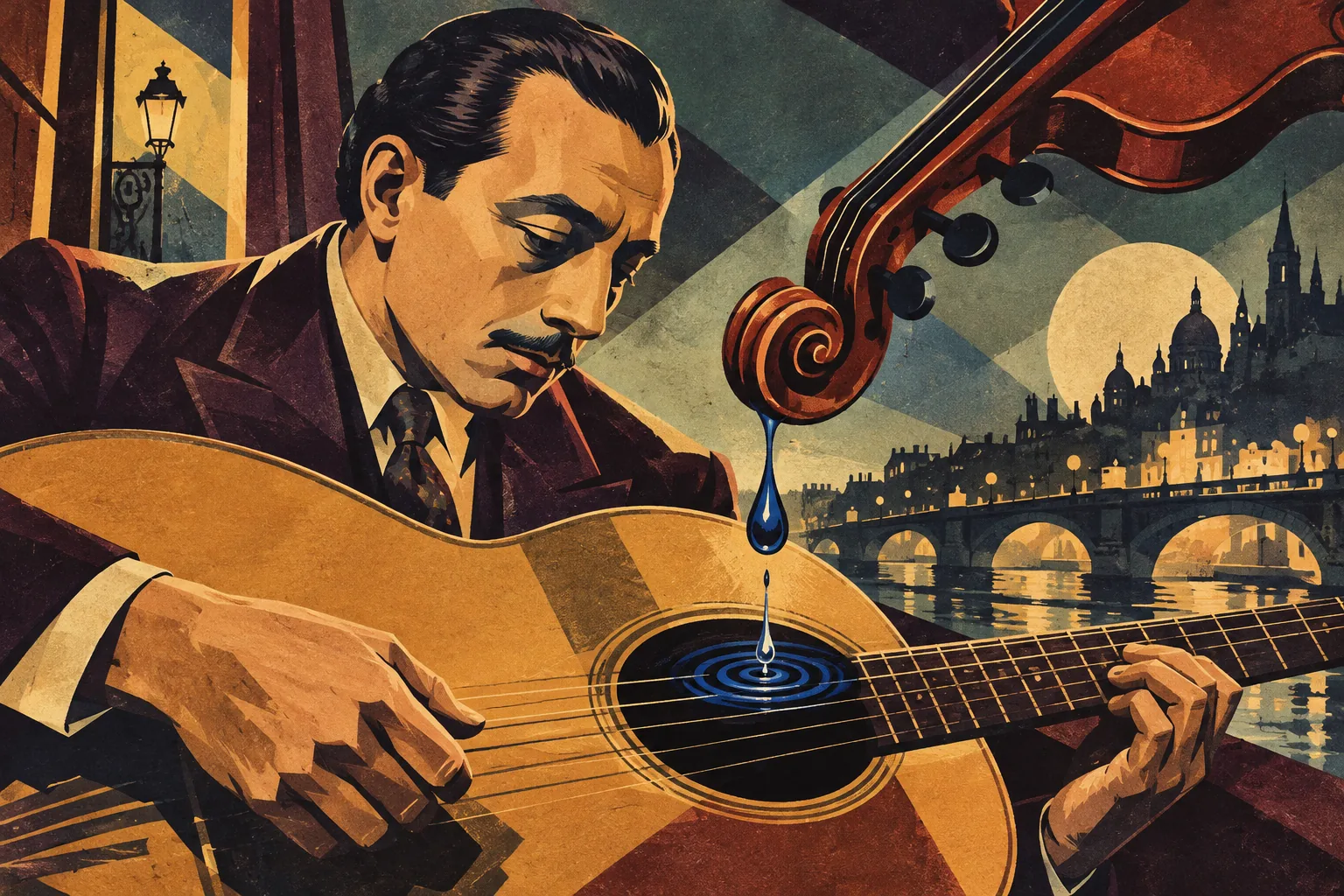
Owner-selected illustration. A single deep-blue teardrop falls from a violin scroll into the guitar's soundhole, making one delicate circular ripple. No crying face; restrained instrumental melancholy and spacious beautiful geometry.
Original AI-assisted editorial artwork inspired by the tune; not a documented historical scene.
Original AI-assisted illustration created for Djangopedia
Illustration credits & provenance →Selected performances by notable Gypsy Jazz players and ensembles. Inclusion is editorial and does not imply an objective popularity ranking.
Joscho Stephan Trio featuring Costel Nițescu · Joscho Stephan
Violin-led quartet performance · Watch title, source description and available positive-duration player checked 2026-10-05; independent performance; owner accuracy not independently verified.
Theme and independent violin/guitar solos; linked lessons are separate.
If playback is unavailable, use the source link.
 Tears /// Joscho Stephan Trio feat. Costel NițescuJoscho Stephan Trio featuring Costel Nițescu · Joscho StephanViolin-led quartet performance · Watch title, source description and available positive-duration player checked 2026-10-05; independent performance; owner accuracy not independently verified.Theme and independent violin/guitar solos; linked lessons are separate.✓ Featured
 Rhythm Future Quartet - Tears (Gypsy jazz)Rhythm Future Quartet: Jason Anick, Olli Soikkeli, Vinny Raniolo, Greg Loughman · magicfiddleQuartet live performance · Watch title, source description and available positive-duration player checked 2026-10-05; independent performance; owner accuracy not independently verified.Violin, acoustic/archtop guitars and bass; named personnel in source.Select video
 Django Reinhardts Tears solo by Elias Prinz 2022 @ Jazz at the OxfordElias Prinz with London Django Collective · Elias Prinz2022 · Jazz at the Oxford, London · Watch title, source description and available positive-duration player checked 2026-10-05; independent performance; owner accuracy not independently verified.Concert solo excerpt: artist explicitly calls this his own solo, rather than a Django transcription.Select video
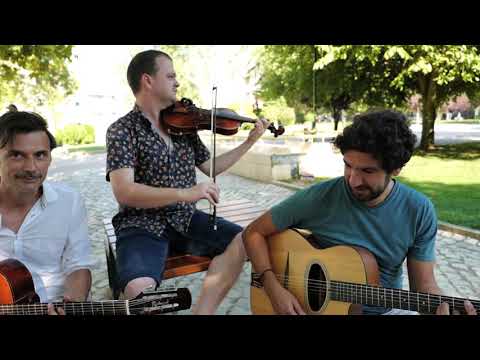 Tears - Django Reinhardt Gypsy Jazz (by Manouchka, Portugal)Manouchka · Nuno MarinhoPortugal Gypsy Jazz performance · Watch title, source description and available positive-duration player checked 2026-10-05; independent performance; owner accuracy not independently verified.Group identified by source; individual personnel and performance year not asserted.Select video
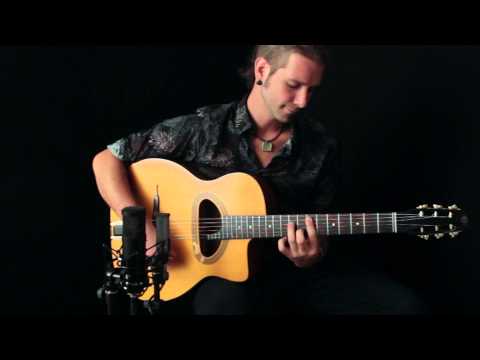 Tears (Django Reinhardt) - Filippo Dall'AstaFilippo Dall’Asta · Filippo Dall'AstaIndependent guitar interpretation · Watch title, source description and available positive-duration player checked 2026-10-05; independent performance; owner accuracy not independently verified.Artist describes this as his own version; separate lesson advertising is outside the performance.Select video
Play the same two-bar motif first over Cm and then C major, changing only the third. Then perform the full head using a written section roadmap you can sing from memory.
Leave room for sustained notes and use a gentle pulse. Change the voicing’s third clearly when the tonic becomes major.
Start at 70–90; explore 100–120 bpm
Play the same two-bar motif first over Cm and then C major, changing only the third. Then perform the full head using a written section roadmap you can sing from memory.
Start below the suggested tempo. First hear four quarter-note clicks, then halve the click rate and place clicks on beats 2 and 4. Keep the same phrase length.
Tears — C minor, with C-major contrast; Contrasting minor/major sections; version-dependent roadmap. Agree the tempo, pickup, solo order and ending before the count.
Set the number of repeats in each section before playing; different backing tracks may use different roadmaps.
Use a chord-melody texture with widely spaced bass notes; highlight the minor/major third change in the top voice.
Set the number of repeats in each section before playing; different backing tracks may use different roadmaps.
This guide studies an instrumental arrangement. Any later lyric adaptation requires its own credit and chosen key.
This player guide combines inherited recording evidence and editorial study notes. Musical study notes are editorial suggestions; compare them with the recording.
Tears — Reinhardt and Grappelli ↗
Guitare Improvisation — backing track ↗
Feature photograph — Gypsy Jazz UK historical archive ↗
Original AI-assisted illustration created for Djangopedia
Original AI-assisted editorial artwork inspired by the tune; not a documented historical scene.
Generated with the native image-generation tool on 2026-10-26; original editorial artwork, not a historical photograph.
Prompt: Use case: stylized-concept. Create one finished original landscape 1536x1024 (3:2) raster illustration for Djangopedia, tune Tears. Tune context for interpretation only: The legacy prose says March 1937, while its detailed first session row gives 21 April 1937, matrix OLA 1705-1. The detailed row is shown and the disagreement remains visible. Later entries include a 1940 recording. Scene: A single deep-blue teardrop falls from a violin scroll into the guitar's soundhole, making one delicate circular ripple. No crying face; restrained instrumental melancholy and spacious beautiful geometry. Art direction: Dramatic 1930s–1940s theatrical serigraph: angular light and shadow, mature expressive caricature with dignity, strong diagonal movement and clean colour separations. Palette: dark aubergine, sage, ochre and cream. Subtle dry ink and paper texture, controlled print misregistration. Make it an artwork with a memorable singular idea, readable as a thumbnail and rewarding at full size; vary viewpoint and composition. Constraints: entirely original composition, not a copy of an artist's print. No title, words, notation, logos or watermark. No photorealism, glossy 3D, gradients, airbrushed romantic haze, generic sunset or decorative hearts. If Django appears, swept-back dark hair, pencil moustache and a distinct mature individual face; period clothes, no ethnic stereotypes. Respect plausible instruments and hands, keep key subjects within frame. Use strong flat ink shapes rather than photorealistic rendering.
Photograph rights are documented separately in its credit. They do not establish the rights status of the composition or recording.
