
Tune details
Music: Claude Debussy
Documented in archive: 1947
Original key: Not established
Study level: Intermediate listening study; advanced source and arrangement awareness
 Djangopedia
The reconciled Rêverie page preserves the 1947 Django's Dream and 1950 Rome claims together. Treat them as performances to compare, not interchangeable recordings. Compare the length of the melodic releases and the amount of space around the guitar in the two versions.
Sing one two-phrase idea from each version.
Owner content reviewed — 2026-10-21T01:13:19Z by admin. Coverage measures presence, not accuracy. Content review does not certify rights or musical perfection.
Django recordings for this tune. Uploader dates and take labels remain source claims; only an evidenced exact association enables a row’s Listen control.
Django Reinhardt
source-described; accuracy not independently verified
Uploader identifies this as Django Reinhardt’s performance; recording date and take require comparison with the discography.
| Entry | Year | Recording / session / release evidence | Listen |
|---|---|---|---|
| 01 | 1950 | Reverie,1950 , BL202,BGO CD 366,"- Rome - Django Reinhardt (elg), Andre Ekyan (as,cl), Ralph Schecroun (p), Alf Masselier (b), Roger Paraboschi (d)" | — |
| 02 | 1947 | Django's Dream (Reverie), 22/9/47, "Fremeaux FA 314, Vogue 228E 6006"," - Paris - Souvenirs de Django - Django Reinhardt (elg), Hubert Rostaing (cl), Eugene Vees (g), Emmanuel Soudieux (b), Andre Jourdan (d)" | — |
A dash means no video has been associated with this exact historical recording. Tune-level listening resources remain available above.
The reconciled Rêverie page preserves the 1947 Django's Dream and 1950 Rome claims together. Treat them as performances to compare, not interchangeable recordings.
Music: Claude Debussy
Documented in archive: 1947
Original key: Not established
Study level: Intermediate listening study; advanced source and arrangement awareness
Compare the length of the melodic releases and the amount of space around the guitar in the two versions. Source-attributed credits: The 1950 publisher discography credits Claude Debussy, arranged by Django Reinhardt; Django's Dream is the documented alternate title.
Establish the actual melody and harmonic arrivals before choosing substitutions. Sing one two-phrase idea from each version. Keep the pitches you can verify, then compare the rest before each phrase's return.
No verified complete chart or concert key is supplied. Any inherited raw notation is retained without silently repairing it.
No readable chord chart has been added for this title.
No backing track has been added.
Performed studies, transcriptions, TAB, notation and lessons for studying Django’s solo. Inclusion does not certify note-for-note accuracy.
No Django solo study aid yet. Know a useful resource — or want to record a study of this solo?
Follow a shared key, a harmonic idea or a familiar form. Keys refer to this site’s chart editions; other recordings may use a different key.
No sufficiently supported harmonic comparison has been added yet.
No match is established in the current chart metadata.
No match is established in the current chart metadata.
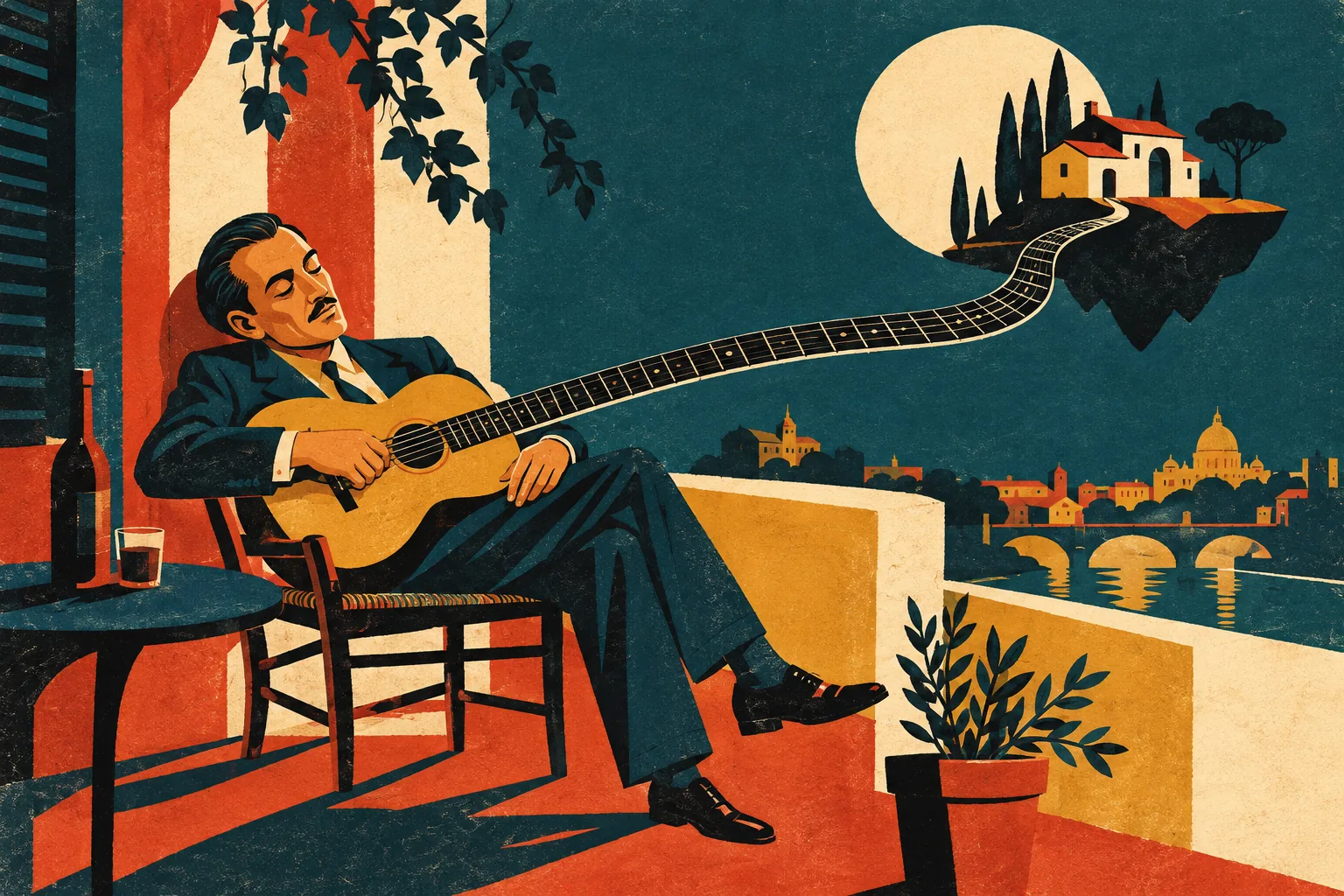
Owner-selected illustration. A guitarist dozes lightly while their chair's shadow becomes a small floating house and a winding guitar neck becomes its footpath. Quiet imaginative dream logic, spare cut-paper geometry, no sentimental haze.
Original AI-assisted editorial artwork inspired by the tune; not a documented historical scene.
Original AI-assisted illustration created for Djangopedia
Illustration credits & provenance →Selected performances by notable Gypsy Jazz players and ensembles. Inclusion is editorial and does not imply an objective popularity ranking.
Denis Chang
Public, processed and embeddable when checked; creator-described identity.
Creator Denis Chang identifies Debussy’s Rêverie adapted to jazz by Django, with Rino Van Hooijdonk, Tcha Limberger, Denis Chang and Vilmos Csikos. Studio album performance; not an exact Django take or performed solo study.
If playback is unavailable, use the source link.
Sing one two-phrase idea from each version. Keep the pitches you can verify, then compare the rest before each phrase's return.
Leave the melody's final note room to decay before introducing the next chord attack.
Dmitry Kushnirov describes his own solo-guitar arrangement and performance. Compare arrangement choices; this is not presented as a note-for-note recreation of a historical Django solo.
Begin short phrase work around 60–90 quarter-note BPM; adapt to the verified source
Sing one two-phrase idea from each version. Keep the pitches you can verify, then compare the rest before each phrase's return.
Use a quiet quarter-note click for short loops. Keep the preceding rest and the next entry in the loop; remove the click briefly to test internal time.
Confirm the composition identity, concert key and complete arrangement before calling the tune. Agree pickup and ending together.
The publisher identifies a Debussy-derived arrangement, not an original Django composition. Do not equate a classical upload with Django's arrangement or infer a take from the title.
Begin with the melody alone, then add only independently established bass arrivals. Leave the melody's final note room to decay before introducing the next chord attack.
Leave the melody's final note room to decay before introducing the next chord attack.
Follow the song’s breathing where a vocal version exists. Establish the singer’s key independently; lyrics are not reproduced here.
This player guide combines inherited recording evidence and editorial study notes. Musical study notes are editorial suggestions; compare them with the recording.
Reissue publisher booklet and discography ↗
Reissue publisher booklet and discography ↗
Inherited Djangopedia recording and chart evidence ↗
Creator-described Debussy/Django adaptation and personnel ↗
Original AI-assisted illustration created for Djangopedia
Original AI-assisted editorial artwork inspired by the tune; not a documented historical scene.
Generated with the native image-generation tool on 2026-10-26; original editorial artwork, not a historical photograph.
Prompt: Use case: stylized-concept. Create one finished original landscape 1536x1024 (3:2) raster illustration for Djangopedia, tune Reverie. Tune context for interpretation only: The reconciled Rêverie page preserves the 1947 Django's Dream and 1950 Rome claims together. Treat them as performances to compare, not interchangeable recordings. Scene: A guitarist dozes lightly while their chair's shadow becomes a small floating house and a winding guitar neck becomes its footpath. Quiet imaginative dream logic, spare cut-paper geometry, no sentimental haze. Art direction: Minimal mid-century musical still-life print: crisp hand-cut shapes, ingenious symbolic composition, uneven hand-pulled ink edges, very few carefully chosen details. Palette: vermilion, mustard, deep petrol teal and warm ivory. Subtle dry ink and paper texture, controlled print misregistration. Make it an artwork with a memorable singular idea, readable as a thumbnail and rewarding at full size; vary viewpoint and composition. Constraints: entirely original composition, not a copy of an artist's print. No title, words, notation, logos or watermark. No photorealism, glossy 3D, gradients, airbrushed romantic haze, generic sunset or decorative hearts. If Django appears, swept-back dark hair, pencil moustache and a distinct mature individual face; period clothes, no ethnic stereotypes. Respect plausible instruments and hands, keep key subjects within frame. Use strong flat ink shapes rather than photorealistic rendering.
