
Tune details
Music: Charles Trenet, Albert Lasry
Words: Charles Trenet
Documented in archive: 1949
Original key: Not established
Study level: Intermediate; sing the tonic at the start of each twelve-bar section
 Djangopedia
A flowing French standard whose longer phrases reward careful counting and smooth key-centre changes.
Sing the tonic at the start of each twelve-bar section.

Owner content reviewed — 2026-10-18T23:08:31Z by admin. Coverage measures presence, not accuracy. Content review does not certify rights or musical perfection.
Django recordings for this tune. Uploader dates and take labels remain source claims; only an evidenced exact association enables a row’s Listen control.
Django Reinhardt
source-described; accuracy not independently verified
Uploader identifies this as Django Reinhardt’s performance; recording date and take require comparison with the discography.
| Entry | Year | Recording / session / release evidence | Listen |
|---|---|---|---|
| 01 | 1949 | La Mer, Jan-Feb 1949, CW 35 ,"Fremeaux FA 317, RCA ND 70929-2, RCA ND 90448"," - Rome - Django Reinhardt (g), Stephane Grappelly (v),Gianni Safred (p), Carlo Pecori (b), Aurelio de Carolis (d)" | — |
A dash means no video has been associated with this exact historical recording. Tune-level listening resources remain available above.
La Mer is associated with Charles Trenet, with Albert Lasry credited in the selected release metadata. Beyond the Sea is its English-language adaptation; the English lyric is not treated as the French song’s original text.
Music: Charles Trenet, Albert Lasry
Words: Charles Trenet
Documented in archive: 1949
Original key: Not established
Study level: Intermediate; sing the tonic at the start of each twelve-bar section
A flowing French standard whose longer phrases reward careful counting and smooth key-centre changes.
La Mer, Jan-Feb 1949, CW 35 ,"Fremeaux FA 317, RCA ND 70929-2, RCA ND 90448"," - Rome - Django Reinhardt (g), Stephane Grappelly (v),Gianni Safred (p), Carlo Pecori (b), Aurelio de Carolis (d)"
The F-major arrangement moves into A and then C during the contrasting passage. Practise those key-centre changes as separate arrivals before connecting them with passing chords. Check the video key before playing with the chart.
The F-major arrangement moves into A and then C during the contrasting passage. Practise those key-centre changes as separate arrivals before connecting them with passing chords.
Inherited archive chart retained without harmonic or notation edits. The playing notes below discuss this particular version, not a definitive score.
[[Image:Lamer.gif]]

| F/ Dm/ | Gm/ C7/ | F/ Dm/ | Gm/ C7/ | F/ C#dim/ | Dm/ C7/ | F/ F7+/ | Bb/ D7(9)/ | Gm/ C7/ | Dm/// | Db7(9)/// | C7/ C7+/ |

| F/ Dm/ | Gm/ C7/ | F/ Dm/ | Gm/ C7/ | F/ C#7dim/ | Dm/ C7/ | F/ F7+/ | Bb/ D7(9)/ | Gm/ C7/ | Dm/// | Db7/ C7/ | F/ E7/ |

| A/ F#m/ | Bm/ E7/ | A/ F#m/ | Bm/ E7/ | A/ E7(9)/ | A/ G7/ | C/ Am/ | Dm/ G7/ | C/ Am/ | Dm/ G7/ | C/ Bb/ | Ab7/ C7/ |

| F/ Dm/ | Gm/ C7/ | F/ Dm/ | Gm/ C7/ | F/ C#7dim/ | Dm/ C7/ | F/ F7+/ | Bb/ D7(9)/ | Gm/ C7/ | Dm/// | Db7/ C7/ | F/// :||
Original source ↗
Manouche Club
5m17s · Video available when checked; creator-described attribution.
Creator-provided play-along; instrumentation and feel vary by selection. Check the key and full arrangement before joining in; the guide chart may use another key.
If playback is unavailable, use the source link.
Performed studies, transcriptions, TAB, notation and lessons for studying Django’s solo. Inclusion does not certify note-for-note accuracy.
DjangoKOR
Video available when checked; creator-described attribution.
Creator-presented transcription of Django’s solo. This is a study aid, not an independent certification of note-for-note accuracy.
If playback is unavailable, use the source link.
Follow a shared key, a harmonic idea or a familiar form. Keys refer to this site’s chart editions; other recordings may use a different key.
No sufficiently supported harmonic comparison has been added yet.
No match is established in the current chart metadata.
Showing 8 of 83 matches. Explore the full catalogue →
Original jazz serigraph illustration for la mer
Original AI-assisted editorial artwork inspired by the tune’s mood. It does not depict a documented historical event.
Original AI-generated illustration for Djangopedia; not a historical photograph.
Illustration credits & provenance →Selected performances by notable Gypsy Jazz players and ensembles. Inclusion is editorial and does not imply an objective popularity ranking.
Sepia Jazz Band
Video available when checked; creator-described attribution.
Performer attribution follows the video title and channel description. Proposed listening selection; no popularity ranking implied.
If playback is unavailable, use the source link.
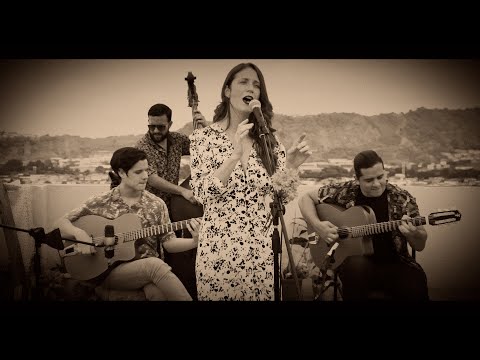 La Mer - Charles Trenet - Sepia Jazz Trio (Gypsy Jazz Cover)Sepia Jazz BandVideo available when checked; creator-described attribution.Performer attribution follows the video title and channel description. Proposed listening selection; no popularity ranking implied.✓ Featured
 La Mer (Django Reinhardt and Stephane Grappelli) by Jason Anick TriomagicfiddleVideo available when checked; creator-described attribution.Performer attribution follows the video title and channel description. Proposed listening selection; no popularity ranking implied.Select video
Sing the tonic at the start of each twelve-bar section. Then play a sparse melody line that makes the bridge’s new tonal centres audible.
Keep a broad, buoyant pulse and avoid hurrying the longer sections. Use smooth upper voices when the harmony moves to a new key.
Sven Jungbeck's chord lesson; arrangement-specific accompaniment guidance.
80–130 bpm
Sing the tonic at the start of each twelve-bar section. Then play a sparse melody line that makes the bridge’s new tonal centres audible.
Count quarter notes first. Then place the click on beats 2 and 4 at half the click rate, keeping the phrase length unchanged.
F; 48-bar AABA arrangement, with twelve-bar sections in the inherited grid. Agree the arrangement, pickup and ending before counting in.
Do not compress each section to eight bars; the inherited arrangement prints twelve. Ambiguous altered symbols require checking against the chosen version.
Keep the melody uppermost and begin with a single bass note under each harmony. Keep a broad, buoyant pulse and avoid hurrying the longer sections. Use smooth upper voices when the harmony moves to a new key.
Keep a broad, buoyant pulse and avoid hurrying the longer sections. Use smooth upper voices when the harmony moves to a new key.
Choose a comfortable singing key and transpose the accompaniment as a whole; lyrics are not reproduced here.
This player guide combines inherited recording evidence and editorial study notes. Musical study notes are editorial suggestions; compare them with the recording.
Credit / historical reference ↗
Inherited Djangopedia chart and recording evidence ↗
Original AI-generated illustration for Djangopedia; not a historical photograph.
Original AI-assisted editorial artwork inspired by the tune’s mood. It does not depict a documented historical event.
Generated with the native image-generation tool on 2026-10-18; original editorial artwork, not a historical photograph.
Prompt: Create a landscape 1536x1024 original midcentury jazz serigraph illustration. A sailboat and rhythmic waves seen from a seaside cafe, acoustic guitar leaning safely against a chair; turquoise, deep blue, lemon yellow, cream. Bold angular cut-paper silhouettes, limited flat spot-color palette, tactile screenprint ink and paper grain, elegant balanced composition. No text, lettering, logos or watermark. Not a historical photograph or documented event. Distinctive polished editorial artwork for a jazz tune guide.

