
Tune details
Music: Ben Bernie, Maceo Pinkard
Words: Kenneth Casey
Published / composed: 1925
Original key: Not established
Study level: Intermediate to advanced
 Djangopedia
A jubilant standard whose dominant chain creates a strong sense of forward motion. Longer chord durations leave room for thematic development, while the final turnaround tests precision.
Develop one motif through E7–A7–D7 instead of starting a new lick on each chord.
Owner content reviewed — 2026-10-05T23:51:53Z by admin. Coverage measures presence, not accuracy. Content review does not certify rights or musical perfection.
Django recordings for this tune. Uploader dates and take labels remain source claims; only an evidenced exact association enables a row’s Listen control.
Django Reinhardt
source-described; accuracy not independently verified
Uploader identifies this as Django Reinhardt’s performance; recording date and take require comparison with the discography.
| Entry | Year | Recording / session / release evidence | Listen |
|---|---|---|---|
| 01 | 1937 | Sweet Georgia Brown, 28/4/37, OLA 1745-1 ,"Fremeaux FA 305, Affinity AFS 1003, Conifer HD 230, EMI 780671-2, Jazz Time 251277-2"," - Paris - Coleman Hawkins (ts), Alix Combelle (ts,cl), Benny Carter (as,tpt), Andre Ekyan (as), Stephane Grappelly (p), Django Reinhardt (g), Eugene d'Hellemmes (b), Tommy Benford (d)" | — |
| 02 | 1937 | Sweet Georgia Brown,OLA 2220-1 ,"Fremeaux 307, Affinity AFS 1003, Classics 762, Jazz Time 789604-2, Mosaic MD6-190(6 CD Set).","Reinhardt (g), Grappelly (p)" | — |
| 03 | 1938 | Sweet Georgia Brown, 31/1/38, DTB 3524-1 ,"Fremeaux 307, JSP 342, Classics 777, Music Memoria 87948, Conifer HD 206"," - London - QHCF - Stephane Grappelly (v), Django Reinhardt, Roger Chaput, Eugene Vees (g), Louis Vola (b)" | — |
| 04 | 1949 | Sweet Georgia Brown, Jan-Feb 1949, CW 36,"Fremeaux FA 317, Jazz Time 827447-2"," - Rome - Django Reinhardt (g), Stephane Grappelly (v),Gianni Safred (p), Carlo Pecori (b), Aurelio de Carolis (d)" | — |
| 05 | 1950 | Sweet Georgia Brown,1950, BL101, "Fremeaux FA 318, BGO CD 198, EMI 746 5012"," - Rome - Django Reinhardt (elg), Andre Ekyan (as,cl), Ralph Schecroun (p), Alf Masselier (b), Roger Paraboschi (d)" | — |
| 06 | 1937 | Sweet Georgia Brown*,29/9/37, OLA 2146-1 ,"Fremeaux 306, Affinity AFS 1003"," - Paris - Eddie South (v), Django Reinhardt (g), Wilson Myers (b)*" | — |
A dash means no video has been associated with this exact historical recording. Tune-level listening resources remain available above.
Ben Bernie and Maceo Pinkard wrote the music, with lyrics by Kenneth Casey, in 1925. The Djangopedia archive lists multiple Django recordings from the late 1930s onward, including work with different ensembles.
Music: Ben Bernie, Maceo Pinkard
Words: Kenneth Casey
Published / composed: 1925
Original key: Not established
Study level: Intermediate to advanced
Listening task: Let the repeated melodic phrases accumulate energy. Count the head before comparing solo choruses.
Sweet Georgia Brown, 28/4/37, OLA 1745-1 ,"Fremeaux FA 305, Affinity AFS 1003, Conifer HD 230, EMI 780671-2, Jazz Time 251277-2"," - Paris - Coleman Hawkins (ts), Alix Combelle (ts,cl), Benny Carter (as,tpt), Andre Ekyan (as), Stephane Grappelly (p), Django Reinhardt (g), Eugene d'Hellemmes (b), Tommy Benford (d)"
Compare the tempo, key, introduction and final cadence with the first entry. Develop one motif through E7–A7–D7 instead of starting a new lick on each chord.
Sweet Georgia Brown*,29/9/37, OLA 2146-1 ,"Fremeaux 306, Affinity AFS 1003"," - Paris - Eddie South (v), Django Reinhardt (g), Wilson Myers (b)*"
Count its form and check its key before joining in. In the G-major chart, E7 leads to A7, then D7 finally reaches G. The last eight bars introduce E-minor colour and a descending dominant route into the close.
In the G-major chart, E7 leads to A7, then D7 finally reaches G. The last eight bars introduce E-minor colour and a descending dominant route into the close.
Chord symbols follow the inherited Djangopedia chart. Slashes are rhythmic marks; chord quality and turnaround choices may differ from the backing track. This is a chord reference, not a melody transcription.
[[Image:Sweet_georgia.gif]]


| E7/// | E7/// | E7/// | E7/// | A7/// | A7/// | A7/// | A7/// |

| D7/// | D7/// | D7/// | D7/// | G/// | D7/// | G/// | B7/// |

| E7/// | E7/// | E7/// | E7/// | A7/// | A7/// | A7/// | A7/// |

| Em/// | B7/// | Em/// | B7/// | G7/ Gb7/ | F7/ E7/ | A7/ D7/ | G/// :||
Original source ↗
Guitare Improvisation
5:09
If playback is unavailable, use the source link.
 Sweet Georgia Brown (180 bpm) - Gypsy jazz Backing track / Jazz manoucheGuitare Improvisation5:09✓ Featured
 Gypsy Jazz Play Along - Sweet georgia BrownGonzalo Bergara2:08Select video
 Sweet Georgia Brown (220 bpm) - Gypsy jazz Backing track / Jazz manoucheGuitare Improvisation5:29Select video
 Sweet Georgia Brown (270 bpm) - Gypsy jazz Backing track / Jazz manoucheGuitare Improvisation5:25Select video
Performed studies, transcriptions, TAB, notation and lessons for studying Django’s solo. Inclusion does not certify note-for-note accuracy.
From Music
Owner-selected 2026-10-06; source title and available 2:05 player verified.
Owner-selected replacement: the creator presents a complete Django solo transcription with tablature. Exact note-for-note accuracy has not been independently certified.
If playback is unavailable, use the source link.
Follow a shared key, a harmonic idea or a familiar form. Keys refer to this site’s chart editions; other recordings may use a different key.
No sufficiently supported harmonic comparison has been added yet.
Showing 8 of 28 matches. Explore the full catalogue →
Showing 8 of 26 matches. Explore the full catalogue →
The 1925 Bernie/Pinkard/Casey standard uses an extended dominant chain; Django entries span 1937–1950 with varied ensembles. Fast swing practice range. The current photo shows two standing musicians in white tuxedos with guitar/violin.
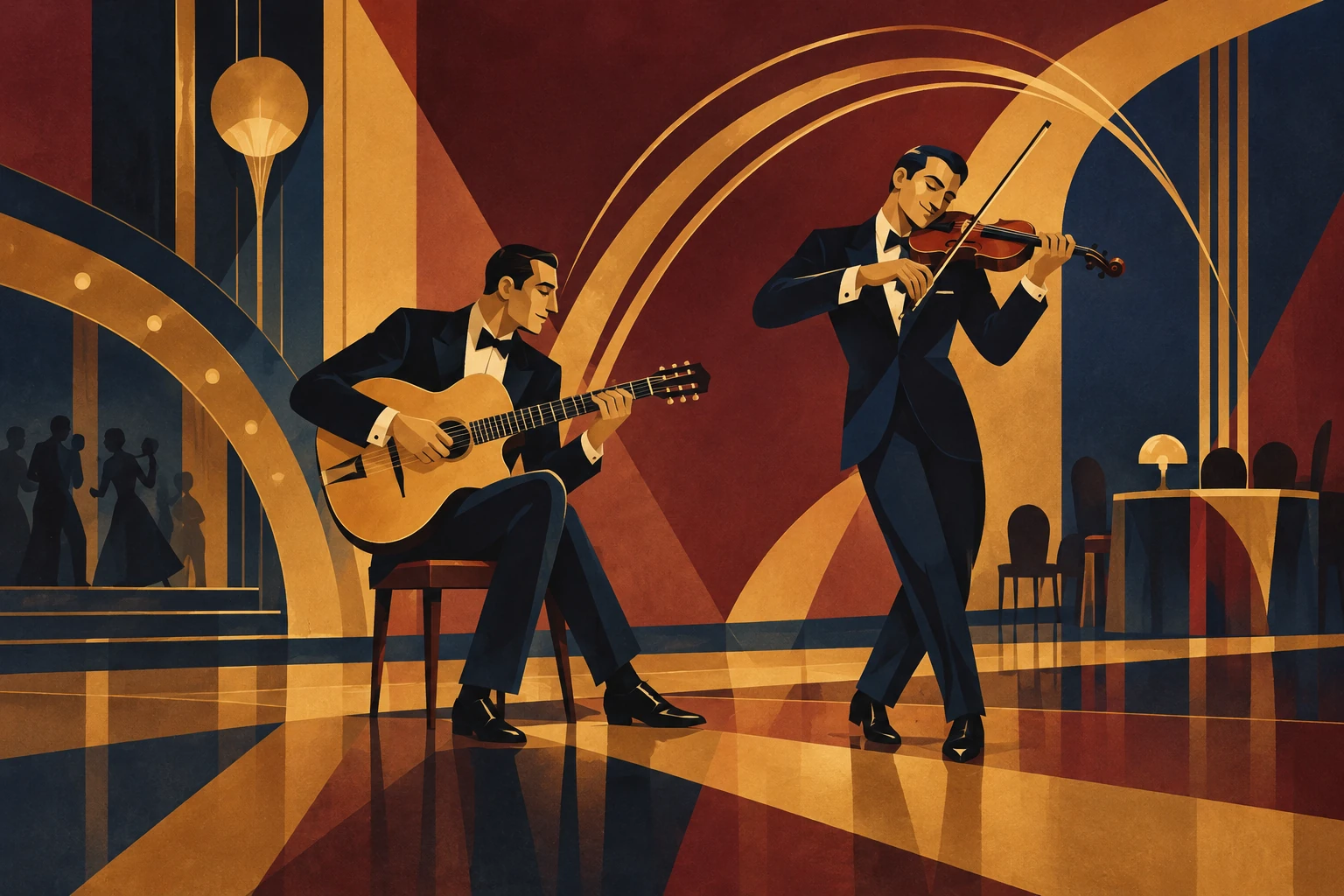
An original editorial interpretation of the tune. This is an illustration, not an archival photograph or a documented reconstruction of a recording session.
Original Djangopedia illustration · AI-assisted, 2026
Illustration credits & provenance →Selected performances by notable Gypsy Jazz players and ensembles. Inclusion is editorial and does not imply an objective popularity ranking.
Joscho Stephan Quintet · Joscho Stephan
Filmed quintet performance · Source-described independent performance; available player checked 2026-10-06. Musical suitability awaits owner review.
Costel Nițescu, Joscho Stephan, Olli Soikkeli, Sven Jungbeck and Volker Kamp. The linked lesson is separate.
If playback is unavailable, use the source link.
 Sweet Georgia Brown // Joscho Stephan QuintetJoscho Stephan Quintet · Joscho StephanFilmed quintet performance · Source-described independent performance; available player checked 2026-10-06. Musical suitability awaits owner review.Costel Nițescu, Joscho Stephan, Olli Soikkeli, Sven Jungbeck and Volker Kamp. The linked lesson is separate.✓ Featured
 Sweet Georgia Brown | Jonny Hepbir Quartet | UK & International Gypsy Jazz Band HireJonny Hepbir Quartet · Jonny Hepbir Trio2017 · Fez, Margate, Kent, October 2017 · Source-described independent performance; available player checked 2026-10-06. Musical suitability awaits owner review.Live quartet performance filmed and edited by Dan Redding.Select video
 Sweet Georgia Brown - Gypsy Jazz Style GuitarDamjan PejcinoskiFilmed Gypsy Jazz guitar performance · Source-described independent performance; available player checked 2026-10-06. Musical suitability awaits owner review.Short independent guitar interpretation; linked tablature is separate from the performed video.Select video
 Bireli Lagrène - Sweet Georgia Brown, Minor Swing, Visper’s Dream - Jazz à Vienne 2002 - LIVEBiréli Lagrène ensemble · Zycopolis TV2002 · Jazz à Vienne, 9 July 2002 · Source-described independent performance; available player checked 2026-10-06. Musical suitability awaits owner review.Sweet Georgia Brown is the opening number of a concert clip also containing Minor Swing and Visper’s Dream; not a single-tune upload.Select video
Create a four-bar phrase on E7, adapt its function to A7 and D7, then write a different answer for G. Use repetition to build a whole chorus.
Drive the pulse gently through the long dominants, then make the quicker final changes readable. A common top voice helps connect the chain.
Start at 120–140; build toward 180–230 bpm
Create a four-bar phrase on E7, adapt its function to A7 and D7, then write a different answer for G. Use repetition to build a whole chorus.
Start below the suggested tempo. First hear four quarter-note clicks, then halve the click rate and place clicks on beats 2 and 4. Keep the same phrase length.
Sweet Georgia Brown — G major (this chart); 32-bar chorus with extended dominant chain. Agree the tempo, pickup, solo order and ending before the count.
Name the concert key; this standard circulates in several keys and tempo traditions.
Use bass landmarks under the repeated melody and reserve chordal movement for the cadence.
Name the concert key; this standard circulates in several keys and tempo traditions.
Choose the singer’s comfortable key, then transpose the whole arrangement, including the introduction. Use the original lyric phrasing to shape breathing.
This player guide combines inherited recording evidence and editorial study notes. Musical study notes are editorial suggestions; compare them with the recording.
Composition background and credits ↗
Guitare Improvisation — backing track ↗
Feature photograph — Gypsy Jazz UK historical archive ↗
Original Djangopedia illustration · AI-assisted, 2026
An original editorial interpretation of the tune. This is an illustration, not an archival photograph or a documented reconstruction of a recording session.
Generated with the native image-generation tool on 2026-10-08; original editorial artwork, not a historical photograph.
Prompt: Original editorial feature illustration for Sweet Georgia Brown. Original Art Deco poster-language illustration without typography: two small stylised standing jazz musicians, guitar and violin, placed off-centre in a wide dance-hall abstraction, with long rising golden arcs sweeping from one instrument to the next. Burgundy, warm gold and midnight blue, elegant flat planes and fast swing energy. Preserve only the old photo’s paired instrumental relationship, with entirely new poses and spacing, full heads comfortably inside the central safe crop. This is a conceptual interpretation, not a specific documented performance. Original Djangopedia editorial illustration, clearly non-photographic. Do not copy a photograph, known artwork or specific artist. Landscape 1536 by 1024 feature image, important subjects within the middle 75% for responsive hero cropping. No lettering, numbers, musical notation glyphs, logos, signature, watermark, fake archival markings, caption or border. One finished candidate only.
Photograph rights are documented separately in its credit. They do not establish the rights status of the composition or recording.
