
Tune details
Music: Philip Braham
Words: Douglas Furber
Published / composed: 1921
Original key: Not established
Study level: Advanced at customary fast tempos
 Djangopedia
A fast swing standard with long dominant spans and a clear two-half design. Despite its title, its song form requires a different sense of pacing from a twelve-bar blues.
Keep the 32-bar roadmap stable as the tempo rises.
Owner content reviewed — 2026-10-04T23:06:44Z by admin. Coverage measures presence, not accuracy. Content review does not certify rights or musical perfection.
Django recordings for this tune. Uploader dates and take labels remain source claims; only an evidenced exact association enables a row’s Listen control.
Django Reinhardt
source-described; accuracy not independently verified
Uploader identifies this as Django Reinhardt’s performance; recording date and take require comparison with the discography.
| Entry | Year | Recording / session / release evidence | Listen |
|---|---|---|---|
| 01 | 1935 | Limehouse Blues, Oct 1935, 2035-HPP ,"Fremeaux FA 304, Classics 708, JSP 344, Rhapsody RHCD6, Gitanes 159 853-2" | — |
| 02 | 1936 | Limehouse Blues, 4/5/36, OLA 1062-1 ,"Fremeaux FA 305, Affinity AFS 1003, Classics 739, JSP 344, Conifer HD 206, EMI 7806712-2, EMI 746 5012 (Mistitled Bill Coleman Blues),Blue Note CDP 7243837138-2, Mosaic MD6-190(6 CD Set)."," Paris - QHCF - Stephane Grappelly (v), Django Reinhardt, Joseph Reinhardt, Pierre Ferret (g), Lucien Simoens (b), Freddy Taylor (vo)" | — |
| 03 | 1937 | Limehouse Blues, 13/6/37, Fremeaux 306," - CBS Broadcast - Stephane Grappelli (v), Django&Joseph Reinhardt (g), Gusti Mahla (g), Louis Vola (b)." | — |
| 04 | 1938 | Limehouse Blues, 30/6/38, Acetate ,Fremeaux 308,- Swing Night in Paris | — |
| 05 | 1940 | Limehouse Blues, 22/3/40, OSW 119-1 ,"Fremeaux FA 310, Classics 831, Affinity AFS 1003, Jazz Time 252707-2, HEP 1041"," - Paris - Django Reinhardt (g), Philippe Brun, Pierre Allier, Alex Renard, Al Piguillem (tpt), Andre Ekyan (as), Guy Paquinet, Gaston Moat, Pierre Deck (tbn), Alix Combelle (bs), Charlie Lewis (p), Pierre Ferret (g), Emmanuel Soudieux (b)" | — |
A dash means no video has been associated with this exact historical recording. Tune-level listening resources remain available above.
Philip Braham and Douglas Furber wrote the song for the 1921 London revue A to Z. The legacy Django page lists several versions beginning in 1935. Its origin in musical theatre predates its life as an instrumental virtuoso piece.
Music: Philip Braham
Words: Douglas Furber
Published / composed: 1921
Original key: Not established
Study level: Advanced at customary fast tempos
Listening task: Learn the phrase endpoints at a slow tempo before connecting the fast notes. Count the head before comparing solo choruses.
Limehouse Blues, Oct 1935, 2035-HPP ,"Fremeaux FA 304, Classics 708, JSP 344, Rhapsody RHCD6, Gitanes 159 853-2"
Compare the tempo, key, introduction and final cadence with the first entry. Keep the 32-bar roadmap stable as the tempo rises.
Limehouse Blues, 22/3/40, OSW 119-1 ,"Fremeaux FA 310, Classics 831, Affinity AFS 1003, Jazz Time 252707-2, HEP 1041"," - Paris - Django Reinhardt (g), Philippe Brun, Pierre Allier, Alex Renard, Al Piguillem (tpt), Andre Ekyan (as), Guy Paquinet, Gaston Moat, Pierre Deck (tbn), Alix Combelle (bs), Charlie Lewis (p), Pierre Ferret (g), Emmanuel Soudieux (b)"
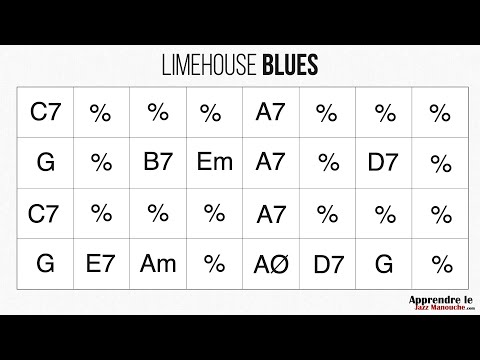
Count its form and check its key before joining in. The inherited G-major version opens on C7, then A7 before reaching G. B7 points to E minor; A7 and D7 prepare the next phrase. The final half uses Am and C-minor colour on its way home.
The inherited G-major version opens on C7, then A7 before reaching G. B7 points to E minor; A7 and D7 prepare the next phrase. The final half uses Am and C-minor colour on its way home.
Chord symbols follow the inherited Djangopedia chart. Slashes are rhythmic marks; chord quality and turnaround choices may differ from the backing track. This is a chord reference, not a melody transcription.
[[Image:limehouse.gif]]


| C7/// | C7/// | C7/// | C7/// | A7/// | A7/// | A7/// | A7/// |

| G/// | G/// | B7/// | Em/// | A7/// | A7/// | D7/// | D7/// |

| C7/// | C7/// | C7/// | C7/// | A7/// | A7/// | A7/// | A7/// |

| G/// | E7/// | Am/// | Cm6/// | Am/// | D7/// | G/// | G/// :||
Original source ↗
Gonzalo Bergara
2:20
If playback is unavailable, use the source link.
 Gypsy Jazz Play Along - Limehouse BluesGonzalo Bergara2:20✓ Featured
 Gypsy Jazz Backing Track / Play Along - Limehouse BluesStudy Gypsy Jazz3:19Select video
 Limehouse Blues (270bpm) - Playback jazz manouche - Gypsy jazz backing track / play alongClément Reboul4:00Select video
 Gypsy Jazz / Manouche - Limehouse Blues 200bpm (Play along / Backing Track )DC Music School5:12Select video
Performed studies, transcriptions, TAB, notation and lessons for studying Django’s solo. Inclusion does not certify note-for-note accuracy.
Christiaan van Hemert
source-described; accuracy not independently verified
Creator presents a study of Django’s recorded solo. Use it alongside the original recording; exact transcription accuracy has not been independently reviewed.
If playback is unavailable, use the source link.
Follow a shared key, a harmonic idea or a familiar form. Keys refer to this site’s chart editions; other recordings may use a different key.
No sufficiently supported harmonic comparison has been added yet.
Showing 8 of 25 matches. Explore the full catalogue →
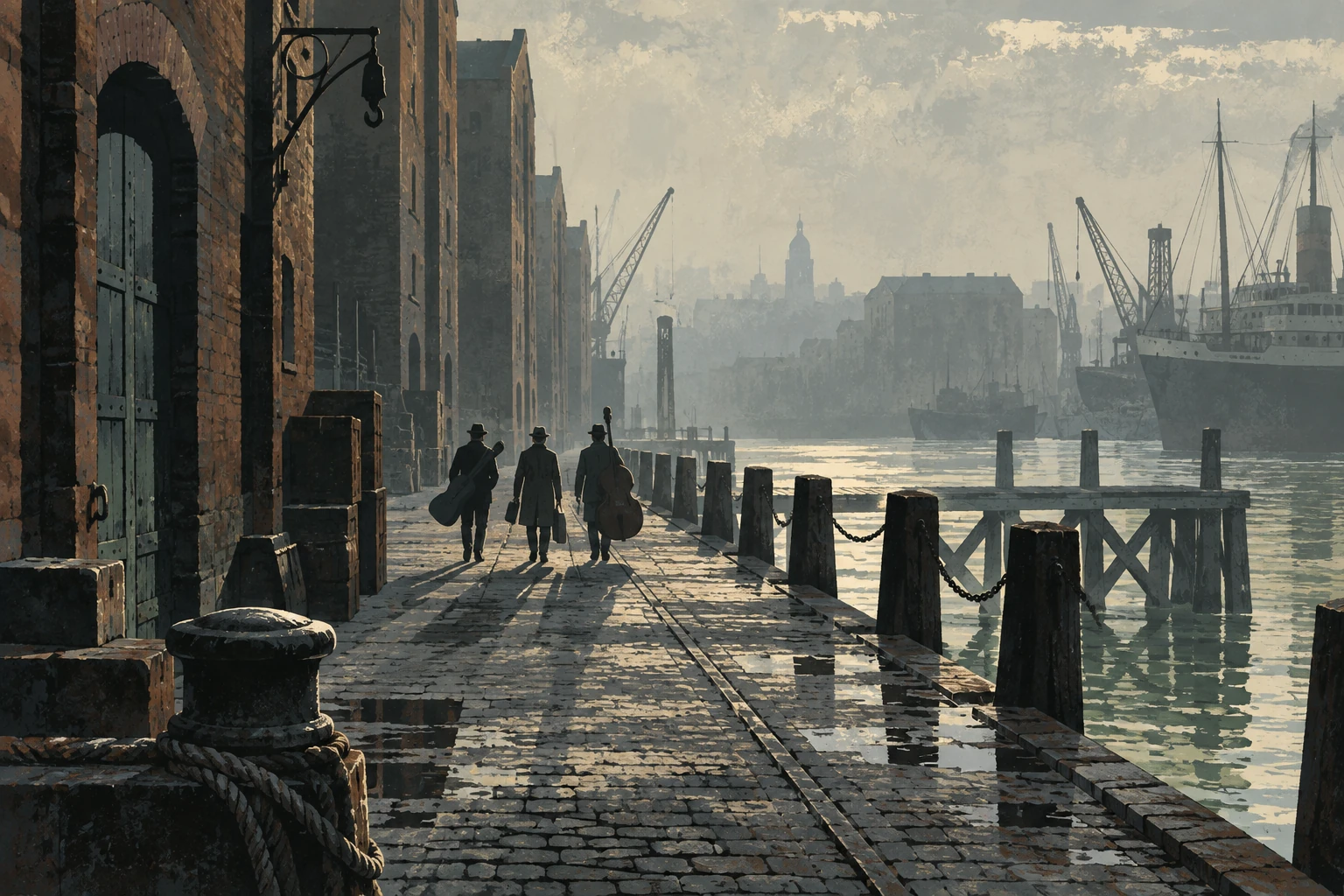
A generic London dockside view with long warehouse shadows, three tiny distant musicians carrying cases and a single straight rhythm of posts interrupted by a turning jetty. Long dominant spans and the full song chorus, not a twelve-bar loop, shape the perspective.
An original editorial interpretation of the tune. This is an illustration, not an archival photograph or a documented reconstruction of a recording session.
Original Djangopedia illustration · AI-assisted, 2026
Illustration credits & provenance →Selected performances by notable Gypsy Jazz players and ensembles. Inclusion is editorial and does not imply an objective popularity ranking.
Stochelo Rosenberg, Biréli Lagrène, Dorado Schmitt · magicfiddle
2000 · Strasbourg Festival Tsigane · Source title/description and available watch page checked 2026-10-05; independent performance; owner accuracy not independently verified.
Festival jam with three named guitarists.
If playback is unavailable, use the source link.
 "Limehouse Blues" - Gypsy Jazz - Bireli Lagren and Stochelo RosenbergStochelo Rosenberg, Biréli Lagrène, Dorado Schmitt · magicfiddle2000 · Strasbourg Festival Tsigane · Source title/description and available watch page checked 2026-10-05; independent performance; owner accuracy not independently verified.Festival jam with three named guitarists.✓ Featured
 Joscho Stephan & friends - Limehouse BluesJoscho Stephan, Costel Nitescu, Sven Jungbeck, Volker Kamp · Jazz Club Hannover by Gartenheim2022 · Hannover; 25 November 2022 · Source title/description and available watch page checked 2026-10-05; independent performance; owner accuracy not independently verified.Concert quartet with violin; uploader's composer attribution omitted.Select video
 Limehouse Blues - Tcha Limberger, Christiaan van Hemert, Rocky GressetTcha Limberger, Christiaan van Hemert, Rocky Gresset, Kumiko Imakyurei · Kumiko Imakyurei2019 · March Manouche; 24 March 2019 · Source title/description and available watch page checked 2026-10-05; independent performance; owner accuracy not independently verified.Violin, two guitars and bass festival setting.Select video
 Limehouse Blues - Peter Beets at the Django Reinhard NY FestivalPeter Beets and Django Reinhardt NY Festival ensemble · Peter Beets2004 · Birdland, New York · Source title/description and available watch page checked 2026-10-05; independent performance; owner accuracy not independently verified.Piano-led festival performance; individual guest appearances not independently identified.Select video
 Stochelo Rosenberg - Limehouse bluesStochelo Rosenberg, Biréli Lagrène, Christian Escoudé · JacopojConcert ensemble; names in description · Source title/description and available watch page checked 2026-10-05; independent performance; owner accuracy not independently verified.Separate upload and named personnel from the Strasbourg clip; no date inferred.Select video
Play the whole form in half-time with one phrase every two bars. Keep that phrase spacing as the backing track becomes faster.
Use economical grips and a consistent pulse. Long dominant spans need time feel more than harmonic decoration.
Start at 130–160; build toward 220–280 bpm
Play the whole form in half-time with one phrase every two bars. Keep that phrase spacing as the backing track becomes faster.
Start below the suggested tempo. First hear four quarter-note clicks, then halve the click rate and place clicks on beats 2 and 4. Keep the same phrase length.
Limehouse Blues — G major (legacy chart); 32-bar song chorus; not a 12-bar blues. Agree the tempo, pickup, solo order and ending before the count.
Confirm the key and form, since non-Manouche charts may use a different key. Keep the starting tempo realistic for everyone.
Simplify bass and harmony to section landmarks; prioritize a relaxed, clearly articulated melody.
Confirm the key and form, since non-Manouche charts may use a different key. Keep the starting tempo realistic for everyone.
Choose the singer’s comfortable key, then transpose the whole arrangement, including the introduction. Use the original lyric phrasing to shape breathing.
This player guide combines inherited recording evidence and editorial study notes. Musical study notes are editorial suggestions; compare them with the recording.
Composition background and credits ↗
Gonzalo Bergara — backing track ↗
Feature photograph — Gypsy Jazz UK historical archive ↗
Original Djangopedia illustration · AI-assisted, 2026
An original editorial interpretation of the tune. This is an illustration, not an archival photograph or a documented reconstruction of a recording session.
Generated with the native image-generation tool on 2026-10-08; original editorial artwork, not a historical photograph.
Prompt: Use case: illustration-story. One original editorial feature illustration for Djangopedia's guide “Limehouse Blues”. Landscape 1536 × 1024, opaque background. Scene: A generic London dockside view with long warehouse shadows, three tiny distant musicians carrying cases and a single straight rhythm of posts interrupted by a turning jetty. Long dominant spans and the full song chorus, not a twelve-bar loop, shape the perspective. Musical basis from the guide: A fast swing standard with long dominant spans and a clear two-half design. Despite its title, its song form requires a different sense of pacing from a twelve-bar blues. The supplied chart is G major (legacy chart); form: 32-bar song chorus; not a 12-bar blues; feel: Swing. These describe musical inspiration, not visible writing. Historical context: Philip Braham and Douglas Furber wrote the song for the 1921 London revue A to Z. The legacy Django page lists several versions beginning in 1935. Its origin in musical theatre predates its life as an instrumental virtuoso piece. Do not illustrate disputed historical claims or suggest this imagined scene is an archival session. Medium: lithographic illustration. Dominant palette: cool grey rust and muted green. Composition: long waterfront perspective. Human presence: three tiny figures. Strong intentional design, clearly drawn/painted, distinctive material marks; keep essential subject safely within the central 70 percent width and middle 80 percent height for card crops. Maintain enough visual substance at thumbnail size. Broad inspiration observed in old photo, ONLY scale/rhythm and never a reference image: three close figures; formal frontal grouping. Independently invent every pose, perspective, clothing, setting and lighting. Avoid: No portrait, opium/Chinatown stereotypes, famous skyline copying. No photorealism, archival simulation, generated text, letters, numbers, labels, fake musical notation, logo, signature, watermark, fake dates, yellowed-paper patina, recognizable artwork or copied photograph. No imitation of any named artist. Render the art edge to edge without borders, mockup or typography. Batch A diversity compensation: avoid blue sky, drifting clouds, cypress trees, moon discs, generic Paris landmarks and curving terrace backdrops unless explicitly essential to the stated scene. Keep this composition tied to its precise stated subject; do not add an unrequested landscape or city. For figure scenes keep the specified standing/walking pose; no seated centered guitar portrait. For abstracts keep purely graphic materials and forms.
Photograph rights are documented separately in its credit. They do not establish the rights status of the composition or recording.
