
Tune details
Music: Jerome Kern
Words: Oscar Hammerstein II
Published / composed: 1939
Original key: Not established
Study level: Advanced harmonic navigation
 Djangopedia
A long melody travels through several tonal centres and takes twelve bars for its final return. This is a tune for connecting destinations, not merely recognising a series of ii–V shapes.
Know the destination of each phrase and the length of the final twelve bars.
Owner content reviewed — 2026-10-04T09:54:53Z by admin. Coverage measures presence, not accuracy. Content review does not certify rights or musical perfection.
Django recordings for this tune. Uploader dates and take labels remain source claims; only an evidenced exact association enables a row’s Listen control.
Django Reinhardt
source-described; accuracy not independently verified
Uploader identifies this as Django Reinhardt’s performance; recording date and take require comparison with the discography.
| Entry | Year | Recording / session / release evidence | Listen |
|---|---|---|---|
| 01 | 1949 | All The Things You Are, Jan-Feb 1949, CW 30,"Fremeaux FA 316, RCA ND 70929-2, RCA ND 90448, Suisa CD 32"," - Rome - Django Reinhardt (g), Stephane Grappelly (v),Gianni Safred (p), Carlo Pecori (b), Aurelio de Carolis (d)" | — |
A dash means no video has been associated with this exact historical recording. Tune-level listening resources remain available above.
Kern and Hammerstein wrote the song for Very Warm for May in 1939. Djangopedia documents Django and Grappelli in Rome in January–February 1949. The inherited chart is in B♭, a whole step above the familiar A♭ concert edition, and includes harmonic readings that need comparison.
Music: Jerome Kern
Words: Oscar Hammerstein II
Published / composed: 1939
Original key: Not established
Study level: Advanced harmonic navigation
Listening task: Learn the melody in the exact key of the selected arrangement. Count the head before comparing solo choruses.
All The Things You Are, Jan-Feb 1949, CW 30,"Fremeaux FA 316, RCA ND 70929-2, RCA ND 90448, Suisa CD 32"," - Rome - Django Reinhardt (g), Stephane Grappelly (v),Gianni Safred (p), Carlo Pecori (b), Aurelio de Carolis (d)"
Count its form and check its key before joining in. The first Gm–Cm–F7 sequence reaches B♭, then A7 leads into D. The next phrase starts Dm–Gm–C7, eventually arriving at A. Bm–E7 and G♯m–C♯7 shape the bridge. The final section lasts twelve bars.
The first Gm–Cm–F7 sequence reaches B♭, then A7 leads into D. The next phrase starts Dm–Gm–C7, eventually arriving at A. Bm–E7 and G♯m–C♯7 shape the bridge. The final section lasts twelve bars.
This 36-cell legacy edition is in B♭, not the common A♭ concert key. Its B♭7 readings in the second phrase and later A7/Dm movement need comparison with the chosen edition. Do not transpose only the first chord.
| Gm7/// | Cm7/// | F9/// | Bb/// | Eb/// | A7/// | D/// | D/// |

| Dm7/// | Gm7/// | C9/// | F69/// | Bb7/// | Bb7/// | A/// | A/// |

| Bm7/// | E9/// | A/// | A/// | Abm7/// | C#9/// | F#69/// | F#7/// |

| Gm7/// | Cm7/// | F9/// | Bb/// | Eb/// | A7/// | Dm7/// | G7/// |

| Cm7/// | F9/// | Bb69 | Eb9/ D9/ :||
Original source ↗
Guitare Improvisation
The inherited chart is in B♭; many backing editions use A♭. Check the track’s opening chord and tonic before playing; Gm in this chart would become Fm when transposed down a whole step. · 5:14
If playback is unavailable, use the source link.
 All the things you are - Backing TrackGuitare ImprovisationThe inherited chart is in B♭; many backing editions use A♭. Check the track’s opening chord and tonic before playing; Gm in this chart would become Fm when transposed down a whole step. · 5:14✓ Featured
 All The Things You Are (Play-Along)Learn Jazz Standards7:05Select video
 All The Things You Are (slow) - Backing track / Play-alongQGVideos4:09Select video
 All The Things You Are BACKING 230bmpSimon Peter King3:48Select video
Performed studies, transcriptions, TAB, notation and lessons for studying Django’s solo. Inclusion does not certify note-for-note accuracy.
Tessa Spaaij
source-described; accuracy not independently verified
Creator presents a study of Django’s recorded solo. Use it alongside the original recording; exact transcription accuracy has not been independently reviewed.
If playback is unavailable, use the source link.
Follow a shared key, a harmonic idea or a familiar form. Keys refer to this site’s chart editions; other recordings may use a different key.
No sufficiently supported harmonic comparison has been added yet.
Showing 8 of 10 matches. Explore the full catalogue →
No match is established in the current chart metadata.
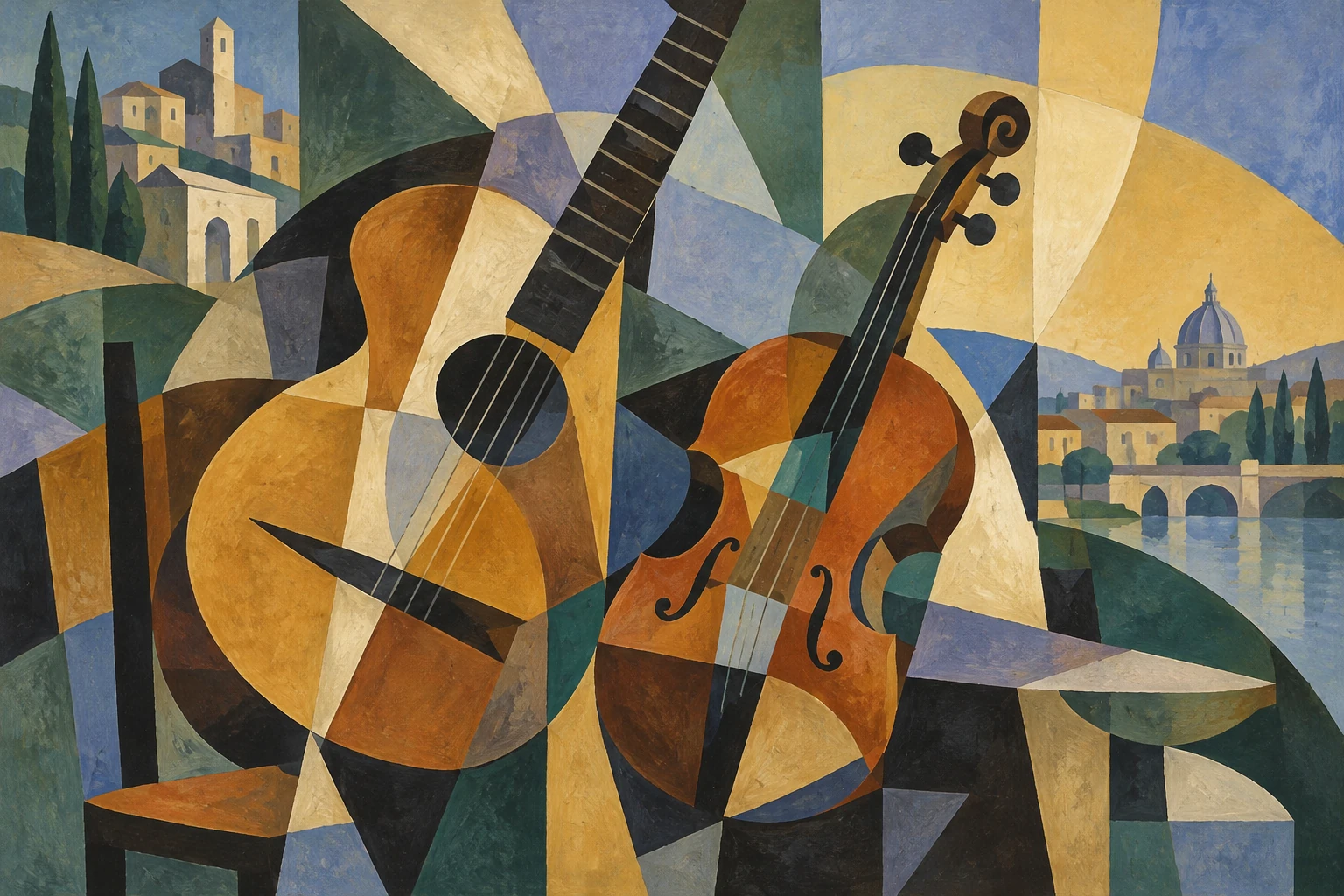
Kern/Hammerstein’s 1939 song is a 36-bar harmonic journey; the archive documents Django/Grappelli in Rome in 1949. The old photograph is a close outdoor conversation between two people; retain only the idea of a dialogue.
An original editorial interpretation of the tune. This is an illustration, not an archival photograph or a documented reconstruction of a recording session.
Original Djangopedia illustration · AI-assisted, 2026
Illustration credits & provenance →Selected performances by notable Gypsy Jazz players and ensembles. Inclusion is editorial and does not imply an objective popularity ranking.
Jimmy Rosenberg, Don Hofstee and Arnoud van den Berg · The Fellowship of Acoustics
The Fellowship Sessions · Watch-page identity, tune, performers and Gypsy jazz context checked 2026-10-07; date/session details remain source claims.
Store-session performance featuring Jimmy Rosenberg on a Gypsy jazz guitar; this is the song performance, not a lesson.
If playback is unavailable, use the source link.
 All The Things You Are - Jimmy Rosenberg | The Fellowship Sessions | @ TFOAJimmy Rosenberg, Don Hofstee and Arnoud van den Berg · The Fellowship of AcousticsThe Fellowship Sessions · Watch-page identity, tune, performers and Gypsy jazz context checked 2026-10-07; date/session details remain source claims.Store-session performance featuring Jimmy Rosenberg on a Gypsy jazz guitar; this is the song performance, not a lesson.✓ Featured
 Adrien Moignard :: "All The Things You Are"Adrien Moignard, William Brunard and Julien Cattiaux · keefboof2016 · Atelier Charonne, Paris · Watch-page identity, tune, performers and Gypsy jazz context checked 2026-10-07; date/session details remain source claims.Live performance dated 26 May 2016 by the uploader.Select video
 Peter Autschbach & Joscho Stephan - "All the things you are"Peter Autschbach and Joscho Stephan · Peter Autschbach2020 · Online guitar-duo concert · Watch-page identity, tune, performers and Gypsy jazz context checked 2026-10-07; date/session details remain source claims.Guitar-duo performance from the 12 June 2020 online concert, featuring Gypsy jazz guitarist Joscho Stephan.Select video
Write the arrival keys above the form, then improvise a chorus using only thirds. Sing the final twelve bars while playing roots to prove the extra length is secure.
Use two- or three-note shells and small voice movements. At first, make each new tonal centre plain instead of adding substitutions to an already rich progression.
Start at 70–90; build toward 130–170 bpm
Write the arrival keys above the form, then improvise a chorus using only thirds. Sing the final twelve bars while playing roots to prove the extra length is secure.
Start below the suggested tempo. First hear four quarter-note clicks, then halve the click rate and place clicks on beats 2 and 4. Keep the same phrase length.
All The Things You Are — B♭ major (legacy chart); A♭ common in other editions; 36-bar chorus, 8 + 8 + 8 + 12. Agree the tempo, pickup, solo order and ending before the count.
Name the concert key and the 36-bar form. Compare the chart’s second eight bars before rehearsal.
Reduce accompaniment to guide tones below the melody; thick grips at every change can interrupt the long line.
Name the concert key and the 36-bar form. Compare the chart’s second eight bars before rehearsal.
Choose the singer’s comfortable key, then transpose the whole arrangement, including the introduction. Use the original lyric phrasing to shape breathing.
Search online videos of "All The Things You Are" in youtube.com ↗
This player guide combines inherited recording evidence and editorial study notes. Musical study notes are editorial suggestions; compare them with the recording.
Composition background and credits ↗
Guitare Improvisation — backing track ↗
Feature photograph — Gypsy Jazz UK historical archive ↗
Original Djangopedia illustration · AI-assisted, 2026
An original editorial interpretation of the tune. This is an illustration, not an archival photograph or a documented reconstruction of a recording session.
Generated with the native image-generation tool on 2026-10-08; original editorial artwork, not a historical photograph.
Prompt: Original editorial feature illustration for All The Things You Are. Create a Cubist-inspired editorial composition of interlocking guitar and violin forms, conversing across broad overlapping planes. A sequence of harmonic colour fields leads across the landscape and ends in an extended final arc, echoing the 36-bar form. Muted ochre, periwinkle and jade, opaque painted edges. Rome 1949 is the documented musical context, but do not depict a claimed venue or session. Instruments and spatial relationships, no centered musician portrait. Original Djangopedia editorial illustration, clearly non-photographic. Do not copy a photograph, known artwork or specific artist. Landscape 1536 by 1024 feature image, important subjects within the middle 75% for responsive hero cropping. No lettering, numbers, musical notation glyphs, logos, signature, watermark, fake archival markings, caption or border. One finished candidate only.
Photograph rights are documented separately in its credit. They do not establish the rights status of the composition or recording.
