
Tune details
Music: Django Reinhardt
Documented in archive: 1940
Original key: Not established
Study level: Intermediate; advanced where the inherited roadmap needs reconstruction
 Djangopedia
A harmonically distinctive Django piece whose inherited chart mixes minor-seventh, major-seventh and half-diminished colours. Its unusual source layout needs arrangement checking before a jam-session count is fixed.
Verify the roadmap and the chord qualities before increasing tempo.
Owner content reviewed — 2026-10-06T15:52:09Z by admin. Coverage measures presence, not accuracy. Content review does not certify rights or musical perfection.
Django recordings for this tune. Uploader dates and take labels remain source claims; only an evidenced exact association enables a row’s Listen control.
Uploader identifies this as Django Reinhardt’s performance; recording date and take require comparison with the discography.
| Entry | Year | Recording / session / release evidence | Listen |
|---|---|---|---|
| 01 | 1940 | Swing '41, 13/12/40, OSW 145-1,"Fremeaux FA 310, Classics 852, Affinity AFS 1003, Jazz Time 252707-2, Music Memoria 31005, EMI 780671-2, Jazz Archives 157222, EMI 7465012, RDC 40032, Mosaic MD6-190(6 CD Set)."," - Paris - QHCF+ - Hubert Rostaing (cl), Alix Combelle (cl,ts) Django & Joseph Reinhardt (g), Tony Rovira (b), Pierre Fouad (d)" | — |
| 02 | 1947 | Swing '41, 29/8/47, "Fremeaux FA 314, Vogue 228E 6006, Vogue 668003-2, Kardum GLO 139"," - Paris - Souvenirs de Django - Django Reinhardt (elg), Maurice Meunier (cl), Eugene Vees (g),Emmanuel Soudieux (b), Andre Jourdan (d)" | — |
A dash means no video has been associated with this exact historical recording. Tune-level listening resources remain available above.
Swing '41 is credited here to Django Reinhardt. The inherited archive lists 2 recording entries, with dated entries spanning 1940–1947. These are archive rows, not a claim that every entry is a distinct released take. The linked recording rows preserve the original discographical wording. Compare their dates, matrices and personnel when choosing a performance to study.
Music: Django Reinhardt
Documented in archive: 1940
Original key: Not established
Study level: Intermediate; advanced where the inherited roadmap needs reconstruction
Listening task: Use the melody to distinguish repeated blocks that share the same written harmony. Mark the key, pickup, phrase lengths and ending before comparing another version.
Swing '41, 13/12/40, OSW 145-1,"Fremeaux FA 310, Classics 852, Affinity AFS 1003, Jazz Time 252707-2, Music Memoria 31005, EMI 780671-2, Jazz Archives 157222, EMI 7465012, RDC 40032, Mosaic MD6-190(6 CD Set)."," - Paris - QHCF+ - Hubert Rostaing (cl), Alix Combelle (cl,ts) Django & Joseph Reinhardt (g), Tony Rovira (b), Pierre Fouad (d)"
Compare the first and last listed entries for tempo, instrumentation and arrangement. Do not infer identical takes from a shared title. Verify the roadmap and the chord qualities before increasing tempo.
Swing '41, 29/8/47, "Fremeaux FA 314, Vogue 228E 6006, Vogue 668003-2, Kardum GLO 139"," - Paris - Souvenirs de Django - Django Reinhardt (elg), Maurice Meunier (cl), Eugene Vees (g),Emmanuel Soudieux (b), Andre Jourdan (d)"
The track is labelled F, while the inherited chart opens on Am7 and has an unresolved roadmap. Compare the complete harmony and form; do not assume a simple key transposition fixes the differences.
Repeated Am7–B♭–Bm7♭5–Cmaj7 material leads to a contrasting B♭–Am7–Fmaj7 passage and a return through G7–Cmaj7.
The source prints four opening eight-cell blocks, a contrasting eight-cell passage and a final opening block. Its F♯ symbol and relationship to other editions remain unresolved; no silent correction is made.
| Am7/// | Am7/// | Bb/// | Bb/// |

| Bm7b5/// | Bm7b5/// | CM7/// | Am7/// |

| Am7/// | Am7/// | Bb/// | Bb/// |

| Bm7b5/// | Bm7b5/// | CM7/// | Am7/// |

| Am7/// | Am7/// | Bb/// | Bb/// |

| Bm7b5/// | Bm7b5/// | CM7/// | Am7/// |

| Am7/// | Am7/// | Bb/// | Bb/// |

| Bm7b5/// | Bm7b5/// | CM7/// | Am7/// |

| Bb/// | Bb/// | Am7/// | FM7/// |

| Bb/// | Bm7b5/// | Bm7b5/ F#/ | G7/ CM7/ |

| Am7/// | Am7/// | Bb/// | Bb/// |

| Bm7b5/// | Bm7b5/// | CM7/// | Am7/// :||
Original source ↗
Chris Fargen · The track is labelled F, while the inherited chart opens on Am7 and has an unresolved roadmap. Compare the complete harmony and form; do not assume a simple key transposition fixes the differences. · 2:02
Checked 2026-10-01
Most-viewed suitable match selected from the captured search results after title/composition review; not a complete YouTube ranking. Source counts were captured on 1 October 2026. Coaching, unrelated songs and non-backing performances are excluded.
Performed studies, transcriptions, TAB, notation and lessons for studying Django’s solo. Resources are described by their creator; inclusion does not certify note-for-note accuracy.
Tracy Kim Music · Tracy Kim · Melody lesson; exact Django solo/source recording not established. 41 is the tune title, not a recording year. · Owner selected and authorized publication. YouTube identity and visible resource type checked; exact take and musical accuracy not independently verified.
Owner-selected Swing 41 guitar lesson/melody with tabs. Shows guitar demonstration and teaching; uploader identifies the melody lesson, not a specific Django improvised performed solo study.
Follow a shared key, a harmonic idea or a familiar form. Keys refer to this site’s chart editions; other recordings may use a different key.
No sufficiently supported harmonic comparison has been added yet.
Showing 8 of 21 matches. Explore the full catalogue →
No match is established in the current chart metadata.
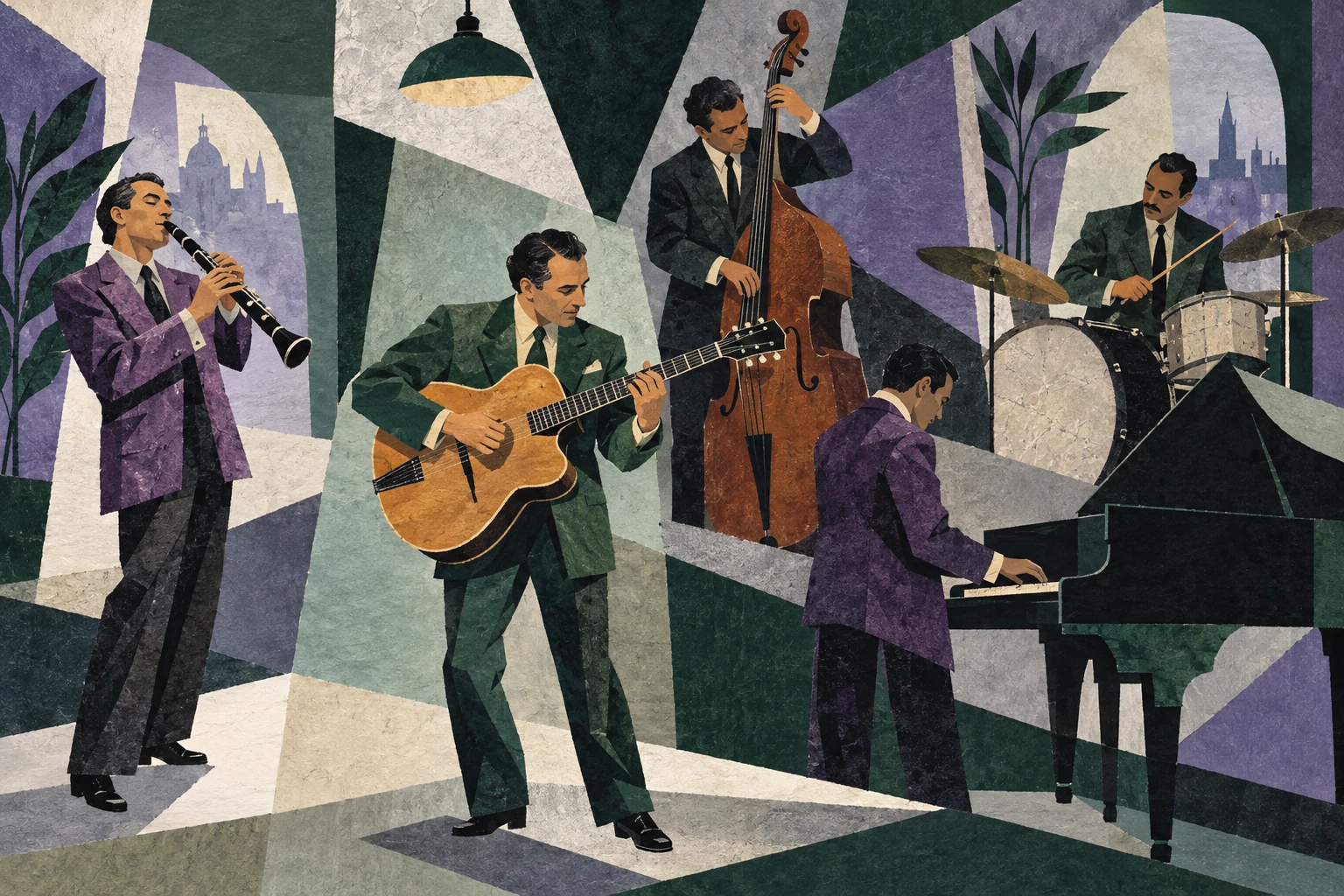
A fictional guitar, clarinet, piano, bass and drums band occupies staggered vertical registers; dark and light chord-shaped planes overlap around them without enclosing their faces. Varied seventh and half-diminished colour supplies the tension, no reenactment of the photograph.
An original editorial interpretation of the tune. This is an illustration, not an archival photograph or a documented reconstruction of a recording session.
Original Djangopedia illustration · AI-assisted, 2026
Illustration credits & provenance →Selected performances by notable Gypsy Jazz players and ensembles. Inclusion is editorial and does not imply an objective popularity ranking.
MustaKa
Artist-channel ensemble recording
Stage 4M private performance. Artist-channel ensemble recording. Marco Néri, Zoltàn Kisàk, Samuel Huguenin and Jean-Baptiste Guerrier; static artwork.
If playback is unavailable, use the source link.
 Swing 41MustaKaArtist-channel ensemble recordingStage 4M private performance. Artist-channel ensemble recording. Marco Néri, Zoltàn Kisàk, Samuel Huguenin and Jean-Baptiste Guerrier; static artwork.✓ Featured
 Swing 41Hot Club of Black RockBand-channel live arrangementStage 4M private performance. Band-channel live arrangement. Visible trio; exact performance date unestablished.Select performance
 Gypsy 808 plays Swing 41 at Dragon Upstairs, Honolulu Jan 4 2018Gypsy 808 · cda7332018 · Dragon Upstairs, Honolulu, 4 January 2018Stage 4M private performance. Dragon Upstairs, Honolulu, 4 January 2018. Live ensemble; individual personnel not identified.Select performance
 "Swing 41" - The New Orleans Swinging GypsiesThe New Orleans Swinging Gypsies · James Sterling2017 · Bamboulas, New Orleans, 12 July 2017Stage 4M private performance. Bamboulas, New Orleans, 12 July 2017. Uploader explicitly warns that crowd noise and room acoustics impair sound quality; proposed last.Select performance
Play the four-chord opening loop using one guide tone per chord. Then mark the repeated blocks while following the chosen recording or backing arrangement.
Voice the changing qualities precisely and quietly. Avoid replacing every major-seventh symbol with a dominant seventh out of stylistic habit.
Start around 100–140 bpm; increase only after the form stays secure
Play the four-chord opening loop using one guide tone per chord. Then mark the repeated blocks while following the chosen recording or backing arrangement.
Begin with four quarter-note clicks. Halve the click rate and hear beats 2 and 4 while maintaining the same phrase lengths.
Swing '41 — A-minor / C-major area in the inherited chart; 48 source cells with repeated opening blocks; roadmap needs review. Agree the pickup, tempo and ending before counting in.
48 source cells with repeated opening blocks; roadmap needs review. The source prints four opening eight-cell blocks, a contrasting eight-cell passage and a final opening block. Its F♯ symbol and relationship to other editions remain unresolved; no silent correction is made.
Start with melody and bass only. Add the following colour without interrupting the melody: Distinguish B♭ over B♭ major from B natural over Bm7♭5 and Cmaj7.
Voice the changing qualities precisely and quietly. Avoid replacing every major-seventh symbol with a dominant seventh out of stylistic habit. Agree the full roadmap and signal the last head before it starts.
This guide focuses on the instrumental arrangement; any lyric adaptation needs separate credit and a chosen key.
This player guide combines inherited recording evidence and editorial study notes. Musical study notes are editorial suggestions; compare them with the recording.
Djangopedia — inherited chart and recording rows ↗
Composition credits and background ↗
Chris Fargen — practice backing ↗
Feature photograph — source collection ↗
Original Djangopedia illustration · AI-assisted, 2026
An original editorial interpretation of the tune. This is an illustration, not an archival photograph or a documented reconstruction of a recording session.
Generated with the native image-generation tool on 2026-10-08; original editorial artwork, not a historical photograph.
Prompt: Use case: illustration-story. One original editorial feature illustration for Djangopedia's guide “Swing '41”. Landscape 1536 × 1024, opaque background. Scene: A fictional guitar, clarinet, piano, bass and drums band occupies staggered vertical registers; dark and light chord-shaped planes overlap around them without enclosing their faces. Varied seventh and half-diminished colour supplies the tension, no reenactment of the photograph. Musical basis from the guide: A harmonically distinctive Django piece whose inherited chart mixes minor-seventh, major-seventh and half-diminished colours. Its unusual source layout needs arrangement checking before a jam-session count is fixed. The supplied chart is A-minor / C-major area in the inherited chart; form: 48 source cells with repeated opening blocks; roadmap needs review; feel: Swing. These describe musical inspiration, not visible writing. Historical context: Swing '41 is credited here to Django Reinhardt. Do not illustrate disputed historical claims or suggest this imagined scene is an archival session. Medium: cut-paper collage. Dominant palette: silver dark green and restrained violet. Composition: asymmetric split-register band. Human presence: five small figures. Strong intentional design, clearly drawn/painted, distinctive material marks; keep essential subject safely within the central 70 percent width and middle 80 percent height for card crops. Maintain enough visual substance at thumbnail size. Broad inspiration observed in old photo, ONLY scale/rhythm and never a reference image: wide ensemble with central guitar; vertical horns; layered depth. Independently invent every pose, perspective, clothing, setting and lighting. Avoid: No seated central soloist, exact chairs, yellow stage backdrop. No photorealism, archival simulation, generated text, letters, numbers, labels, fake musical notation, logo, signature, watermark, fake dates, yellowed-paper patina, recognizable artwork or copied photograph. No imitation of any named artist. Render the art edge to edge without borders, mockup or typography. Batch B diversity compensation: make light and midtone areas substantial; avoid near-black dominant backdrops, violet monochrome, empty chair/stool/bench compositions, repeated sunset terraces and generic cloud panoramas. Preserve the stated tune-specific scene. Human figures remain standing or peripheral except an explicitly named ensemble; no centered seated Django portrait. For graphic images use clearly plain colour shapes, no ruled parallel staffs, circles with stems, note-like marks or typography.
Photograph provenance and rights are stated separately. Attribution does not establish permission.