
Tune details
Music: Django Reinhardt, Stéphane Grappelli
Documented in archive: 1939
Original key: Not established
Study level: Intermediate harmony; advanced edition comparison
 Djangopedia
A tune of repeated harmonic blocks and contrasting dominant tension. The inherited chart is unusually expanded, making this a useful case for separating the composition’s form from the way an arrangement is written out.
Settle the roadmap and final tonic before adding substitutions.
Owner content reviewed — 2026-10-05T23:51:55Z by admin. Coverage measures presence, not accuracy. Content review does not certify rights or musical perfection.
Django recordings for this tune. Uploader dates and take labels remain source claims; only an evidenced exact association enables a row’s Listen control.
Django Reinhardt
source-described; accuracy not independently verified
Uploader identifies this as Django Reinhardt’s performance; recording date and take require comparison with the discography.
| Entry | Year | Recording / session / release evidence | Listen |
|---|---|---|---|
| 01 | 1939 | Swing '39, 21/3/39, 4969-1/2HPP,"Fremeaux FA 308, VJSP 343, Classics 793, Conifer HD 206, Jazz Archives 157222, Music Memoria 87949, Gitanes 159 854-2"," - Paris - QHCF - Stephane Grappelly (v), Django Reinhardt, Joseph Reinhardt,Pierre Ferret (g), Emmanuel Soudieux (b)" | — |
| 02 | 1947 | Swing '39, 29/8/47, "Fremeaux FA 314, Vogue 228E 6006, Vogue 668003-2, Vogue 670205"," - Paris - Souvenirs de Django - Django Reinhardt (elg), Maurice Meunier (cl), Eugene Vees (g),Emmanuel Soudieux (b), Andre Jourdan (d)" | — |
| 03 | 1949 | Swing '39, Jan-Feb 1949, CW 27,"Fremeaux FA 316, Jazz Time 827447-2"," - Rome - Django Reinhardt (g), Stephane Grappelly (v),Gianni Safred (p), Carlo Pecori (b), Aurelio de Carolis (d)" | — |
A dash means no video has been associated with this exact historical recording. Tune-level listening resources remain available above.
The composition is credited to Django Reinhardt and Stéphane Grappelli. The inherited discography begins with Paris on 21 March 1939 and includes 1947 and 1949 versions. The title’s date agrees with that earliest listed session, but the old chart still needs a separate musical check.
Music: Django Reinhardt, Stéphane Grappelli
Documented in archive: 1939
Original key: Not established
Study level: Intermediate harmony; advanced edition comparison
Listening task: Sing the head with a verified recording before counting the expanded printed repeats. Count the head before comparing solo choruses.
Swing '39, 21/3/39, 4969-1/2HPP,"Fremeaux FA 308, VJSP 343, Classics 793, Conifer HD 206, Jazz Archives 157222, Music Memoria 87949, Gitanes 159 854-2"," - Paris - QHCF - Stephane Grappelly (v), Django Reinhardt, Joseph Reinhardt,Pierre Ferret (g), Emmanuel Soudieux (b)"
Compare the tempo, key, introduction and final cadence with the first entry. Settle the roadmap and final tonic before adding substitutions.
Swing '39, Jan-Feb 1949, CW 27,"Fremeaux FA 316, Jazz Time 827447-2"," - Rome - Django Reinhardt (g), Stephane Grappelly (v),Gianni Safred (p), Carlo Pecori (b), Aurelio de Carolis (d)"
Count its form and check its key before joining in. The inherited opening alternates B♭ with C7, then moves toward D7 and E♭7. Several phrases close on a bare G symbol. The source writes 56 cells with repeated blocks; it must not be assumed to be a clean universal chorus or silently relabelled as G minor.
The inherited opening alternates B♭ with C7, then moves toward D7 and E♭7. Several phrases close on a bare G symbol. The source writes 56 cells with repeated blocks; it must not be assumed to be a clean universal chorus or silently relabelled as G minor.
The source writes 56 cells with repeated blocks and bare G symbols. Neither the chorus length nor the final major/minor quality is established by this grid alone. Cell numbers are source positions.
[[Image:Swing39.gif]]]


| Bb/// | Bb/// | C7/// | C7/// | Bb/// | Bb/// | C7/// | C7/// |

| Bb/// | Bb/// | D7/// | D7/// | Eb7/// | Eb7/// | D7/// | D7/// |

| Bb/// | Bb/// | C7/// | C7/// | Bb/// | Bb/// | C7/// | C7/// |

| Bb/// | Bb/// | D7/// | D7/// | Eb7/// | D7/// | G/// | G/// |

| D7/// | D7/// | Eb7/// | Eb7/// | D7/// | D7/// | Eb7/ D7/ | Eb7/ D7/ |

| Bb/// | Bb/// | C7/// | C7/// | Bb/// | Bb/// | C7/// | C7/// |

| Bb/// | Bb/// | D7/// | D7/// | Eb7/// | D7/// | G/// | G/// |
Original source ↗
Guitare Improvisation
5:52
If playback is unavailable, use the source link.
 Swing 39 (160 bpm) - Gypsy jazz Backing track / Jazz manoucheGuitare Improvisation5:52✓ Featured
 Play Along Manouche - SWING 39 - Gipsy Jazzgael rouilhac5:54Select video
 Swing 39 (200 bpm) - Gypsy jazz Backing track / Jazz manoucheGuitare Improvisation5:50Select video
 Swing 39 (Django Reinhardt) - Playback jazz manouche - Gypsy jazz backing track / play alongClément Reboul4:08Select video
Performed studies, transcriptions, TAB, notation and lessons for studying Django’s solo. Inclusion does not certify note-for-note accuracy.
David Jones
source-described; accuracy not independently verified
Creator presents a study of Django’s recorded solo. Use it alongside the original recording; exact transcription accuracy has not been independently reviewed.
If playback is unavailable, use the source link.
Follow a shared key, a harmonic idea or a familiar form. Keys refer to this site’s chart editions; other recordings may use a different key.
No sufficiently supported harmonic comparison has been added yet.
No match is established in the current chart metadata.
No match is established in the current chart metadata.
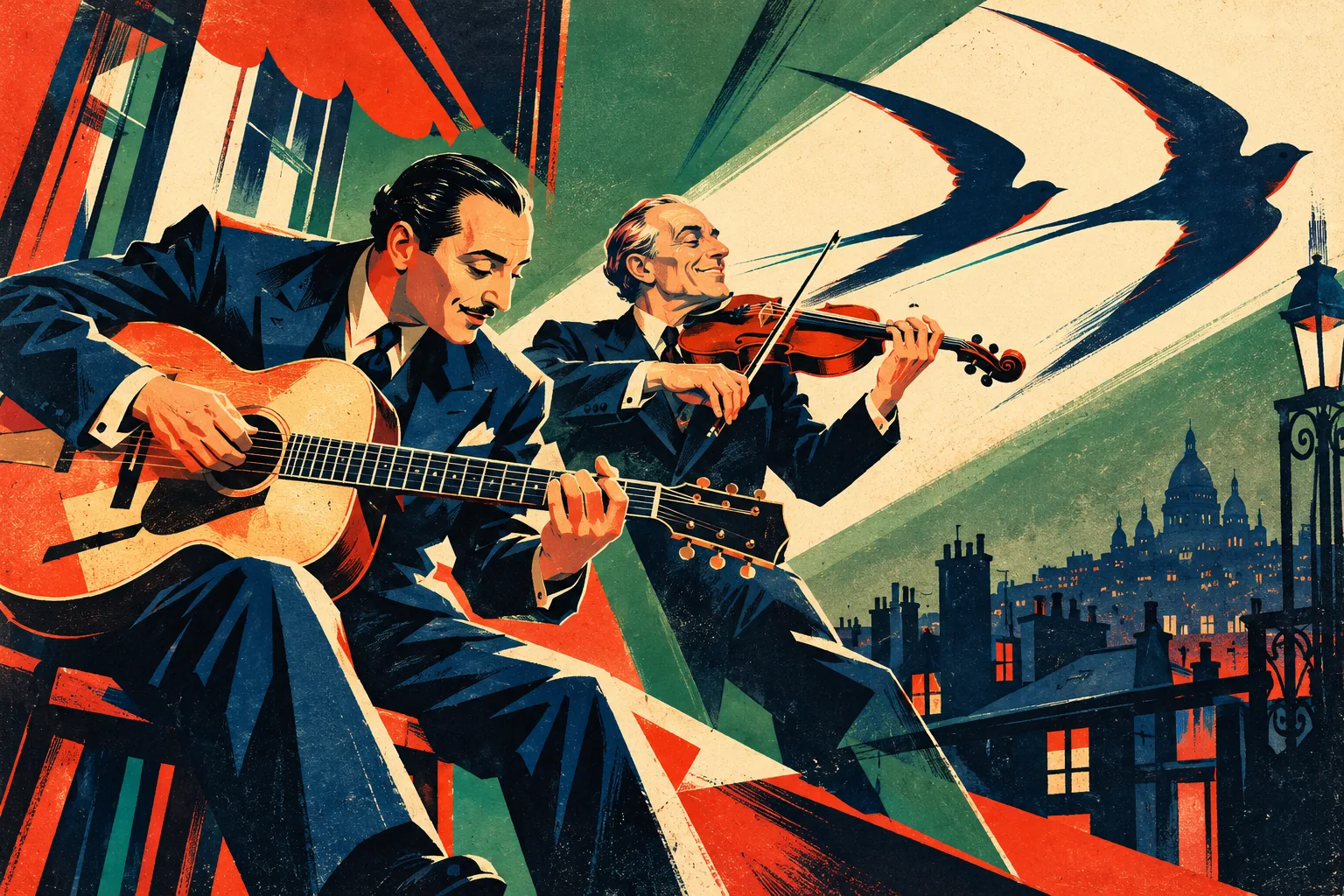
Owner-selected illustration. A prewar acoustic guitar-and-violin duo lean forward in an energetic diagonal, their shadows becoming a pair of racing swallows. Crisp quick swing and joyful invention; no printed year or false session reconstruction.
Original AI-assisted editorial artwork inspired by the tune; not a documented historical scene.
Original AI-assisted illustration created for Djangopedia
Illustration credits & provenance →Selected performances by notable Gypsy Jazz players and ensembles. Inclusion is editorial and does not imply an objective popularity ranking.
Joscho Stephan Trio; Costel Nițescu · Joscho Stephan
Live concert performance · Source-described independent performance; available player checked 2026-10-06. Musical suitability awaits owner review.
Joscho uses an electric guitar with Costel Nițescu, Sven Jungbeck and Volker Kamp; contrasting ensemble sound.
If playback is unavailable, use the source link.
 Django Reinhardt's - Swing 39 // Joscho Stephan Trio feat. Costel NițescuJoscho Stephan Trio; Costel Nițescu · Joscho StephanLive concert performance · Source-described independent performance; available player checked 2026-10-06. Musical suitability awaits owner review.Joscho uses an electric guitar with Costel Nițescu, Sven Jungbeck and Volker Kamp; contrasting ensemble sound.✓ Featured
 Swing 39 - Peter Beets, Dorado Schmit a.o. at the Django Reinhard NY FestivalPeter Beets; Dorado Schmitt ensemble · Peter Beets2004 · Django Reinhardt New York Festival, Birdland · Source-described independent performance; available player checked 2026-10-06. Musical suitability awaits owner review.Festival performance with piano and Manouche guitar; rhythm section credited as Mayo Hubert and Brian Torff.Select video
 Tatiana Eva-Marie & Avalon Jazz Band - Swing 39 (DJANGO)Tatiana Eva-Marie & Avalon Jazz Band · Tatiana Eva-MarieThe Keep, Brooklyn; sound recorded live · Source-described independent performance; available player checked 2026-10-06. Musical suitability awaits owner review.French vocal interpretation with Gabe Terracciano, Vinny Raniolo, Dennis Pol and Wallace Stelzer.Select video
 Swing 39 - (Django Reinhardt)Cordeone ensemble · CORDEONE OFFICIALChâteau du Plessis, La Riche, France · Source-described independent performance; available player checked 2026-10-06. Musical suitability awaits owner review.Accordion-led Manouche interpretation with Gabriel Bonnin, Giovanni Colletti and Sylavin Prince. The dated channel credit is not assumed to be a recording date.Select video
 Swing 39José Diaz de Leon; Sven Jungbeck; Stefan Berger · Sven JungbeckGuitar and bass trio performance · Source-described independent performance; available player checked 2026-10-06. Musical suitability awaits owner review.Independent interpretation from Sven Jungbeck’s channel.Select video
 "Swing 39" - Mission Hot ClubMission Hot Club2019 · Rose Avenue Acoustic Delights, Oakland, 15 December 2019 · Source-described independent performance; available player checked 2026-10-06. Musical suitability awaits owner review.Six-piece Gypsy Jazz ensemble with violin, clarinet, accordion, two guitars and bass.Select video
Mark the repeated source blocks with letters, then compare them with one backing-track chorus. Practise E♭7→D7 at a slow tempo with two moving voices.
Repeat a reliable rhythm through long blocks. Change only the notes that identify the next dominant rather than shifting the whole hand unnecessarily.
Start at 90–110; explore 140–180 bpm
Mark the repeated source blocks with letters, then compare them with one backing-track chorus. Practise E♭7→D7 at a slow tempo with two moving voices.
Start below the suggested tempo. First hear four quarter-note clicks, then halve the click rate and place clicks on beats 2 and 4. Keep the same phrase length.
Swing '39 — B♭-centred opening; source closes phrases on G; Extended source layout: 56 printed cells; roadmap requires comparison. Agree the tempo, pickup, solo order and ending before the count.
Use one shared chart and explicitly agree repeated blocks, tonic quality and ending.
Keep bass landmarks and melody clear; defer dense reharmonisation until the roadmap is settled.
Use one shared chart and explicitly agree repeated blocks, tonic quality and ending.
This guide studies an instrumental arrangement. Any later lyric adaptation requires its own credit and chosen key.
This player guide combines inherited recording evidence and editorial study notes. Musical study notes are editorial suggestions; compare them with the recording.
Composition background and credits ↗
Guitare Improvisation — backing track ↗
Feature photograph — Gypsy Jazz UK historical archive ↗
Original AI-assisted illustration created for Djangopedia
Original AI-assisted editorial artwork inspired by the tune; not a documented historical scene.
Generated with the native image-generation tool on 2026-10-26; original editorial artwork, not a historical photograph.
Prompt: Use case: stylized-concept. Create one finished original landscape 1536x1024 (3:2) raster illustration for Djangopedia, tune Swing '39. Tune context for interpretation only: The composition is credited to Django Reinhardt and Stéphane Grappelli. The inherited discography begins with Paris on 21 March 1939 and includes 1947 and 1949 versions. The title’s date agrees with that earliest listed session, but the old chart still needs a separate musical check. Scene: A prewar acoustic guitar-and-violin duo lean forward in an energetic diagonal, their shadows becoming a pair of racing swallows. Crisp quick swing and joyful invention; no printed year or false session reconstruction. Art direction: Dramatic 1930s–1940s theatrical serigraph: angular light and shadow, mature expressive caricature with dignity, strong diagonal movement and clean colour separations. Palette: ink blue, leaf green, vermilion and ivory. Subtle dry ink and paper texture, controlled print misregistration. Make it an artwork with a memorable singular idea, readable as a thumbnail and rewarding at full size; vary viewpoint and composition. Constraints: entirely original composition, not a copy of an artist's print. No title, words, notation, logos or watermark. No photorealism, glossy 3D, gradients, airbrushed romantic haze, generic sunset or decorative hearts. If Django appears, swept-back dark hair, pencil moustache and a distinct mature individual face; period clothes, no ethnic stereotypes. Respect plausible instruments and hands, keep key subjects within frame. Use strong flat ink shapes rather than photorealistic rendering.
Photograph rights are documented separately in its credit. They do not establish the rights status of the composition or recording.
