
Tune details
Music: Django Reinhardt, Stéphane Grappelli
Documented in archive: 1937
Original key: Not established
Study level: Intermediate; melody, pulse and arrangement awareness
 Djangopedia
A challenging Django chart for tracing tonal destinations through chromatic dominant movement.
Play only the destination tonics D, G and C while counting the full grid.

Owner content reviewed — 2026-10-19T04:10:15Z by admin. Coverage measures presence, not accuracy. Content review does not certify rights or musical perfection.
Django recordings for this tune. Uploader dates and take labels remain source claims; only an evidenced exact association enables a row’s Listen control.
Django Reinhardt
source-described; accuracy not independently verified
Uploader identifies this as Django Reinhardt’s performance; recording date and take require comparison with the discography.
| Entry | Year | Recording / session / release evidence | Listen |
|---|---|---|---|
| 01 | 1937 | Speevy, 25/11/37, OLA 1988, "Fremeaux 306, Mosaic MD6-190(6 CD Set), JSP 904A."," - Paris - QHCF - Stephane Grappelly (v), Django Reinhardt, Joseph Reinhardt, Eugene Vees (g), Louis Vola (b)" | — |
A dash means no video has been associated with this exact historical recording. Tune-level listening resources remain available above.
Speevy appears in the publisher’s 1937 session sequence. The inherited chart contains several contrasted blocks and extended dominant symbols; the typed form is retained as source material.
Music: Django Reinhardt, Stéphane Grappelli
Documented in archive: 1937
Original key: Not established
Study level: Intermediate; melody, pulse and arrangement awareness
A challenging Django chart for tracing tonal destinations through chromatic dominant movement.
Speevy, 25/11/37, OLA 1988, "Fremeaux 306, Mosaic MD6-190(6 CD Set), JSP 904A."," - Paris - QHCF - Stephane Grappelly (v), Django Reinhardt, Joseph Reinhardt, Eugene Vees (g), Louis Vola (b)"
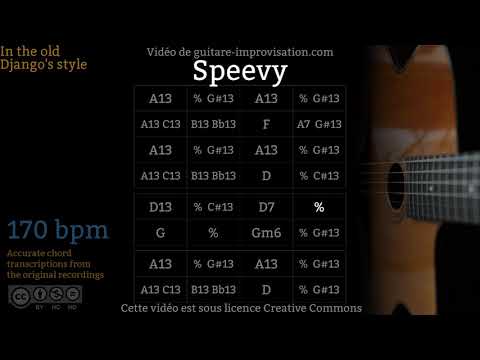
The opening A7/G#7 alternation leads to D, then D7 moves toward G. A later G7/F#7 block leads to C. Learn those destinations before attempting the chromatic dominant chains. Check the video key before playing with the chart.
The opening A7/G#7 alternation leads to D, then D7 moves toward G. A later G7/F#7 block leads to C. Learn those destinations before attempting the chromatic dominant chains.
Inherited chart retained exactly. Harmonic comments refer to this edition; ambiguous symbols are flagged rather than silently corrected.
[[Image:Speevy.gif]]

(G#7/) | A7/// | A7/ G#7/ | A7/// | A7/ G#7/ | A7/ C7/ | B7/ Bb7/ | F/// | A7/ G#7/ |

| A7/// | A7/ G#7/ | A7/// | A7/ G#7/ | A7/ C7/ | B7/ Bb7/ | D/// | D/ C#7/ |

| D7/// | D7/ C#9/ | D9/// | D9/ D7/ | G/// | G/// | C+11/// | C+11/ G#7/ |

| A7/// | A7/ G#7/ | A7/// | A7/ G#7/ | A7/ C7/ | B7/ Bb7/ | D/// | D/ G#7/ :||

last time:

(F#7/) | G7/// | G7/ F#7/ | G7/// | G7/ F#7/ | G7/ Bb7/ | A7/ Ab7/ | C/// | C/ F#7 |

| G7/// | G7/ F#7/ | G7/// | G7/ F#7/ | G7/ Bb7/ | A7/ Ab7/ | C/// | C/ C#7/ |

| D7/// | D7/ C#9/ | D9/// | D9/ D7/ | G/// | G/// | C+11/// | C+11/ G#7/ |

| A7/// | A7/ G#7/ | A7/// | A7/ G#7/ | A7/ C7/ | B7/ Bb7/ | D9/// | D9/ ||
Original source ↗
Guitare Improvisation
Swing · 170 BPM · 5m25s · Video available when checked; creator-described attribution.
Creator-provided play-along; instrumentation and feel vary by selection. Check the key and full arrangement before joining in; the guide chart may use another key. Tempo is the creator’s stated value.
If playback is unavailable, use the source link.
 Speevy (170 bpm) - Gypsy jazz Backing track / Jazz manoucheGuitare ImprovisationSwing · 170 BPM · 5m25s · Video available when checked; creator-described attribution.Creator-provided play-along; instrumentation and feel vary by selection. Check the key and full arrangement before joining in; the guide chart may use another key. Tempo is the creator’s stated value.✓ Featured
 Speevy (200 bpm) - Gypsy jazz Backing track / Jazz manoucheGuitare ImprovisationSwing · 200 BPM · 5m22s · Video available when checked; creator-described attribution.Creator-provided play-along; instrumentation and feel vary by selection. Check the key and full arrangement before joining in; the guide chart may use another key. Tempo is the creator’s stated value.Select video
Performed studies, transcriptions, TAB, notation and lessons for studying Django’s solo. Inclusion does not certify note-for-note accuracy.
No Django solo study aid yet. Know a useful resource — or want to record a study of this solo?
Follow a shared key, a harmonic idea or a familiar form. Keys refer to this site’s chart editions; other recordings may use a different key.
No sufficiently supported harmonic comparison has been added yet.
No match is established in the current chart metadata.
Showing 8 of 83 matches. Explore the full catalogue →
An acoustic guitarist and clarinetist race through angular zigzag ribbons, with a tilted double bass behind; witty graphic speed and changing directions.
Original AI-assisted editorial artwork inspired by the tune’s mood. It does not depict a documented historical event.
Original AI-assisted illustration created for Djangopedia
Illustration credits & provenance →Selected performances by notable Gypsy Jazz players and ensembles. Inclusion is editorial and does not imply an objective popularity ranking.
Angelo Debarre - Topic
Video available when checked; creator-described attribution.
Performer attribution follows the video title and channel description. Proposed listening selection; no popularity ranking implied.
If playback is unavailable, use the source link.
 SpeevyAngelo Debarre - TopicVideo available when checked; creator-described attribution.Performer attribution follows the video title and channel description. Proposed listening selection; no popularity ranking implied.✓ Featured
 SpeevyAngelo Debarre Quartet - TopicVideo available when checked; creator-described attribution.Performer attribution follows the video title and channel description. Proposed listening selection; no popularity ranking implied.Select video
Play only the destination tonics D, G and C while counting the full grid. Add the preceding dominant’s third on the next pass, then connect one chromatic chain at a time.
Use compact voicings and a stable pulse through the half-bar dominant shifts. Treat C+11 as an unresolved source spelling until checked.
85–120 bpm initially; increase gradually
Play only the destination tonics D, G and C while counting the full grid. Add the preceding dominant’s third on the next pass, then connect one chromatic chain at a time.
Count quarter notes first. Then place the click on beats 2 and 4 at half the click rate, keeping the phrase length unchanged.
D and C destinations in inherited grid; Multi-block inherited arrangement; do not assume a single AABA chorus. Agree the arrangement, pickup and ending before counting in.
The inherited block order and C+11 spelling require checking against the chosen performance.
Keep the melody uppermost and begin with a single bass note under each harmony. Use compact voicings and a stable pulse through the half-bar dominant shifts. Treat C+11 as an unresolved source spelling until checked.
Use compact voicings and a stable pulse through the half-bar dominant shifts. Treat C+11 as an unresolved source spelling until checked.
No vocal arrangement is prescribed; use the instrumental melody as the phrasing reference.
This player guide combines inherited recording evidence and editorial study notes. Musical study notes are editorial suggestions; compare them with the recording.
Reissue publisher discography and credits ↗
Inherited chart and recording evidence ↗
Original AI-assisted illustration created for Djangopedia
Original AI-assisted editorial artwork inspired by the tune’s mood. It does not depict a documented historical event.
Generated with the native image-generation tool on 2026-10-19; original editorial artwork, not a historical photograph.
Prompt: Use case: stylized-concept. Asset: horizontal 1536x1024, 3:2 Djangopedia tune illustration for Speevy. Original scene: An acoustic guitarist and clarinetist race through angular zigzag ribbons, with a tilted double bass behind; witty graphic speed and changing directions. Medium: authentic-feeling 1950s silk-screen editorial print, flat separate ink layers, boldly simplified shapes, long expressive angular silhouettes, spare wiry line accents, off-register overlaps, small areas of crosshatching, slight dry ink and paper texture. Strong asymmetric composition with generous negative space; witty and musical, sophisticated rather than children's cartoon. Limited palette: olive green, burnt orange, warm cream and black. All heads and instrument bodies wholly inside frame unless otherwise specified. No letters, words, numbers, captions, borders, logos, watermark, realistic shading, gradients or photographed paper. Invent an entirely new composition, not a reproduction of any existing print. No claim of a documented historical scene.