
Tune details
Music: George Gershwin
Words: Ira Gershwin
Published / composed / adapted — see history: 1924
Original key: Not established
Study level: Intermediate; advanced where the inherited roadmap needs reconstruction
 Djangopedia
A lyrical Gershwin standard whose major opening darkens through borrowed chords and whose bridge turns to the relative minor. The inherited chart uses expanded durations that need agreement with the backing track.
Agree the pulse and follow the minor-coloured inner voices.
Owner content reviewed — 2026-10-06T18:41:04Z by admin. Coverage measures presence, not accuracy. Content review does not certify rights or musical perfection.
Django recordings for this tune. Uploader dates and take labels remain source claims; only an evidenced exact association enables a row’s Listen control.
Uploader identifies this as Django Reinhardt’s performance; recording date and take require comparison with the discography.
| Entry | Year | Recording / session / release evidence | Listen |
|---|---|---|---|
| 01 | 1939 | The Man I Love, 25/8/39, DR 3864-1 ,"Fremeaux FA 309, Classics 813, JSP 342, Verve 516 931-2, Music Memoria 87949, Rhapsody RHCD6"," - London - QHCF - Stephane Grappelly (v,p), Django Reinhardt, Joseph Reinhardt, Eugene Vees (g), Emmanuel Soudieux (b), Beryl Davis (vo)" | — |
| 02 | 1949 | The Man I Love, Jan-Feb 1949, WL 208 ,"Fremeaux FA 317, BGO CD 366"," - Rome - Django Reinhardt (g), Stephane Grappelly (v),Gianni Safred (p), Carlo Pecori (b), Aurelio de Carolis (d)." | — |
A dash means no video has been associated with this exact historical recording. Tune-level listening resources remain available above.
The Man I Love is credited here to George Gershwin. The source date is 1924; publication, composition and later lyric adaptations may have separate dates. The inherited archive lists 2 recording entries, with dated entries spanning 1939–1949. These are archive rows, not a claim that every entry is a distinct released take. The linked recording rows preserve the original discographical wording. Compare their dates, matrices and personnel when choosing a performance to study.
Music: George Gershwin
Words: Ira Gershwin
Published / composed / adapted — see history: 1924
Original key: Not established
Study level: Intermediate; advanced where the inherited roadmap needs reconstruction
Listening task: Let the long phrases breathe and keep ornaments away from the main melodic arrivals. Mark the key, pickup, phrase lengths and ending before comparing another version.
The Man I Love, 25/8/39, DR 3864-1 ,"Fremeaux FA 309, Classics 813, JSP 342, Verve 516 931-2, Music Memoria 87949, Rhapsody RHCD6"," - London - QHCF - Stephane Grappelly (v,p), Django Reinhardt, Joseph Reinhardt, Eugene Vees (g), Emmanuel Soudieux (b), Beryl Davis (vo)"
Compare the first and last listed entries for tempo, instrumentation and arrangement. Do not infer identical takes from a shared title. Agree the pulse and follow the minor-coloured inner voices.
The Man I Love, Jan-Feb 1949, WL 208 ,"Fremeaux FA 317, BGO CD 366"," - Rome - Django Reinhardt (g), Stephane Grappelly (v),Gianni Safred (p), Carlo Pecori (b), Aurelio de Carolis (d)."
Count the form and check this arrangement’s key before joining in. The current preferred track is shown in Play along.
G6/9–Gm–F6/9 leads through E7 and Cm7–D7. The bridge uses Em7 and Em(maj7) colours around F♯ diminished–B7 before E7–Am7–D7 returns home.
The source has 64 cells with repeated long chord durations. Match its sixteen-cell sections to the performed pulse and a chosen edition before using the cell numbers as bar numbers.
| G69/// | G69/// | Gm/// | Gm/// | F69/// | F69/// | E7/// | E7/// |

| Cm7/// | Cm7/// | D7/// | D7/// | G6/// | Bb7/// | Eb9/// | D7/// |

| G69/// | G69/// | Gm/// | Gm/// | F69/// | F69/// | E7/// | E7/// |

| Cm7/// | Cm7/// | D7/// | D7/// | G6/// | D7/// | G69/// | C7/ B7/ |

| Em7/// | EMm7/// | F#0/// | B7/// | Em7/// | EMm7/// | B7/// | F#0/ B7/ |

| Em7/// | EMm7/// | F#0/// | B7/// | E7/// | E7/// | Am7/// | D9/// |

| G69/// | G69/// | Gm/// | Gm/// | F69/// | F69/// | E7/// | E7/// |

| Cm7/// | Cm7/// | D7/// | D7/// | G6/// | Bb7/// | Eb9/// | D7/// :||
Original source ↗
Guitare Improvisation · 90 BPM · Agree how the inherited 64-cell notation aligns with the selected backing track’s pulse and chorus length. · 6:00 · Owner-approved study selection. YouTube identity and player availability checked 6 October 2026; musical accuracy and exact take not independently certified.
Owner selected 6 October 2026. Preferred practice resource; confirm its sounding key and full form before playing.
Checked 2026-10-01
Most-viewed suitable match selected from the captured search results after title/composition review; not a complete YouTube ranking. Source counts were captured on 1 October 2026. Coaching, unrelated songs and non-backing performances are excluded.
Performed studies, transcriptions, TAB, notation and lessons for studying Django’s solo. Resources are described by their creator; inclusion does not certify note-for-note accuracy.
Guitareal Jazz Transcriptions · Owner-approved study selection. YouTube identity and player availability checked 6 October 2026; musical accuracy and exact take not independently certified.
Owner selected 6 October 2026. Django transcription/TAB study; a new played recreation is not demonstrated.
Follow a shared key, a harmonic idea or a familiar form. Keys refer to this site’s chart editions; other recordings may use a different key.
No sufficiently supported harmonic comparison has been added yet.
Showing 8 of 23 matches. Explore the full catalogue →
Showing 8 of 42 matches. Explore the full catalogue →
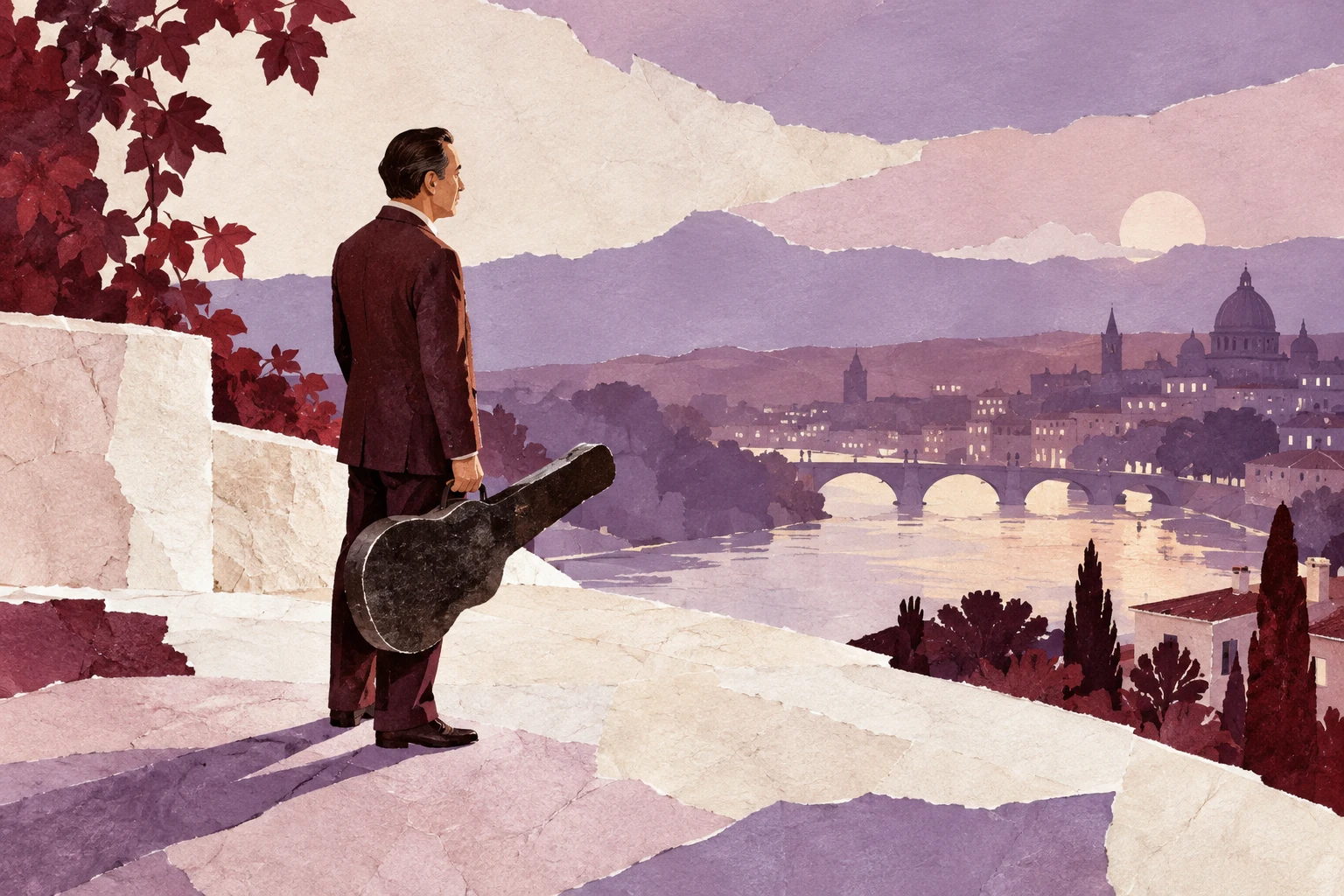
A small drawn Django stands in profile, guitar case in hand, looking across a broad luminous plane that turns inward to a darker lavender zone. Lyrical affection and relative-minor bridge are represented by distance and inner colour, an editorial character scene.
An original editorial interpretation of the tune. This is an illustration, not an archival photograph or a documented reconstruction of a recording session.
Original Djangopedia illustration · AI-assisted, 2026
Illustration credits & provenance →Selected performances by notable Gypsy Jazz players and ensembles. Inclusion is editorial and does not imply an objective popularity ranking.
Adrien Moignard and Mathieu Châtelain · TSF JAZZ
2017 · TSF Jazz studio session, 7 June 2017
Stage 4N private performance. Broadcast duet; intended first/default.
If playback is unavailable, use the source link.
 Adrien Moignard "The Man I Love" en Session live TSFJAZZAdrien Moignard and Mathieu Châtelain · TSF JAZZ2017 · TSF Jazz studio session, 7 June 2017Stage 4N private performance. Broadcast duet; intended first/default.✓ Featured
 Mozes Rosenberg - The Man I Love (Gypsyjazz )Mozes RosenbergArtist performanceStage 4N private performance. Direct artist upload; recording date not supplied.Select performance
 Filippo Dall'Asta Quartet - The Man I Love (Gypsy Jazz)Filippo Dall’Asta Quartet · Filippo Dall'AstaTenerife ensemble sessionStage 4N private performance. Independent quartet with Yeray Herrera, Kepa Martinez and Agustin Buenafuente.Select performance
 Man I Love - Gypsy Jazz Guitar Trio - Hot Club De HullHot Club de Hull · Lewis KilvingtonThe Albemarle, HullStage 4N private performance. Lewis Kilvington, Rob Burgess and David Tomlinson in live guitar trio.Select performance
Sing the G-major to G-minor colour change over held roots. Then loop Em7–Em(maj7), keeping the moving seventh audible without changing the melody's phrasing.
Use long, quiet voicings beneath the melody and keep the E-minor inner line clear. Agree the pulse before interpreting each printed cell as a bar.
Start around 60–90 bpm and preserve the full phrase
Sing the G-major to G-minor colour change over held roots. Then loop Em7–Em(maj7), keeping the moving seventh audible without changing the melody's phrasing.
Begin with four quarter-note clicks. Halve the click rate and hear beats 2 and 4 while maintaining the same phrase lengths.
The Man I Love — G major / E minor; AABA, written as 64 cells with sixteen-cell sections. Agree the pickup, tempo and ending before counting in.
AABA, written as 64 cells with sixteen-cell sections. The source has 64 cells with repeated long chord durations. Match its sixteen-cell sections to the performed pulse and a chosen edition before using the cell numbers as bar numbers.
Start with melody and bass only. Add the following colour without interrupting the melody: Lower B to B♭ when G becomes Gm.
Use long, quiet voicings beneath the melody and keep the E-minor inner line clear. Agree the pulse before interpreting each printed cell as a bar. Agree the full roadmap and signal the last head before it starts.
Choose a comfortable vocal key and transpose the whole arrangement, including its introduction and ending.
This player guide combines inherited recording evidence and editorial study notes. Musical study notes are editorial suggestions; compare them with the recording.
Djangopedia — inherited chart and recording rows ↗
Composition credits and background ↗
Feature photograph — source collection ↗
Original Djangopedia illustration · AI-assisted, 2026
An original editorial interpretation of the tune. This is an illustration, not an archival photograph or a documented reconstruction of a recording session.
Generated with the native image-generation tool on 2026-10-08; original editorial artwork, not a historical photograph.
Prompt: Use case: illustration-story. One original editorial feature illustration for Djangopedia's guide “The Man I Love”. Landscape 1536 × 1024, opaque background. Scene: A small drawn Django stands in profile, guitar case in hand, looking across a broad luminous plane that turns inward to a darker lavender zone. Lyrical affection and relative-minor bridge are represented by distance and inner colour, an editorial character scene. Musical basis from the guide: A lyrical Gershwin standard whose major opening darkens through borrowed chords and whose bridge turns to the relative minor. The inherited chart uses expanded durations that need agreement with the backing track. The supplied chart is G major / E minor; form: AABA, written as 64 cells with sixteen-cell sections; feel: Ballad / gentle swing. These describe musical inspiration, not visible writing. Historical context: The Man I Love is credited here to George Gershwin. The source date is 1924; publication, composition and later lyric adaptations may have separate dates. Do not illustrate disputed historical claims or suggest this imagined scene is an archival session. Medium: torn-paper editorial collage. Dominant palette: clean white burgundy and lavender. Composition: three-quarter figure against broad rising plane. Human presence: one small Django figure. Strong intentional design, clearly drawn/painted, distinctive material marks; keep essential subject safely within the central 70 percent width and middle 80 percent height for card crops. Maintain enough visual substance at thumbnail size. Broad inspiration observed in old photo, ONLY scale/rhythm and never a reference image: close single face; intimate diagonal edge. Independently invent every pose, perspective, clothing, setting and lighting. Avoid: No copied face/pose, portrait filling frame, framed painting or heart. No photorealism, archival simulation, generated text, letters, numbers, labels, fake musical notation, logo, signature, watermark, fake dates, yellowed-paper patina, recognizable artwork or copied photograph. No imitation of any named artist. Render the art edge to edge without borders, mockup or typography. Batch B diversity compensation: make light and midtone areas substantial; avoid near-black dominant backdrops, violet monochrome, empty chair/stool/bench compositions, repeated sunset terraces and generic cloud panoramas. Preserve the stated tune-specific scene. Human figures remain standing or peripheral except an explicitly named ensemble; no centered seated Django portrait. For graphic images use clearly plain colour shapes, no ruled parallel staffs, circles with stems, note-like marks or typography.
Photograph provenance and rights are stated separately. Attribution does not establish permission.