Tune details
Music: James P. Johnson
Words: Cecil Mack
Source-attributed publication / composition: 1923
Original key: Not established
Study level: Intermediate; syncopation and dominant-chain accuracy
 Djangopedia
James P. Johnson’s dance-era standard, bringing syncopated melody and a clear dominant chain into Django’s guitar repertoire.
Clap the melody's rhythm over a metronome before playing pitches.

Owner content reviewed — 2026-10-15T13:12:30Z by admin. Coverage measures presence, not accuracy. Content review does not certify rights or musical perfection.
Django recordings for this tune. Uploader dates and take labels remain source claims; only an evidenced exact association enables a row’s Listen control.
Django Reinhardt
source-described; accuracy not independently verified
Uploader identifies this as Django Reinhardt’s performance; recording date and take require comparison with the discography.
| Entry | Year | Recording / session / release evidence | Listen |
|---|---|---|---|
| 01 | 1937 | Charleston, 21/4/37, OLA 1703-1,"Fremeaux FA 305, Classics 748, Affinity 1003, EMI 780671-2, Jazz Time 790560-2, Jazz Archives ZET 752, EMI 746 5012(Mistitled Swinging With Django), Mosaic MD6-190(6 CD Set)."," - Paris - QHCF - Stephane Grappelli (v), Django Reinhardt, Pierre Ferret, Marcel Bianchi (g), Louis Vola (b)" | — |
A dash means no video has been associated with this exact historical recording. Tune-level listening resources remain available above.
James P. Johnson composed The Charleston in 1923, with lyrics by Cecil Mack. It belongs to the dance and theatre culture of the twenties rather than being a Django composition. The inherited Django entry is dated 21 April 1937, matrix OLA 1703-1, and the Frémeaux discography credits Johnson. For a guitarist, the tune is an opportunity to separate a strong dance pulse from a syncopated melody: the accompaniment does not need to copy every offbeat.
Music: James P. Johnson
Words: Cecil Mack
Source-attributed publication / composition: 1923
Original key: Not established
Study level: Intermediate; syncopation and dominant-chain accuracy
Listen for how the ensemble keeps time underneath the head's displaced accents.
Charleston, 21/4/37, OLA 1703-1,"Fremeaux FA 305, Classics 748, Affinity 1003, EMI 780671-2, Jazz Time 790560-2, Jazz Archives ZET 752, EMI 746 5012(Mistitled Swinging With Django), Mosaic MD6-190(6 CD Set)."," - Paris - QHCF - Stephane Grappelli (v), Django Reinhardt, Pierre Ferret, Marcel Bianchi (g), Louis Vola (b)"
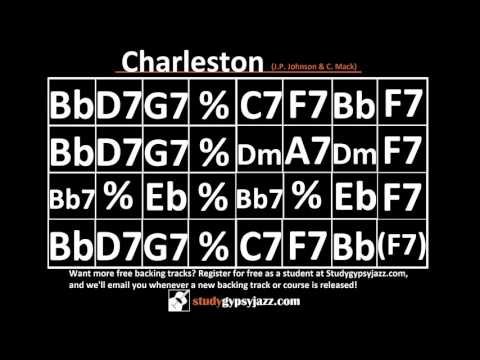
The B-flat study chart uses a chain of dominants, including D7–G7–C7–F7, and visits the E-flat area. Follow the thirds through that chain to hear where each chord is heading. The rhythm supplies much of the identity, so harmony alone is not enough to recognize the tune. Check the video key before playing with the chart.
The B-flat study chart uses a chain of dominants, including D7–G7–C7–F7, and visits the E-flat area. Follow the thirds through that chain to hear where each chord is heading. The rhythm supplies much of the identity, so harmony alone is not enough to recognize the tune.
Inherited chart retained as a study source. The tune is Johnson's Charleston, not a video merely filmed in the city of Charleston.
[[Image:Charleston.gif]]


| Bb/// | D7/// | G7/// | G7/// | C7/// | F7/// | Bb/// | F7/// |

| Bb/// | D7/// | G7/// | G7/// | C7/// | A7/// | Dm/// | F7/// |

| Bb7/// | Bb7/// | Eb/// | Eb/// | Bb7/// | Bb7/// | Eb/// | F7/// |

| Bb/// | D7/// | G7/// | G7/// | C7/// | F7/// | Bb/// | F7/// :||
Original source ↗
Study Gypsy Jazz
3m13s · Video available when checked; creator-described attribution.
Creator-described gypsy-jazz play-along. Check the key and full arrangement before joining in; the guide chart may use another key.
If playback is unavailable, use the source link.
Performed studies, transcriptions, TAB, notation and lessons for studying Django’s solo. Inclusion does not certify note-for-note accuracy.
Christiaan van Hemert
source-described; accuracy not independently verified
Creator presents a study of Django’s recorded solo. Use it alongside the original recording; exact transcription accuracy has not been independently reviewed.
If playback is unavailable, use the source link.
Follow a shared key, a harmonic idea or a familiar form. Keys refer to this site’s chart editions; other recordings may use a different key.
No sufficiently supported harmonic comparison has been added yet.
Showing 8 of 9 matches. Explore the full catalogue →
Showing 8 of 15 matches. Explore the full catalogue →
Original illustration: Two dancers kicking their heels on a colorful geometric dance floor.
Original AI-assisted editorial artwork inspired by the tune’s mood. It does not depict a documented historical event.
Original Djangopedia illustration · AI-assisted, 2026
Illustration credits & provenance →Selected performances by notable Gypsy Jazz players and ensembles. Inclusion is editorial and does not imply an objective popularity ranking.
Jérémy Dutheil
Video available when checked; creator-described attribution.
Performer attribution follows the video title and channel description. Proposed listening selection; no popularity ranking implied.
If playback is unavailable, use the source link.
 Charleston - Jérémy Dutheil / Solal Poux / Mathieu ChatelainJérémy DutheilVideo available when checked; creator-described attribution.Performer attribution follows the video title and channel description. Proposed listening selection; no popularity ranking implied.✓ Featured
 Rocky Gresset & Mathieu Chatelain :: "Charleston"keefboofVideo available when checked; creator-described attribution.Performer attribution follows the video title and channel description. Proposed listening selection; no popularity ranking implied.Select video
Clap the melody's rhythm over a metronome before playing pitches. Then play only the thirds of the dominant chain and reconnect them to the melody.
Keep steady, light quarter notes while the melody supplies the Charleston accents. Try the characteristic syncopated rhythm only as a deliberate variation, not as an unchanging accompaniment pattern.
Start at 100–120; explore 170–200 bpm
Clap the melody's rhythm over a metronome before playing pitches. Then play only the thirds of the dominant chain and reconnect them to the melody.
Count quarter notes first. Then place the click on beats 2 and 4 at half the click rate, keeping the phrase length unchanged.
B♭ major (inherited chart); 32-bar study chorus; four eight-bar phrases. Agree the arrangement, pickup and ending before counting in.
Letting the syncopation pull the rhythm section off its underlying pulse.
Keep the melody uppermost and begin with a single bass note under each harmony. B♭6: B♭–D–F–G.
Keep steady, light quarter notes while the melody supplies the Charleston accents. Try the characteristic syncopated rhythm only as a deliberate variation, not as an unchanging accompaniment pattern.
Choose a comfortable singing key and transpose the accompaniment as a whole; lyrics are not reproduced here.
This player guide combines inherited recording evidence and editorial study notes. Musical study notes are editorial suggestions; compare them with the recording.
Smithsonian — James P. Johnson ↗
IMSLP — Charleston bibliographic entry ↗
Frémeaux — Django intégrale volume 5 ↗
Original Djangopedia illustration · AI-assisted, 2026
Original AI-assisted editorial artwork inspired by the tune’s mood. It does not depict a documented historical event.
Generated with the native image-generation tool on 2026-10-15; original editorial artwork, not a historical photograph.
Prompt: Create one original Djangopedia tune-guide illustration for Charleston. Landscape 1536x1024, 3:2. Playful mid-century modern print with broad 1930s–1950s jazz and Art Deco influences, angular geometric characters, confident navy outlines, flat warm cream, mustard yellow, warm red and turquoise, subtle paper grain. Two lively dancers doing an exuberant Charleston kick, fully visible heads and feet, asymmetrical rhythmic geometric floor, small stylized guitar and double-bass silhouettes behind. Joyful syncopation, balanced negative space, distinctive original composition, not a historical documentary scene. No words, letters, logos or watermark. Do not imitate any particular artist or existing artwork.