Tune details
Music: Sigmund Romberg
Words: Oscar Hammerstein II
Published / composed / adapted — see history: 1928
Original key: Not established
Study level: Intermediate; advanced where the inherited roadmap needs reconstruction
 Djangopedia
A major-key song with a substantial relative-minor contrast. The source chart gives useful destinations, but its relationship to longer editions should be checked before counting a performance.
Hear B7 as the doorway into E minor.
Owner content reviewed — 2026-10-06T18:38:09Z by admin. Coverage measures presence, not accuracy. Content review does not certify rights or musical perfection.
Django recordings for this tune. Uploader dates and take labels remain source claims; only an evidenced exact association enables a row’s Listen control.
Django Reinhardt
source-described; accuracy not independently verified
Uploader identifies this as Django Reinhardt’s performance; recording date and take require comparison with the discography.
| Entry | Year | Recording / session / release evidence | Listen |
|---|---|---|---|
| 01 | 1938 | Lover Come Back To Me, 31/5/38, CL 6717-1,"Fremeaux FA 308, Classics 777, EMI 780671-2"," - Paris - Larry Adler (har), Stephane Grappelly (p), Django Reinhardt (g),Joseph Reinhardt, Eugene Vees (g), Roger Grasset (b)" | — |
| 02 | 1938 | Lover Come Back To Me, 31/5/38, CL 6717-2 ,Fremeaux FA 308," - Paris - Larry Adler (har), Stephane Grappelly (p), Django Reinhardt (g),Joseph Reinhardt, Eugene Vees (g), Roger Grasset (b)" | — |
A dash means no video has been associated with this exact historical recording. Tune-level listening resources remain available above.
Lover Come Back To Me is credited here to Sigmund Romberg. The source date is 1928; publication, composition and later lyric adaptations may have separate dates. The inherited archive lists 2 recording entries, with dated entries spanning 1938–1938. These are archive rows, not a claim that every entry is a distinct released take. The linked recording rows preserve the original discographical wording. Compare their dates, matrices and personnel when choosing a performance to study.
Music: Sigmund Romberg
Words: Oscar Hammerstein II
Published / composed / adapted — see history: 1928
Original key: Not established
Study level: Intermediate; advanced where the inherited roadmap needs reconstruction
Listening task: Distinguish the relative-minor passage by tone and phrase direction rather than sudden volume. Mark the key, pickup, phrase lengths and ending before comparing another version.
Lover Come Back To Me, 31/5/38, CL 6717-1,"Fremeaux FA 308, Classics 777, EMI 780671-2"," - Paris - Larry Adler (har), Stephane Grappelly (p), Django Reinhardt (g),Joseph Reinhardt, Eugene Vees (g), Roger Grasset (b)"
Compare the first and last listed entries for tempo, instrumentation and arrangement. Do not infer identical takes from a shared title. Hear B7 as the doorway into E minor.
Lover Come Back To Me, 31/5/38, CL 6717-2 ,Fremeaux FA 308," - Paris - Larry Adler (har), Stephane Grappelly (p), Django Reinhardt (g),Joseph Reinhardt, Eugene Vees (g), Roger Grasset (b)"
The inherited chart is in G major / E minor. Confirm the backing track’s sounding key, pickup and complete form before playing; an instrument label may describe a transposed score.
G moves through A7–D7 and B7 into Em. Later B7–Em and diminished approaches reconnect the final Am–D7 cadence.
The inherited grid has 32 cells. Longer notational editions exist; establish the pulse and phrase durations from the chosen performance rather than treating cell count as universal form.
[[Image:Lover_come_back_to_me.gif]]

| G/// | G/// | A7/// | D7/// | G/// | C7/// | G/// | B7/// |

| Em/// | Em/// | Am/// | Em/// | A7/// | A7/// | D7/// | D7/// |

| G/// | G/// | B7/// | B7/// | Em/// | Em/// | F0/// | F0/// |

| Am/// | Bb0// | G/// | D7/// | G/// | C7/// | G/ G#0/ | Am/ D7/ :||
Original source ↗
Backingtracks JAZZ
The inherited chart is in G major / E minor. Confirm the backing track’s sounding key, pickup and complete form before playing; an instrument label may describe a transposed score. · 6:45
If playback is unavailable, use the source link.
Performed studies, transcriptions, TAB, notation and lessons for studying Django’s solo. Inclusion does not certify note-for-note accuracy.
No Django solo study aid yet. Know a useful resource — or want to record a study of this solo?
Follow a shared key, a harmonic idea or a familiar form. Keys refer to this site’s chart editions; other recordings may use a different key.
No sufficiently supported harmonic comparison has been added yet.
Showing 8 of 28 matches. Explore the full catalogue →
No match is established in the current chart metadata.
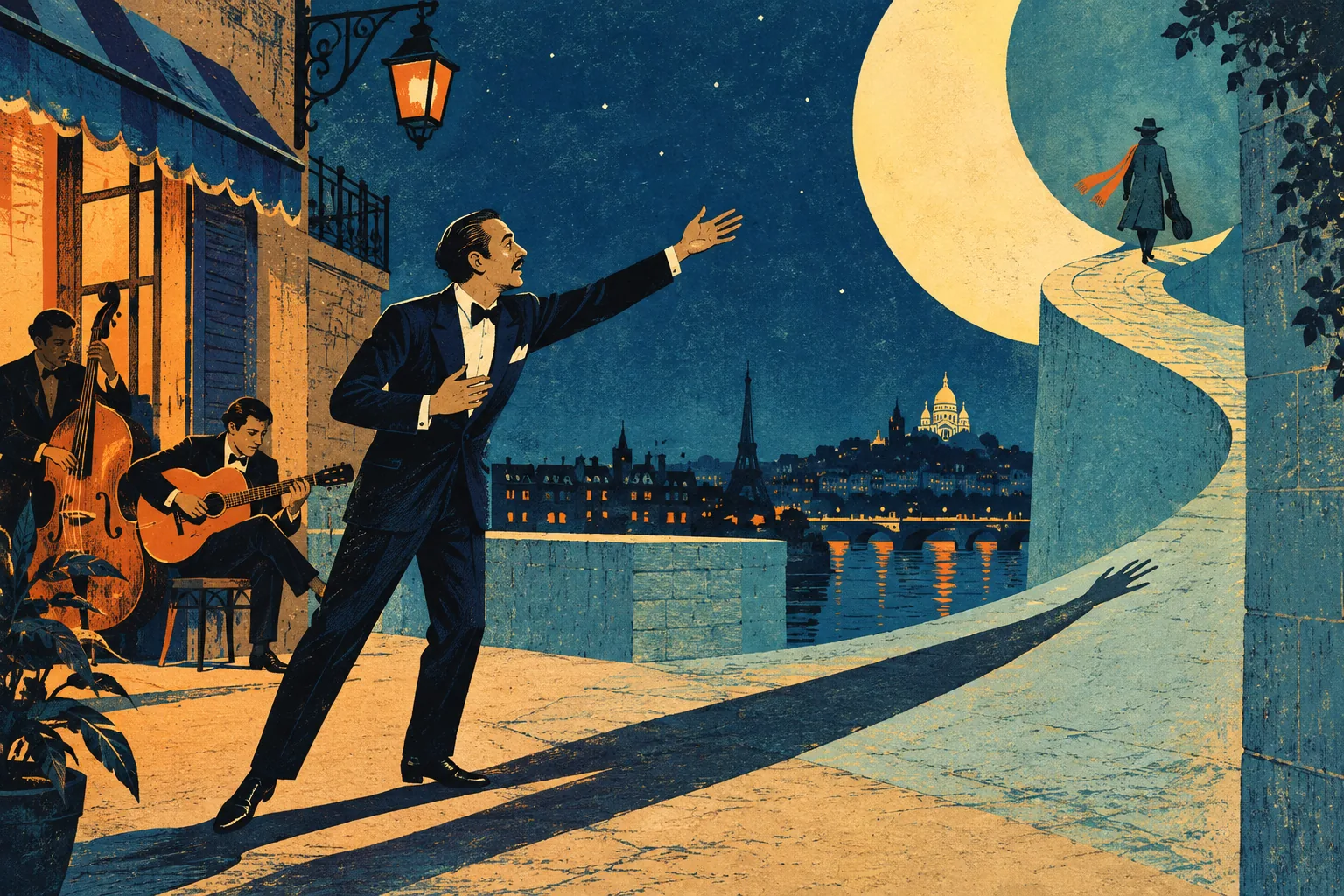
Owner-selected illustration. An adult singer calls toward a departing hat disappearing around an oversized moon-shaped corner; their shadow reaches farther than they do. Spirited longing with operetta-stage wit, no tears or hearts.
Original AI-assisted editorial artwork inspired by the tune; not a documented historical scene.
Original AI-assisted illustration created for Djangopedia
Illustration credits & provenance →Selected performances by notable Gypsy Jazz players and ensembles. Inclusion is editorial and does not imply an objective popularity ranking.
Joscho Stephan and Richard Smith · roger b
Live guitar duet, uploader roger b · YouTube title, uploader metadata and player availability checked 6 October 2026. Independent interpretation; proposed order awaits owner decision. No full-video musical audition claimed.
Stage 4N private performance. Gypsy jazz/fingerstyle crossover; exact performance date unspecified.
If playback is unavailable, use the source link.
 JOSCHO STEPHAN & RICHARD SMITH Lover come back to meJoscho Stephan and Richard Smith · roger bLive guitar duet, uploader roger b · YouTube title, uploader metadata and player availability checked 6 October 2026. Independent interpretation; proposed order awaits owner decision. No full-video musical audition claimed.Stage 4N private performance. Gypsy jazz/fingerstyle crossover; exact performance date unspecified.✓ Featured
 Lover Come Back to MeStéphane Grappelli with Diz Disley, Ike Isaacs and Isla Eckinger · Stéphane Grappelli - TopicViolinspiration, label-distributed album audio · YouTube title, uploader metadata and player availability checked 6 October 2026. Independent interpretation; proposed order awaits owner decision. No full-video musical audition claimed.Stage 4N private performance. Correct Romberg/Hammerstein work; modern reissue date not recording date.Select video
 Lover Come Back to Me - Gaucho with Tamar Korn - Porto Franco FilesGaucho with Tamar Korn · Porto Franco RecordsPearl album, Porto Franco Records · YouTube title, uploader metadata and player availability checked 6 October 2026. Independent interpretation; proposed order awaits owner decision. No full-video musical audition claimed.Stage 4N private performance. Gypsy swing/hot-jazz vocal ensemble; album cited as 2010, recording date not assigned.Select video
Alternate a G-major cadence with B7–Em, keeping the same short melodic rhythm. Mark all phrase lengths while following the selected track.
Give the E-minor arrival a distinct colour without changing the pulse. Keep passing diminished voicings small and connected to the next chord.
Start around 100–140 bpm; increase only after the form stays secure
Alternate a G-major cadence with B7–Em, keeping the same short melodic rhythm. Mark all phrase lengths while following the selected track.
Begin with four quarter-note clicks. Halve the click rate and hear beats 2 and 4 while maintaining the same phrase lengths.
Lover Come Back To Me — G major / E minor; 32 source cells; agree the chosen arrangement's duration. Agree the pickup, tempo and ending before counting in.
32 source cells; agree the chosen arrangement's duration. The inherited grid has 32 cells. Longer notational editions exist; establish the pulse and phrase durations from the chosen performance rather than treating cell count as universal form.
Start with melody and bass only. Add the following colour without interrupting the melody: Resolve D♯ on B7 into E.
Give the E-minor arrival a distinct colour without changing the pulse. Keep passing diminished voicings small and connected to the next chord. Agree the full roadmap and signal the last head before it starts.
Choose a comfortable vocal key and transpose the whole arrangement, including its introduction and ending.
Search online videos of "Lover Come Back To Me" in youtube.com ↗
This player guide combines inherited recording evidence and editorial study notes. Musical study notes are editorial suggestions; compare them with the recording.
Djangopedia — inherited chart and recording rows ↗
Composition credits and background ↗
Backingtracks JAZZ — practice backing ↗
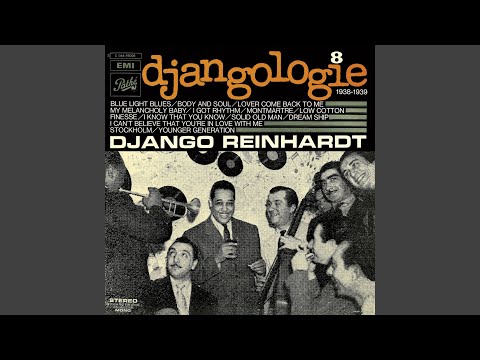
Feature photograph — source collection ↗
Original AI-assisted illustration created for Djangopedia
Original AI-assisted editorial artwork inspired by the tune; not a documented historical scene.
Generated with the native image-generation tool on 2026-10-26; original editorial artwork, not a historical photograph.
Prompt: Use case: stylized-concept. Create one finished original landscape 1536x1024 (3:2) raster illustration for Djangopedia, tune Lover Come Back To Me. Tune context for interpretation only: Lover Come Back To Me is credited here to Sigmund Romberg. The source date is 1928; publication, composition and later lyric adaptations may have separate dates. The inherited archive lists 2 recording entries, with dated entries spanning 1938–1938. These are archive rows, not a claim that every entry is a distinct released take. The linked recording rows preserve the original discographical wording. Compare their dates, matrices and personnel when choosing a performance to study. Scene: An adult singer calls toward a departing hat disappearing around an oversized moon-shaped corner; their shadow reaches farther than they do. Spirited longing with operetta-stage wit, no tears or hearts. Art direction: Graphic 1950s cartoon-lithograph feeling with dry screenprinted ink: loose lively line meeting disciplined flat colour, economical expressive detail, playful but accomplished. Palette: deep indigo, dusty turquoise, burnt orange and warm paper. Subtle dry ink and paper texture, controlled print misregistration. Make it an artwork with a memorable singular idea, readable as a thumbnail and rewarding at full size; vary viewpoint and composition. Constraints: entirely original composition, not a copy of an artist's print. No title, words, notation, logos or watermark. No photorealism, glossy 3D, gradients, airbrushed romantic haze, generic sunset or decorative hearts. If Django appears, swept-back dark hair, pencil moustache and a distinct mature individual face; period clothes, no ethnic stereotypes. Respect plausible instruments and hands, keep key subjects within frame. Use strong flat ink shapes rather than photorealistic rendering.
Photograph provenance and rights are stated separately. Attribution does not establish permission.
