
Tune details
Music: Django Reinhardt, Stéphane Grappelli
Documented in archive: 1935
Original key: Not established
Study level: Intermediate to advanced; moving bass and bridge modulation
 Djangopedia
A nimble early-quintet tune with a moving bass line and a bridge that rewards careful harmonic navigation.
Play the opening bass notes alone, then add the melody without full chords.
Owner content reviewed — 2026-10-18T10:57:14Z by admin. Coverage measures presence, not accuracy. Content review does not certify rights or musical perfection.
Django recordings for this tune. Uploader dates and take labels remain source claims; only an evidenced exact association enables a row’s Listen control.
Django Reinhardt
source-described; accuracy not independently verified
Uploader identifies this as Django Reinhardt’s performance; recording date and take require comparison with the discography.
| Entry | Year | Recording / session / release evidence | Listen |
|---|---|---|---|
| 01 | 1935 | Ultrafox, April 1935, P 77354 ,"Fremeaux FA 303, JSP 341, Classics 727, Conifer HD 206, Rhapsody RHCD6"," - QHCF - Stephane Grappelly (v), Django Reinhardt, Roger Chaput, Joseph Reinhardt (g), Louis Vola (b)." | — |
A dash means no video has been associated with this exact historical recording. Tune-level listening resources remain available above.
The inherited archive places Ultrafox in April 1935 with the Quintette du Hot Club de France. Universal’s distributor metadata for the existing listening reference credits both Reinhardt and Grappelli. The proposed Charlie Roman Hot Club performance names its guitarists, violinist and bassist, providing a clearly identified modern ensemble comparison. Search results for bands named Ultrafox playing other songs have been excluded.
Music: Django Reinhardt, Stéphane Grappelli
Documented in archive: 1935
Original key: Not established
Study level: Intermediate to advanced; moving bass and bridge modulation
Listen to the original quintet’s balance, then compare how the Charlie Roman group places the violin against the lead guitar.
Ultrafox, April 1935, P 77354 ,"Fremeaux FA 303, JSP 341, Classics 727, Conifer HD 206, Rhapsody RHCD6"," - QHCF - Stephane Grappelly (v), Django Reinhardt, Roger Chaput, Joseph Reinhardt (g), Louis Vola (b)."
The F-major A section moves through F7 over E-flat and a B-flat area before returning home. The bridge visits A major and then C, using diminished passing chords between stable destinations. Follow the bass and the melody as separate lines. The inherited B-flat-minor-over-D notation is unusual; confirm that voicing against the chosen arrangement instead of treating it as unquestionable. Check the video key before playing with the chart.
The F-major A section moves through F7 over E-flat and a B-flat area before returning home. The bridge visits A major and then C, using diminished passing chords between stable destinations. Follow the bass and the melody as separate lines. The inherited B-flat-minor-over-D notation is unusual; confirm that voicing against the chosen arrangement instead of treating it as unquestionable.
Inherited chart is preserved verbatim as historical study material, not silently corrected or newly authenticated. Check the specific caveats below and match the arrangement and key to the selected video. External teaching material remains on its creator’s site.
[[Image:Ultrafox.gif]]


| F/ F7(/Eb)/ | Bb(/D)/ Bbm(/D)/ | F/ F7(/Eb)/ | Bb(/D)/ Bbm(/D)/ | F/ Dm/ | Gm / C7/ | A7/ D7/ | G7/ C7/ |

| F/ F7(/Eb)/ | Bb(/D)/ Bbm(/D)/ | F/ F7(/Eb)/ | Bb(/D)/ Bbm(/D)/ | F/ Dm/ | Gm / C7/ | F/ C7/ | F/ E7/ |

| A/ A#0/ | Bm/ C0/ | A(/C#)/ C0/ | Bm/ G7/ | C/ C#0/ | Dm / D#0/ | C(/E)/ G7/ | C7/// |

| F/ F7(/Eb)/ | Bb(/D)/ Bbm(/D)/ | F/ F7(/Eb)/ | Bb(/D)/ Bbm(/D)/ | F/ Dm/ | Gm / C7/ | F/ Bb/ | F/// :||
Original source ↗
Hot Club de France
Swing · 160 BPM · 5m · Video available when checked; creator-described attribution.
Creator-provided play-along; instrumentation and feel vary by selection. Check the key and full arrangement before joining in; the guide chart may use another key. Tempo is the creator’s stated value.
If playback is unavailable, use the source link.
 Ultrafox - Gypsy Jazz Backing Track 160 BPM - Django ReinhardtHot Club de FranceSwing · 160 BPM · 5m · Video available when checked; creator-described attribution.Creator-provided play-along; instrumentation and feel vary by selection. Check the key and full arrangement before joining in; the guide chart may use another key. Tempo is the creator’s stated value.✓ Featured
 Ultrafox - Gypsy Jazz Backing Track 180 BPM - Django ReinhardtHot Club de FranceSwing · 180 BPM · 4m27s · Video available when checked; creator-described attribution.Creator-provided play-along; instrumentation and feel vary by selection. Check the key and full arrangement before joining in; the guide chart may use another key. Tempo is the creator’s stated value.Select video
Performed studies, transcriptions, TAB, notation and lessons for studying Django’s solo. Inclusion does not certify note-for-note accuracy.
Miguel Mateu Jazz Guitar
Video available when checked; creator-described attribution.
Creator-presented transcription of Django’s solo. This is a study aid, not an independent certification of note-for-note accuracy.
If playback is unavailable, use the source link.
Follow a shared key, a harmonic idea or a familiar form. Keys refer to this site’s chart editions; other recordings may use a different key.
No sufficiently supported harmonic comparison has been added yet.
Showing 8 of 30 matches. Explore the full catalogue →
Showing 8 of 83 matches. Explore the full catalogue →
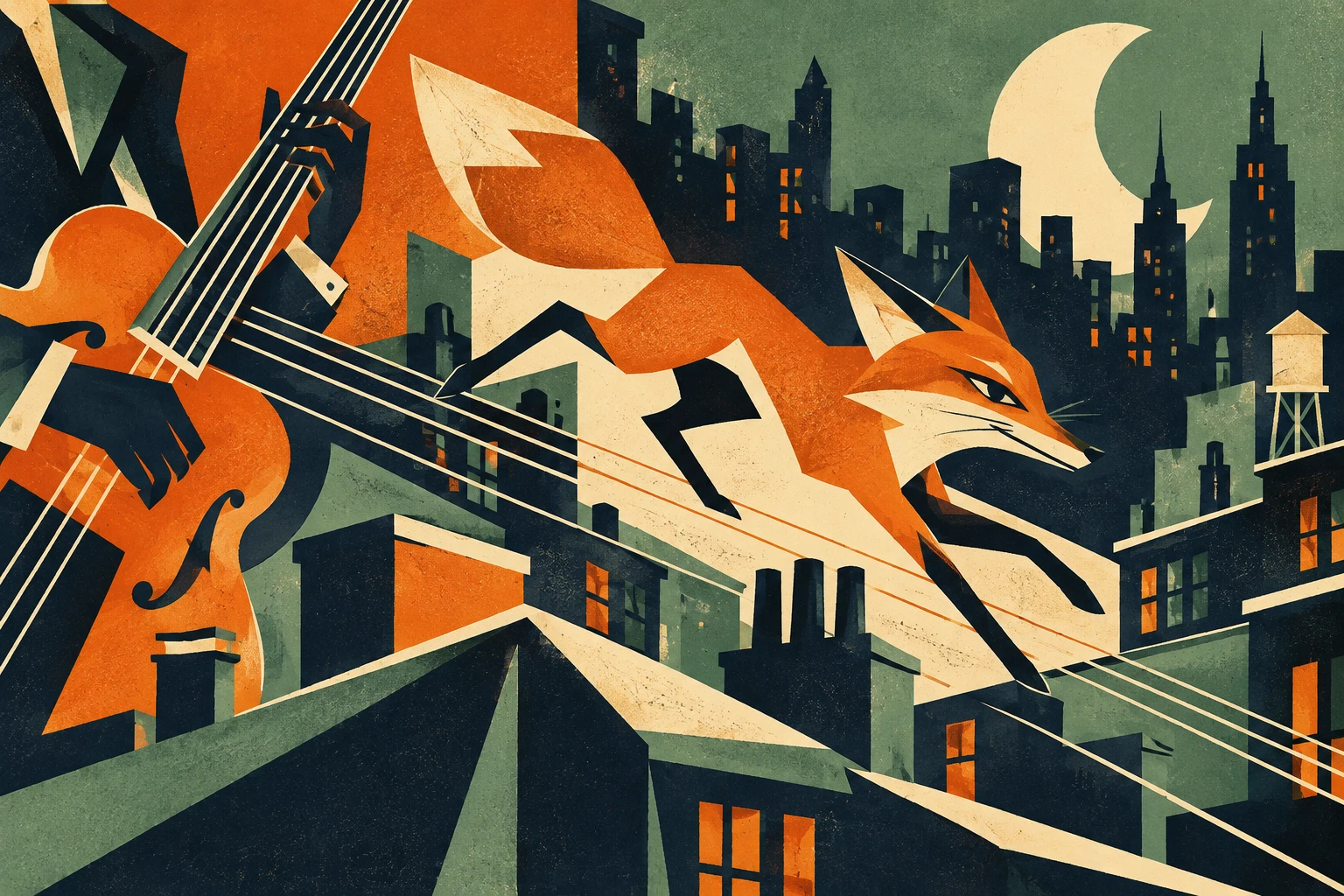
Original serigraph-style illustration for ultrafox
Original AI-assisted editorial artwork inspired by the tune’s mood. It does not depict a documented historical event.
Original AI-assisted illustration created for Djangopedia
Illustration credits & provenance →Selected performances by notable Gypsy Jazz players and ensembles. Inclusion is editorial and does not imply an objective popularity ranking.
Charlie Roman Jazz Band
Video available when checked; creator-described attribution.
Performer attribution follows the video title and channel description. Proposed listening selection; no popularity ranking implied.
If playback is unavailable, use the source link.
Play the opening bass notes alone, then add the melody without full chords. Isolate the bridge’s A-major and C-major arrivals and connect them with one short motif. Only then increase the tempo.
Keep the bass movement audible without over-accenting each inversion. Use economical strokes and give the violin or guitar melody space.
Begin at 90–110 bpm; proposed tracks 160 and 180 bpm
Play the opening bass notes alone, then add the melody without full chords. Isolate the bridge’s A-major and C-major arrivals and connect them with one short motif. Only then increase the tempo.
Count quarter notes first. Then place the click on beats 2 and 4 at half the click rate, keeping the phrase length unchanged.
F major (inherited chart); 32-bar AABA study grid. Agree the arrangement, pickup and ending before counting in.
The band name Ultrafox is not evidence that a video performs this composition. The inherited slash-chord ambiguity also needs checking.
Keep the melody uppermost and begin with a single bass note under each harmony. Reduce inversions to bass plus two upper voices; verify the unusual B-flat-minor slash chord before adding extra tones.
Keep the bass movement audible without over-accenting each inversion. Use economical strokes and give the violin or guitar melody space.
No vocal arrangement is prescribed; use the instrumental melody as the phrasing reference.
This player guide combines inherited recording evidence and editorial study notes. Musical study notes are editorial suggestions; compare them with the recording.
Charlie Roman Hot Club — creator credits ↗
Preserved Djangopedia archive ↗
Existing Django listening reference ↗
Original AI-assisted illustration created for Djangopedia
Original AI-assisted editorial artwork inspired by the tune’s mood. It does not depict a documented historical event.
Generated with the native image-generation tool on 2026-10-18; original editorial artwork, not a historical photograph.
Prompt: Create an original horizontal 3:2 editorial serigraph illustration for the jazz tune ultrafox. A nimble geometric fox darts between abstract guitar strings and angular city rooftops, a witty visual metaphor for a quick swinging tune. Mid-century jazz screen-print: strongly simplified geometric silhouettes, inventive asymmetry, broad flat shapes, limited ink palette of burnt orange, cream, midnight navy and sage, rough ink edges, restrained paper grain, playful sophisticated poster design. No gradients, no photographic rendering, no text, no border. Original composition only. Subjects and instruments stay inside frame.

