
Tune details
Music: Django Reinhardt
Documented in archive: 1952
Original key: Not established
Study level: Advanced; chromatic movement and brisk melodic articulation
 Djangopedia
Late Django with a bebop character: learn the chromatic movement slowly, then keep the E-flat melody clear at session tempo.
Loop two bars of chromatic movement at half the intended tempo, keeping one fingering position.

Owner content reviewed — 2026-10-15T13:12:32Z by admin. Coverage measures presence, not accuracy. Content review does not certify rights or musical perfection.
Django recordings for this tune. Uploader dates and take labels remain source claims; only an evidenced exact association enables a row’s Listen control.
Django Reinhardt - Topic
Video available when checked; creator-described attribution.
Distributor-supplied Django recording. No exact historical row association is asserted.
| Entry | Year | Recording / session / release evidence | Listen |
|---|---|---|---|
| 01 | 1952 | Nuit de St.Germain Des Pres, 30/1/52, P 1182 ,"DRG 8473,Musidisc 403222"," - Paris - Django Reinhardt (elg), Roger Guerin (tpt), Hubert Fol (as), Raymond Fol (p), Barney Spieler (b), Pierre Lemarchand (d)" | — |
| 02 | 1952 | Nuit de St.Germain Des Pres, 1952, Vogue 228E 6010," - Paris - Django Reinhardt (elg), Hubert Fol (as), Sadi Lallemand (vib), Maurice Vander (p), Pierre Michelot (b), Pierre Lemarchand (d)" | — |
A dash means no video has been associated with this exact historical recording. Tune-level listening resources remain available above.
Nuits de Saint-Germain-des-Prés belongs to Django's late, bebop-facing repertoire. This identity preserves a 30 January 1952 Decca entry, matrix P 1182, and a separate 1952 broadcast row. Django in June recommends learning the E-flat version before exploring G-major performances. The archive also contains a differently spelled Saint-Germaine identity; it is retained untouched rather than silently merged. This guide develops only the requested stable identity.
Music: Django Reinhardt
Documented in archive: 1952
Original key: Not established
Study level: Advanced; chromatic movement and brisk melodic articulation
Compare the late Django recording's attack and rhythmic density with a modern acoustic ensemble.
Nuit de St.Germain Des Pres, 30/1/52, P 1182 ,"DRG 8473,Musidisc 403222"," - Paris - Django Reinhardt (elg), Roger Guerin (tpt), Hubert Fol (as), Raymond Fol (p), Barney Spieler (b), Pierre Lemarchand (d)"
The E-flat study chart contains chromatic minor-chord motion around Fm–F♯m–Gm and a contrasting A-flat area. Hear the chromatic movement as connected voices while keeping the long AABA form intact. The melody deserves slow study before the tune is taken at session speed. Check the video key before playing with the chart.
The E-flat study chart contains chromatic minor-chord motion around Fm–F♯m–Gm and a contrasting A-flat area. Hear the chromatic movement as connected voices while keeping the long AABA form intact. The melody deserves slow study before the tune is taken at session speed.
Inherited chart and both recording rows preserved. No reliable Django-solo recreation was established; the gap remains.
[[Image:Nuits_st_germain.gif]]

| Fm/// | Fm/ F#m/ | Gm/// | Gm/ Gbm/ | Fm/// | Bb7/// | Eb/ Fm/ | Gm/ Gb7/ |

| Fm/// | Fm/ F#m/ | Gm/// | Gm/ Gbm/ | Fm/// | Bb7/// | Eb/ Fm/ | Eb |

| Bbm/// | Eb7/// | Ab/// | Ab/// | Cm/// | F7/// | Fm/// | Bb7/ Bb0/ |

| Fm/// | Fm/ F#m/ | Gm/// | Gm/ Gbm/ | Fm/// | Bb7/// | Eb/ Fm/ | Eb :||
Original source ↗
Stephane Wrembel
Swing · 200 BPM · 3m18s · Video available when checked; creator-described attribution.
Creator-described gypsy-jazz play-along. Check the key and full arrangement before joining in; the guide chart may use another key. Tempo is the creator’s stated value.
If playback is unavailable, use the source link.
Performed studies, transcriptions, TAB, notation and lessons for studying Django’s solo. Inclusion does not certify note-for-note accuracy.
No Django solo study aid yet. Know a useful resource — or want to record a study of this solo?
Follow a shared key, a harmonic idea or a familiar form. Keys refer to this site’s chart editions; other recordings may use a different key.
No sufficiently supported harmonic comparison has been added yet.
Showing 8 of 49 matches. Explore the full catalogue →
Original illustration: A musician carrying a guitar case along a Paris street lit by jazz-club windows.
Original AI-assisted editorial artwork inspired by the tune’s mood. It does not depict a documented historical event.
Original Djangopedia illustration · AI-assisted, 2026
Illustration credits & provenance →Selected performances by notable Gypsy Jazz players and ensembles. Inclusion is editorial and does not imply an objective popularity ranking.
kapitanswing
Video available when checked; creator-described attribution.
Performer attribution follows the video title and channel description. Proposed listening selection; no popularity ranking implied.
If playback is unavailable, use the source link.
 Angelo DeBarre - Nuit De Saint Germain Des Pres (Dutch TV)kapitanswingVideo available when checked; creator-described attribution.Performer attribution follows the video title and channel description. Proposed listening selection; no popularity ranking implied.✓ Featured
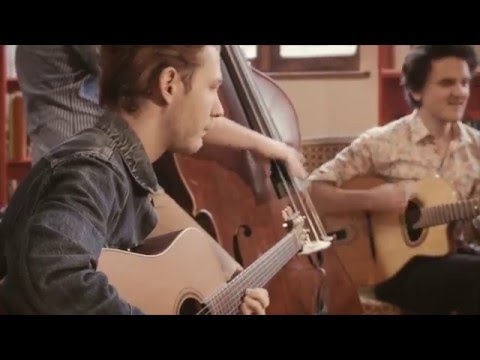 Nuits de St Germain des près // GYPSY GALAXYBob FeVideo available when checked; creator-described attribution.Performer attribution follows the video title and channel description. Proposed listening selection; no popularity ranking implied.Select video
Loop two bars of chromatic movement at half the intended tempo, keeping one fingering position. Then play the full melody slowly and name the bridge entry before increasing speed.
Use economical voicings and a light pulse; fast chromatic movement becomes muddy when every chord has six strings. Agree the key before counting in, since G-major versions also circulate.
Start at 100–120; work toward the 200-bpm play-along
Loop two bars of chromatic movement at half the intended tempo, keeping one fingering position. Then play the full melody slowly and name the bridge entry before increasing speed.
Count quarter notes first. Then place the click on beats 2 and 4 at half the click rate, keeping the phrase length unchanged.
E♭ major (inherited chart and documented recording practice); 32-bar AABA study form. Agree the arrangement, pickup and ending before counting in.
Starting in G when the rhythm section expects E-flat, or treating a general modern solo as Django's transcription.
Keep the melody uppermost and begin with a single bass note under each harmony. E♭6: E♭–G–B♭–C; A♭6: A♭–C–E♭–F.
Use economical voicings and a light pulse; fast chromatic movement becomes muddy when every chord has six strings. Agree the key before counting in, since G-major versions also circulate.
No vocal arrangement is prescribed; use the instrumental melody as the phrasing reference.
This player guide combines inherited recording evidence and editorial study notes. Musical study notes are editorial suggestions; compare them with the recording.
Django in June — Nuits de Saint-Germain-des-Prés ↗
Bayard Musique — Le dernier Django ↗
Original Djangopedia illustration · AI-assisted, 2026
Original AI-assisted editorial artwork inspired by the tune’s mood. It does not depict a documented historical event.
Generated with the native image-generation tool on 2026-10-15; original editorial artwork, not a historical photograph.
Prompt: Original Djangopedia jazz-guide illustration for Nuit de Saint-Germain-des-Prés. Landscape 1536x1024 3:2. Evocative 1950s Paris night street seen diagonally: angular tall buildings, glowing basement jazz-club windows with tiny musicians, a lone figure carrying a guitar case past an amber streetlamp, rainlike geometric reflections. Focus on architecture and atmosphere, not portraits. Broad Art Deco and mid-century modern print design, flat deep navy, soft violet, muted turquoise, mustard and warm cream, bold angular silhouettes, fine vintage paper grain. Lively but balanced spatial rhythm, no photographic realism, no documented-event claim. Original composition, no particular artist imitation, no text, lettering, logos, readable signs or watermark.
