
Tune details
Music: Abner Silver
Words: Benny Davis
Source-attributed publication / composition: 1935
Original key: Not established
Study level: Intermediate; major/minor colour and bridge direction
 Djangopedia
A lyrical standard whose darker bridge makes a rewarding study in changing colour without losing the melodic thread.
Play the last two bars of the A section into the first two bars of the bridge.
Owner content reviewed — 2026-10-18T10:57:15Z by admin. Coverage measures presence, not accuracy. Content review does not certify rights or musical perfection.
Django recordings for this tune. Uploader dates and take labels remain source claims; only an evidenced exact association enables a row’s Listen control.
Django Reinhardt
source-described; accuracy not independently verified
Uploader identifies this as Django Reinhardt’s performance; recording date and take require comparison with the discography.
| Entry | Year | Recording / session / release evidence | Listen |
|---|---|---|---|
| 01 | 1935 | Chasing Shadows, Sept.1935, P 77537 ,"Fremeaux FA 303, Classics 727, JSP 341, Conifer CDHD165, Vogue 668003-1"," - Stephane Grappelly (v), Django Reinhardt, Joseph Reinhardt, PierreFerret (g), Louis Vola (b)." | — |
A dash means no video has been associated with this exact historical recording. Tune-level listening resources remain available above.
The University of Chicago sheet-music inventory identifies Benny Davis’s words and Abner Silver’s music in a 1935 edition. Django’s inherited entry is from September 1935. The existing Samy Zouari transcription is preserved. Dmitry Kushnirov’s proposed solo-guitar arrangement is a new interpretation, not labelled as a recreation of Django’s complete solo.
Music: Abner Silver
Words: Benny Davis
Source-attributed publication / composition: 1935
Original key: Not established
Study level: Intermediate; major/minor colour and bridge direction
Listen for the change into G minor and how the soloist connects it to the preceding major-key phrase.
Chasing Shadows, Sept.1935, P 77537 ,"Fremeaux FA 303, Classics 727, JSP 341, Conifer CDHD165, Vogue 668003-1"," - Stephane Grappelly (v), Django Reinhardt, Joseph Reinhardt, PierreFerret (g), Louis Vola (b)."
The E-flat A section alternates tonic and B-flat7, then passes through C minor and F minor before returning. A half-diminished A chord and D7 lead into G minor at the bridge. The later E-flat-minor-sixth colour is another specific change, not evidence that the whole tune is minor. Keep the melody audible over these shifts. Check the video key before playing with the chart.
The E-flat A section alternates tonic and B-flat7, then passes through C minor and F minor before returning. A half-diminished A chord and D7 lead into G minor at the bridge. The later E-flat-minor-sixth colour is another specific change, not evidence that the whole tune is minor. Keep the melody audible over these shifts.
Inherited chart is preserved verbatim as historical study material, not silently corrected or newly authenticated. Check the specific caveats below and match the arrangement and key to the selected video. External teaching material remains on its creator’s site.
| Eb/ Bb7/ | Eb/ Db/ | Eb/ Bb7/ | Eb/ Abm7/ |

| Eb/ Cm/ | Fm/ Bb7/ | Eb/ Cm/ | Fm/ Bb7/ |

| Eb/ Bb7/ | Eb/ Db/ | Eb/ Bb7/ | Eb/ Abm7/ |

| Eb/ Cm/ | Fm/ Bb7/ | Eb/ Am7b5/ | Am7b5/ D7/ |

| Gm7/// | Gm7/// | Gm7/// | C(/G)/// |

| Bb/// | Cm/// | Ebm6/// | Bb7/// |

| Eb/ Bb7/ | Eb/ Db/ | Eb/ Bb7/ | Eb/ Abm7/ |

| Eb/ Cm/ | Fm/ Bb7/ | Eb/ Cm/ | Fm/ Bb7/ :||
Original source ↗
Laurent Courtois et Nuages de Swing
2m59s · Video available when checked; creator-described attribution.
Creator-provided play-along; instrumentation and feel vary by selection. Check the key and full arrangement before joining in; the guide chart may use another key.
If playback is unavailable, use the source link.
Performed studies, transcriptions, TAB, notation and lessons for studying Django’s solo. Inclusion does not certify note-for-note accuracy.
Samy Zouari
source-described; accuracy not independently verified
Creator presents a study of Django’s recorded solo. Use it alongside the original recording; exact transcription accuracy has not been independently reviewed.
If playback is unavailable, use the source link.
Follow a shared key, a harmonic idea or a familiar form. Keys refer to this site’s chart editions; other recordings may use a different key.
No sufficiently supported harmonic comparison has been added yet.
No match is established in the current chart metadata.
Showing 8 of 85 matches. Explore the full catalogue →
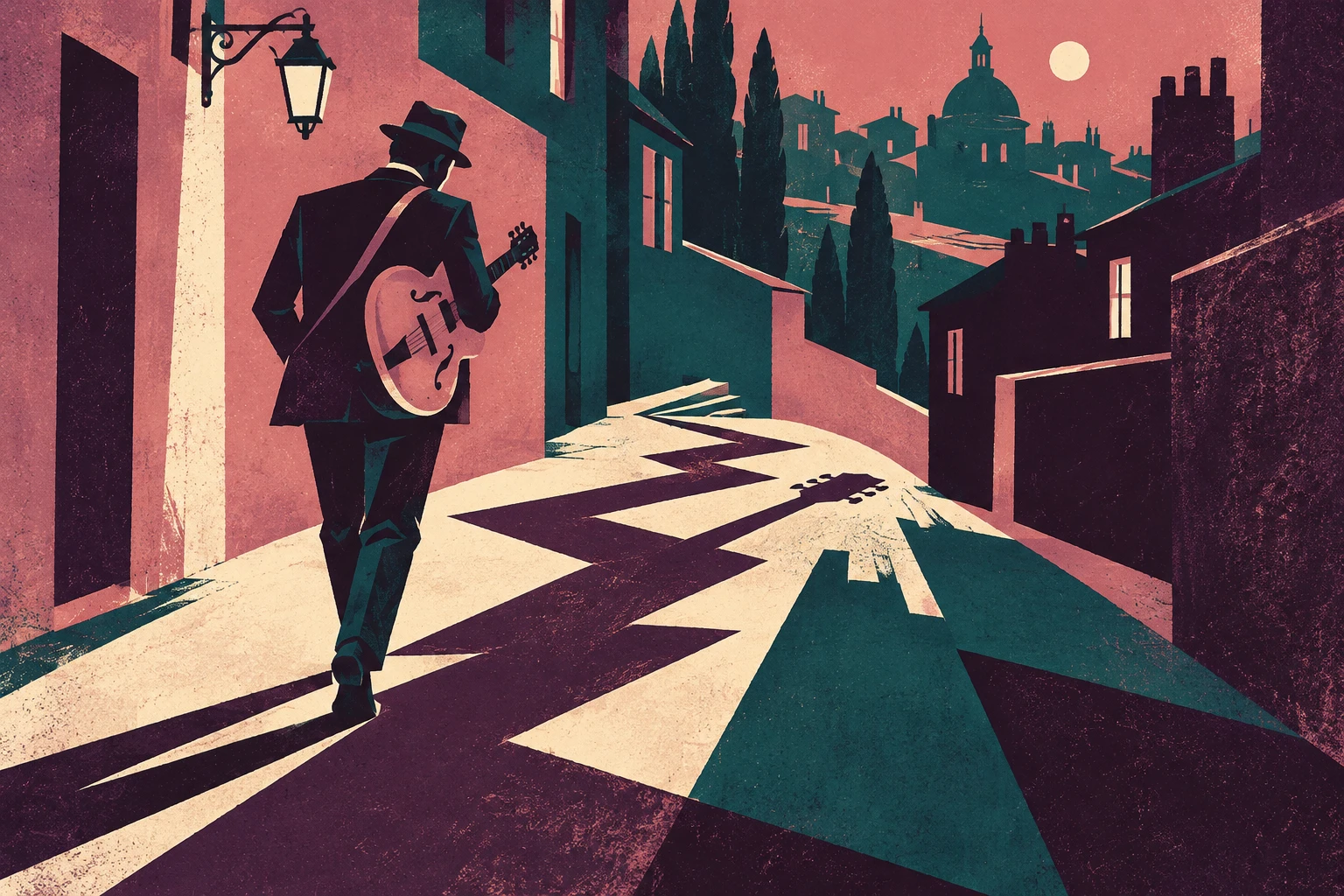
Original serigraph-style illustration for chasing shadows
Original AI-assisted editorial artwork inspired by the tune’s mood. It does not depict a documented historical event.
Original AI-assisted illustration created for Djangopedia
Illustration credits & provenance →Selected performances by notable Gypsy Jazz players and ensembles. Inclusion is editorial and does not imply an objective popularity ranking.
Дмитрий Кушниров
Video available when checked; creator-described attribution.
Performer attribution follows the video title and channel description. Proposed listening selection; no popularity ranking implied.
If playback is unavailable, use the source link.
Play the last two bars of the A section into the first two bars of the bridge. Land on B-flat over G minor and hold it. Repeat with one short pickup, then practise the bridge-to-A return with equal care.
Use soft chord releases and clear phrase lengths. Avoid thick voicings under the melody’s sustained notes.
Begin at 80–100 bpm with a relaxed swing
Play the last two bars of the A section into the first two bars of the bridge. Land on B-flat over G minor and hold it. Repeat with one short pickup, then practise the bridge-to-A return with equal care.
Count quarter notes first. Then place the click on beats 2 and 4 at half the click rate, keeping the phrase length unchanged.
E-flat major (inherited chart); 32-bar AABA study grid. Agree the arrangement, pickup and ending before counting in.
A full concert set containing Chasing Shadows is not offered as a tune-only performance without a verified start time.
Keep the melody uppermost and begin with a single bass note under each harmony. Compare E-flat–G–B-flat with E-flat–G-flat–B-flat; the single changed voice should be easy to hear.
Use soft chord releases and clear phrase lengths. Avoid thick voicings under the melody’s sustained notes.
Choose a comfortable singing key and transpose the accompaniment as a whole; lyrics are not reproduced here.
This player guide combines inherited recording evidence and editorial study notes. Musical study notes are editorial suggestions; compare them with the recording.
University of Chicago — sheet-music inventory ↗
Preserved Djangopedia archive ↗
Existing Django listening reference ↗
Original AI-assisted illustration created for Djangopedia
Original AI-assisted editorial artwork inspired by the tune’s mood. It does not depict a documented historical event.
Generated with the native image-generation tool on 2026-10-18; original editorial artwork, not a historical photograph.
Prompt: Create an original horizontal 3:2 editorial serigraph illustration for the jazz tune chasing shadows. An angular guitarist walks down a narrow evening street; long playful shadows of guitar and rooftops stretch ahead in rhythmic zigzags. Mid-century jazz screen-print: strongly simplified geometric silhouettes, inventive asymmetry, broad flat shapes, limited ink palette of aubergine, dusty pink, deep teal and ivory, rough ink edges, restrained paper grain, playful sophisticated poster design. No gradients, no photographic rendering, no text, no border. Original composition only. Subjects and instruments stay inside frame.


