
Tune details
Music: Edgar Sampson, Benny Goodman, Chick Webb
Words: Andy Razaf
Published / composed / adapted — see history: 1933
Original key: Not established
Study level: Intermediate; advanced where the inherited roadmap needs reconstruction
 Djangopedia
A riff-friendly swing standard with a distinctive chain of dominant colours in the bridge. The contrast between relaxed tonic material and moving bridge harmony makes it useful for rhythmic development.
Keep the bridge's descending guide-tone line audible.
Owner content reviewed — 2026-10-06T18:40:09Z by admin. Coverage measures presence, not accuracy. Content review does not certify rights or musical perfection.
Django recordings for this tune. Uploader dates and take labels remain source claims; only an evidenced exact association enables a row’s Listen control.
Django Reinhardt
source-described; accuracy not independently verified
Uploader identifies this as Django Reinhardt’s performance; recording date and take require comparison with the discography.
| Entry | Year | Recording / session / release evidence | Listen |
|---|---|---|---|
| 01 | 1944 | Stompin' At The Savoy, Dec.1944, ST 1230 ,"Fremeaux FA 312, Classics 945"," - Paris - Jazz Club Mystery Hot Band - Bernie Previn (tpt), Peanuts Hucko (cl,ts), Mel Powell (p), Django Reinhardt (g),Josz Schulman (b), Ray McKinley (d)" | — |
| 02 | 1950 | Stompin' At The Savoy, 1950, BL201,(unissued)," - Rome - Django Reinhardt (elg), Andre Ekyan (as,cl), Ralph Schecroun (p), Alf Masselier (b), Roger Paraboschi (d)" | — |
A dash means no video has been associated with this exact historical recording. Tune-level listening resources remain available above.
Stompin' At The Savoy is credited here to Edgar Sampson, Benny Goodman, Chick Webb. The source date is 1933; publication, composition and later lyric adaptations may have separate dates. The inherited archive lists 2 recording entries, with dated entries spanning 1944–1950. These are archive rows, not a claim that every entry is a distinct released take. The linked recording rows preserve the original discographical wording. Compare their dates, matrices and personnel when choosing a performance to study.
Music: Edgar Sampson, Benny Goodman, Chick Webb
Words: Andy Razaf
Published / composed / adapted — see history: 1933
Original key: Not established
Study level: Intermediate; advanced where the inherited roadmap needs reconstruction
Listening task: Preserve the head's rhythmic identity; more notes do not make a riff swing harder. Mark the key, pickup, phrase lengths and ending before comparing another version.
Stompin' At The Savoy, Dec.1944, ST 1230 ,"Fremeaux FA 312, Classics 945"," - Paris - Jazz Club Mystery Hot Band - Bernie Previn (tpt), Peanuts Hucko (cl,ts), Mel Powell (p), Django Reinhardt (g),Josz Schulman (b), Ray McKinley (d)"
Compare the first and last listed entries for tempo, instrumentation and arrangement. Do not infer identical takes from a shared title. Keep the bridge's descending guide-tone line audible.
Stompin' At The Savoy, 1950, BL201,(unissued)," - Rome - Django Reinhardt (elg), Andre Ekyan (as,cl), Ralph Schecroun (p), Alf Masselier (b), Roger Paraboschi (d)"
The inherited chart is in F major in the inherited chart. Confirm the backing track’s sounding key, pickup and complete form before playing; an instrument label may describe a transposed score.
F-centred A sections contrast with B♭7–E♭7–A♭7–D♭7 before C7 returns home. The source adds chromatic upper neighbours to several bridge dominants.
The first cells of the opening two rows contain only slashes. Their intended harmony is not stated; confirm it from a chosen edition. This source uses F, which may differ from other charts and tracks.
| //// | C7/// | F/// | F/ C7/ | F/// |  F/ F#0/ | F/// | F/ C7/ |

| //// | C7/// | F/// | F/ C7/ | G7/// |  C7/// | F/// | F/ C7/ |

| Bb7/ B7/ | Bb7/// | Eb7/ E7/ | Eb7/// | Ab7/ A7/ | Ab7/// | Db7/// | C7/// |

| F/// | F/ C7/ | F/// | F/ F#0/ | Gm7/// |  C7/// | F/// | F/// :||
Original source ↗
Guitare Improvisation
The inherited chart is in F major in the inherited chart. Confirm the backing track’s sounding key, pickup and complete form before playing; an instrument label may describe a transposed score. · 5:24
If playback is unavailable, use the source link.
Performed studies, transcriptions, TAB, notation and lessons for studying Django’s solo. Inclusion does not certify note-for-note accuracy.
No Django solo study aid yet. Know a useful resource — or want to record a study of this solo?
Follow a shared key, a harmonic idea or a familiar form. Keys refer to this site’s chart editions; other recordings may use a different key.
No sufficiently supported harmonic comparison has been added yet.
Showing 8 of 31 matches. Explore the full catalogue →
Showing 8 of 85 matches. Explore the full catalogue →
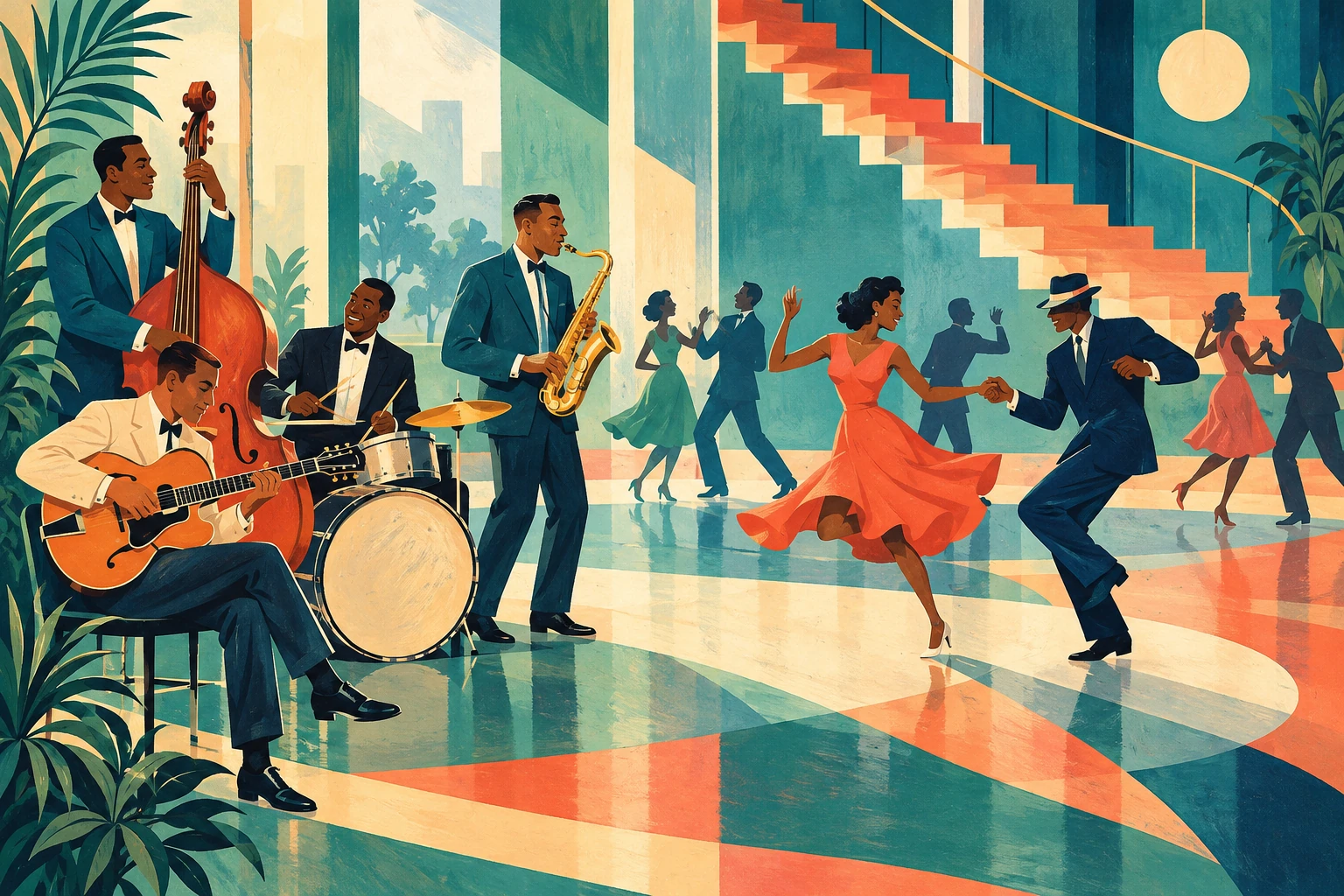
A fictional small swing band occupies one corner of a broad abstract dance floor while distant dancer silhouettes answer its riff. A contrasting descending colour staircase crosses the far wall. The tune's riff-friendly head and dominant bridge motivate a Savoy-inspired title setting, not an exact historical hall.
An original editorial interpretation of the tune. This is an illustration, not an archival photograph or a documented reconstruction of a recording session.
Original Djangopedia illustration · AI-assisted, 2026
Illustration credits & provenance →Selected performances by notable Gypsy Jazz players and ensembles. Inclusion is editorial and does not imply an objective popularity ranking.
Stochelo Rosenberg and Joscho Stephan · Joscho Stephan
Studio guest session · YouTube title, uploader metadata and player availability checked 6 October 2026. Independent interpretation; proposed order awaits owner decision. No full-video musical audition claimed.
Stage 4N private performance. Performed theme, solos and trading; separate lesson links are promotional.
If playback is unavailable, use the source link.
 Stompin´At The Savoy ⎮Stochelo Rosenberg & Joscho StephanStochelo Rosenberg and Joscho Stephan · Joscho StephanStudio guest session · YouTube title, uploader metadata and player availability checked 6 October 2026. Independent interpretation; proposed order awaits owner decision. No full-video musical audition claimed.Stage 4N private performance. Performed theme, solos and trading; separate lesson links are promotional.✓ Featured
 'Stompin' at the Savoy' - The Rosenberg Trio @ Jazz in Marciac. July 31 2019.Rosenberg Trio · SINTI MUSIC2019 · Jazz in Marciac, 31 July 2019 · YouTube title, uploader metadata and player availability checked 6 October 2026. Independent interpretation; proposed order awaits owner decision. No full-video musical audition claimed.Stage 4N private performance. Festival performance featuring Stochelo, Mozes and Nonnie Rosenberg.Select video
 Stomping at the Savoy - Gypsy Jazz in Paris 2026Romain Vuillemin Quartet with Noe Codjia · Romain Vuillemin2026 · Django meets Armstrong, Paris · YouTube title, uploader metadata and player availability checked 6 October 2026. Independent interpretation; proposed order awaits owner decision. No full-video musical audition claimed.Stage 4N private performance. Gypsy-jazz trumpet and guitar quartet; year identified in title.Select video
 Stompin' at the SavoyRemi Harris and Tom Moore · Remi Harris2020 · Guitar and bass support-bubble jam · YouTube title, uploader metadata and player availability checked 6 October 2026. Independent interpretation; proposed order awaits owner decision. No full-video musical audition claimed.Stage 4N private performance. Description dates session to day before 16 June 2020 upload.Select video
Play the bridge without chromatic neighbours, then add them while keeping the same guide-tone line and pulse. Practise a repeated two-note motif over the A sections.
Keep the bridge's main dominant roots clear and make the chromatic neighbours brief colours. Match the head's rhythmic placement without crowding it.
Start around 100–140 bpm; increase only after the form stays secure
Play the bridge without chromatic neighbours, then add them while keeping the same guide-tone line and pulse. Practise a repeated two-note motif over the A sections.
Begin with four quarter-note clicks. Halve the click rate and hear beats 2 and 4 while maintaining the same phrase lengths.
Stompin' At The Savoy — F major in the inherited chart; 32 bars, AABA; first source cell is unspecified. Agree the pickup, tempo and ending before counting in.
32 bars, AABA; first source cell is unspecified. The first cells of the opening two rows contain only slashes. Their intended harmony is not stated; confirm it from a chosen edition. This source uses F, which may differ from other charts and tracks.
Start with melody and bass only. Add the following colour without interrupting the melody: Follow D–D♭–C–C♭ through B♭7–E♭7–A♭7–D♭7.
Keep the bridge's main dominant roots clear and make the chromatic neighbours brief colours. Match the head's rhythmic placement without crowding it. Agree the full roadmap and signal the last head before it starts.
Choose a comfortable vocal key and transpose the whole arrangement, including its introduction and ending.
Search online videos of "Stompin' At The Savoy" in youtube.com ↗
This player guide combines inherited recording evidence and editorial study notes. Musical study notes are editorial suggestions; compare them with the recording.
Djangopedia — inherited chart and recording rows ↗
Composition credits and background ↗
Guitare Improvisation — practice backing ↗
Feature photograph — source collection ↗
Original Djangopedia illustration · AI-assisted, 2026
An original editorial interpretation of the tune. This is an illustration, not an archival photograph or a documented reconstruction of a recording session.
Generated with the native image-generation tool on 2026-10-08; original editorial artwork, not a historical photograph.
Prompt: Use case: illustration-story. One original editorial feature illustration for Djangopedia's guide “Stompin' At The Savoy”. Landscape 1536 × 1024, opaque background. Scene: A fictional small swing band occupies one corner of a broad abstract dance floor while distant dancer silhouettes answer its riff. A contrasting descending colour staircase crosses the far wall. The tune's riff-friendly head and dominant bridge motivate a Savoy-inspired title setting, not an exact historical hall. Musical basis from the guide: A riff-friendly swing standard with a distinctive chain of dominant colours in the bridge. The contrast between relaxed tonic material and moving bridge harmony makes it useful for rhythmic development. The supplied chart is F major in the inherited chart; form: 32 bars, AABA; first source cell is unspecified; feel: Swing. These describe musical inspiration, not visible writing. Historical context: Stompin' At The Savoy is credited here to Edgar Sampson, Benny Goodman, Chick Webb. The source date is 1933; publication, composition and later lyric adaptations may have separate dates. Do not illustrate disputed historical claims or suggest this imagined scene is an archival session. Medium: mid-century editorial. Dominant palette: jade coral and midnight blue. Composition: wide diagonal dance-floor exchange. Human presence: four small figures and distant dancers. Strong intentional design, clearly drawn/painted, distinctive material marks; keep essential subject safely within the central 70 percent width and middle 80 percent height for card crops. Maintain enough visual substance at thumbnail size. Broad inspiration observed in old photo, ONLY scale/rhythm and never a reference image: wide seated outdoor group; repeated chairs; open daylight. Independently invent every pose, perspective, clothing, setting and lighting. Avoid: No terrace photo recreation, famous ballroom copy, repeated nightclub scene. No photorealism, archival simulation, generated text, letters, numbers, labels, fake musical notation, logo, signature, watermark, fake dates, yellowed-paper patina, recognizable artwork or copied photograph. No imitation of any named artist. Render the art edge to edge without borders, mockup or typography. Batch B diversity compensation: make light and midtone areas substantial; avoid near-black dominant backdrops, violet monochrome, empty chair/stool/bench compositions, repeated sunset terraces and generic cloud panoramas. Preserve the stated tune-specific scene. Human figures remain standing or peripheral except an explicitly named ensemble; no centered seated Django portrait. For graphic images use clearly plain colour shapes, no ruled parallel staffs, circles with stems, note-like marks or typography.
Photograph provenance and rights are stated separately. Attribution does not establish permission.
