
Tune details
Music: Django Reinhardt
Documented in archive: 1942
Original key: Not established
Study level: Accessible structure; intermediate minor harmony
 Djangopedia
A concise minor blues with a dark tonic-sixth sound and a descending dominant close. It is a useful place to develop space, recurring motifs and a strong twelve-bar sense of time.
Build a complete blues statement from a small recurring idea.
Owner content reviewed — 2026-10-04T17:06:27Z by admin. Coverage measures presence, not accuracy. Content review does not certify rights or musical perfection.
Django recordings for this tune. Uploader dates and take labels remain source claims; only an evidenced exact association enables a row’s Listen control.
Django Reinhardt
source-described; accuracy not independently verified
Uploader identifies this as Django Reinhardt’s performance; recording date and take require comparison with the discography.
| Entry | Year | Recording / session / release evidence | Listen |
|---|---|---|---|
| 01 | 1947 | Blues en Mineur, 8-13/11/47, "Fremeaux FA 315, Vogue 228E 6007, Vogue 668003-3, Vogue 670205, Kardum GLO 139(Blues),Legacy 411(""Paris Blues"")"," - Paris - Souvenirs de Django Reinhardt - Django Reinhardt (elg), Gerard Leveque (cl), Eugene Vees (g), Emmanuel Soudieux (b), Andre Jourdan (d)" | — |
| 02 | 1942 | Blues en Mineur,16191,16/4/42,"Fremeaux FA 311, Classics 877, Verve 513 947-2, Music Memoria 87949-2, RDC 40032"," - Brussels - Django Reinhardt (g & v*), Ivan de Bie (p)" | — |
A dash means no video has been associated with this exact historical recording. Tune-level listening resources remain available above.
The legacy prose claims a 1935 recording, but the recovered rows identify Brussels in April 1942 and Paris in November 1947. This guide uses those rows as documented source claims and leaves the earlier date unresolved. Similar blues titles and reissue names need careful reconciliation.
Music: Django Reinhardt
Documented in archive: 1942
Original key: Not established
Study level: Accessible structure; intermediate minor harmony
Listening task: Shape a four-bar question, another four-bar response and a closing answer. Count the head before comparing solo choruses.
Blues en Mineur, 8-13/11/47, "Fremeaux FA 315, Vogue 228E 6007, Vogue 668003-3, Vogue 670205, Kardum GLO 139(Blues),Legacy 411(""Paris Blues"")"," - Paris - Souvenirs de Django Reinhardt - Django Reinhardt (elg), Gerard Leveque (cl), Eugene Vees (g), Emmanuel Soudieux (b), Andre Jourdan (d)"
Compare the tempo, key, introduction and final cadence with the first entry. Build a complete blues statement from a small recurring idea.
Blues en Mineur,16191,16/4/42,"Fremeaux FA 311, Classics 877, Verve 513 947-2, Music Memoria 87949-2, RDC 40032"," - Brussels - Django Reinhardt (g & v*), Ivan de Bie (p)"
Count its form and check its key before joining in. Four bars of Gm6 lead to two of Cm6, then two back on Gm6. E♭7–D7 prepares the final tonic and the turnaround into another chorus.
Four bars of Gm6 lead to two of Cm6, then two back on Gm6. E♭7–D7 prepares the final tonic and the turnaround into another chorus.
This inherited grid contains a full twelve-bar minor blues. The source’s prose and recording dates disagree; the old 1935 claim is not treated as independently confirmed.
[[Image:Blues_mineur.gif]]


| Gm6/// | Gm6/// | Gm6/// | Gm6/// | Cm6/// | Cm6/// |

| Gm6/// | Gm6/// | Eb7/// | D7/// | Gm6/// | D7/// :||
Original source ↗
Guitare Improvisation
5:18
If playback is unavailable, use the source link.
 Blues en mineur : Gm (160 bpm) - Gypsy jazz Backing track / Jazz manoucheGuitare Improvisation5:18✓ Featured
 Blues en mineur : Gm (160 bpm) Old Style - Gypsy jazz Backing track / Jazz manoucheGuitare Improvisation5:04Select video
 Blues en mineur - Gypsy Jazz Play AlongSven Jungbeck4:01Select video
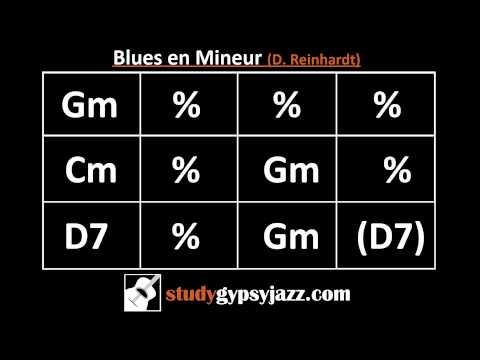 Gypsy Jazz Backing Track / Play Along - Blues en Mineur - MediumStudy Gypsy Jazz3:11Select video
Performed studies, transcriptions, TAB, notation and lessons for studying Django’s solo. Inclusion does not certify note-for-note accuracy.
Zak Martel
source-described; accuracy not independently verified
Creator presents a study of Django’s recorded solo. Use it alongside the original recording; exact transcription accuracy has not been independently reviewed.
If playback is unavailable, use the source link.
Follow a shared key, a harmonic idea or a familiar form. Keys refer to this site’s chart editions; other recordings may use a different key.
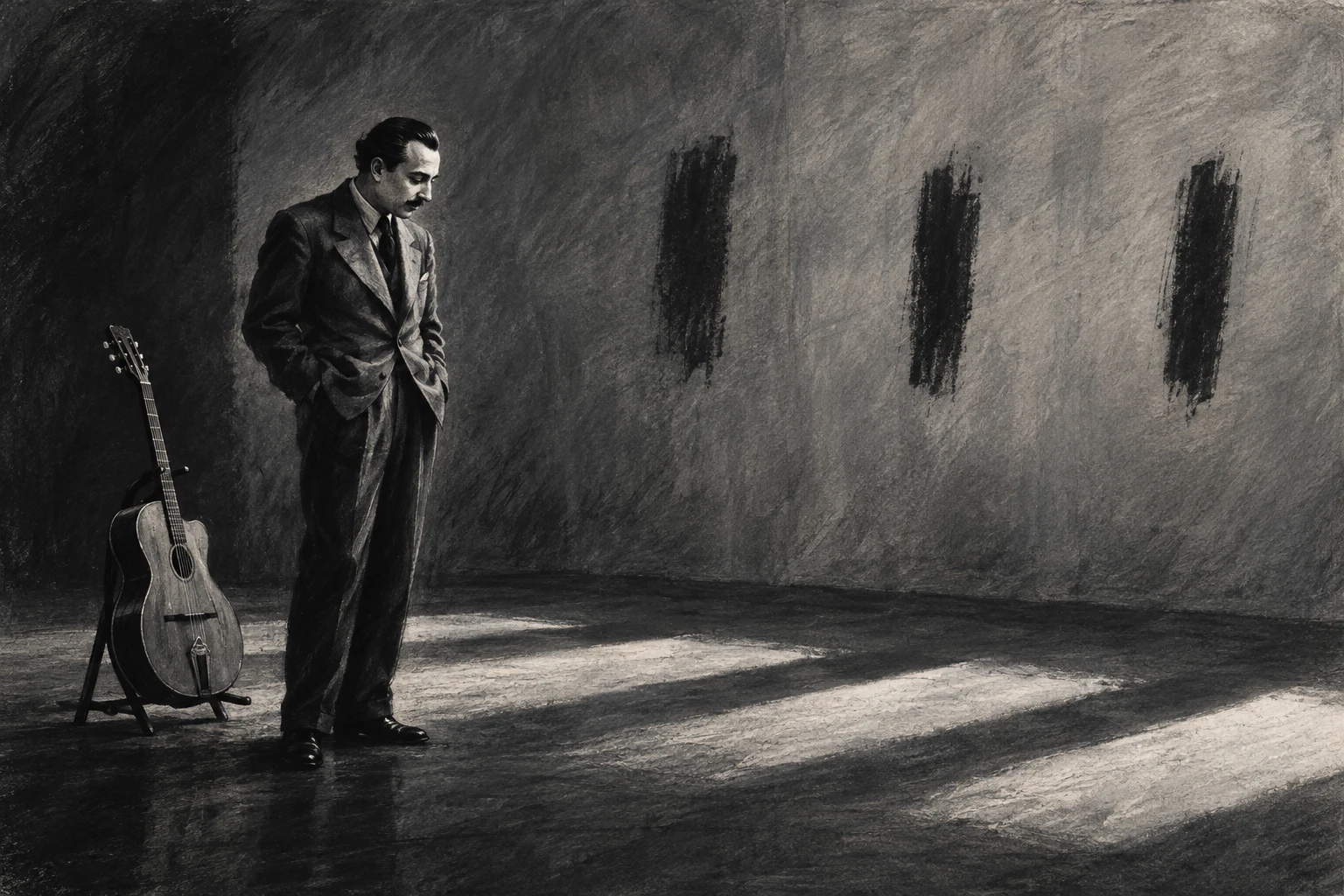
An unmistakably drawn Django Reinhardt as a small standing figure listening beside a guitar on its stand, three separated dark brush marks recurring across twelve implied spacious intervals. Emphasise introspection, minor-blues economy and breathing room; no claim to depict an actual session.
An original editorial interpretation of the tune. This is an illustration, not an archival photograph or a documented reconstruction of a recording session.
Original Djangopedia illustration · AI-assisted, 2026
Illustration credits & provenance →Selected performances by notable Gypsy Jazz players and ensembles. Inclusion is editorial and does not imply an objective popularity ranking.
Joscho Stephan, Raffael Mueller and Julia Hornung · Joscho Stephan
Munich Connection trio · Watch-page identity, tune, performers and Gypsy jazz context checked 2026-10-07; date/session details remain source claims.
Django’s Minor Blues / Blues en Mineur interpreted by the Munich Connection trio. A lesson advertisement follows the theme–solos–theme performance at 3:25.
If playback is unavailable, use the source link.
 Minor Blues // Joscho Stephan Munich ConnectionJoscho Stephan, Raffael Mueller and Julia Hornung · Joscho StephanMunich Connection trio · Watch-page identity, tune, performers and Gypsy jazz context checked 2026-10-07; date/session details remain source claims.Django’s Minor Blues / Blues en Mineur interpreted by the Munich Connection trio. A lesson advertisement follows the theme–solos–theme performance at 3:25.✓ Featured
 Blues En MineurAdrien Moignard Trio · Moignard Adrien2021 · Adrien Moignard Trio Live — artist release · Watch-page identity, tune, performers and Gypsy jazz context checked 2026-10-07; date/session details remain source claims.Artist release from the live trio album; year denotes the release.Select video
 Joscho Stephan & friends live: Blues en mineur !Joscho Stephan, Sven Jungbeck, Volker Kamp and Costel Nitescu · Jazz Club Hannover by Gartenheim2022 · Live in Hannover · Watch-page identity, tune, performers and Gypsy jazz context checked 2026-10-07; date/session details remain source claims.Ensemble concert performance recorded on 25 November 2022, according to the venue.Select video
 Hugo Guezbar & Fanou Torracinta play Blues Mineur (Django Reinhardt)Hugo Guezbar and Fanou Torracinta · Festival Django PortugalChez George, Paris · Watch-page identity, tune, performers and Gypsy jazz context checked 2026-10-07; date/session details remain source claims.Jazz manouche guitar performance at Chez George, documented by Festival Django Portugal.Select video
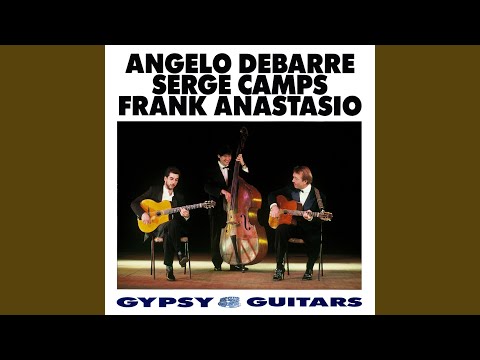 Blues En MineurAngelo Debarre, Serge Camps and Frank Anastasio · Angelo Debarre - Θέμα1989 · Gypsy Guitars — artist release · Watch-page identity, tune, performers and Gypsy jazz context checked 2026-10-07; date/session details remain source claims.Acoustic ensemble recording issued on Gypsy Guitars; year denotes the release.Select video
Play a twelve-bar chorus with only three pitches and rests. Keep the same motif for three choruses but change the final cadence each time.
Use short, steady Gm6 and Cm6 shapes. Let the bass mark the four-bar boundaries; avoid over-accenting each passing dominant.
Start at 90–110; build toward 140–180 bpm
Play a twelve-bar chorus with only three pitches and rests. Keep the same motif for three choruses but change the final cadence each time.
Start below the suggested tempo. First hear four quarter-note clicks, then halve the click rate and place clicks on beats 2 and 4. Keep the same phrase length.
Blues en Mineur — G minor; 12-bar minor blues. Agree the tempo, pickup, solo order and ending before the count.
For trading fours, count three four-bar exchanges per chorus and decide who brings back the head.
Alternate a low G anchor with concise chord and melody answers.
For trading fours, count three four-bar exchanges per chorus and decide who brings back the head.
This guide studies an instrumental arrangement. Any later lyric adaptation requires its own credit and chosen key.
This player guide combines inherited recording evidence and editorial study notes. Musical study notes are editorial suggestions; compare them with the recording.
Composition background and credits ↗
Guitare Improvisation — backing track ↗
Feature photograph — Gypsy Jazz UK historical archive ↗
Original Djangopedia illustration · AI-assisted, 2026
An original editorial interpretation of the tune. This is an illustration, not an archival photograph or a documented reconstruction of a recording session.
Generated with the native image-generation tool on 2026-10-08; original editorial artwork, not a historical photograph.
Prompt: Use case: illustration-story. One original editorial feature illustration for Djangopedia's guide “Blues en Mineur”. Landscape 1536 × 1024, opaque background. Scene: An unmistakably drawn Django Reinhardt as a small standing figure listening beside a guitar on its stand, three separated dark brush marks recurring across twelve implied spacious intervals. Emphasise introspection, minor-blues economy and breathing room; no claim to depict an actual session. Musical basis from the guide: A concise minor blues with a dark tonic-sixth sound and a descending dominant close. It is a useful place to develop space, recurring motifs and a strong twelve-bar sense of time. The supplied chart is G minor; form: 12-bar minor blues; feel: Swing. These describe musical inspiration, not visible writing. Historical context: The legacy prose claims a 1935 recording, but the recovered rows identify Brussels in April 1942 and Paris in November 1947. This guide uses those rows as documented source claims and leaves the earlier date unresolved. Similar blues titles and reissue names need careful reconciliation. Do not illustrate disputed historical claims or suggest this imagined scene is an archival session. Medium: charcoal. Dominant palette: black white and restrained slate. Composition: off-centre silhouette with long space. Human presence: one Django figure. Strong intentional design, clearly drawn/painted, distinctive material marks; keep essential subject safely within the central 70 percent width and middle 80 percent height for card crops. Maintain enough visual substance at thumbnail size. Broad inspiration observed in old photo, ONLY scale/rhythm and never a reference image: solo instrument prominence; dark light contrast; intimate scale. Independently invent every pose, perspective, clothing, setting and lighting. Avoid: No fireplace, crossed-leg seated pose, centered guitar portrait. No photorealism, archival simulation, generated text, letters, numbers, labels, fake musical notation, logo, signature, watermark, fake dates, yellowed-paper patina, recognizable artwork or copied photograph. No imitation of any named artist. Render the art edge to edge without borders, mockup or typography.
Photograph rights are documented separately in its credit. They do not establish the rights status of the composition or recording.
