
Tune details
Music: Fletcher Allen
Documented in archive: 1937
Original key: Not established
Study level: Intermediate; contrasting forms and blues phrasing
 Djangopedia
A distinctive head, a blues-based solo chorus and an independent ending: learn the roadmap before adding speed.
Record one F-blues chorus using only a two-note motif.
Owner content reviewed — 2026-10-18T01:19:58Z by admin. Coverage measures presence, not accuracy. Content review does not certify rights or musical perfection.
Django recordings for this tune. Uploader dates and take labels remain source claims; only an evidenced exact association enables a row’s Listen control.
Django Reinhardt
source-described; accuracy not independently verified
Uploader identifies this as Django Reinhardt’s performance; recording date and take require comparison with the discography.
| Entry | Year | Recording / session / release evidence | Listen |
|---|---|---|---|
| 01 | 1937 | Viper's Dream, 25/11/37, "Fremeaux 306, Classics 762, Jazz Time 790560-2, Jazz Archives ZET 752, Mosaic MD6-190(6 CD Set)."," - Paris - QHCF - Stephane Grappelly (v), Django Reinhardt, Joseph Reinhardt, Eugene Vees (g), Louis Vola (b)" | — |
| 02 | 1947 | Viper's Dream, 25/8/47, "Fremeaux FA 314, Vogue 228E 6006, Vogue 668003-2, Vogue 670205"," - Paris - Souvenirs de Django - Django Reinhardt (g), Maurice Meunier (cl), Eddie Bernard (p), Eugene Vees (g), Emmanuel Soudieux (b), Jacques Martinon (d)" | — |
A dash means no video has been associated with this exact historical recording. Tune-level listening resources remain available above.
Fletcher Allen’s Viper’s Dream entered Django’s repertoire in the 1930s. This archive preserves two recordings, dated 25 November 1937 and 25 August 1947. Their different ensemble settings invite comparison without assuming identical arrangements. The tune is particularly useful for learning that a theme and its improvisation chorus need not share the same shape. The selected creator transcription explicitly distinguishes its head, blues solo and outro.
Music: Fletcher Allen
Documented in archive: 1937
Original key: Not established
Study level: Intermediate; contrasting forms and blues phrasing
Compare the opening, the first solo entrance and the ending in the two archive recordings; mark those boundaries before transcribing notes.
Viper's Dream, 25/11/37, "Fremeaux 306, Classics 762, Jazz Time 790560-2, Jazz Archives ZET 752, Mosaic MD6-190(6 CD Set)."," - Paris - QHCF - Stephane Grappelly (v), Django Reinhardt, Joseph Reinhardt, Eugene Vees (g), Louis Vola (b)"
The inherited grid begins around C and later settles on F; its twenty printed cells should not be mistaken for a single standard chorus. Study the F-blues solo framework separately from the opening and ending. Build phrases that announce the arrival of the subdominant, then leave space before the dominant return. Check the video key before playing with the chart.
The inherited grid begins around C and later settles on F; its twenty printed cells should not be mistaken for a single standard chorus. Study the F-blues solo framework separately from the opening and ending. Build phrases that announce the arrival of the subdominant, then leave space before the dominant return.
Existing chart material is retained without transcription changes. Linked teaching editions are external references, not newly licensed charts. Match their key and arrangement to your chosen recording.
| C6/// | A7/// | D7/ G7/ | C6/// |

| C6/// | A7/// | D7/ G7/ | C6/// |


| F6/// | F6/// | F6/// | F6/// |

| Eb7/// | Eb7/// | F6/// | D7/// |

| G7/// | C7/// | F6/// | F6/// |
Original source ↗
Guitare Improvisation
Swing · 150 BPM · 5m51s · Video available when checked; creator-described attribution.
Creator-described gypsy-jazz play-along. Check the key and full arrangement before joining in; the guide chart may use another key. Tempo is the creator’s stated value.
If playback is unavailable, use the source link.
 Viper's Dream (150 bpm) : Gypsy jazz Backing track / Jazz manoucheGuitare ImprovisationSwing · 150 BPM · 5m51s · Video available when checked; creator-described attribution.Creator-described gypsy-jazz play-along. Check the key and full arrangement before joining in; the guide chart may use another key. Tempo is the creator’s stated value.✓ Featured
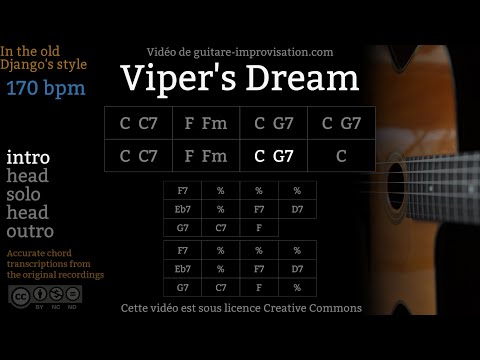 Viper's Dream (170 bpm) : Gypsy jazz Backing track / Jazz manoucheGuitare ImprovisationSwing · 170 BPM · 6m2s · Video available when checked; creator-described attribution.Creator-described gypsy-jazz play-along. Check the key and full arrangement before joining in; the guide chart may use another key. Tempo is the creator’s stated value.Select video
Performed studies, transcriptions, TAB, notation and lessons for studying Django’s solo. Inclusion does not certify note-for-note accuracy.
Guitareal Jazz Transcriptions
Video available when checked; creator-described attribution.
Creator-presented transcription of Django’s solo. This is a study aid, not an independent certification of note-for-note accuracy.
If playback is unavailable, use the source link.
Follow a shared key, a harmonic idea or a familiar form. Keys refer to this site’s chart editions; other recordings may use a different key.
No sufficiently supported harmonic comparison has been added yet.
Showing 8 of 31 matches. Explore the full catalogue →
An abstract ribbon winds between a guitar and clarinet in a moonlit café.
Original AI-assisted editorial artwork inspired by the tune’s mood. It does not depict a documented historical event.
Original Djangopedia illustration · AI-assisted, 2026
Illustration credits & provenance →Selected performances by notable Gypsy Jazz players and ensembles. Inclusion is editorial and does not imply an objective popularity ranking.
Sven Jungbeck
Video available when checked; creator-described attribution.
Performer attribution follows the video title and channel description. Proposed listening selection; no popularity ranking implied.
If playback is unavailable, use the source link.
 Vipers Dream by Django Reinhardt and Stephane Grapelli - played by Joscho StephanSven JungbeckVideo available when checked; creator-described attribution.Performer attribution follows the video title and channel description. Proposed listening selection; no popularity ranking implied.✓ Featured
 The Hot Club Of Berlin - Vipers Dream (Django Reinhardt)The Hot Club of BerlinVideo available when checked; creator-described attribution.Performer attribution follows the video title and channel description. Proposed listening selection; no popularity ranking implied.Select video
Record one F-blues chorus using only a two-note motif. Repeat it with one rhythmic change when the harmony moves to the subdominant. Then rehearse the theme-to-solo transition separately, without adding another chorus by habit.
Use short, even strokes and a clear bass pulse. Follow the agreed theme arrangement; settle into a consistent swing accompaniment only when the solo chorus begins.
Begin at 90–110 bpm; approach the selected 150 bpm play-along gradually
Record one F-blues chorus using only a two-note motif. Repeat it with one rhythmic change when the harmony moves to the subdominant. Then rehearse the theme-to-solo transition separately, without adding another chorus by habit.
Count quarter notes first. Then place the click on beats 2 and 4 at half the click rate, keeping the phrase length unchanged.
F major (solo chorus); C-major opening in inherited chart; Contrasting head and ending; 12-bar blues solo chorus. Agree the arrangement, pickup and ending before counting in.
Do not loop the entire inherited twenty-cell grid as though it were the twelve-bar solo form.
Keep the melody uppermost and begin with a single bass note under each harmony. For an F7 study shell, hear A–E-flat; for B-flat7, hear D–A-flat. These are note sets, not prescribed fingerings.
Use short, even strokes and a clear bass pulse. Follow the agreed theme arrangement; settle into a consistent swing accompaniment only when the solo chorus begins.
No vocal arrangement is prescribed; use the instrumental melody as the phrasing reference.
This player guide combines inherited recording evidence and editorial study notes. Musical study notes are editorial suggestions; compare them with the recording.
Guitareal creator transcription ↗
Original Djangopedia illustration · AI-assisted, 2026
Original AI-assisted editorial artwork inspired by the tune’s mood. It does not depict a documented historical event.
Generated with the native image-generation tool on 2026-10-17; original editorial artwork, not a historical photograph.
Prompt: Create one original Djangopedia tune-guide editorial illustration. Landscape 3:2, 1536x1024. Broad mid-century jazz record sleeve and Art Deco graphic traditions: bold confident outlines, flat geometric shapes, subtle vintage paper print texture, sophisticated playful composition. No imitation of a specific artist, no lettering, no logo, no watermark, no photorealism. Keep important subjects within central 80% for responsive cropping. Fictional atmospheric interpretation, not a documented historical event. A dreamy nocturnal café with a sinuous abstract ribbon winding between a guitar and a clarinet, moonlit window and playful rhythmic shadows. Teal, plum, warm cream, mustard. No smoking or drugs.
