
Tune details
Music: Django Reinhardt
Documented in archive: 1947
Original key: Not established
Study level: Intermediate
 Djangopedia
A minor blues that rewards rhythmic authority and economical lines. The tonic and subdominant minor-sixth sounds contrast with the descending dominant close.
Keep the 12-bar structure audible through rests.
Owner content reviewed — 2026-10-05T18:26:42Z by admin. Coverage measures presence, not accuracy. Content review does not certify rights or musical perfection.
Django recordings for this tune. Uploader dates and take labels remain source claims; only an evidenced exact association enables a row’s Listen control.
Django Reinhardt
source-described; accuracy not independently verified
Uploader identifies this as Django Reinhardt’s performance; recording date and take require comparison with the discography.
| Entry | Year | Recording / session / release evidence | Listen |
|---|---|---|---|
| 01 | 1948 | Swing 48, 29/02/48, Fremeaux FA 316," - Festival de Jazz de Nice - Stephane Grappelly (v), Django & Joseph Reinhardt, Challun Ferret (g), Emmanuel Soudieux (b)" | — |
| 02 | 1947 | Swing 48, 6/7/47, ST 2092-1 ,"Fremeaux FA 314, Classics 1001,Verve 835 418-1,Verve 516 931-2"," - Paris - QHCF - Django Reinhardt (elg), Hubert Rostaing (cl), Joseph Reinhardt (g), Ladislas Czabanyck (b), Andre Jourdan" | — |
A dash means no video has been associated with this exact historical recording. Tune-level listening resources remain available above.
Despite the title, Djangopedia includes a Paris recording from 6 July 1947, matrix ST 2092-1, followed by a 1948 Nice entry. The title must not be used as proof of the composition or first-recording year.
Music: Django Reinhardt
Documented in archive: 1947
Original key: Not established
Study level: Intermediate
Listening task: Keep the blues phrases in call-and-response pairs. Count the head before comparing solo choruses.
Swing 48, 29/02/48, Fremeaux FA 316," - Festival de Jazz de Nice - Stephane Grappelly (v), Django & Joseph Reinhardt, Challun Ferret (g), Emmanuel Soudieux (b)"
Compare the tempo, key, introduction and final cadence with the first entry. Keep the 12-bar structure audible through rests.
Swing 48, 6/7/47, ST 2092-1 ,"Fremeaux FA 314, Classics 1001,Verve 835 418-1,Verve 516 931-2"," - Paris - QHCF - Django Reinhardt (elg), Hubert Rostaing (cl), Joseph Reinhardt (g), Ladislas Czabanyck (b), Andre Jourdan"
Count its form and check its key before joining in. Think in three four-bar blues phrases: G minor, a move to C minor and back, then E♭7–D7 returning to G minor. The old six-cell text is a compact notation, not a six-bar chorus.
Think in three four-bar blues phrases: G minor, a move to C minor and back, then E♭7–D7 returning to G minor. The old six-cell text is a compact notation, not a six-bar chorus.
The legacy six-cell notation compresses a 12-bar minor blues. The expanded grid below is an editorial practice reduction; turnaround variants differ.
| Gm6/// | Gm6/// | Cm6/// | Gm6/// | Eb7/ D7/ | Gm6 Gm(/Bb) Am7b5 D7 :||Original source ↗
Gonzalo Bergara
2:15
If playback is unavailable, use the source link.
 Gypsy Jazz Play Along - Swing 48Gonzalo Bergara2:15✓ Featured
 Swing 48 - Playback jazz manouche - Gypsy jazz backing track / play alongClément Reboul4:17Select video
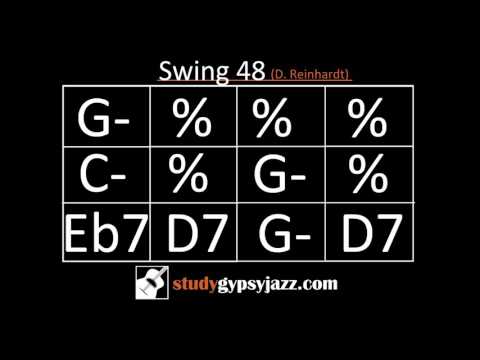 Gypsy Jazz Backing Track / Play Along - Swing 48Study Gypsy Jazz2:46Select video
 Playback jazz manouche - Swing 48 par Clément ReboulClément Reboul3:10Select video
Performed studies, transcriptions, TAB, notation and lessons for studying Django’s solo. Inclusion does not certify note-for-note accuracy.
DjangoKOR
source-described; accuracy not independently verified
Creator presents a study of Django’s recorded solo. Use it alongside the original recording; exact transcription accuracy has not been independently reviewed.
If playback is unavailable, use the source link.
Follow a shared key, a harmonic idea or a familiar form. Keys refer to this site’s chart editions; other recordings may use a different key.
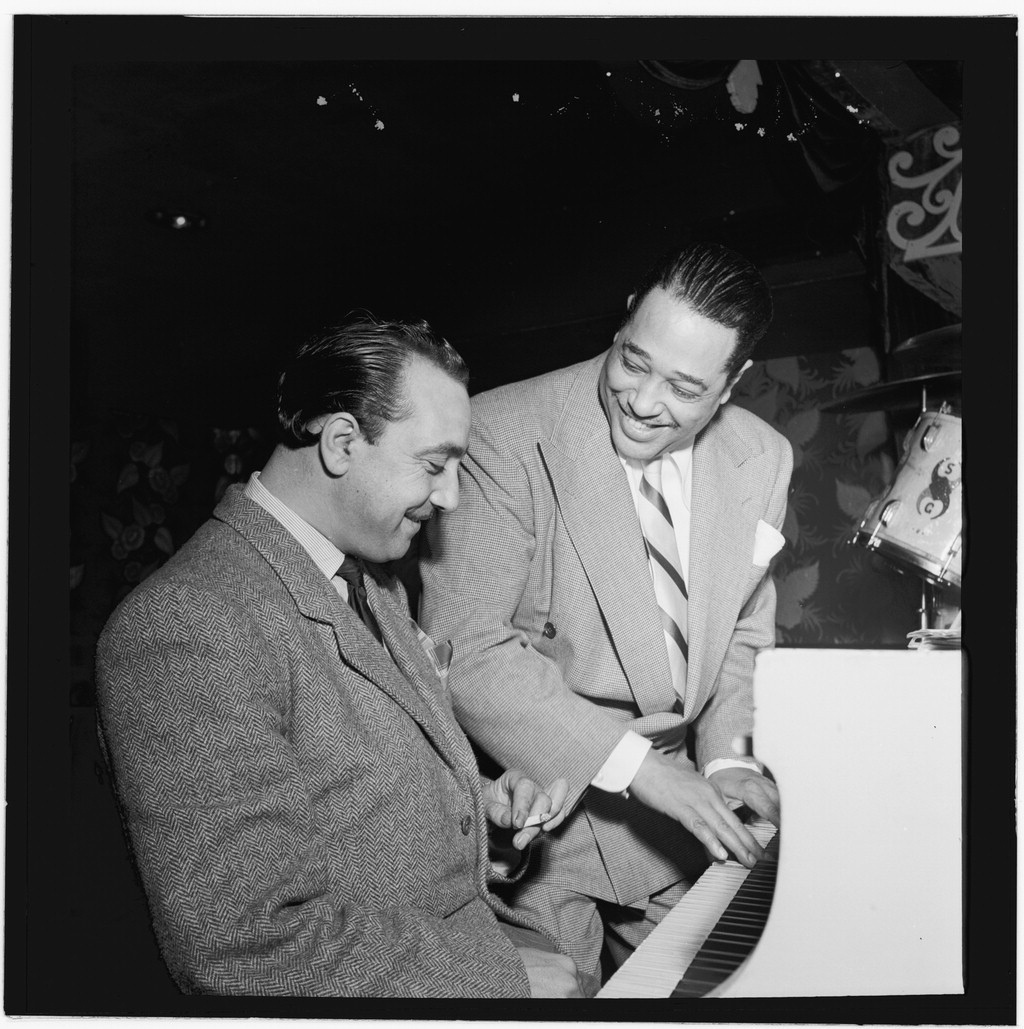
Chosen as a view of Django from circa November 1946, to place the study beside his changing performing life. The closest dated recording entry here is 1947. This is an editorial pairing; the photograph is not claimed to depict a performance or session of this tune.
Part of William P. Gottlieb’s documented Aquarium photographs in New York, circa November 1946. The catalogue supplies the location and approximate date; this is not evidence of a particular tune being played.
Explore this photograph, its context & credits →Selected performances by notable Gypsy Jazz players and ensembles. Inclusion is editorial and does not imply an objective popularity ranking.
Mozes Rosenberg, Reppie Corvers, Faifie Reinhardt, Johnny Rosenberg, Sani van Mullem · annecy75
2013 · Django Reinhardt Festival, Samois; June 2013 · Watch title, source description and available positive-duration player checked 2026-10-05; independent performance; owner accuracy not independently verified.
Masters of Swing festival ensemble with three featured guitarists.
If playback is unavailable, use the source link.
 Mozes Rosenberg, Virtuoses du jazz manouche (6/6) "Swing 48"Mozes Rosenberg, Reppie Corvers, Faifie Reinhardt, Johnny Rosenberg, Sani van Mullem · annecy752013 · Django Reinhardt Festival, Samois; June 2013 · Watch title, source description and available positive-duration player checked 2026-10-05; independent performance; owner accuracy not independently verified.Masters of Swing festival ensemble with three featured guitarists.✓ Featured
 Swan Berger, Levis Adel et Pierre Manetti "Swing 48" Django Reinhardt (gypsy jazz guitar) subtitledSwan Berger, Levis Adel, Pierre Manetti, Marc-Michel Le Bevillon · annecy752010 · Django tribute concert; January 2010; France 2 broadcast · Watch title, source description and available positive-duration player checked 2026-10-05; independent performance; owner accuracy not independently verified.Three guitarists and bass; performance year follows description.Select video
 Swing 48 Django Reinhardt Festival à Fontainebleau 2023Mano Guttenberger, Moreno and Dadi Guttenberger, Watti Rosenberg, Jan Jankeje · Mano Guttenberger2023 · Django Reinhardt Festival, Fontainebleau · Watch title, source description and available positive-duration player checked 2026-10-05; independent performance; owner accuracy not independently verified.Festival ensemble; named guitar, violin and bass personnel.Select video
 Latches Samois 2008 Swing 48Latchès · Djangodr0m2008 · Samois festival · Watch title, source description and available positive-duration player checked 2026-10-05; independent performance; owner accuracy not independently verified.Live festival interpretation; ensemble and year explicitly stated.Select video
 Swing 48Pearl Django · PearlDjangoVideosLive studio performance · Watch title, source description and available positive-duration player checked 2026-10-05; independent performance; owner accuracy not independently verified.Violin, accordion, two guitars and bass; source supplies personnel.Select video
Play four 12-bar choruses using only a three-note motif. Make the third chorus quieter and the fourth more rhythmically active, without increasing speed.
Use a steady, restrained pompe. A repeated tonic chord can be effective; save stronger attacks for the move to Cm and the final dominant.
Start at 100–120; build toward 160–200 bpm
Play four 12-bar choruses using only a three-note motif. Make the third chorus quieter and the fourth more rhythmically active, without increasing speed.
Start below the suggested tempo. First hear four quarter-note clicks, then halve the click rate and place clicks on beats 2 and 4. Keep the same phrase length.
Swing 48 — G minor; 12-bar minor blues; legacy grid is compressed. Agree the tempo, pickup, solo order and ending before the count.
If trading fours, count three exchanges per 12-bar chorus; a 16-bar mental model will derail the return.
Alternate low G and D bass notes with short minor-sixth stabs, keeping the melody above the accompaniment.
If trading fours, count three exchanges per 12-bar chorus; a 16-bar mental model will derail the return.
This guide studies an instrumental arrangement. Any later lyric adaptation requires its own credit and chosen key.
This player guide combines inherited recording evidence and editorial study notes. Musical study notes are editorial suggestions; compare them with the recording.
Gonzalo Bergara — backing track ↗
Feature photograph — Library of Congress ↗
William P. Gottlieb / Library of Congress · Aquarium, New York · circa November 1946
Public domain (PD-Gottlieb)
Photograph source ↗ · Rights details ↗Used to illustrate Django’s life; no connection to this tune’s recording session is claimed.
Photograph rights are documented separately in its credit. They do not establish the rights status of the composition or recording.
