
Tune details
Music: Django Reinhardt
Documented in archive: 1942
Original key: Not established
Study level: Intermediate; advanced where the inherited roadmap needs reconstruction
 Djangopedia
A blues-shaped opening is set against a strikingly remote contrasting key. Following that change of landscape matters more than playing elaborate lines over the familiar opening.
Know when the G♭ section begins and how it returns.
Owner content reviewed — 2026-10-05T23:51:14Z by admin. Coverage measures presence, not accuracy. Content review does not certify rights or musical perfection.
Django recordings for this tune. Uploader dates and take labels remain source claims; only an evidenced exact association enables a row’s Listen control.
Uploader identifies this as Django Reinhardt’s performance; recording date and take require comparison with the discography.
| Entry | Year | Recording / session / release evidence | Listen |
|---|---|---|---|
| 01 | 1942 | Place de Brouckere, 16/4/42, 16194,"Fremeaux FA 311, Classics 877, Verve 513 947-2, Music Memoria 87949-2, RDC 40032", Brussels - Django Reinhardt et Son Grand Orchestre | — |
| 02 | 1943 | Place de Brouckere, 7/7/43, OSW 359-1 ,"Fremeaux FA 312, Classics 905, Jazz Time 799991-2, HEP 1041, Blue Note CDP 7243837138-2", - Paris - Django Reinhardt et Son Orchestre | — |
| 03 | 1947 | Place de Brouckere, 8-13/11/47, "Fremeaux FA 315, Vogue 228E 6008"," - Paris - Souvenirs de Django Reinhardt - Django Reinhardt (elg), Gerard Leveque (cl), Eugene Vees (g), Emmanuel Soudieux (b), Andre Jourdan (d)" | — |
| 04 | 1949 | Place de Brouckere, 25/10/49, "Fremeaux FA 318, Vogue 228E 6010, Vogue 600121, Vogue 668003"," - Radio Geneve - Django Reinhardt (elg), Andre Ekyan (as,cl), Francois Vermeille (p), Jean Bouchety (b), Gaston Leonard (d)" | — |
| 05 | 1950 | Place de Brouckere, 1950, CW14,"Fremeaux FA 318, Jazz Time 827447-2, BGO CD 366"," - Rome - Django Reinhardt (elg), Andre Ekyan (as,cl), Ralph Schecroun (p) Alf Masselier (b), Roger Paraboschi (d)" | — |
| 06 | 1948 | Place de Brouckere, Dec 1948, "Vogue 228E 6009, RCA 74321 237692"," - Concert in Brussels - Hubert Rostaing (cl), Django Reinhardt (g), Henri ""Louson"" Baumgartner (g), Louis Vola (b), Arthur Motta (d)" | — |
A dash means no video has been associated with this exact historical recording. Tune-level listening resources remain available above.
Place de Brouckere is credited here to Django Reinhardt. The inherited archive lists 6 recording entries, with dated entries spanning 1942–1950. These are archive rows, not a claim that every entry is a distinct released take. The linked recording rows preserve the original discographical wording. Compare their dates, matrices and personnel when choosing a performance to study.
Music: Django Reinhardt
Documented in archive: 1942
Original key: Not established
Study level: Intermediate; advanced where the inherited roadmap needs reconstruction
Listening task: Learn the contrasting section as a complete phrase, not a transposed blues lick. Mark the key, pickup, phrase lengths and ending before comparing another version.
Place de Brouckere, 16/4/42, 16194,"Fremeaux FA 311, Classics 877, Verve 513 947-2, Music Memoria 87949-2, RDC 40032", Brussels - Django Reinhardt et Son Grand Orchestre
Compare the first and last listed entries for tempo, instrumentation and arrangement. Do not infer identical takes from a shared title. Know when the G♭ section begins and how it returns.
Place de Brouckere, Dec 1948, "Vogue 228E 6009, RCA 74321 237692"," - Concert in Brussels - Hubert Rostaing (cl), Django Reinhardt (g), Henri ""Louson"" Baumgartner (g), Louis Vola (b), Arthur Motta (d)"
The inherited chart is in B♭ major; G♭ contrasting section. Confirm the backing track’s sounding key, pickup and complete form before playing; an instrument label may describe a transposed score.
B♭ and E♭7 anchor the opening; Cm7–F7 brings it home. The later G♭–D♭7 material moves outside that home area before F7 prepares the return to B♭.
The source prints three 12-cell statements and a 16-cell contrasting section. It also contains undefined Dd7 spellings. These are source cells, not a verified universal chorus map.
[[Image:Place_de_broukere.gif]]

| Bb/// | Bb/// | Bb/// | Fm7/ Bb13b9/ |

| Eb7/// | Eb7/// | Bb/// | Bb(D)/ Db0/ |

| Cm7/// | F7/// | Bb/ B0/ | Cm7/ F7/ |

| Bb/// | Bb/// | Bb/// | Fm7/ Bb13b9/ |

| Eb7/// | Eb7/// | Bb/// | Bb(D)/ Db0/ |

| Cm7/// | F7/// | Bb/// | Bb/// |

| Bb/// | Bb/// | Bb/// | Fm7/ Bb13b9/ |

| Eb7/// | Eb7/// | Bb/// | Bb(D)/ Db0/ |

| Cm7/// | F7/// | Bb/// | Bb/// |

| Gb/// | Db7/// | Gb/// | Dd7/// |

| Gb/// | Db7/// | Gb/// | Dd7/// |

| Gb/// | Db7/// | Gb/// | Dd7/// |

| Gb/ F/ | F/ C7/ | F/// | F7/// :||
Original source ↗
gael rouilhac · The inherited chart is in B♭ major; G♭ contrasting section. Confirm the backing track’s sounding key, pickup and complete form before playing; an instrument label may describe a transposed score. · 4:57
Checked 2026-10-01
Most-viewed suitable match selected from the captured search results after title/composition review; not a complete YouTube ranking. Source counts were captured on 1 October 2026. Coaching, unrelated songs and non-backing performances are excluded.
Performed studies, transcriptions, TAB, notation and lessons for studying Django’s solo. Resources are described by their creator; inclusion does not certify note-for-note accuracy.
Acoustic Standards · source-described; accuracy not independently verified
Creator presents a study of Django’s recorded solo. Use it alongside the original recording; exact transcription accuracy has not been independently reviewed.
Checked 2026-10-02
Follow a shared key, a harmonic idea or a familiar form. Keys refer to this site’s chart editions; other recordings may use a different key.
No sufficiently supported harmonic comparison has been added yet.
No match is established in the current chart metadata.
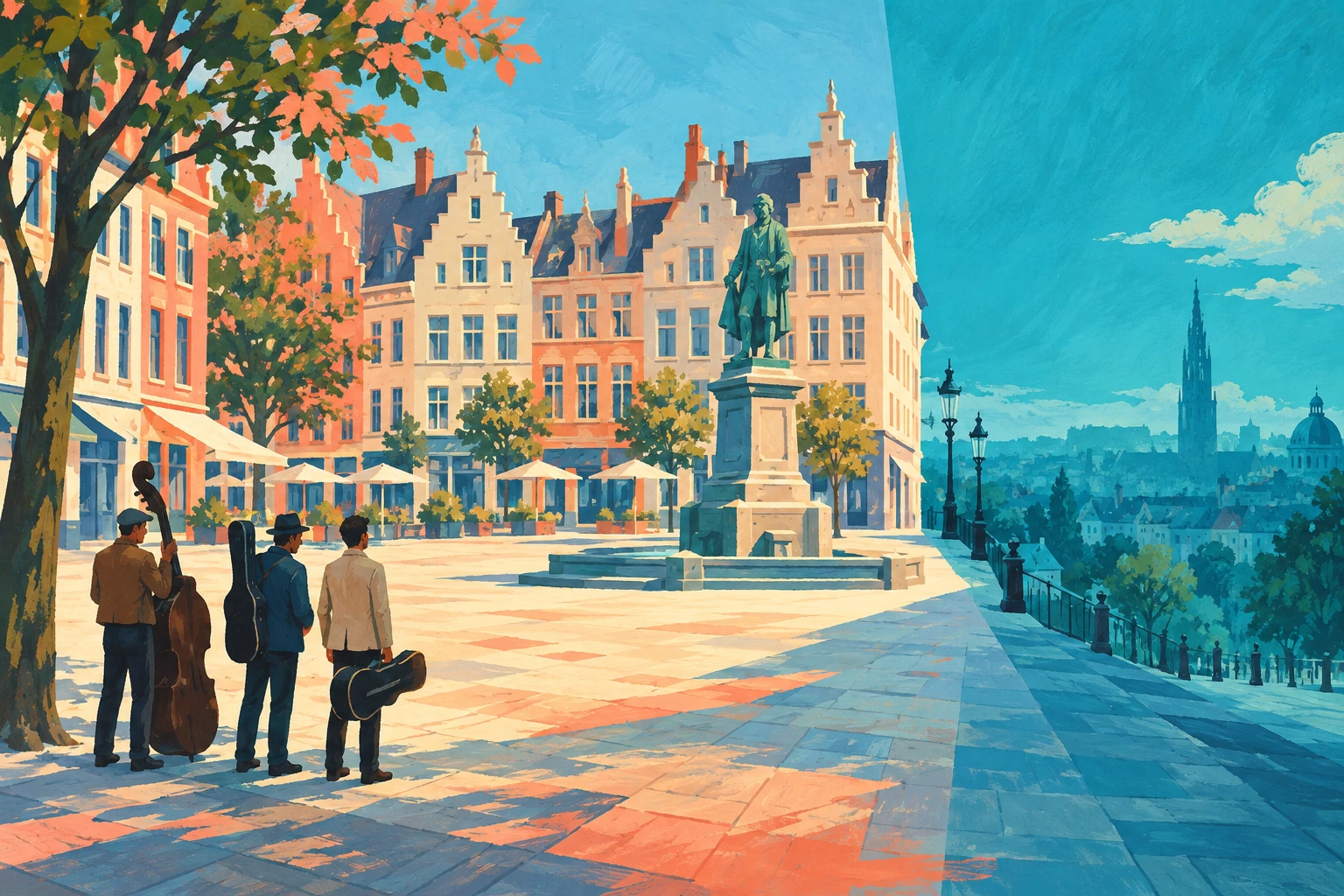
An imagined Brussels square with generous pavement and generic stepped facades, a tiny trio with instrument cases at one edge. The perspective turns sharply into a second colour field to suggest the remote contrasting key. Refer to the title place without documenting a real performance.
An original editorial interpretation of the tune. This is an illustration, not an archival photograph or a documented reconstruction of a recording session.
Original Djangopedia illustration · AI-assisted, 2026
Illustration credits & provenance →Selected performances by notable Gypsy Jazz players and ensembles. Inclusion is editorial and does not imply an objective popularity ranking.
Joscho Stephan Trio · Joscho Stephan
Concert performance
Acoustic trio interpretation with a contrasting funk passage.
If playback is unavailable, use the source link.
 Django's Place de Brouckère // Joscho Stephan TrioJoscho Stephan Trio · Joscho StephanConcert performanceAcoustic trio interpretation with a contrasting funk passage.✓ Featured
 Jimmy Rosenberg Trio Place de Brouckere Django Amsterdam 2025 (insync)Jimmy Rosenberg Trio · Daniel Gueli Gypsy Jazz Channel2025 · Django Amsterdam, 24 January 2025Jimmy Rosenberg with Faifie Reinhardt and Fremdo Rosenberg.Select performance
 Place De Brouckere 1 - Romain Vuillemin, Adrien Tarraga, Julien Cattiaux and Edouard PennesRomain Vuillemin; Adrien Tarraga; Julien Cattiaux; Edouard Pennes · Paul McEvoy GuitarsFilmed ensemble performanceMulti-guitar interpretation; the description’s 2024 guitar model is not a performance date.Select performance
 Place de Brouckere - Dario Napoli Trio at Festival Django PortugalDario Napoli Trio · Festival Django Portugal2022 · Festival Django Portugal, second editionDario Napoli, Tonino de Sensi and Tommaso Papini.Select performance
 Duved Dunayesky - Place De Brouckere (Trad Jazz)Duved Dunayevsky; Zak Martel; Denis Chang · Denis Chang2018 · Recorded in Montreal, November 2018Traditional jazz interpretation by a Manouche guitar trio.Select performance
 Olli Soikkeli - Place De Brouckere (Django)Olli Soikkeli; Gabe Terracciano; Vinny Raniolo; Wallace Stelzer · Olli SoikkeliDjango birthday celebration, Dizzy’s Club, New YorkGuitar and violin ensemble; upload year not used as a concert year.Select performance
 THE STRATOSPHERES - "Place de Brouckère" (Django Reinhardt) - Gypsy Jazz / Western Swing - LIVEThe Stratospheres · Owl Mountain Productions2017 · Corkscrew Wine Bar, PetalumaGypsy Jazz and Western Swing trio: Hanna Mignano, Steve Froberg and Greg Dunn.Select performance
Practise the last four cells of the G♭ section into the first four of the B♭ section. Sing the destination tonic before playing either chord.
Keep the opening blues pulse relaxed. At the G♭ section, change the voicing register enough to make the new area audible without changing tempo.
Start around 100–140 bpm; increase only after the form stays secure
Practise the last four cells of the G♭ section into the first four of the B♭ section. Sing the destination tonic before playing either chord.
Begin with four quarter-note clicks. Halve the click rate and hear beats 2 and 4 while maintaining the same phrase lengths.
Place de Brouckere — B♭ major; G♭ contrasting section; Repeated 12-cell blues-like sections plus a 16-cell contrast in the source; agree repeats. Agree the pickup, tempo and ending before counting in.
Repeated 12-cell blues-like sections plus a 16-cell contrast in the source; agree repeats. The source prints three 12-cell statements and a 16-cell contrasting section. It also contains undefined Dd7 spellings. These are source cells, not a verified universal chorus map.
Start with melody and bass only. Add the following colour without interrupting the melody: Use D over B♭ and D♭ over E♭7 to colour the blues movement.
Keep the opening blues pulse relaxed. At the G♭ section, change the voicing register enough to make the new area audible without changing tempo. Agree the full roadmap and signal the last head before it starts.
This guide focuses on the instrumental arrangement; any lyric adaptation needs separate credit and a chosen key.
Search online videos of "Place de Brouckere" in youtube.com ↗
This player guide combines inherited recording evidence and editorial study notes. Musical study notes are editorial suggestions; compare them with the recording.
Djangopedia — inherited chart and recording rows ↗
Composition credits and background ↗
gael rouilhac — practice backing ↗
Feature photograph — source collection ↗
Original Djangopedia illustration · AI-assisted, 2026
An original editorial interpretation of the tune. This is an illustration, not an archival photograph or a documented reconstruction of a recording session.
Generated with the native image-generation tool on 2026-10-08; original editorial artwork, not a historical photograph.
Prompt: Use case: illustration-story. One original editorial feature illustration for Djangopedia's guide “Place de Brouckere”. Landscape 1536 × 1024, opaque background. Scene: An imagined Brussels square with generous pavement and generic stepped facades, a tiny trio with instrument cases at one edge. The perspective turns sharply into a second colour field to suggest the remote contrasting key. Refer to the title place without documenting a real performance. Musical basis from the guide: A blues-shaped opening is set against a strikingly remote contrasting key. Following that change of landscape matters more than playing elaborate lines over the familiar opening. The supplied chart is B♭ major; G♭ contrasting section; form: Repeated 12-cell blues-like sections plus a 16-cell contrast in the source; agree repeats; feel: Swing. These describe musical inspiration, not visible writing. Historical context: Place de Brouckere is credited here to Django Reinhardt. Do not illustrate disputed historical claims or suggest this imagined scene is an archival session. Medium: travel-poster tempera. Dominant palette: bright turquoise slate and coral. Composition: wide urban square in daylight. Human presence: tiny trio. Strong intentional design, clearly drawn/painted, distinctive material marks; keep essential subject safely within the central 70 percent width and middle 80 percent height for card crops. Maintain enough visual substance at thumbnail size. Broad inspiration observed in old photo, ONLY scale/rhythm and never a reference image: wide stage group; vertical instruments; high-key wall. Independently invent every pose, perspective, clothing, setting and lighting. Avoid: No radio-stage recreation, known-building copy, signage or sepia. No photorealism, archival simulation, generated text, letters, numbers, labels, fake musical notation, logo, signature, watermark, fake dates, yellowed-paper patina, recognizable artwork or copied photograph. No imitation of any named artist. Render the art edge to edge without borders, mockup or typography. Batch B diversity compensation: make light and midtone areas substantial; avoid near-black dominant backdrops, violet monochrome, empty chair/stool/bench compositions, repeated sunset terraces and generic cloud panoramas. Preserve the stated tune-specific scene. Human figures remain standing or peripheral except an explicitly named ensemble; no centered seated Django portrait. For graphic images use clearly plain colour shapes, no ruled parallel staffs, circles with stems, note-like marks or typography.
Photograph provenance and rights are stated separately. Attribution does not establish permission.