
Tune details
Music: Johnny Green, Carmen Lombardo
Words: Gus Kahn
Published / composed: 1928
Original key: Not established
Study level: Approachable jam repertoire
 Djangopedia
A clear, singable standard with a bridge that moves through secondary dominants. Its spacious harmonic rhythm makes it useful for building melodic solos with strong beginnings and endings.
Make each bridge dominant point clearly to its target.
Owner content reviewed — 2026-10-04T17:07:10Z by admin. Coverage measures presence, not accuracy. Content review does not certify rights or musical perfection.
Django recordings for this tune. Uploader dates and take labels remain source claims; only an evidenced exact association enables a row’s Listen control.
Uploader identifies this as Django Reinhardt’s performance; recording date and take require comparison with the discography.
| Entry | Year | Recording / session / release evidence | Listen |
|---|---|---|---|
| 01 | 1946 | Coquette, 31/1/46, "Fremeaux FA 313, Classics 945, Jazz Time 789103, EMI 780671-3, Mosaic MD6-190(6 CD Set)."," - London - ""QHCF"" - Stephane Grappelly (v), Django Reinhardt, Jack Llewellyn, Allan Hodgkiss (g), Coleridge Goode (b)" | — |
A dash means no video has been associated with this exact historical recording. Tune-level listening resources remain available above.
Written in 1928 by Johnny Green and Carmen Lombardo with lyrics by Gus Kahn, Coquette was successful in Guy Lombardo’s repertoire. Djangopedia’s Django entry is the London session of 31 January 1946 with Grappelli.
Music: Johnny Green, Carmen Lombardo
Words: Gus Kahn
Published / composed: 1928
Original key: Not established
Study level: Approachable jam repertoire
Listening task: Sing the head with clear eight-bar breath points. Count the head before comparing solo choruses.
Coquette, 31/1/46, "Fremeaux FA 313, Classics 945, Jazz Time 789103, EMI 780671-3, Mosaic MD6-190(6 CD Set)."," - London - ""QHCF"" - Stephane Grappelly (v), Django Reinhardt, Jack Llewellyn, Allan Hodgkiss (g), Coleridge Goode (b)"
Count its form and check its key before joining in. The A sections alternate tonic D with A7 and Em–A7. The bridge moves D7→G, then E7→A7, giving two easily heard dominant-to-target relationships.
The A sections alternate tonic D with A7 and Em–A7. The bridge moves D7→G, then E7→A7, giving two easily heard dominant-to-target relationships.
Chord symbols follow the inherited Djangopedia chart. Slashes are rhythmic marks; chord quality and turnaround choices may differ from the backing track. This is a chord reference, not a melody transcription.
[[Image:Coquette.gif]]


| D/// | D/// | A7/// | A7/// | Em7/// | A7/// | D/// | A7/// |

| D/// | D/// | A7/// | A7/// | Em7/// | A7/// | D/// | D/// |

| D7/// | D7/// | G/// | G/// | E7/// | E7/// | A7/// | A7/// |

| D/// | D/// | A7/// | A7/// | Em7/// | A7/// | D/// | A7/// :||
Original source ↗
Guitare Improvisation · 5:08
Checked 2026-09-20
Highest displayed view count among matching backing-track videos returned by relevance and view-count YouTube searches. Not a complete platform-wide ranking.
Gonzalo Bergara · 2:56
Clément Reboul · 7:42
Guitare Improvisation · 2:36
Performed studies, transcriptions, TAB, notation and lessons for studying Django’s solo. Resources are described by their creator; inclusion does not certify note-for-note accuracy.
From Music · Owner-selected media; guide content review is a separate decision. Video title and channel inspected 2026-10-04.
Owner-selected Django solo study during Stage 4F. Exact recording take and transcription accuracy have not been independently established.
Adrien Tarraga · source-described; accuracy not independently verified
Creator presents a study of Django’s recorded solo. Use it alongside the original recording; exact transcription accuracy has not been independently reviewed.
Checked 2026-10-02
Follow a shared key, a harmonic idea or a familiar form. Keys refer to this site’s chart editions; other recordings may use a different key.
No sufficiently supported harmonic comparison has been added yet.
Showing 8 of 42 matches. Explore the full catalogue →
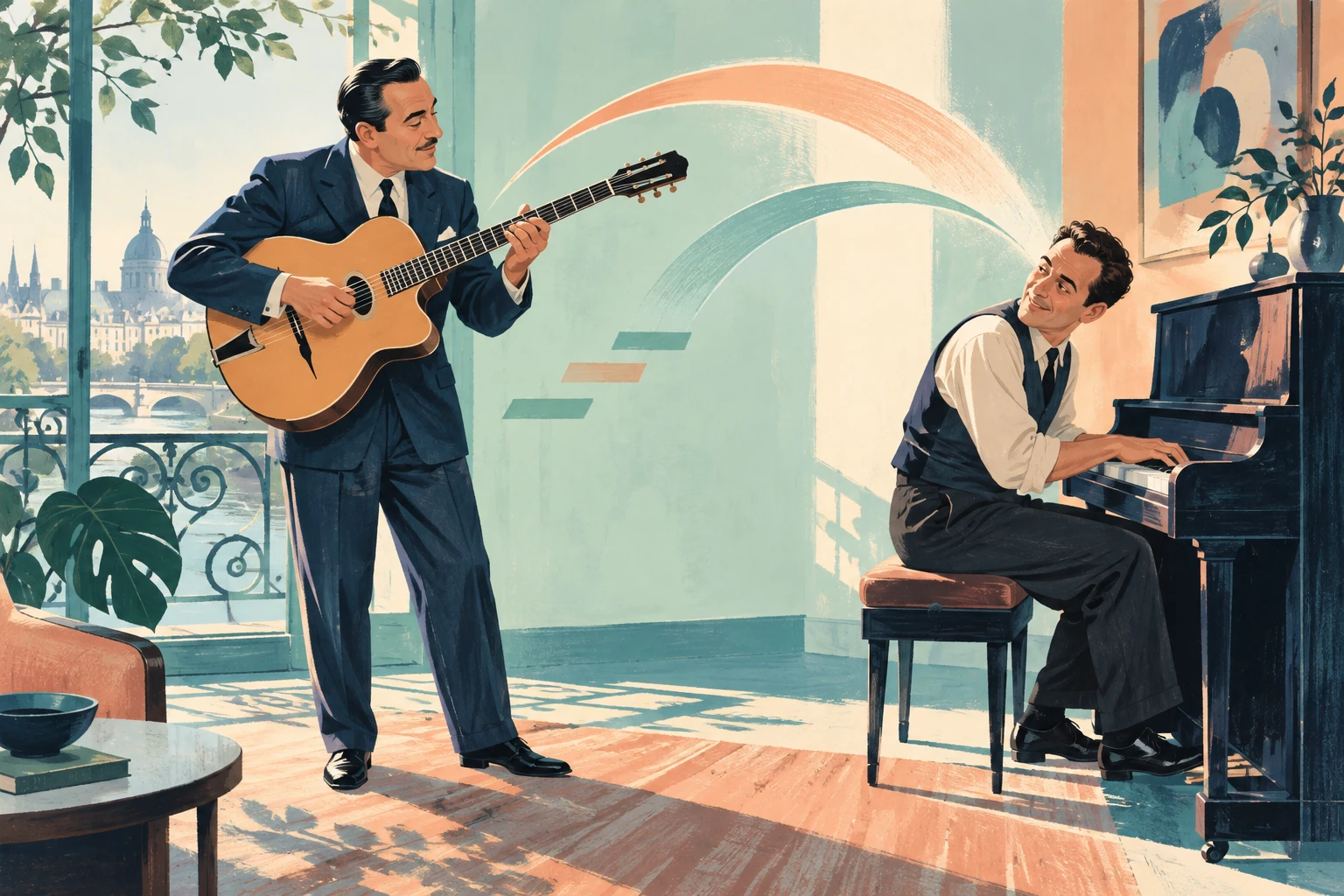
Django Reinhardt standing with guitar and a fictional pianist at a small upright piano, exchanging two spacious melody arcs while three small stepped planes lead toward a clear ending. The duet is an editorial musical conversation, not claimed session personnel.
An original editorial interpretation of the tune. This is an illustration, not an archival photograph or a documented reconstruction of a recording session.
Original Djangopedia illustration · AI-assisted, 2026
Illustration credits & provenance →Selected performances by notable Gypsy Jazz players and ensembles. Inclusion is editorial and does not imply an objective popularity ranking.
Joscho Stephan, Gonzalo Bergara and Jérémie Arranger · Joscho Stephan
Gypsy jazz studio jam
Full theme and contrasting guitar solos from a studio collaboration; linked interview and lesson are separate.
If playback is unavailable, use the source link.
 Studiojam: Coquette feat. Gonzalo BergaraJoscho Stephan, Gonzalo Bergara and Jérémie Arranger · Joscho StephanGypsy jazz studio jamFull theme and contrasting guitar solos from a studio collaboration; linked interview and lesson are separate.✓ Featured
 CoquetteBiréli Lagrène Gipsy Project · Biréli Lagrène2001 · Gipsy Project — artist releaseEnsemble recording issued on Gipsy Project; year denotes the release.Select performance
 Joscho Stephan Trio feat. Costel Nitescu - CoquetteJoscho Stephan Trio and Costel Nitescu · Jazz Club Hannover by Gartenheim2021 · Live in HannoverPerformance recorded on 21 September 2021 with Sven Jungbeck and Volker Kamp, according to the venue.Select performance
 Coquette - gypsy jazzSven Jungbeck, Reinhard Glöder and Markus Callejon · Sven JungbeckGypsy jazz trioTrio performance published by Sven Jungbeck and explicitly identified as Gypsy jazz.Select performance
Improvise a chorus using only the melody’s rhythm and new chord-tone pitches. On the next chorus, keep the pitches and vary the rhythm instead.
An even, relaxed pompe suits the long chords. Try a two-feel first chorus and four-to-the-bar solo accompaniment if the bassist agrees.
Start at 100–120; build toward 150–190 bpm
Improvise a chorus using only the melody’s rhythm and new chord-tone pitches. On the next chorus, keep the pitches and vary the rhythm instead.
Start below the suggested tempo. First hear four quarter-note clicks, then halve the click rate and place clicks on beats 2 and 4. Keep the same phrase length.
Coquette — D major; 32 bars, AABA. Agree the tempo, pickup, solo order and ending before the count.
Call D major, count a comfortable tempo, and clarify the ending before a faster version.
Use melody with alternating bass landmarks; save chordal fills for long held melody notes.
Call D major, count a comfortable tempo, and clarify the ending before a faster version.
Choose the singer’s comfortable key, then transpose the whole arrangement, including the introduction. Use the original lyric phrasing to shape breathing.
This player guide combines inherited recording evidence and editorial study notes. Musical study notes are editorial suggestions; compare them with the recording.
Composition background and credits ↗
Guitare Improvisation — backing track ↗
Feature photograph — Gypsy Jazz UK historical archive ↗
Original Djangopedia illustration · AI-assisted, 2026
An original editorial interpretation of the tune. This is an illustration, not an archival photograph or a documented reconstruction of a recording session.
Generated with the native image-generation tool on 2026-10-08; original editorial artwork, not a historical photograph.
Prompt: Use case: illustration-story. One original editorial feature illustration for Djangopedia's guide “Coquette”. Landscape 1536 × 1024, opaque background. Scene: Django Reinhardt standing with guitar and a fictional pianist at a small upright piano, exchanging two spacious melody arcs while three small stepped planes lead toward a clear ending. The duet is an editorial musical conversation, not claimed session personnel. Musical basis from the guide: A clear, singable standard with a bridge that moves through secondary dominants. Its spacious harmonic rhythm makes it useful for building melodic solos with strong beginnings and endings. The supplied chart is D major; form: 32 bars, AABA; feel: Swing. These describe musical inspiration, not visible writing. Historical context: Written in 1928 by Johnny Green and Carmen Lombardo with lyrics by Gus Kahn, Coquette was successful in Guy Lombardo’s repertoire. Djangopedia’s Django entry is the London session of 31 January 1946 with Grappelli. Do not illustrate disputed historical claims or suggest this imagined scene is an archival session. Medium: mid-century editorial. Dominant palette: mint navy and peach. Composition: open asymmetrical conversation. Human presence: two medium figures. Strong intentional design, clearly drawn/painted, distinctive material marks; keep essential subject safely within the central 70 percent width and middle 80 percent height for card crops. Maintain enough visual substance at thumbnail size. Broad inspiration observed in old photo, ONLY scale/rhythm and never a reference image: one instrument-led figure; airy light background. Independently invent every pose, perspective, clothing, setting and lighting. Avoid: No seated guitar portrait, violin partner, nightclub curtain. No photorealism, archival simulation, generated text, letters, numbers, labels, fake musical notation, logo, signature, watermark, fake dates, yellowed-paper patina, recognizable artwork or copied photograph. No imitation of any named artist. Render the art edge to edge without borders, mockup or typography.
Photograph rights are documented separately in its credit. They do not establish the rights status of the composition or recording.