
Tune details
Music: Django Reinhardt
Documented in archive: 1953
Original key: Not established
Study level: Intermediate; blues space and electric-era articulation
 Djangopedia
A late Django blues study built around touch, timing and the ability to make a small phrase carry a whole chorus.
Choose a two-beat blues phrase and repeat it three times with different spaces after it.
Owner content reviewed — 2026-10-18T10:57:14Z by admin. Coverage measures presence, not accuracy. Content review does not certify rights or musical perfection.
Django recordings for this tune. Uploader dates and take labels remain source claims; only an evidenced exact association enables a row’s Listen control.
Django Reinhardt
source-described; accuracy not independently verified
Uploader identifies this as Django Reinhardt’s performance; recording date and take require comparison with the discography.
| Entry | Year | Recording / session / release evidence | Listen |
|---|---|---|---|
| 01 | 1953 | Blues For Ike, 10/3/53, Verve 835418-2," - Paris - Django Reinhardt (elg), Maurice Vander (p), Pierre Michelot(b), Jean-Louis Viale (d)" | — |
A dash means no video has been associated with this exact historical recording. Tune-level listening resources remain available above.
The inherited archive entry dates Blues for Ike to 10 March 1953 and names Django on electric guitar with Maurice Vander, Pierre Michelot and Jean-Louis Viale. The distributor of the existing listening reference credits Reinhardt. This is a useful contrast with the earlier acoustic string-quintet repertoire. The date is recording evidence, not an asserted composition date, and the selected video is not newly mapped to a historical take.
Music: Django Reinhardt
Documented in archive: 1953
Original key: Not established
Study level: Intermediate; blues space and electric-era articulation
Compare the length and release of Django’s notes with the modern Rocky Gresset/David Reinhardt/Levis Adel solo exchange.
Blues For Ike, 10/3/53, Verve 835418-2," - Paris - Django Reinhardt (elg), Maurice Vander (p), Pierre Michelot(b), Jean-Louis Viale (d)"
The surviving grid begins on A and moves through Em7–A13-flat9 toward D7, but it contains only eight printed bars. It is not a complete chorus roadmap. Learn the full blues cycle from the selected recording or teaching arrangement before looping it. Within that agreed form, contrast the major third with blues inflection and make the subdominant arrival clear. Check the video key before playing with the chart.
The surviving grid begins on A and moves through Em7–A13-flat9 toward D7, but it contains only eight printed bars. It is not a complete chorus roadmap. Learn the full blues cycle from the selected recording or teaching arrangement before looping it. Within that agreed form, contrast the major third with blues inflection and make the subdominant arrival clear.
Inherited chart is preserved verbatim as historical study material, not silently corrected or newly authenticated. Check the specific caveats below and match the arrangement and key to the selected video. External teaching material remains on its creator’s site.
| A/// | A/// | A/// | Em7/ A13b9/ | D7/// | D7/// | A/// | A(/C#)/ C0/ :||Original source ↗
Gonzalo Bergara
1m47s · Video available when checked; creator-described attribution.
Creator-provided play-along; instrumentation and feel vary by selection. Check the key and full arrangement before joining in; the guide chart may use another key.
If playback is unavailable, use the source link.
 Gypsy Jazz Play Along - Blues for IkeGonzalo Bergara1m47s · Video available when checked; creator-described attribution.Creator-provided play-along; instrumentation and feel vary by selection. Check the key and full arrangement before joining in; the guide chart may use another key.✓ Featured
 BLUES FOR IKE - BACKiNG TRACKMAURO ALBERT - GYPSY GUITAR1m59s · Video available when checked; creator-described attribution.Creator-provided play-along; instrumentation and feel vary by selection. Check the key and full arrangement before joining in; the guide chart may use another key.Select video
Performed studies, transcriptions, TAB, notation and lessons for studying Django’s solo. Inclusion does not certify note-for-note accuracy.
DjangoKOR
source-described; accuracy not independently verified
Creator presents a study of Django’s recorded solo. Use it alongside the original recording; exact transcription accuracy has not been independently reviewed.
If playback is unavailable, use the source link.
Follow a shared key, a harmonic idea or a familiar form. Keys refer to this site’s chart editions; other recordings may use a different key.
No match is established in the current chart metadata.
No match is established in the current chart metadata.
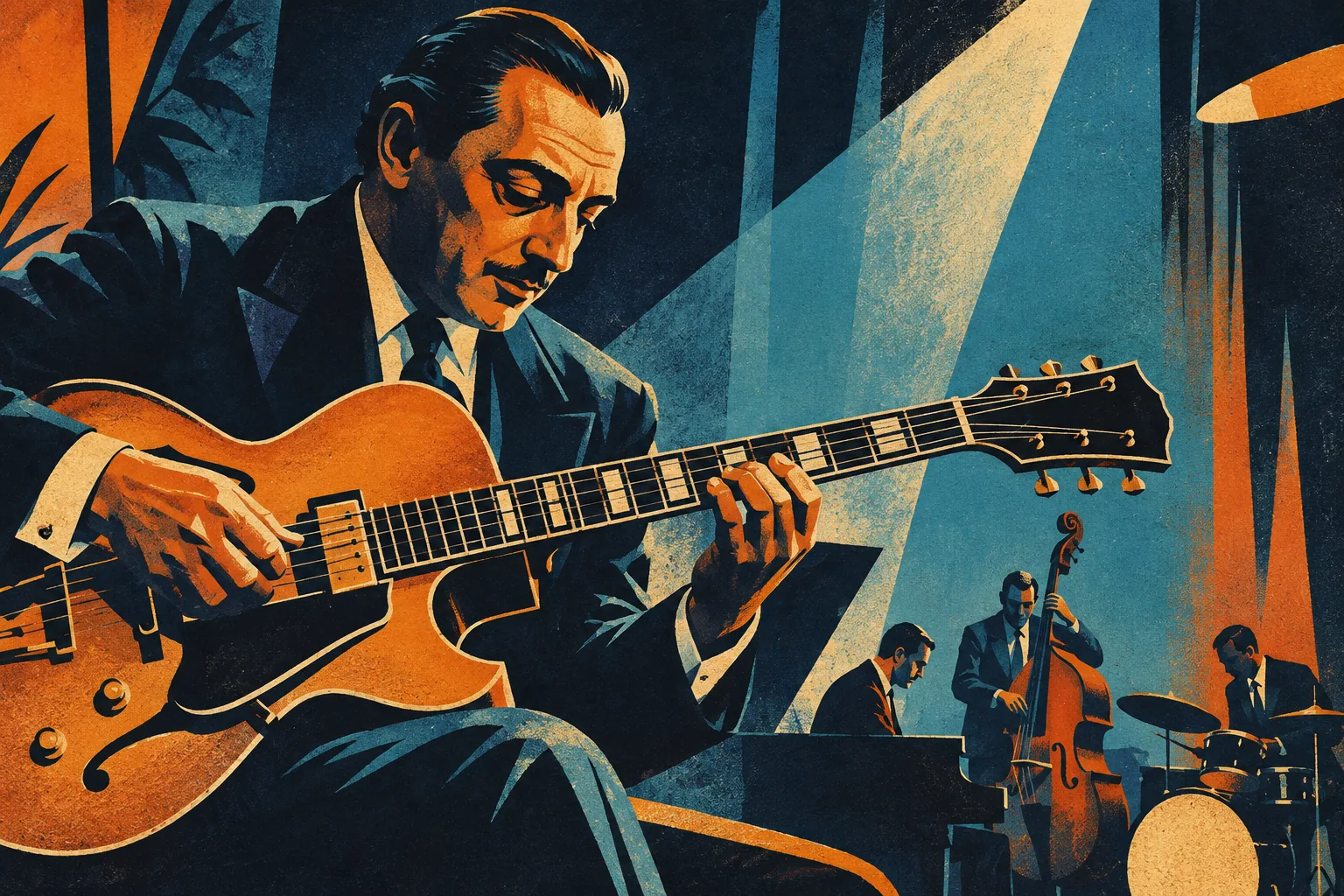
Owner-selected illustration. A solitary Django-like electric guitarist, cropped at mid-torso with instrument fully legible, holds a pensive note above a small piano/bass/drums rhythm trio rendered as three compact shapes. Intimate late-period modern jazz, no political portrait.
Original AI-assisted editorial artwork inspired by the tune; not a documented historical scene.
Original AI-assisted illustration created for Djangopedia
Illustration credits & provenance →Selected performances by notable Gypsy Jazz players and ensembles. Inclusion is editorial and does not imply an objective popularity ranking.
annecy75
Video available when checked; creator-described attribution.
Performer attribution follows the video title and channel description. Proposed listening selection; no popularity ranking implied.
If playback is unavailable, use the source link.
 Solos Rocky Gresset, David Reinhardt & Levis Adel "Blues for Ike" (Django) - guitare jazz manoucheannecy75Video available when checked; creator-described attribution.Performer attribution follows the video title and channel description. Proposed listening selection; no popularity ranking implied.✓ Featured
 Blues for Ike - Django Reinhardt- Carmelo TartamellaCarmelo Tartamella Jazz GuitarVideo available when checked; creator-described attribution.Performer attribution follows the video title and channel description. Proposed listening selection; no popularity ranking implied.Select video
Choose a two-beat blues phrase and repeat it three times with different spaces after it. Record a complete agreed chorus, then check the subdominant and turnaround locations. Rehearse the missing part of the archive fragment separately.
Leave space around the soloist’s sustained notes. Keep the pulse steady and avoid turning an electric-era blues into a relentless wall of acoustic chords.
Begin at 60–80 bpm, then follow the chosen backing pulse
Choose a two-beat blues phrase and repeat it three times with different spaces after it. Record a complete agreed chorus, then check the subdominant and turnaround locations. Rehearse the missing part of the archive fragment separately.
Count quarter notes first. Then place the click on beats 2 and 4 at half the click rate, keeping the phrase length unchanged.
A (inherited fragment); confirm complete arrangement; Blues study; inherited grid is an incomplete eight-bar fragment. Agree the arrangement, pickup and ending before counting in.
Eight printed bars are not proof of an eight-bar blues form. Do not repeat the incomplete fragment as a complete chorus.
Keep the melody uppermost and begin with a single bass note under each harmony. Use two-note A7 and D7 shells to hear the change before adding a sixth, ninth or bass note.
Leave space around the soloist’s sustained notes. Keep the pulse steady and avoid turning an electric-era blues into a relentless wall of acoustic chords.
No vocal arrangement is prescribed; use the instrumental melody as the phrasing reference.
This player guide combines inherited recording evidence and editorial study notes. Musical study notes are editorial suggestions; compare them with the recording.
Preserved Djangopedia archive ↗
Existing Django listening reference ↗
Original AI-assisted illustration created for Djangopedia
Original AI-assisted editorial artwork inspired by the tune; not a documented historical scene.
Generated with the native image-generation tool on 2026-10-26; original editorial artwork, not a historical photograph.
Prompt: Use case: stylized-concept. Create one finished original landscape 1536x1024 (3:2) raster illustration for Djangopedia, tune Blues For Ike. Tune context for interpretation only: The inherited archive entry dates Blues for Ike to 10 March 1953 and names Django on electric guitar with Maurice Vander, Pierre Michelot and Jean-Louis Viale. The distributor of the existing listening reference credits Reinhardt. This is a useful contrast with the earlier acoustic string-quintet repertoire. The date is recording evidence, not an asserted composition date, and the selected video is not newly mapped to a historical take. Scene: A solitary Django-like electric guitarist, cropped at mid-torso with instrument fully legible, holds a pensive note above a small piano/bass/drums rhythm trio rendered as three compact shapes. Intimate late-period modern jazz, no political portrait. Art direction: Dramatic 1930s–1940s theatrical serigraph: angular light and shadow, mature expressive caricature with dignity, strong diagonal movement and clean colour separations. Palette: deep indigo, dusty turquoise, burnt orange and warm paper. Subtle dry ink and paper texture, controlled print misregistration. Make it an artwork with a memorable singular idea, readable as a thumbnail and rewarding at full size; vary viewpoint and composition. Constraints: entirely original composition, not a copy of an artist's print. No title, words, notation, logos or watermark. No photorealism, glossy 3D, gradients, airbrushed romantic haze, generic sunset or decorative hearts. If Django appears, swept-back dark hair, pencil moustache and a distinct mature individual face; period clothes, no ethnic stereotypes. Respect plausible instruments and hands, keep key subjects within frame. Use strong flat ink shapes rather than photorealistic rendering.
