
Tune details
Music: Theo Mackeben
Documented in archive: 1942
Original key: Not established
Study level: Intermediate listening work; advanced arrangement and source awareness
 Djangopedia
The 1942 Brussels title is Mackeben’s song. The inherited second row names Bei Mir Bis Du Schon with Valaida Snow in 1938: a different work, retained here unchanged and flagged for a later, separately approved row correction. Follow the sustained melody and distinguish its contour from Bei Mir Bist Du Schön.
Learn the opening melodic sentence by ear, sing its destination, then find two neighbouring fingerings without changing the note lengths.
Owner content reviewed — 2026-10-21T08:20:29Z by admin. Coverage measures presence, not accuracy. Content review does not certify rights or musical perfection.
Django recordings for this tune. Uploader dates and take labels remain source claims; only an evidenced exact association enables a row’s Listen control.
Django Reinhardt
source-described; accuracy not independently verified
Uploader identifies this as Django Reinhardt’s performance; recording date and take require comparison with the discography.
| Entry | Year | Recording / session / release evidence | Listen |
|---|---|---|---|
| 01 | 1942 | Bei dir war es immer so schon, 16/4/42, 16197,"Fremeaux FA 311, Classics 877, Verve 513 947-2, Music Memoria 87949-2, HEP 1041", Brussels - Django Reinhardt et Son Grand Orchestre | — |
| 02 | 1938 | Bei Mir Bis Du Schon, 30/6/38, Acetate ,Fremeaux 308," - Swing Night in Paris - Valaida Snow (tp&voc), Django Reinhardt (g),Roger Grasset (g)" | — |
A dash means no video has been associated with this exact historical recording. Tune-level listening resources remain available above.
The 1942 Brussels title is Mackeben’s song. The inherited second row names Bei Mir Bis Du Schon with Valaida Snow in 1938: a different work, retained here unchanged and flagged for a later, separately approved row correction.
Music: Theo Mackeben
Documented in archive: 1942
Original key: Not established
Study level: Intermediate listening work; advanced arrangement and source awareness
Follow the sustained melody and distinguish its contour from Bei Mir Bist Du Schön. Source-attributed credits: Source-attributed credit: Theo Mackeben. Roles follow the cited source; legal rights are not certified.
Establish the melody, bass arrivals and actual phrase length before assigning chord functions. Learn the opening melodic sentence by ear, sing its destination, then find two neighbouring fingerings without changing the note lengths.
Inherited notation retained exactly. No new complete chart, concert key or take-specific transcription is certified.
[[Image:Bei_dir_war_es_immer_so_schon.gif]]


| C/// | Cm/// | G/// | Bb0/// | Am/// | D7/// | G/// | G7/// |

| C/// | Cm/// | G/// | Bb0/// | Am/// | D7/// | B0/// | G7/// |

| Am/// | D7/// | G/// | G#0/// | Am/// | B7/// | Em/// | G7/// |

| C/// | Cm/// | G/// | Bb0/// | Am/// | D7/// | G/// | G7/// :||
Original source ↗
Berlin Backing Tracks
4m5s · Public, processed and embeddable when checked; creator-described identity.
Creator-provided play-along. Confirm the concert key, complete roadmap and count-in before joining; it is not certified as the historical arrangement.
If playback is unavailable, use the source link.
Performed studies, transcriptions, TAB, notation and lessons for studying Django’s solo. Inclusion does not certify note-for-note accuracy.
No Django solo study aid yet. Know a useful resource — or want to record a study of this solo?
Follow a shared key, a harmonic idea or a familiar form. Keys refer to this site’s chart editions; other recordings may use a different key.
No sufficiently supported harmonic comparison has been added yet.
No match is established in the current chart metadata.
No match is established in the current chart metadata.
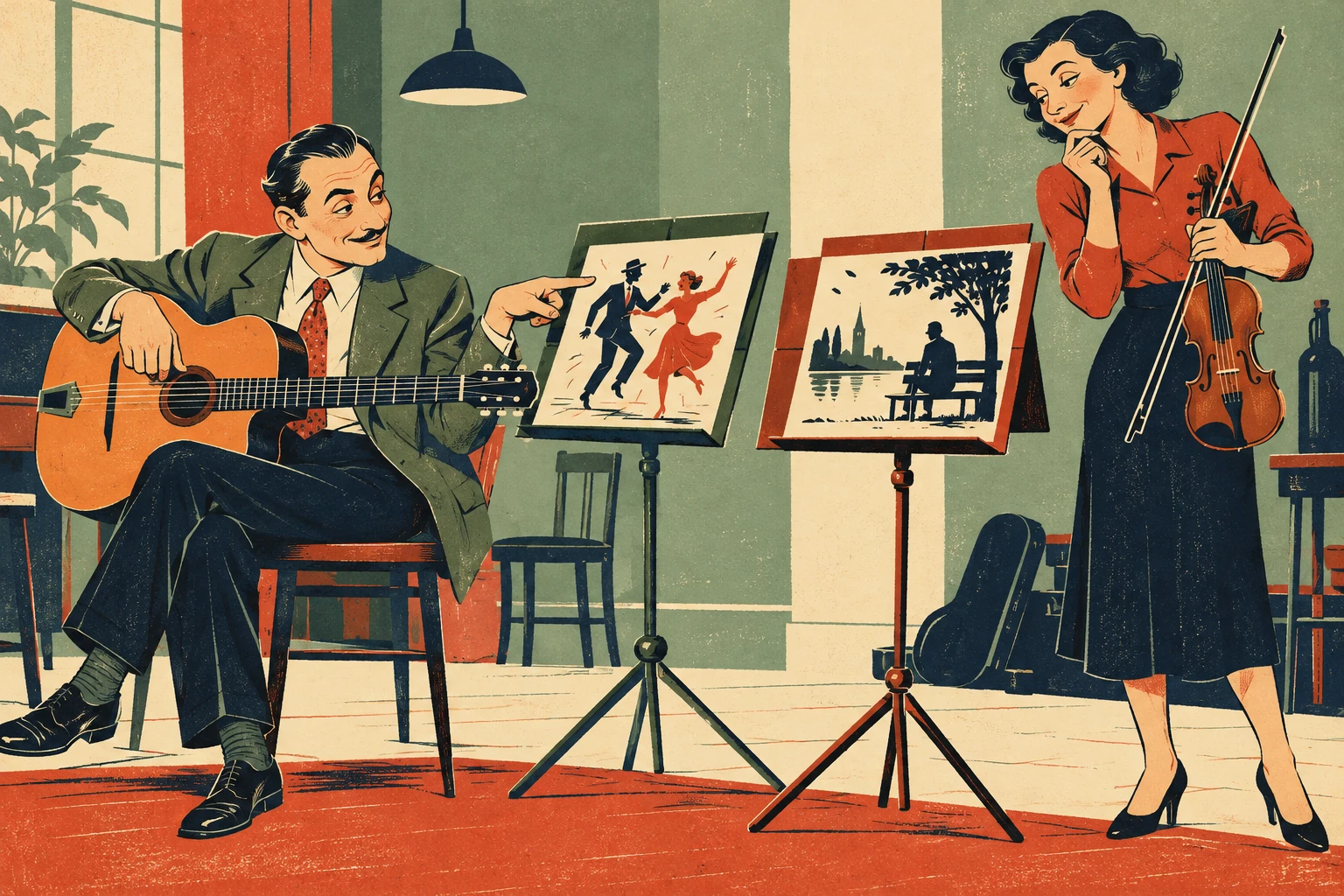
This image is an editorial illustration; a connection to this recording has not been established.
Original AI-assisted editorial artwork inspired by the tune’s mood; not a documented historical scene.
Original AI-assisted illustration created for Djangopedia
Illustration credits & provenance →Selected performances by notable Gypsy Jazz players and ensembles. Inclusion is editorial and does not imply an objective popularity ranking.
Joscho Stephan
Public, processed and embeddable when checked; creator-described identity.
Performer and tune attribution follow the named creator/distributor metadata. Selected listening resource; no ranking or exact historical-take equivalence is implied.
If playback is unavailable, use the source link.
 Bei Dir War Es Immer So Schön /// Joscho Stephan Trio /// Studio ConcertJoscho StephanPublic, processed and embeddable when checked; creator-described identity.Performer and tune attribution follow the named creator/distributor metadata. Selected listening resource; no ranking or exact historical-take equivalence is implied.✓ Featured
 "Bei Dir War Es Immer So Schön" by Theo Mackeben played by Sven JungbeckSven JungbeckPublic, processed and embeddable when checked; creator-described identity.Performer and tune attribution follow the named creator/distributor metadata. Selected listening resource; no ranking or exact historical-take equivalence is implied.Select video
Learn the opening melodic sentence by ear, sing its destination, then find two neighbouring fingerings without changing the note lengths.
Support the long melody with light chord releases; rehearse the bridge entry independently before increasing the pulse.
Slow phrase practice, adjusted to the chosen source; no historical BPM asserted
Learn the opening melodic sentence by ear, sing its destination, then find two neighbouring fingerings without changing the note lengths.
Use a quiet quarter-note click for short loops. Keep the preceding rest and the next entry in the loop; remove the click briefly to test internal time.
Confirm the composition identity, concert key and complete arrangement before calling the tune. Agree pickup and ending together.
The 1938 row is not evidence for the date or identity of Mackeben’s composition. No recording row is moved in this proposal.
Begin with the melody alone, then add only independently established bass arrivals. Support the long melody with light chord releases; rehearse the bridge entry independently before increasing the pulse.
Support the long melody with light chord releases; rehearse the bridge entry independently before increasing the pulse.
Follow the song’s breathing where a vocal version exists. Establish the singer’s key independently; lyrics are not reproduced here.
Search online videos of "Bei dir war es immer so schon" in youtube.com ↗
This player guide combines inherited recording evidence and editorial study notes. Musical study notes are editorial suggestions; compare them with the recording.
Reissue publisher booklet and discography ↗
Original AI-assisted illustration created for Djangopedia
Original AI-assisted editorial artwork inspired by the tune’s mood; not a documented historical scene.
Generated with the native image-generation tool on 2026-10-21; original editorial artwork, not a historical photograph.
Prompt: Use case: stylized-concept. Asset: one original Djangopedia tune illustration, landscape 1536x1024, 3:2. Title context only, do not write words: Bei dir war es immer so schön. Scene: An adult guitarist and violinist pause beside two clearly different angular music stands. One musician points toward the correct stand with an amused raised eyebrow. Flat rehearsal-room geometry and a witty distinction between two songs. Style: witty 1950s cartoon serigraph, dry graphic and unsentimental. Confident chunky contours, flat separate ink shapes, mildly exaggerated expressive adult faces and hands, humorous posture, strong asymmetric composition. Limited palette: deep navy, sage, vermilion and cream. Slight screen-print misregistration and occasional dry ink texture, generous clean paper. No gradients or glossy shading. Django-like guitarist where present: documented swept-back dark hair and thin pencil moustache, individual mature face. Supporting adults are distinct individuals in historically informed 1930s–1940s jazz-circle clothing. No ethnic caricatures or stereotypes. Keep heads, hands and instrument bodies within the frame, plausible instrument anatomy. No text, letters, numerals, notation, logos, watermark, border, photorealism, dreamy sunset, hearts or romantic haze. Imagined editorial scene, not a documented event. Entirely original composition, no reproduction of an existing artist’s print.
