
Tune details
Music: Vincent Youmans
Words: Irving Caesar
Published / composed / adapted — see history: 1924
Original key: Not established
Study level: Intermediate; advanced where the inherited roadmap needs reconstruction
 Djangopedia
A cheerful melody hides an abrupt change of key. Repeated ii–V motion becomes a useful landmark: listen for where the same pattern starts pointing to a different tonic.
Recognise the new tonic before changing scale patterns.
Owner content reviewed — 2026-10-05T23:51:57Z by admin. Coverage measures presence, not accuracy. Content review does not certify rights or musical perfection.
Django recordings for this tune. Uploader dates and take labels remain source claims; only an evidenced exact association enables a row’s Listen control.
Uploader identifies this as Django Reinhardt’s performance; recording date and take require comparison with the discography.
| Entry | Year | Recording / session / release evidence | Listen |
|---|---|---|---|
| 01 | 1937 | Tea For Two,OLA 2216-1 ,"Fremeaux 307, Classics 762, EMI 780671-2, Jazz Time 798975-2","Michel Warlop (v), Django Reinhardt (g)" | — |
| 02 | 1937 | Tea For Two,OLA 2221-1,"Fremeaux 307, Affinity AFS 1003, Classics 762, RCA 4321 237692, Mosaic MD6-190(6 CD Set).", Django Reinhardt (g) | — |
| 03 | 1939 | Tea For Two, 21/3/39, 4972-HPP ,"Fremeaux FA 308, JSP 343, Gitanes 159 854-2"," - Paris - QHCF - Stephane Grappelly (g), Django Reinhardt, Joseph Reinhardt,Pierre Ferret (g), Emmanuel Soudieux (b)" | — |
| 04 | 1939 | Tea For Two, 21/3/39, 4972-1/2HPP ,"Fremeaux FA 308, JSP 343, Classics 793, Jazz Archives 157222, Music Memoria 87949 (Wrong Matrix - 4972-HPP), Gitanes 159 854-2"," - Paris - QHCF - Stephane Grappelly (g), Django Reinhardt, Joseph Reinhardt,Pierre Ferret (g), Emmanuel Soudieux (b)" | — |
| 05 | 1939 | Tea For Two, 17/5/39, 5082-HPP ,"Fremeaux FA 309, Classics 813, JSP 343, Music Memoria 87949, Rhapsody RHCD6"," - QHCF - Stephane Grappelly (v), Django Reinhardt, Joseph Reinhardt,Pierre Ferret (g),Emmanuel Soudieux (b)" | — |
A dash means no video has been associated with this exact historical recording. Tune-level listening resources remain available above.
Tea For Two is credited here to Vincent Youmans. The source date is 1924; publication, composition and later lyric adaptations may have separate dates. The inherited archive lists 5 recording entries, with dated entries spanning 1939–1939. These are archive rows, not a claim that every entry is a distinct released take. The linked recording rows preserve the original discographical wording. Compare their dates, matrices and personnel when choosing a performance to study.
Music: Vincent Youmans
Words: Irving Caesar
Published / composed / adapted — see history: 1924
Original key: Not established
Study level: Intermediate; advanced where the inherited roadmap needs reconstruction
Listening task: Phrase across the ii–V pairs; the repeating accompaniment should not make every two bars sound identical. Mark the key, pickup, phrase lengths and ending before comparing another version.
Tea For Two,OLA 2216-1 ,"Fremeaux 307, Classics 762, EMI 780671-2, Jazz Time 798975-2","Michel Warlop (v), Django Reinhardt (g)"
Compare the first and last listed entries for tempo, instrumentation and arrangement. Do not infer identical takes from a shared title. Recognise the new tonic before changing scale patterns.
Tea For Two, 17/5/39, 5082-HPP ,"Fremeaux FA 309, Classics 813, JSP 343, Music Memoria 87949, Rhapsody RHCD6"," - QHCF - Stephane Grappelly (v), Django Reinhardt, Joseph Reinhardt,Pierre Ferret (g),Emmanuel Soudieux (b)"
The inherited chart is in F major; A-major contrast in the inherited chart. Confirm the backing track’s sounding key, pickup and complete form before playing; an instrument label may describe a transposed score.
Gm7–C7 points to F; Bm7–E7 points to A. The tune’s return must be learned as a phrase, not guessed from a familiar guitar grip.
The source includes compressed within-cell symbols such as F(/A) and Cb0. Compare their intended bass movement with a chosen edition before treating them as chord-quality instructions.
| Gm7/ C7/ | Gm7/ C7/  | F/ Gm7 Ab0 | F(/A)/ Ab0/ | Gm7/ C7/ | Gm7/ C7/  | F/ Gm7 Ab0 | F(/A)/ Ab0/ |

| Bm7/ E7/ | Bm7/ E7/  | A/ Bm7 Cb0 | A(/C#)/ Cb0/ | Bm7/ E7/ | Bm7/ E7/  | A/// | C7/// |

| Gm7/ C7/ | Gm7/ C7/  | F/ Gm7 Ab0 | F(/A)/ Ab0/ | Gm7/ C7/ | Gm7/ C7/  | Am7b5/// | D7/// |

| Gm7/ D7/ | Gm7/ D7/  | Gm7/// | Bbm7/ Eb7/ | F(/A)/ Ab0/ | Gm7/ C7/  | F/// | F(/A)/ Ab0/ :||
Original source ↗
Backingtracks JAZZ · The inherited chart is in F major; A-major contrast in the inherited chart. Confirm the backing track’s sounding key, pickup and complete form before playing; an instrument label may describe a transposed score. · 5:10
Checked 2026-10-01
Most-viewed suitable match selected from the captured search results after title/composition review; not a complete YouTube ranking. Source counts were captured on 1 October 2026. Coaching, unrelated songs and non-backing performances are excluded.
Performed studies, transcriptions, TAB, notation and lessons for studying Django’s solo. Resources are described by their creator; inclusion does not certify note-for-note accuracy.
Oscar Wolf · source-described; accuracy not independently verified
Creator presents a study of Django’s recorded solo. Use it alongside the original recording; exact transcription accuracy has not been independently reviewed.
Checked 2026-10-02
Follow a shared key, a harmonic idea or a familiar form. Keys refer to this site’s chart editions; other recordings may use a different key.
No sufficiently supported harmonic comparison has been added yet.
Showing 8 of 21 matches. Explore the full catalogue →
No match is established in the current chart metadata.
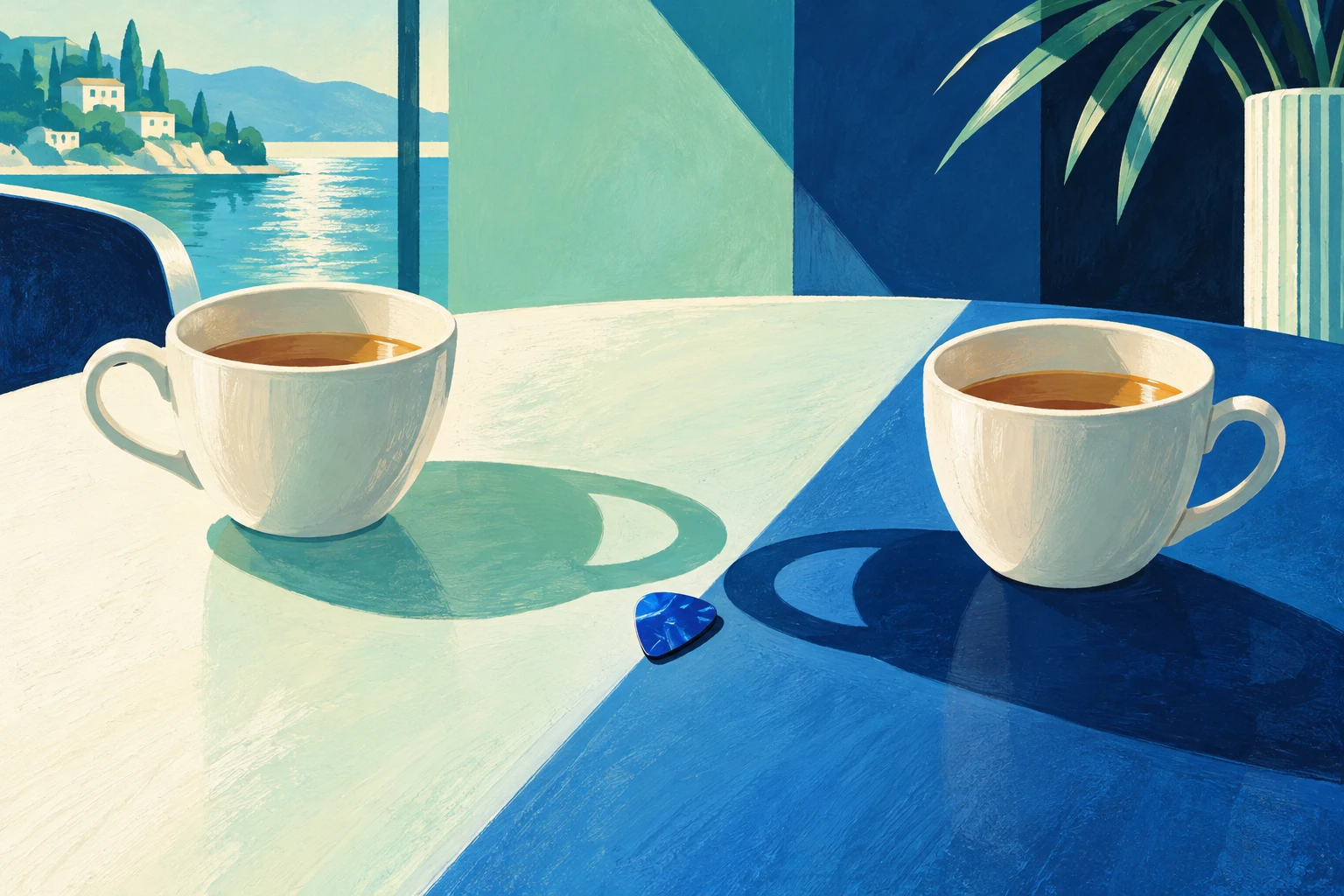
Two plain teacups and one small guitar pick arranged along an oblique tabletop; paired shadow loops suddenly turn into another colour zone then reconnect. The cheerful title and abrupt harmonic key contrast make the rhythm, no decorative lettering.
An original editorial interpretation of the tune. This is an illustration, not an archival photograph or a documented reconstruction of a recording session.
Original Djangopedia illustration · AI-assisted, 2026
Illustration credits & provenance →Selected performances by notable Gypsy Jazz players and ensembles. Inclusion is editorial and does not imply an objective popularity ranking.
Peter Beets & Django Reinhardt All Stars · Peter Beets
Newport Jazz Festival
Peter Beets, Samson Schmitt, Ludovic Beier, Pierre Blanchard, DouDou Cuillerier and Brian Torff.
If playback is unavailable, use the source link.
 Tea for Two | Peter Beets & Django Reinhardt All StarsPeter Beets & Django Reinhardt All Stars · Peter BeetsNewport Jazz FestivalPeter Beets, Samson Schmitt, Ludovic Beier, Pierre Blanchard, DouDou Cuillerier and Brian Torff.✓ Featured
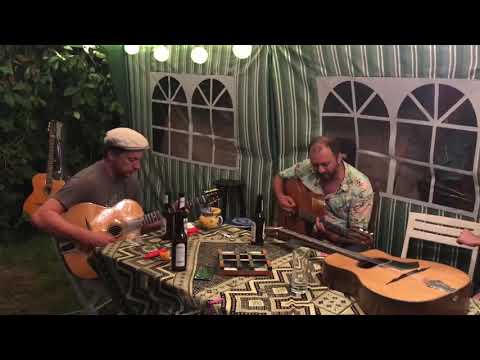 Adrien Moignard & Mathieu Chatelain-Tea for TwoAdrien Moignard; Mathieu Chatelain · manouchetones2018 · Samoreau 2018Informal festival guitar duo performance.Select performance
 Touche de Manouche - Tea for twoTouche de Manouche · Lu GolovinaArcus Records sessionLu Golovina, Ilya Delizonas, Alexander Fomichëv and Denis Shushkov.Select performance
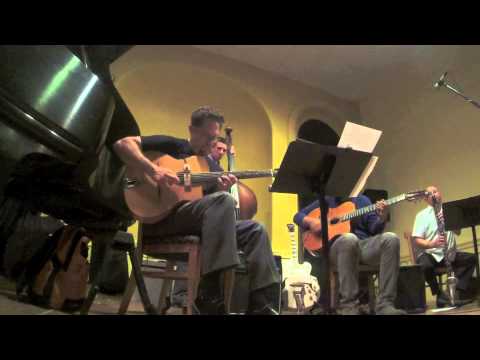 Hot Club of Baltimore - Tea For TwoHot Club of Baltimore · Gypsy Jazz FestAn Die Musik; Festival Jazz Manouche, 5 SeptemberExpanded ensemble with piano, clarinet and trumpet. Source warns of random camera placement; no performance year inferred.Select performance
 Tea For Two w/ Adrien Tarraga (Gypsy jazz) + Free TABAdrien Tarraga; Guitare Improvisation · Guitare ImprovisationFilmed Gypsy Jazz guitar duoCreator describes their own interpretation. Separate tablature transcribes this performance; not a performed study of Django’s solo or notation-only upload.Select performance
Transpose a two-bar Gm7–C7 phrase up a major third to Bm7–E7. Return to the original key without pausing and keep the melody’s phrase length.
Use the same rhythmic pattern in both key areas so the harmonic change remains clear. Avoid chasing every printed diminished passing chord before the main progression is secure.
Start around 100–140 bpm; increase only after the form stays secure
Transpose a two-bar Gm7–C7 phrase up a major third to Bm7–E7. Return to the original key without pausing and keep the melody’s phrase length.
Begin with four quarter-note clicks. Halve the click rate and hear beats 2 and 4 while maintaining the same phrase lengths.
Tea For Two — F major; A-major contrast in the inherited chart; 32 printed bars with contrasting tonal areas. Agree the pickup, tempo and ending before counting in.
32 printed bars with contrasting tonal areas. The source includes compressed within-cell symbols such as F(/A) and Cb0. Compare their intended bass movement with a chosen edition before treating them as chord-quality instructions.
Start with melody and bass only. Add the following colour without interrupting the melody: Hear B♭–A over the F-major ii–V–I.
Use the same rhythmic pattern in both key areas so the harmonic change remains clear. Avoid chasing every printed diminished passing chord before the main progression is secure. Agree the full roadmap and signal the last head before it starts.
Choose a comfortable vocal key and transpose the whole arrangement, including its introduction and ending.
This player guide combines inherited recording evidence and editorial study notes. Musical study notes are editorial suggestions; compare them with the recording.
Djangopedia — inherited chart and recording rows ↗
Composition credits and background ↗
Backingtracks JAZZ — practice backing ↗
Feature photograph — source collection ↗
Original Djangopedia illustration · AI-assisted, 2026
An original editorial interpretation of the tune. This is an illustration, not an archival photograph or a documented reconstruction of a recording session.
Generated with the native image-generation tool on 2026-10-08; original editorial artwork, not a historical photograph.
Prompt: Use case: illustration-story. One original editorial feature illustration for Djangopedia's guide “Tea For Two”. Landscape 1536 × 1024, opaque background. Scene: Two plain teacups and one small guitar pick arranged along an oblique tabletop; paired shadow loops suddenly turn into another colour zone then reconnect. The cheerful title and abrupt harmonic key contrast make the rhythm, no decorative lettering. Musical basis from the guide: A cheerful melody hides an abrupt change of key. Repeated ii–V motion becomes a useful landmark: listen for where the same pattern starts pointing to a different tonic. The supplied chart is F major; A-major contrast in the inherited chart; form: 32 printed bars with contrasting tonal areas; feel: Swing. These describe musical inspiration, not visible writing. Historical context: Tea For Two is credited here to Vincent Youmans. The source date is 1924; publication, composition and later lyric adaptations may have separate dates. Do not illustrate disputed historical claims or suggest this imagined scene is an archival session. Medium: Art Deco still life. Dominant palette: mint cobalt and clean white. Composition: two cups with abruptly shifted shadows. Human presence: none. Strong intentional design, clearly drawn/painted, distinctive material marks; keep essential subject safely within the central 70 percent width and middle 80 percent height for card crops. Maintain enough visual substance at thumbnail size. Broad inspiration observed in old photo, ONLY scale/rhythm and never a reference image: three intimate figures; close conversation; broad tabletop rhythm. Independently invent every pose, perspective, clothing, setting and lighting. Avoid: No faces, copied social gathering, readable china pattern or notes. No photorealism, archival simulation, generated text, letters, numbers, labels, fake musical notation, logo, signature, watermark, fake dates, yellowed-paper patina, recognizable artwork or copied photograph. No imitation of any named artist. Render the art edge to edge without borders, mockup or typography. Batch B diversity compensation: make light and midtone areas substantial; avoid near-black dominant backdrops, violet monochrome, empty chair/stool/bench compositions, repeated sunset terraces and generic cloud panoramas. Preserve the stated tune-specific scene. Human figures remain standing or peripheral except an explicitly named ensemble; no centered seated Django portrait. For graphic images use clearly plain colour shapes, no ruled parallel staffs, circles with stems, note-like marks or typography.
Photograph provenance and rights are stated separately. Attribution does not establish permission.