Tune details
Music: Django Reinhardt, Stéphane Grappelli
Published / composed: 1937
Original key: Not established
Study level: Accessible harmony; intermediate phrasing
 Djangopedia
A compact minor-key conversation between guitar, violin and rhythm section. The familiar introduction and ending frame a 16-bar improvising chorus; the main challenge is making those repeated changes tell a story.
Make the E7 resolution audible without increasing the number of notes.
Owner content reviewed — 2026-10-04T23:08:17Z by admin. Coverage measures presence, not accuracy. Content review does not certify rights or musical perfection.
Django recordings for this tune. Uploader dates and take labels remain source claims; only an evidenced exact association enables a row’s Listen control.
Django Reinhardt
source-described; accuracy not independently verified
Uploader identifies this as Django Reinhardt’s performance; recording date and take require comparison with the discography.
| Entry | Year | Recording / session / release evidence | Listen |
|---|---|---|---|
| 01 | 1937 | Minor Swing, 25/11/37, OLA 1990-1, Fremeaux 306, Classics 762, Jazz Time 790560-2, EMI 780671-2, Suisa JZCD 376, Conifer HD 206, Jazz Archives ZET 752, Blue Note CDP 7243837138-2, Mosaic MD6-190(6 CD Set). Paris - QHCF - Stephane Grappelly (v), Django Reinhardt, Joseph Reinhardt, Eugene Vees (g), Louis Vola (b) | — |
| 02 | 1947 | Minor Swing, 29/8/47, Fremeaux FA 314, Classics 1046, Vogue 228E 6006, Vogue 668003-2, Legacy 411("Swinging Down") - Paris - Souvenirs de Django - Django Reinhardt (elg), Maurice Meunier (cl), Eugene Vees (g),Emmanuel Soudieux (b), Andre Jourdan (d) | — |
| 03 | 1948 | Minor Swing, Dec 1948, Fremeaux FA 316, Vogue 228E 6009, RCA 74321 237692 - Concert in Brussels - Hubert Rostaing (cl), Django Reinhardt (g), Henri "Louson" Baumgartner (g), Louis Vola (b), Arthur Motta (d) | — |
| 04 | 1949 | Minor Swing, Jan-Feb 1949, CW 40, Fremeaux FA 317, RCA ND 70929-2, RCA ND 90448 - Rome - Django Reinhardt (g), Stephane Grappelly (v),Gianni Safred (p), Carlo Pecori (b), Aurelio de Carolis (d) | — |
| 05 | 1950 | Minor Swing, 1950, BL102, Fremeaux FA 318, BGO CD 198, Jazz Time 827447-2 - Rome - Django Reinhardt (elg), Andre Ekyan (as,cl), Ralph Schecroun (p), Alf Masselier (b), Roger Paraboschi (d) | — |
A dash means no video has been associated with this exact historical recording. Tune-level listening resources remain available above.
The legacy discography begins with the Paris session of 25 November 1937, matrix OLA 1990-1. Later entries document different ensembles and electric-guitar settings. The original page’s description of the harmony as II–IV–I is misleading: the main centres are tonic minor, subdominant minor and dominant seventh.
Music: Django Reinhardt, Stéphane Grappelli
Published / composed: 1937
Original key: Not established
Study level: Accessible harmony; intermediate phrasing
Listening task: Learn the composed opening and final answer as an ensemble arrangement. Count the head before comparing solo choruses.
Minor Swing, 25/11/37, OLA 1990-1, Fremeaux 306, Classics 762, Jazz Time 790560-2, EMI 780671-2, Suisa JZCD 376, Conifer HD 206, Jazz Archives ZET 752, Blue Note CDP 7243837138-2, Mosaic MD6-190(6 CD Set). Paris - QHCF - Stephane Grappelly (v), Django Reinhardt, Joseph Reinhardt, Eugene Vees (g), Louis Vola (b)
Compare the tempo, key, introduction and final cadence with the first entry. Make the E7 resolution audible without increasing the number of notes.
Minor Swing, 1950, BL102, Fremeaux FA 318, BGO CD 198, Jazz Time 827447-2 - Rome - Django Reinhardt (elg), Andre Ekyan (as,cl), Ralph Schecroun (p), Alf Masselier (b), Roger Paraboschi (d)
Count its form and check its key before joining in. Hear Am as home, Dm as the departure and E7 as the return signal. The A7 that can lead into Dm is a local dominant, not evidence that the tune has changed to A major.
Hear Am as home, Dm as the departure and E7 as the return signal. The A7 that can lead into Dm is a local dominant, not evidence that the tune has changed to A major.
Chord symbols follow the inherited Djangopedia chart. Slashes are rhythmic marks; chord quality and turnaround choices may differ from the backing track. This is a chord reference, not a melody transcription.
[[Image:minor_swing.gif]]

form: AABB..BBCC

A:| Am/// | Dm/// | Am///| Dm///| Am/// | Dm/// | E7/// | E7/// |

B:| Am/// | Am/// | Dm/// | Dm/// | E7/// | E7/// | Am/// | A7/// |

| Dm/// | Dm/// | Am/// | Am/// | E7/// | E7/// | Am/// | E7/// |

C:| Am/// | Am/// | Dm/// | Dm/// | E7/// | E7/// | Am/// | Am/// :||
Original source ↗
Guitare Improvisation
5:09
If playback is unavailable, use the source link.
 Minor Swing (160 bpm) (Old Style) - Gypsy jazz Backing track / Jazz manoucheGuitare Improvisation5:09✓ Featured
 Minor Swing (190 bpm) (1937) - Gypsy jazz Backing track / Jazz manoucheGuitare Improvisation5:04Select video
 Minor Swing (110 bpm) : Backing track (electric guitar)Guitare Improvisation5:00Select video
 Minor Swing - Backing trackMusic School Grudziadz2:46Select video
Performed studies, transcriptions, TAB, notation and lessons for studying Django’s solo. Inclusion does not certify note-for-note accuracy.
Nils Frechilla
source-described; accuracy not independently verified
Creator presents a study of Django’s recorded solo. Use it alongside the original recording; exact transcription accuracy has not been independently reviewed.
If playback is unavailable, use the source link.
 Django Reinhardt - Minor Swing 1949 (Solo Transcription)Nils Frechillasource-described; accuracy not independently verifiedCreator presents a study of Django’s recorded solo. Use it alongside the original recording; exact transcription accuracy has not been independently reviewed.✓ Featured
 Minor Swing Django Solo + TabSébastien Dorotte · Gypsy Jazz Manouche - Sébastien DorotteOwner requested this resource; watch page identity and availability checked 2026-10-05.Owner-selected Minor Swing solo transcription with tab.Select video
 LEARN TO SOUND LIKE A LEGEND (Tutorial - Django's 1937 Minor Swing solo)Christiaan van HemertOwner requested this resource; watch page identity and availability checked 2026-10-05.Owner-selected tutorial of Django’s 1937 Minor Swing solo.Select video
Follow a shared key, a harmonic idea or a familiar form. Keys refer to this site’s chart editions; other recordings may use a different key.
No sufficiently supported harmonic comparison has been added yet.
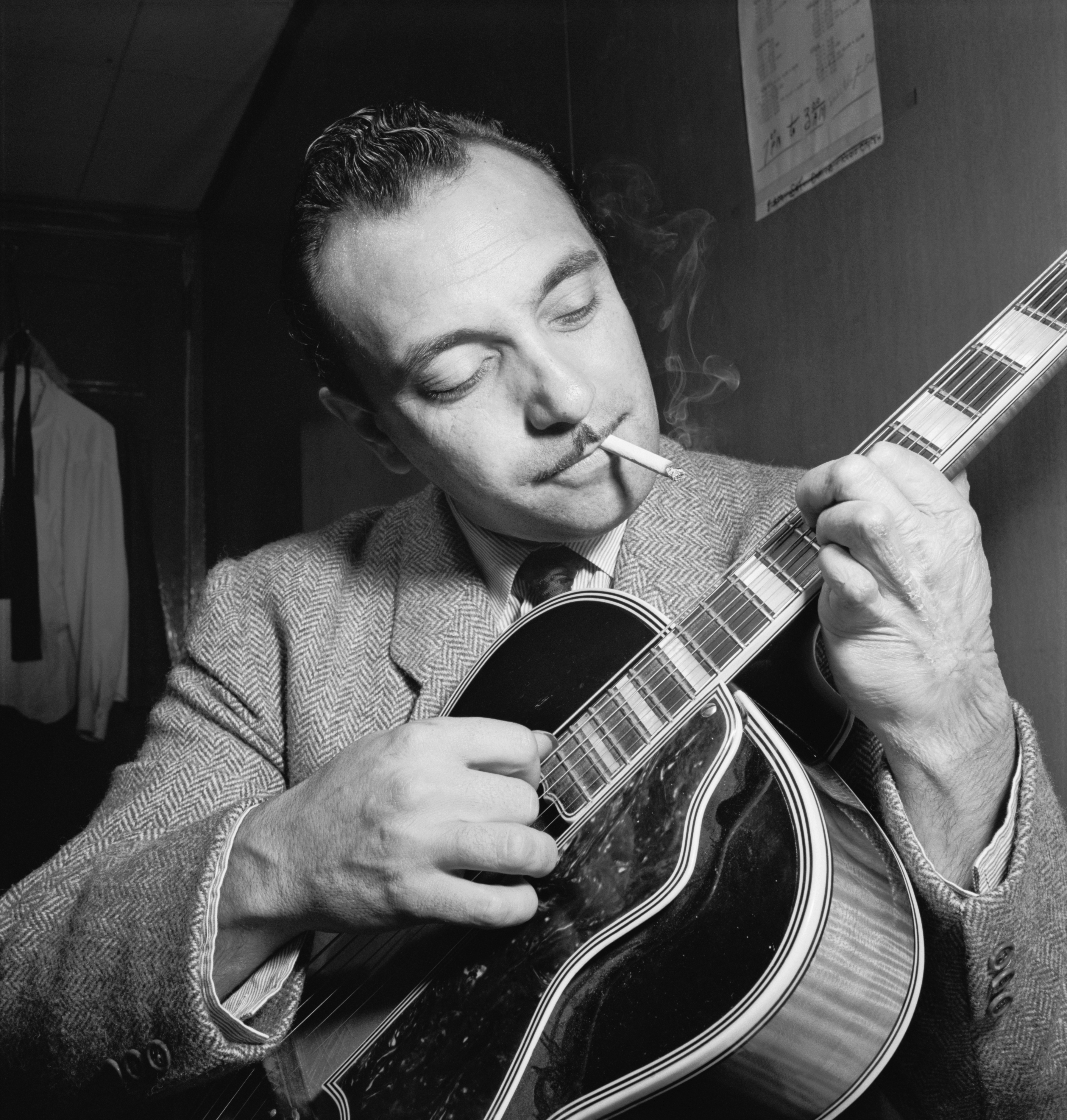
Chosen as a view of Django from circa November 1946, to place the study beside his changing performing life. The closest dated recording entry here is 1947. This is an editorial pairing; the photograph is not claimed to depict a performance or session of this tune.
Part of William P. Gottlieb’s documented Aquarium photographs in New York, circa November 1946. The catalogue supplies the location and approximate date; this is not evidence of a particular tune being played.
Explore this photograph, its context & credits →Selected performances by notable Gypsy Jazz players and ensembles. Inclusion is editorial and does not imply an objective popularity ranking.
Rhythm Future Quartet · magicfiddle
Redstar Studio, Cambridge · Source title/description and available watch page checked 2026-10-05; independent performance; owner accuracy not independently verified.
Jason Anick, Olli Soikkeli, Vinny Raniolo and Greg Loughman credited.
If playback is unavailable, use the source link.
 Gypsy Jazz - "Minor Swing" - Rhythm Future QuartetRhythm Future Quartet · magicfiddleRedstar Studio, Cambridge · Source title/description and available watch page checked 2026-10-05; independent performance; owner accuracy not independently verified.Jason Anick, Olli Soikkeli, Vinny Raniolo and Greg Loughman credited.✓ Featured
 Minor Swing - Joscho Stephan Trio feat. Marcus SchinkelJoscho Stephan Trio with Marcus Schinkel · Joscho StephanGuitar and piano ensemble · Source title/description and available watch page checked 2026-10-05; independent performance; owner accuracy not independently verified.Complete independent performance with theme and solo chapters; description advertises a separate lesson.Select video
 PARIS jazz SESSIONS - "Minor Swing" (D. Reinhardt) Feat Hugo Guezbar & Giacomo SmithHugo Guezbar, Giacomo Smith and Paris jazz Sessions ensemble · Edouard PennesLive in Paris · Source title/description and available watch page checked 2026-10-05; independent performance; owner accuracy not independently verified.Clarinet and acoustic guitars; source credits Rémi Oswald, Julien Cattiaux and Edouard Pennes.Select video
 Minor Swing - Peter Beets live at the Django Reinhard NY FestivalPeter Beets and Django Reinhardt NY Festival ensemble · Peter Beets2004 · Birdland, New York · Source title/description and available watch page checked 2026-10-05; independent performance; owner accuracy not independently verified.Piano-led festival interpretation; source's guest roster is not treated as verified personnel on this particular track.Select video
 Joscho Stephan quintet - Minor swing live 2021!Joscho Stephan Quintet · Jazz Club Hannover by Gartenheim2021 · Hannover summer concert · Source title/description and available watch page checked 2026-10-05; independent performance; owner accuracy not independently verified.Three-guitar setting with Fredi Gebhard, Sven Jungbeck, Thimo Niesterok and Volker Kamp.Select video
 Minor Swing (Django Reinhardt) played by Joscho Stephan Trio & Matthias StruckenJoscho Stephan Trio with Matthias Strucken · Jazz Club Hannover by GartenheimJazz Club Hannover by Gartenheim · Source title/description and available watch page checked 2026-10-05; independent performance; owner accuracy not independently verified.Contrasting concert ensemble; upload date not used as performance date.Select video
Play three choruses: roots only, then thirds only, then a two-bar motif with a full bar of silence after each answer. Record the result and check whether the Dm arrival remains audible without accompaniment.
Use compact Am6, Dm6 and E7 shapes with even, short releases. Coordinate the volume of beats two and four with the rhythm guitarist rather than adding a second backbeat.
Start at 100–120; build toward 160–200 bpm
Play three choruses: roots only, then thirds only, then a two-bar motif with a full bar of silence after each answer. Record the result and check whether the Dm arrival remains audible without accompaniment.
Start below the suggested tempo. First hear four quarter-note clicks, then halve the click rate and place clicks on beats 2 and 4. Keep the same phrase length.
Minor Swing — A minor; 16-bar solo chorus; separate intro and ending. Agree the tempo, pickup, solo order and ending before the count.
Let guitar and violin divide the opening responses, then leave the soloist room. Decide the coda cue before the first count.
Alternate the short opening melody with low Am6 and Dm6 responses; keep the bass sparse enough to preserve the pulse.
Let guitar and violin divide the opening responses, then leave the soloist room. Decide the coda cue before the first count.
This guide studies an instrumental arrangement. Any later lyric adaptation requires its own credit and chosen key.
Search online videos of "Minor Swing" in youtube.com ↗
Minor Swing : HCF (without django) ↗
Minor Swing : Yorgui Loeffler ↗
Minor Swing : Rosenberg Trio ↗
Minor Swing : Matelo Ferret : 1965 ↗
Minor Swing : Fapy Lafertin : 1990 ↗
Minor Swing: Boulou and Elios Ferre : 1990 ↗
Minor Swing: Jimmy Rosenberg at the age of 10 ↗
Minor Swing : Wawau Adler, Ritary Gaguenetti, and Yorgui Loeffler ↗
Minor Swing : Di Mauro Swing ↗
Minor Swing : Stephane Wrembel : 2000 ↗
This player guide combines inherited recording evidence and editorial study notes. Musical study notes are editorial suggestions; compare them with the recording.
Composition background and credits ↗
Guitare Improvisation — backing track ↗
Feature photograph — Library of Congress ↗
William P. Gottlieb / Library of Congress / restoration by Adam Cuerden · Aquarium, New York, N.Y. · circa November 1946
Gottlieb collection photographs entered the public domain on February 16, 2010, according to the source file page.
Photograph source ↗ · Rights details ↗Used to illustrate Django’s life; no connection to this tune’s recording session is claimed.
Photograph rights are documented separately in its credit. They do not establish the rights status of the composition or recording.