
Tune details
Music: Joseph Kosma
Documented in archive: 1947
Original key: Not established
Study level: Intermediate; exposed phrasing and minor-key voice leading
 Djangopedia
Joseph Kosma’s lyrical Clair de Lune: study space, tone and minor-key resolution while distinguishing the chart key from Django’s recording.
Play the melody without accompaniment, then add one bass note per bar.
Owner content reviewed — 2026-10-15T13:12:27Z by admin. Coverage measures presence, not accuracy. Content review does not certify rights or musical perfection.
Django recordings for this tune. Uploader dates and take labels remain source claims; only an evidenced exact association enables a row’s Listen control.
Django Reinhardt
source-described; accuracy not independently verified
Uploader identifies this as Django Reinhardt’s performance; recording date and take require comparison with the discography.
| Entry | Year | Recording / session / release evidence | Listen |
|---|---|---|---|
| 01 | 1947 | Clair de Lune, 16/4/47, ST 1985 ,"Fremeaux FA 313, Classics 1001,Vogue 228E 6005","Same date - Django Reinhardt (g), Michel de Villers (cl,as), Eddie Bernard (p), Joseph Reinhardt (g), Willy Lockwood (b), Al Craig (d)" | — |
A dash means no video has been associated with this exact historical recording. Tune-level listening resources remain available above.
This is Joseph Kosma's Clair de Lune, not Debussy's piano work. The archive preserves a Paris session dated 16 April 1947 with matrix ST 1985. Specialist discussion places Django's recording in E-flat minor, while the inherited study chart uses D minor. That difference is valuable to a player: a familiar guitar shape is not evidence of the original recording's key. The brief form rewards attention to tone, melodic space and the placement of a resolving note.
Music: Joseph Kosma
Documented in archive: 1947
Original key: Not established
Study level: Intermediate; exposed phrasing and minor-key voice leading
Listen for the relationship between guitar and clarinet; leave enough space to hear the sustained ends of phrases.
Clair de Lune, 16/4/47, ST 1985 ,"Fremeaux FA 313, Classics 1001,Vogue 228E 6005","Same date - Django Reinhardt (g), Michel de Villers (cl,as), Eddie Bernard (p), Joseph Reinhardt (g), Willy Lockwood (b), Al Craig (d)"
Read the supplied sixteen-bar D-minor chart as a study version. Its minor tonic and dominant returns need a clear distinction between C natural in the minor color and C♯ when A7 resolves. Compare the bass movement with the melody before adding substitute chords. Check the video key before playing with the chart.
Read the supplied sixteen-bar D-minor chart as a study version. Its minor tonic and dominant returns need a clear distinction between C natural in the minor color and C♯ when A7 resolves. Compare the bass movement with the melody before adding substitute chords.
D-minor inherited chart retained. E-flat minor is a source-described recording key, not a silent transposition of this chart.
[[Image:Clairlune.gif]]

| Dm/ D7/ | Gm/// | Gm7/ C7/ | F/ F#0/ |

| Gm/ A7/ | Dm/// | A7/ Bb7/ | A7/// |

| Dm/ D7/ | Gm/// | Gm7/ C7/ | F/ F#0/ |

| Gm/ A7/ | Dm/ D0/ | Bb7/ A7/ | Dm/// :||
Original source ↗
Guitare Improvisation
Swing · 80 BPM · 5m5s · Video available when checked; creator-described attribution.
Creator-described gypsy-jazz play-along. Check the key and full arrangement before joining in; the guide chart may use another key. Tempo is the creator’s stated value.
If playback is unavailable, use the source link.
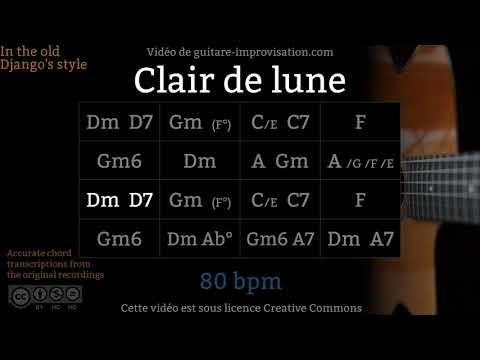 Clair de Lune (80 bpm) - Gypsy jazz Backing track / Jazz manoucheGuitare ImprovisationSwing · 80 BPM · 5m5s · Video available when checked; creator-described attribution.Creator-described gypsy-jazz play-along. Check the key and full arrangement before joining in; the guide chart may use another key. Tempo is the creator’s stated value.✓ Featured
 Gypsy Jazz / Manouche - Clair De Lune - Django Changes 70bpm (Play along / Backing Track )DC Music SchoolSwing · 70 BPM · 5m45s · Video available when checked; creator-described attribution.Creator-described gypsy-jazz play-along. Check the key and full arrangement before joining in; the guide chart may use another key. Tempo is the creator’s stated value.Select video
Performed studies, transcriptions, TAB, notation and lessons for studying Django’s solo. Inclusion does not certify note-for-note accuracy.
Evgenios Sastix
source-described; accuracy not independently verified
Creator presents a study of Django’s recorded solo. Use it alongside the original recording; exact transcription accuracy has not been independently reviewed.
If playback is unavailable, use the source link.
Follow a shared key, a harmonic idea or a familiar form. Keys refer to this site’s chart editions; other recordings may use a different key.
No sufficiently supported harmonic comparison has been added yet.
Showing 8 of 10 matches. Explore the full catalogue →
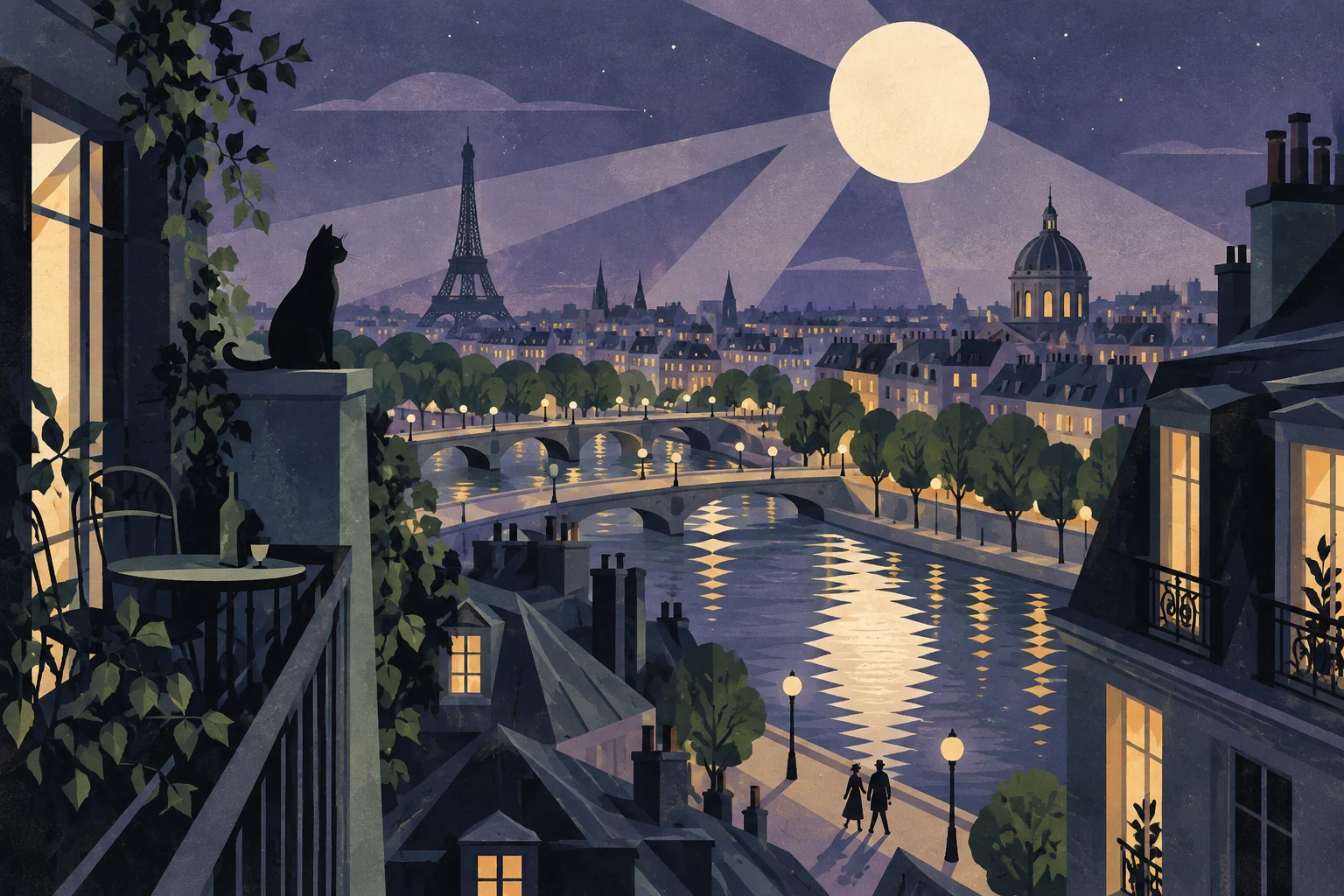
Original illustration: Moonlight above stylized Paris rooftops and a curving river.
Original AI-assisted editorial artwork inspired by the tune’s mood. It does not depict a documented historical event.
Original Djangopedia illustration · AI-assisted, 2026
Illustration credits & provenance →Selected performances by notable Gypsy Jazz players and ensembles. Inclusion is editorial and does not imply an objective popularity ranking.
magicfiddle
Video available when checked; creator-described attribution.
Performer attribution follows the video title and channel description. Proposed listening selection; no popularity ranking implied.
If playback is unavailable, use the source link.
 Gypsy Jazz - "Clair De Lune" - Rhythm Future QuartetmagicfiddleVideo available when checked; creator-described attribution.Performer attribution follows the video title and channel description. Proposed listening selection; no popularity ranking implied.✓ Featured
 Stochelo Rosenberg - Clair de lune (4K)PARAMAX FILMSVideo available when checked; creator-described attribution.Performer attribution follows the video title and channel description. Proposed listening selection; no popularity ranking implied.Select video
Play the melody without accompaniment, then add one bass note per bar. Transpose a short phrase from the inherited D-minor version to E-flat minor before comparing with Django.
Use sparse shells and longer releases so the melody remains exposed. A ballad needs a dependable inner pulse even when the lead line leans behind the beat.
Start at 60–80; retain a relaxed ballad pulse
Play the melody without accompaniment, then add one bass note per bar. Transpose a short phrase from the inherited D-minor version to E-flat minor before comparing with Django.
Count quarter notes first. Then place the click on beats 2 and 4 at half the click rate, keeping the phrase length unchanged.
D minor (inherited study chart); 16-bar study chorus. Agree the arrangement, pickup and ending before counting in.
Selecting Debussy videos or assuming D minor is the recorded key.
Keep the melody uppermost and begin with a single bass note under each harmony. Dm6: D–F–A–B.
Use sparse shells and longer releases so the melody remains exposed. A ballad needs a dependable inner pulse even when the lead line leans behind the beat.
No vocal arrangement is prescribed; use the instrumental melody as the phrasing reference.
This player guide combines inherited recording evidence and editorial study notes. Musical study notes are editorial suggestions; compare them with the recording.
Pierre Nauleau — Clair de lune ↗
Original Djangopedia illustration · AI-assisted, 2026
Original AI-assisted editorial artwork inspired by the tune’s mood. It does not depict a documented historical event.
Generated with the native image-generation tool on 2026-10-15; original editorial artwork, not a historical photograph.
Prompt: Use case: illustration-story. One original Djangopedia jazz tune guide illustration. High resolution landscape 3:2, 1536x1024 or larger. Original playful mid-century modern graphic illustration mixed with 1930s–1950s Paris and Art Deco. Angular geometric construction, expressive silhouettes, bold confident outlines, flat limited colors, subtle vintage print grain. Balanced professional editorial artwork with personality. No text, no lettering, no logos, no watermark. Not a photograph or documented event. Do not imitate any particular artist. Focal objects within safe 10% margins. Quiet Paris rooftops under a large stylized moon reflected in a curving river, angular windows and a tiny pair of walking silhouettes far below, lyrical breathing space, decorative geometric moonbeams. Soft violet, deep navy, sage and warm cream. No giant musician portrait.
