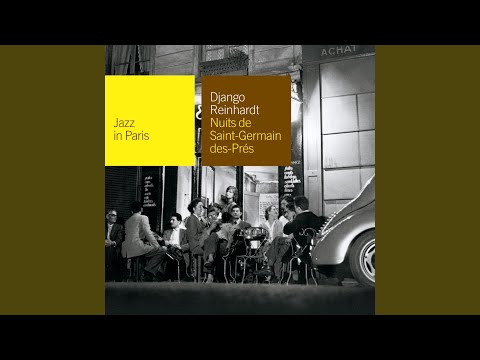
Tune details
Music: Django Reinhardt
Documented in archive: 1951
Original key: Not established
Study level: Intermediate listening study; arrangement and source awareness
 Djangopedia
Vamp belongs to Django's May 1951 electric-guitar studio repertoire; the later creator-posted versions provide contrasting arrangements. Compare one melodic arrival across Django, Dario Napoli and Martin Taylor with Nando Reinhardt, keeping each version's harmonic choices separate.
Sing the arrival, learn the historical approach, then write a second approach of your own.
Owner content reviewed — 2026-10-20T01:43:24Z by admin. Coverage measures presence, not accuracy. Content review does not certify rights or musical perfection.
Django recordings for this tune. Uploader dates and take labels remain source claims; only an evidenced exact association enables a row’s Listen control.
Django Reinhardt
source-described; accuracy not independently verified
Uploader identifies this as Django Reinhardt’s performance; recording date and take require comparison with the discography.
| Entry | Year | Recording / session / release evidence | Listen |
|---|---|---|---|
| 01 | 1951 | Vamp,P 854 ,"DRG 8473,Dejavu CD 32","11/5/51 - Paris - Django Reinhardt (elg), Bernard Hullin (tpt), Hubert Fol (as), Raymond Fol (p), Pierre Michelot (b), Pierre Lemarchand (d)" | — |
A dash means no video has been associated with this exact historical recording. Tune-level listening resources remain available above.
Vamp belongs to Django's May 1951 electric-guitar studio repertoire; the later creator-posted versions provide contrasting arrangements.
Music: Django Reinhardt
Documented in archive: 1951
Original key: Not established
Study level: Intermediate listening study; arrangement and source awareness
Compare one melodic arrival across Django, Dario Napoli and Martin Taylor with Nando Reinhardt, keeping each version's harmonic choices separate. Source-attributed credits: Django Reinhardt in the detailed publisher discography.
A complete harmonic route is not established here. First sing the melody and mark phrase endings; verify the underlying chords from a reliable edition before adding substitutions.
No verified complete chart is supplied. The listening and practice notes do not stand in for a chord chart.
No readable chord chart has been added for this title.
Superloco guitar
4m24s · Public, processed and embeddable when checked; creator-described identity.
Creator-provided play-along. Confirm the concert key, complete roadmap and count-in before joining; it is not certified as the historical arrangement.
If playback is unavailable, use the source link.
Performed studies, transcriptions, TAB, notation and lessons for studying Django’s solo. Inclusion does not certify note-for-note accuracy.
Antonis Arfanis
source-described; accuracy not independently verified
Creator presents a study of Django’s recorded solo. Use it alongside the original recording; exact transcription accuracy has not been independently reviewed.
If playback is unavailable, use the source link.
Follow a shared key, a harmonic idea or a familiar form. Keys refer to this site’s chart editions; other recordings may use a different key.
No sufficiently supported harmonic comparison has been added yet.
No match is established in the current chart metadata.
No match is established in the current chart metadata.
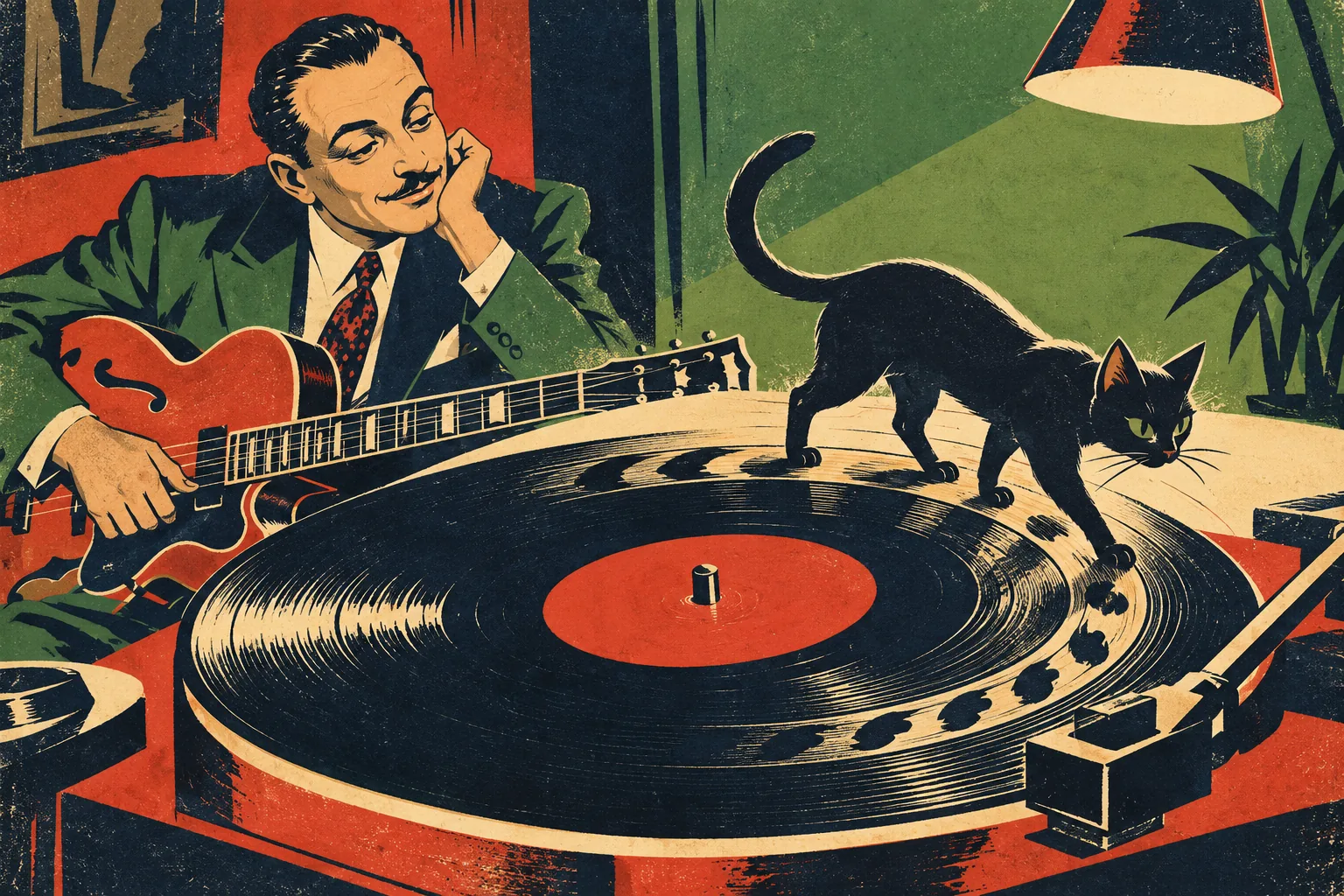
Owner-selected illustration. A repeating electric-guitar riff is imagined as a small sleek black cat walking repeatedly around a circular record groove while a guitarist watches with a dry smile. Minimal hypnotic rhythm, no vampire or sexualized femme fatale.
Original AI-assisted editorial artwork inspired by the tune; not a documented historical scene.
Original AI-assisted illustration created for Djangopedia
Illustration credits & provenance →Selected performances by notable Gypsy Jazz players and ensembles. Inclusion is editorial and does not imply an objective popularity ranking.
Dario Napoli
Public, processed and embeddable when checked; creator-described identity.
Dario Napoli performs the Django composition and explicitly says he altered the harmony. Compare arrangements; this is not an exact historical-performed solo study.
If playback is unavailable, use the source link.
 Vamp (Django Reinhardt) - Dario Napoli, gypsy jazz classic standardDario NapoliPublic, processed and embeddable when checked; creator-described identity.Dario Napoli performs the Django composition and explicitly says he altered the harmony. Compare arrangements; this is not an exact historical-performed solo study.✓ Featured
 Studio Session 'Vamp' Martin Taylor & Nando ReinhardtMartin Taylor MBEPublic, processed and embeddable when checked; creator-described identity.Creator-posted Martin Taylor and Nando Reinhardt studio performance. An alternative arrangement, not an exact performed study of Django’s solo or historical take.Select video
Sing the arrival, learn the historical approach, then write a second approach of your own. Identify any changed chord before copying a modern version.
Use a quiet, sustained accompaniment where it supports the melody; verify chord durations before introducing substitutions.
60–90 quarter-note BPM for short study fragments; slow the source as needed
Sing the arrival, learn the historical approach, then write a second approach of your own. Identify any changed chord before copying a modern version.
Use a quiet quarter-note click for short loops. Keep the preceding rest and the next entry in the loop; remove the click briefly to test internal time.
Confirm the composition identity, concert key and complete arrangement before calling the tune. Agree pickup and ending together.
Dario Napoli explicitly says he altered the harmony. Neither modern performance is an exact Django-solo recreation or a certified historical arrangement.
Begin with the melody alone, then add only independently established bass arrivals. Use a quiet, sustained accompaniment where it supports the melody; verify chord durations before introducing substitutions.
Use a quiet, sustained accompaniment where it supports the melody; verify chord durations before introducing substitutions.
Follow the song’s breathing where a vocal version exists. Establish the singer’s key independently; lyrics are not reproduced here.
This player guide combines inherited recording evidence and editorial study notes. Musical study notes are editorial suggestions; compare them with the recording.
Djangopedia full discography ↗
Reissue publisher booklet and track listing ↗
Original AI-assisted illustration created for Djangopedia
Original AI-assisted editorial artwork inspired by the tune; not a documented historical scene.
Generated with the native image-generation tool on 2026-10-26; original editorial artwork, not a historical photograph.
Prompt: Use case: stylized-concept. Create one finished original landscape 1536x1024 (3:2) raster illustration for Djangopedia, tune Vamp. Tune context for interpretation only: Vamp belongs to Django's May 1951 electric-guitar studio repertoire; the later creator-posted versions provide contrasting arrangements. Scene: A repeating electric-guitar riff is imagined as a small sleek black cat walking repeatedly around a circular record groove while a guitarist watches with a dry smile. Minimal hypnotic rhythm, no vampire or sexualized femme fatale. Art direction: Lively late-1930s editorial cartoon screenprint: rhythmic black contours, expressive adult posture, flat separated colour plates and a strong asymmetrical composition. Palette: ink blue, leaf green, vermilion and ivory. Subtle dry ink and paper texture, controlled print misregistration. Make it an artwork with a memorable singular idea, readable as a thumbnail and rewarding at full size; vary viewpoint and composition. Constraints: entirely original composition, not a copy of an artist's print. No title, words, notation, logos or watermark. No photorealism, glossy 3D, gradients, airbrushed romantic haze, generic sunset or decorative hearts. If Django appears, swept-back dark hair, pencil moustache and a distinct mature individual face; period clothes, no ethnic stereotypes. Respect plausible instruments and hands, keep key subjects within frame. Use strong flat ink shapes rather than photorealistic rendering.

